Archive for the English Anime Category


Magical Girl Lyrical Nanoha EXCEEDS Gun Blaze Vengeance, Episodes 1-4

July 30th, 2026

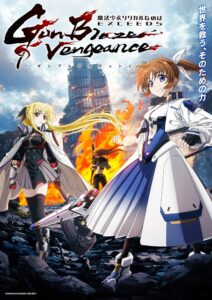
In a ruined landscape in front of a city, Fate and Nanoha stand in their barrier jackets, holding their sentient weapons, while a girl burns brightly behind them.It has been a long while since I reviewed a Nanoha franchise entry. In fact, it’s been more than 10 years! And truthfully, I love The Nanoha franchise very much for what I would like it to be, far more than for what it is. 

But here we are again, 22 years after my first post about Magical Girl Lyrical Nanoha, with a new entry and I once again both really like it and don’t in nearly equal portion. This time for exciting new reasons! Magical Girl Lyrical Nanoha EXCEEDS Gun Blaze Vengeance, is streaming now on Crunchyroll and I had a chance to watch the first four episodes.

Let’s get the negatives done first, so we can focus on the positives. The story is…generic. It’s true that the fighting in earlier Nanoha entries were hardly works of literature, but ends of the world, and eternity-eating books are abstract enough that we don’t have to sit through grimdark blood and guts. In this new world, mutating gross monsters are the foe and there is a lot of blood and guts.

The other negative is the same as the original series in that the trauma, loneliness and misery of young girls is mined for entertainment. And in this, the misery has notched up. We’re not just watching them be emotionally and psychologically manipulated, but physically hurt as well.  We understand that this is to increase our empathy for the young women in question…but, eww. It’s just a nasty habit of anime’s that children’s suffering is regularly turned into motivation for revenge, i.e., everyone is fridged, all the time. 

So, Episode 1, a double-length episode, introduces us to Kuze Shiina and her sister Setsuna, an abandoned girl she took in. They live on a remote island. The entire world has been infested by ravenous monsters called Majin, cleverly translated here as Diaboli. Shiina is a very talented hunter, since the government and experts have abandoned them. Within seconds it becomes apparent that her and Setsuna’s happy life is not going to last, and so, we are treated to our first two of many tragic stories. But things are not what they seem and Shiina will lose something and gain it again all at once.

Shiina leaves the island and comes to the city, where we see an adult Yagate Hayate is in charge of the fight against the Diaboli. But it is 13-year old Takamachi Nanoha that saves Shiina, and asks her to be part of the new task force: c.p.,  being abandoned by the government. Shiina refuses, but eventually becomes part of the EXCCEDS taskforce.

As of Episode 4, the typical nude transformation scenes have been left behind. In my book, that is a huge plus. Those made it hard to recommend Nanoha, because they wee so obviously pro-creeper.

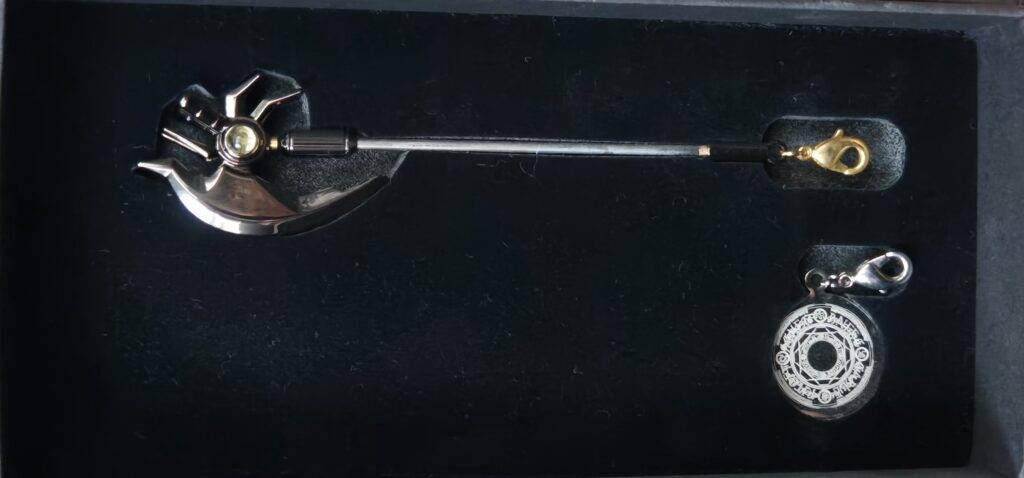
And while we have not yet seen them except as a still, Hayate’s Knights got a mention. I cheered when Raising Heart and Bardiche had lines. Bardiche is my favorite character. I even have a lovely metal keychain replica of him. This is an approximately accurate size picture of it. This is the kind of shit I pick up when I’m in Japan, get home and think…okay, what am I gonna do with that?
Now that the story is lined up, the next few episodes proceed to introduce our frenemy squad. These are girls who have been abused and suffered and are doing good work fighting assassinating the people who profit off the Diaboli, but of course will be our enemies and then, ultimately part of the Nanoha extended family.

Immediately, Shiina meets Towa, and they become friends right away. They will be the Nanoha and Fate of this series. Towa’s mission is good, the way she and her friends go about is understandable…but we all know that they are going to be “befriended.” before the end.

And in this, Magical Girl Lyrical Nanoha EXCEEDS Gun Blaze Vengeance hits the sweet spot for me, even though the monsters and the people who profit off them are the most generic, unmagical, overdone plot ever. Because Nanoha is not about the fights, those some of those have been excellent. Nanoha is about family.  I talk about this in a 2012 essay The Concept of Family in the Magical Girl Lyrical Nanoha-verse, this idea of bringing people into one’s family, giving love and affection to the outcast and unwanted, is one of the key features that makes the Nanoha franchise appealing, even despite a legacy of sexualization of young women. This progression of friend to enemy to family is a repeated theme in this series.  By the end of Episode 4, it is clear where we will find our newest family members.

For Yuri fans, since we’ve returned Nanoha and Fate to their tween years, they are once again in the time just after A‘s. We know this, because in this iteration, Fate introduces herself as Fate Testarrossa Harlaown. Fate, to our eyes, has more of an interest in Nanoha, and blushes when she is in proximity to the other girl, while Nanoha proudly declares Fate her “best friend.” Again, undoubtedly, we’ll see emotional intimacy, tears and reconciliation between Shiina and Towa, as we did with Nanoha and Fate.

To be very honest, I felt Episode 1 did not do the series justice at all. The banality of the “invasion of the mutating monsters” just left me feeling like it was a magic-less world. Nanoha has clarified that her “magic” is not an innate ability, but that it can be learned, as we know. In this world, science and magic are nearly the same. 

But as the story proceeds, I felt it move closer to the Nanoha-verse, and not just because more familiar characters arrived on screen. Whether they are fighting monsters, magical items running amok or megalomanics, when it comes down to Nanoha, it’s always about humans connecting.

Ratings: 

Art – 9 Actually really good! Gone are the days of cheaping out on this series
Story – 6, but I’m willing to give it a chance
Characters – 8 Nice to see old friends and make new ones
Service – 2 Much less than it used to be. I’m so glad.
Yuri – Who knows?

Overall – 7

It was a bit of a slow start, but we’ll see where it goes.


Revolutionary Girl Utena Movie: The Adolescence of Utena Report

June 22nd, 2026

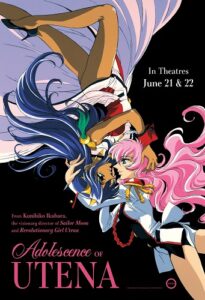
Title image for Revolutionary Girl Utena The Movie: The Adolescence of Utena, a brown-skinned woman with flowing dark hair in a flowing white dress floats diagonally upwards, a pale-skinned woman with flowing pink hair in a white school uniform jacket and shirts floats diagonally downward from the same center.

Yesterday was the big day!  Revolutionary Girl Utena Movie: The Adolescence of Utena was in North American theaters. Yes, the movie had gotten screenings at Film Festivals (sometimes accompanied by me doing an intro) and the Japan Society, and other orgs, but this was  a first – North America-wide screenings. 

So my wife and I and a friend, headed over to the mall at which I spent a lot of my youth and I went into the megaplex that the theater has become.  Our friend was going to be  a great test of what this movie looks like from the outside. She’s smart and well-read, curious and interested in ideas, so I expected her to be able to follow. 

We were disappointed that there wasn’t a movie poster for the movie. I was told that old movies don’t get posters, so boo. I would have loved to have one of those. 

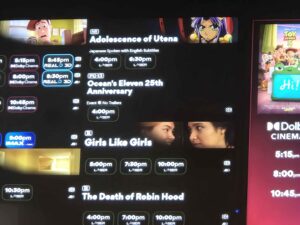
Our theater never got the aspect ratio right, which meant that subtitles were cutoff on the bottom. It was just like  the old days, when they fucked up regularly. ^_^;

Yeah this image came out bad, oh well. But props for “Girls Like Girls” on the same screen. 
I have decided to take a page from K-pop fandom and show up to events with stuff to give away. In this case, I brought some of the By Your Side (still on sale thorugh June 30!) bookplates, with original art by Rica Takashima that are meant to be understood as Anthy and Utena’s hands reaching for one another. I also brought some Yuri Heart stickers and Okazu heart stickers based on the t-shirts designs. 

Giving folks stuff is a great way to make new friends. ^_^

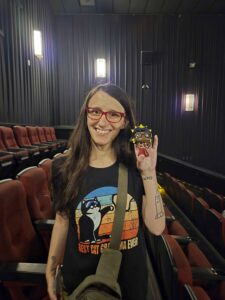
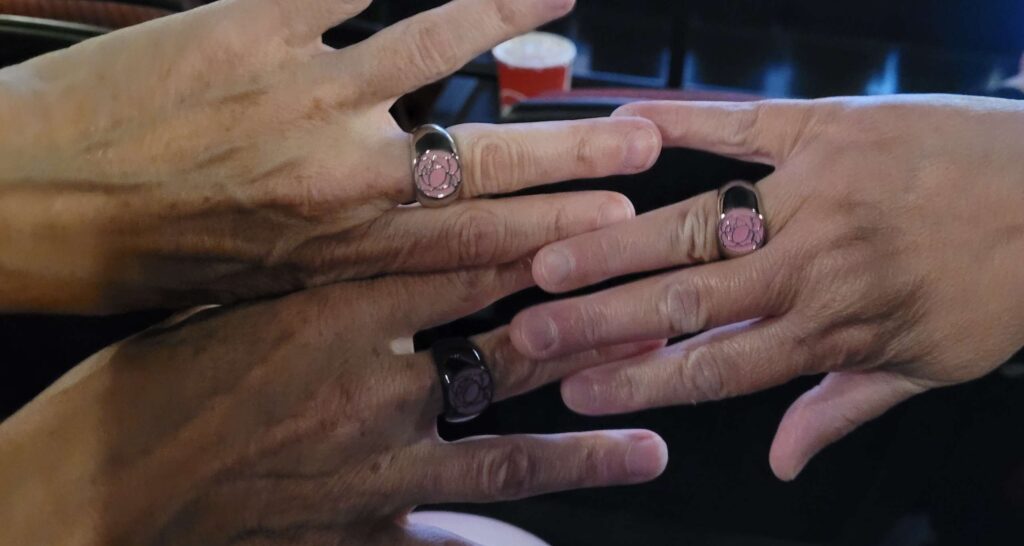
Earlier that day, I had been chatting with RKasa on Bluesky, and learned about an amazing database of otaku goods and figures, and when we started to chat with the person sitting next to us, I was amazed to meet RKasa in person. ^_^ What a hoot, huh? We took a paired selfie of our Duelist rings. ^_^ 

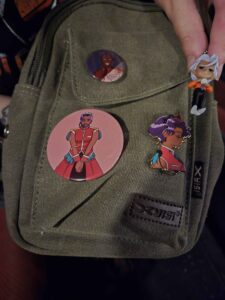
Then I got to meet Mutti, who allowed me to take pictures of their awesome custom Anthy Funko and pins.

Muti holding a custom Funko to look like the Rose Bride from Revolutionary Girl Utena, with red dress and crown.Olive green canvas bag with pins and toy of Anthy and Akio from Revolutionary Girl Utena.


Everyone in the theater was lovely. Thank you all for taking a moment to chat!

The movie is so great on a big screen. The school is vertiginous and surreal. The scenes that are always impactful are that much more so on a large scree. The dance on the dueling ground, the castle car…

As Utena says to Anthy, “Let’s go…to the outside world..” I turned to my friend and said, “Now it’s gonna get weird” and she laughed, “NOW?” Afterward, we listened to her ideas about what it all meant.

We had a great time seeing it in a theater. I hope you’ve all gotten your tickets and will tell us about your experience in the comments.


A Hundred Scenes of Awajima, streaming on Crunchyroll

June 17th, 2026

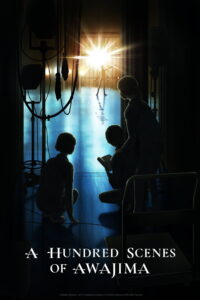
From a dark backstage, three girls look out upon a brightly lit stage where a young woman acts as a male character, blindingly bright as she lifts her arm.Are you comfortable? Have a drink, maybe a snack? Good, because this review is going to be 95% exposition and 5% review. Okay, maybe 85/15. But still. 
To understand A Hundred Scenes of Awajima, let us begin with a rather famous book called Fugaku Hyakkei, (富嶽百景) One Hundred Scenes of Mt Fuji, by the rather famous artist Hokusai. And, the equally famous Meisho Edo Hyakkei (名所江戸百景) the One Hundred Famous Views of Edo by the equally famous Hiroshige. From these titles, we see that hyakkei (百景) means “one hundred views.” This is clearly a trope. One understands that this word means “various perspectives from various angles.”  Hachiko used this trope in their Yuri Hyakkei (百合百景) volume in 2017.

Awajima Hyakkei, the manga series for which today’s subject is an anime adaptation, began in 2015.  I reviewed Volume 1 and Volume 2 here on Okazu and, although I kept reading I did not review other volumes. Yuri, while a part of this manga, is not a major part.  But it is a fundamental part, as we shall see.  The story is set in the preparatory school for girls who want to perform with the all-female famous Awajima Revue. 

Some of you will have understood immediately that this is mean to represent a fictionalized version of the second cultural relic in this series…a very famous, very real, all-female Revue Troupe school.  In a long ago post, scholar Rachel Thorn did a breakdown on the many visual, cultural, linguistic, geographical and organizational similarities between Awajima Revue and the real school. There are also other similarities, as well.

One of the similarities of the Awajima Musical Revue School and the school upon which is is based, is the constant refrain of bullying and power harassment within the organization. This is a real, and very front-facing issue in the story, but it has a sad truth to it. Unfortunately both the school and the troupes themselves have a history of power harassment against junior students and members, likely stemming from the para-military organization of the student body. This bullying is alluded to in the documentary Dream Girls, where one can visibly see actresses struggling as they remember their “strict” seniors at the school. So, as we watch our characters move from first to second year in the anime, speaking of being better seniors to their underclassman, we understand that the bullying was significant. 

Another similarity is the intense, intimate and sometimes romantic relationships formed by the students. Jennifer Robertson’s 1998 book Takarazuka: Sexual Politics and Popular Culture in Modern Japan, touched on this topic and, for her efforts, she was banned from the organization’s archive. The organization has still avoided any formal recognition of lesbian performers, bun there is a less rigid perspective in fandom where queer readings and female intimacy are more acceptable. (Nobuko Anan’s “Performing Female Intimacy in Japan’s Takarazuka Revue” and “Transcultural Desires and Lesbian Fandom: Takarazuka Revue in Taiwan” by Lucetta Y.L. Kam are interesting in that regard.) In that old and lost (and if you find it anywhere, DO NOT POST A LINK, this was deleted by Thorn and should remain lost out of respect. I have the original, but I will not share it, nor should you) post, Thorn noted that the real school was not at all comfortable with the idea that any of their girls form pairs, despite at least one well-known out lesbian who was a member. You may remember Higashi, who was one of the women whose marriage at Tokyo Disneyland caused the resort to change their policies. 

The manga, written and drawn by Takako Shimura, is available from Yen Press in English as Scenes From Awajima. This title is, in part, why I take time to explain the meaning of “One Hundred Scenes”. Sure you could read the book without understanding the whole thing behind “hyakkei” but if you know what it means and where we know it from, the series makes more sense. Knowing is half the battle. ^_^

All of which brings us, finally, to A Hundred Scenes of Awajima, streaming on Crunchyroll, the anime adaptation of the manga. The manga suffered a bit, as Shimura had not yet quite matured into the storyteller we saw in Even Though We’re Adults. This anime adaptation is the best adaptation of a Shimura work to date. 

Artistically, the animation captures her watercolor pen art in a way that feels true to her work and also somehow feels realistic. Each episode begins with a “scene” that moves into a story that is multi-layered. First-year students, their parents, the teachers, and predecessors all move through the school in one time or another. Shadows from prior years’ successes and failures, loves and losses are all presented as they impact the present. The present, however is treated differently. Students, current and former, try to heal wounds, and change the culture for the future. We see girls who were loved and hated, girls whose family was supportive, and those who were not.

The story begins and ends with a girl who was bullied into leaving the school and ultimately taking her own life. It’s a sad story made sadder when you see how strong she was, and how good she might have been. That shadow lingers into many other of the stories, even when the girls in them don’t know that. 

These are the “one hundred scenes” of Awajima. A place, a person, a story may look different when seen from another angle, but Awajima, like it’s real-world analog, is still there. Still dealing with the good and the bad.

Ratings
Art – 9
Story – 8 
Characters – 8
Service – 0
Yuri – 2?

Overall – 9

I would never suggest this story for someone new to anime, but if non-linearity and beautiful art is enough to interest you, I especially recommend watching the anime before reading the manga. It’s easier to follow for having been simplified a bit.  One Hundred Scenes From Awajima is streaming now, on Crunchyroll.


Revolutionary Girl Utena The Movie: The Adolescence of Utena in N. American Theaters June 21-22

May 29th, 2026

Title poster for Revolutionary Girl Utena The Movie: The Adolescence of Utena, a brown-skinned woman with flowing dark hair in a flowing white dress floats diagonally upwards, a pale-skinned woman with flowing pink hair in a white school uniform jacket and shirts floats diagonally downward from the same center.It is with joy that I heard that Revolutionary Girl Utena The Movie: The Adolescence of Utena is getting a theatrical release in the United States (and, apparently Canada!) Yesterday, GKIDS made their official announcement and I spent some hours tracking down every theater I could find that will be playing this movie, so before I rave about why you should go see it, here’s the most important information, about where and when.


Where To Watch Revolutionary Girl Utena The Movie: The Adolescence of Utena

The following movie chains are carrying the movie.  The chain in my town is running the movie in my old hometown, but not here, so check for the nearest location.

AMC Theaters

Cineplex

Regal Theaters

Cinemark Theaters

The GKIDS announcement only mentions AMC, so do take a look at local theater chains…and, if there is a chain that is showing it that I have not included, let me know in comments. You don’t have to mention that the chain theater near you has it, unless it’s a chain I don’t have here.


When To Watch Revolutionary Girl Utena The Movie: The Adolescence of Utena

June 21-22, 2026

These are the most common dates, but I have seen 21 and 23 for some theaters. Check your nearest theaters for time and dates. 


Why You Should Watch Revolutionary Girl Utena The Movie: The Adolescence of Utena

In 1990s, we had two anime series that were foundational for the growing Yuri fandom.  One of the directors for Sailor Moon was Ikuhara Kunihiko. Under his direction in the third and the beginning of the fifth seasons, we were introduced to Sailor Uranus/Tenoh Haruka and Sailor Neptune/Kaioh Michiru. This young lesbian couple changed the world, by making an anime one of the very first portrayals of a lesbian couple on Japanese TV.

Following that series, Ikuhara built a creative team, known as Be-Papas, and they created an anime and manga series, Shoujo Kakumei Utena (少女革命ウテナ) Revolutionary Girl Utena in English. (This link goes the category on Okazu, where you will see many, many posts about the series and its influence. One of those posts was included in my book: Retrospective of a Revolution – 20 Years of Shoujo Kakumei Utena.)

This movie is the one of four alternate versions of the Utena narrative. The TV animation is a 39-episode fantasy exploration of magical and school shoujo tropes, gender, abuse and redemption. It’s fantasy and funny as hell, with intense and fabulous background music.  At the moment it is out of print, but if you check your library system, you might find one of the many releases available. I know I donated at least one to my library. The manga from Viz Media, is another iteration of the narrative. It is much less queer.  The manga for the movie, the fourth iteration, is largely the major influence for me to discover the history of the references in the series, launching me on my trajectory of learning the artistic and literary history of Yuri.

And then there is the movie. This movie is visually one of the most astonishing experiences I have ever had. I first saw it on a shitty VHS copy from an illicit video rental place, then was able to see it on the big screen at the Japan Foundation in NYC.  It is my eternal pleasure to have introduced this film at the Frameline LGBTQ+ Film Festival in San Francisco. At that time I spoke to an audience of 1200 people (about 1000 of which had no idea what it was about)  at the Castro theater, with Ikuhara himself sitting in the front row. 

This movie is a magnificent work, often intentionally inexplicable, (sometimes unintentionally) with symbolism that may appear profound, and may not. The music is gorgeous and meaningful. The voice acting is memorable, even more so as  we have lost Kawakami Tomoko, Utena’s voice actress.

Please go and see this movie while you can…and if you find you cannot understand it, just let it wash over you, like the roses on the dueling ground. I promise it’ll be worth it.


Roll Over and Die: I Will Fight For an Ordinary Love With My Cursed Sword, Episodes 4-12

May 4th, 2026

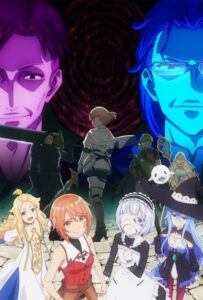
Main visual for Roll Over and Die anime: 2 girls are in the foreground, the one on the left has apricot coloured hair, the one on the right has silver hair and is wearing a maid's uniform. Other characters appear in the background

By Eleanor W, Okazu Staff Writer.

This review contains spoilers.

When we left Flum and Milkit at the end of episodes 1-3, reviewed here on Okazu , a man called Leitch has asked them to retrieve some illicit herbs to turn into medicine for his sick wife. Remembering that the Church has outlawed such magic, they are joined by Sara, a nun who is willing to defy Church law. While searching for the herbs in a cave outside of the city, our main antagonist Dein, (the man who tried to trick Flum and kill her when she first came to the Adventurer’s Guild looking for work) collapses the entrance, leaving Flum and Sara trapped inside.

If you didn’t enjoy the first 3 episodes, then there’s nothing here for you. As I suspected in my previous review, there is more to the Church than meets the eye, but I was pleased to see it built up in such a way that we gradually learn more as the show goes on, rather than just a massive infodump all at once. An abandoned underground laboratory proves to belong to them, and Flum’s name appears in the papers left behind. Flum reunites with Eterna, a witch from the Hero’s party who quit after an argument with Jean, and is furious when she learns that Jean secretly sold Flum into slavery. Dein and his men continue to pursue Flum, and a new character, a blind girl named Ink, joins the group, as well as some other former members of the hero’s party.

Dein is not the greatest antagonist ever created. He is revealed to be a pawn of the Church and gets a disproportionate amount of screentime for how ultimately inconsequential he is as a character, before he is finally killed by Flum in episode 11. I feel the show would have been much more interesting if Flum and the group had gradually built up to fighting Origin as the final boss, but it may be that the anime just wasn’t able to do this in the 12 episodes available so I don’t want to judge too harshly on that basis.

Artwise, the same dark moody colour palette as in the first 3 episodes prevails. Some character designs are more interesting than others, and most of the budget seems to have gone on the gore, particularly (CW) the torture scene at the beginning of episode 12.

There’s lots of potential directions the story could have gone in, but ultimately I did enjoy this version of it, including Flum and Milkit’s relationship. I liked that the show isn’t shy about making their feelings for each other clear. This is about two girls who desperately need each other and desperately want to protect each other and that’s what they do.  Whilst it does lean on the ick and gore a little too much in places, the setting is still interesting enough that I’d watch a season 2 if it gets made (there were potential threads left dangling to set one up) and I’m curious to read more of the novels too.

Overall, if you’re looking for something in the “kicked out of the hero’s party and wants revenge” genre that’s a little different from the norm with some genuinely nice relationships between the characters, I’d recommend giving this one a go as long as you can deal with the gore.

Ratings: 

Art – 6
Story – 7
Characters – 6
Service – 8 if you enjoy gore, 5 if you don’t care for it.
Yuri – 8

Overall – 7

Eleanor has been a fan of anime and manga for over 20 years, and has several thousand volumes to prove it. Since discovering the original Seven Seas translation of the first 2 Strawberry Panic! light novels back in the early 2000s, they fell down the Yuri rabbit hole and never looked back. They can be found around the Internet under the handle st_owly, and live in Scotland with their wife and 2 cats.