Archive for the Light Novel Category


The Executioner and Her Way of Life, Volume 2

September 13th, 2021

In Volume 1, we encountered a world in which “Lost Ones,” normal humans from Japan might find themselves saddled with “Pure Concepts,” magic too big, too unfettered, too uncontrollable for that world. In order to avoid monstrous calamity, there are Executioners who kill these Lost Ones. Executioners are not heroes, they are killers. Menou knows she is the villain of her story, but still strives to do her best in her job. In The Executioner and Her Way of Life, Volume 2, Menou is failing to do her job well.

The basic set up of the world is the typical three estates of the ancien regime – Nobles, Church, Commoners and the Knights who protect them. In this world (where media almost complete lacks of any kind, which I maintain is weird) the Fourth is a combined force of people who think this whole setup is ass and are trying to find power in the chaos. That’s the setup of the world, but it is almost irrelevant to the story, except as a background.

The actual story is that Akari is a Lost One with the pure concept of Time and therefore cannot be killed, despite Menou’s increasingly half-hearted attempts. Momo, Menou’s junior brings Menou important information almost having sacrificed herself to gain it. One of the worst calamities to strike this world, a Human Error, is free once again. And indeed, Menou encounters it…her. Akari is not strong enough to fight it, neither is Menou, but a concerted effort by Menou and “the Princess Knight” Ashuna (in a kind of Nobles-Church alliance) are able to bring her to a short-term standstill.  The battle, as one might expect from this series, is meant as an exercise in grossness and body horror.

At this point, I am now faced with the same choice I had in regards to Roll Over and Die. Do I keep going through what must be ever deepening levels of body horror and guro…and to what end? Will the payoff be enough for me to care? There are at least 4 more books in the series in Japan to date. Right now, I have no answer.

There are elements to this story that I genuinely like – primarily, the magic. The world is uninteresting and, sadly, so have the people been so far. The world is filled with that are mostly bad people, apparently.  We rarely, if ever, see someone decent, kind or even neutral. And here is where I find myself in a quandry. Some of those bad people are interesting, even if the book is at pains to present them as uninteresting. For instance, Manon’s backstory was to date the only fully realized story we’ve had. She’s initially presented as bored/boring, but turns out to have layers. Evil is presented in a way that works, but isn’t interesting in the same exact way Momo is uninteresting – monomanias are bad storytelling.  Ashuna and Momo present us with an avenue for growth and that interest me. And, ultimately, one might want Menou and Akari to have their stories filled in, since this is presented to us as the key plot of the series, around which all others revolve. But will it be enough to keep me engaged?

The worst element of this book is, without question, the art. I don’t know why it exists at all, honestly. Well yes, I do and it makes me want to punch someone. It serves one purpose, as the characters barely look different except to have increasingly insulting lack of underwear and clothing for costumes. It’s, frankly embarrassing that no one says, “No. Seriously, stop.” for “clothing” drawn in this fashion. The breast fetishism here is just…dull. Who is the front cover even supposed to be? It’s definitely not Menou (who wears blue,) Momo (pink hair, white robes,)  Manon (kimono and hair loosely bound at the bottom,) Ashuna (chainmail bikini and tall, with a lot of hair) or Akari (absurdly emphasized chest and black hair.)

Jenny McKeon does a pretty solid translation here, given that the overall tone with which this particular volume is written is “boredom.” And she makes the magic interesting to me, which is keeping me going. Since Yen does not credit anyone else, I’d just like to thank the rest of the team who made this volume possible.

Ratings:

Art – Atrocious and vulgar
Story – On the magic alone I’d give it a 9, but let’s temper it to an 8 for the grim
Characters – This one is still hard, let’s say, 7 with an upward creep.
Service – See art. Yes, I get it, it’s all very exciting that women have tits. /eyeroll/
Yuri – Everyone loves Menou.

Overall – 8

Yen was kind enough to provide me with a review PDF, thank you Yen Press, but I ended up buying the volume in print when I saw it in Kinokuniya. I am unlikely to keep this series on my shelves, but it actually looks really substantial and nicely put together as a print volume. It’ll go into a future Lucky Box. In the meantime, I’ll have some time to decide if I’m continuing as Volume 3 will hit shelves here in November.


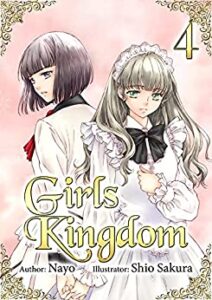
Girls Kingdom, Volume 4

September 12th, 2021

When I tell you that Girls Kingdom, Volume 4 is worth reading, please understand that I am 100% aware of what I am saying. The series is, thus far, a ridiculous concoction of overblown Yuri tropes seen on a jumbotron screen of Light Novel excess. It’s also kind of fun. In Volume 4, it is both entirely, gobsmackingly, batty and much more clever than it has any right to be…and then it is…charming. Imagine that I write that sentence in equal parts awe, amazement, frustration and maniacal giggling.

You may remember that series is set at a school for absurdly wealthy young women, in which commoners aspire to become maids for the wealthy young women.

In Volume 1 of this series, we met Misaki, a regular girl attending this school, who has no desire to become a maid, and Himeko, a wealthy young lady who has no desire to have a maid, and who thus join as maid and mistress.

In Volume 2, Misaki and her roommate are required to jump through silly hoops for silly prizes.

In Volume 3, Misaki is both detective and diplomat and maid and one hopes her school grades are okay, but hey, she’ll probably always have work as fixer. And, oh, by the way, there is a surprise vampire.

So, by Volume 4, surely you know not to take any of this too seriously. And we don’t, as the initial scenario is a battle of the absurdly wealthy girl Salons to recruit a new member; a story whose conclusion which rests on a secret sauce of business acumen, baking and friendship.

And then the story takes a serious turn, as a maid and mistress pair faces a crisis no one can find a way out of …until a resolution is indeed found and I stopped and said, “Well, that was clever. How annoying.” ^_^ This book ends with more vampire hunting and the only actual laugh out loud moment in the book for me as Misaki seriously states, “The ‘III’ is important.”

She’s right too, because now Misaki has a magical animal mascot. And that surely must be important in this school where maids cook and clean and negotiate and fight and draw up legal contracts and arrange polite confrontations and engage in battles of eating escargot, and, presumably, go to class sometimes.

This series is too silly to hate. ^_^ You might not like it, but from my perspective Misaki is delightful and the whole story is so utterly loopy that you might as well just lean into it. And so author Nayo does. Shio Sakura’s illustrations once again illustrate the people, not the scene, so expect elaborate, yet impractical costuming. (Also, not sure what they think “evening gowns” look like here.)

Ratings:

Art – 7 lost me on the “evening gowns”*
Story – 8 Actually good in places, or am I losing some grip on reality? Not sure.
Characters – 9 Even more likeable and even more loopy
Service – 6 Still tiresome, but shifting
Yuri – 4.5 Himeko is finding reasons to touch Misaki

Overall – 8 I…liked…it?

In any case, if you have managed to make it this far, I encourage you to read Volume 4. Misaki may not be Noriko, but her relative normality at this absurdly fictitious school makes the whole thing work. You are not reading this series for either sense or sensibility, but as far as entertainment goes, you’re golden.

*Evening gowns for tea? Look, I’m not “British,” either, but that’s not how that works.


Watashi no Oshi ha Akuyaku Reijou. Volume 5 (私の推しは悪役令嬢。)

September 9th, 2021

What if you had the chance to remake the entire world in order to save the person you love…and learned that the world was never what it seemed?

The first thing you will note about Watashi no Oshi ha Akuyaku Reijou., Volume 5, (私の推しは悪役令嬢。) by Inori, with illustrations by Hanagata, is that it is a large-ish volume. That is because there is a lot to get through.

We left Volume 4 with a number of major and minor plot points up in the air. Since, once again, you will be able to read I’m In Love With The Villainess, Volume 4 this winter from Seven Seas, I will not spoil those plot points, except to say that they are mostly all entirely relevant to Volume 4 and only one is relevant to Volume 5. This volume mostly takes place in the Nur Kingdom and when I tell you “the world was never what it seemed,” please consider that as much of a spoiler as you will get from me beyond the cover art, which is also a spoiler. I’m actually glad I read this on Amazon’s Kindle app, because the translation dictionaries made it that much easier to wade through some of the terminology. My Japanese vocabulary is not up to economics and finance, and other specific disciplines.

Because so much happens here – loss and gain and loss once more and salvation and damnation and eternity, it’s actually impossible to talk about it, so I will content myself with the least important thing I told Sean Gaffney as I messaged him to spoil the living hell out of it. If you are familiar with Doctor Who, you will entirely understand how everything in this book works…and how it must work. ^_^ This leads to the only criticism, if you can even call it that, I have. Because of that specific narrative structure, there was no way to give it a punchy ending, which was perfectly okay. It ended as it had to…and then didn’t end for a few more post-epilogue shorts. When you like your characters, it’s hard to let go, I understand completely. ^_^ 

Inori-sensei’s writing has evolved. Originally published as a webnovel, the chapters moved quickly, were carefree and goofy. The story began to take on a serious bent as the plot unfolded in later volumes. Through everything, the writing was very, very aware of LGBTQ+ issues in the real world. This is true through the very end of the story. What has changed is that the writing now is very visually descriptive, where before it was narratively descriptive. Inori-sensei clearly has the currently running manga and any potential future anime (which has not yet been proposed, the author’s note states) in mind. That kind of writing works very well here in what must be described as a grand, sweeping, epic finale, in a way that it would not have in the earlier volumes.

Typical of a Light Novel, the art is portraiture and serves to illustrate the characters, rather than the scene. Hanagata’s art has also improved and evolved, which is kind of fascinating, because we got to watch it in real time.

So what can I tell you about this volume? I can tell you that a couple of times I thought the story was going to make me cry. It didn’t…until it did, and the character that did that, was probably one of two characters I would have absolutely guaranteed that you could not get me to care about. ^_^

While this book wraps up every loose end – even the ones it creates – and finishes the story as such, Inori-sensei is still hard at work. “She’s Such a Cheeky Commoner,” is the story (not entirely the same content) from Claire’s point of view. You can read the webnovel of this if you become a subscriber to Inori’s Pixiv Fanbox.

Ratings:

Art – 9
Story – 9
Characters – 10
Service – Very little, for perfectly good reasons.
Yuri – 10
Queer – 10

Overall – 10

I said of Volume 3, that it was juggling and plate-spinning on a high wire, I called Volume 4 a “wild ride.” Volume 5 of Watashi no Oshi ha Akuyaku Reijou. was an epic parade of the entire circus. ^_^ 


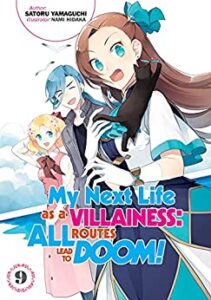
My Next Life as a Villainess: All Routes Lead to Doom! Volume 9

August 29th, 2021

Today I want to talk about My Next Life as a Villainess: All Routes Lead to Doom! Volume 9 and I think I’m probably more surprised than anyone about that. ^_^

If you are still reading by Volume 9, you know that for anything in this series to work, Katarina must remain an uncarved block and all the people around her will flail to preserve her simplicity, at any expense. That remains true here as well, but also, we get to see a new facet of our protagonist…and it kind of changes everything we think about her.

Larna takes Katarina, Sora and Maria on a mission to track down the source of the child trafficking ring that has been constantly mentioned, but sort of skimmed over as a “bad thing over there that we’re not looking at” much the same we most of us deal with, well real-world child trafficking.

In a beautiful seaport town, Katarina makes her peers fall in love with her all over again and drags a new enemy-to-ally into the harem. She forgets that she commands a powerful magical creature, then remembers, then forgets, then remembers. All is well and this crop of children are rescued and maybe, possibly we’re one step closer to finding the shadow noble / dark magic practitioner who is doing all this. But none of that is why I am writing this review.

As you know, I am firmly on Team Mary for shipping with Katarina. Sure, I like Maria, but did not agree when last year, Maria x Katarina came on top of the best couples poll for the series. Until this volume. ^_^

Maria’s no dummy. She can confess as openly as she’d like to Katarina, knowing that no matter how low she flies her banner of love, Katarina will not understand it (and, realistically, it won’t threaten anyone else, as she’s a commoner.) In Volume 9, Maria’s declarations of love are SO blatant that even Sora thinks Maria’s the best choice. In the end, I was convinced that if this were an otome game, Maria probably does have the best route end, by a single scene in which Katarina was allowed to be good at something.

The premise the readership has assumed is that Katarina is a doofus. What if…she’s not? What if you or I had actually been reincarnated as a Duke’s child and forcefed years of etiquette and arcane language classes for magic we couldn’t control? Go ahead…think about it. It’s not a stretch to imagine that I’d also have gotten into loads of trouble for climbing trees and doing shit unbecoming a young lady. (Thanks, Mom and Dad, for not punishing me for climbing trees.)

So, here in this seaport town, as Maria takes over the management and cooking for a restaurant and we learn that Katarina was in her past life a *completely competent waitress,* it kind of changes everything. Even Katarina allows herself a fantasy in which she and Maria run a restaurant together…it’s hard to argue that it wouldn’t work, when we can see that it most certainly would.

If you’re reading this series for Yuri, it’s only here and there in between everyone else’s gaga-ing over Katarina, but you know what? It’s there! For those of us who wish there was a full-on book just about that, our wish is coming true. My Next Life as a Villainess Side Story: Girl’s Patch is on the way from Seven Seas in May 2022.

Ratings:

Art – 7 Perfectly fine, always irrelevant
Story – 8 Predictable with a side of Yuri
Characters – 10 I’m not reading this for the intense crime story
Service – 3 Katarina being swept off her feet by Maria is service, yes.
Yuri – 4 Same, plus 1 for Sora agreeing with us.

Overall – 8

While I will never give up rooting for Mary, now I can definitely agree with the Maria groupies. ^_^

Volume 9 is available now in digital format from J-Novel Club on Amazon Kindle or Bookwalker Global. It will be out in print in winter 2022.


Otherside Picnic, Volume 5

August 22nd, 2021

Otherside Picnic, Volume 5 begins in the middle of a story and for the rest of the book, that is pretty much where we stay. A scenario occurs, but it does not feel particularly resolved by the end of the section when it stops. Nonetheless, this novel covers a fair amount of ground, much the same way Sorawo and Toriko travel the UBL – a mapping of the story, rather than the story itself.

The first scenario begins with the continuation of the Love Hotel Girl’s Party set-up from the end of Volume 4. Clearly, in the real world a love hotel girl’s party is meant as a bachlorette /stag party for women. One might expect alcohol and a male stripper and other straight-women misbehaving nonsense. But because Toriko won’t say things and Sorawo was never socialized normally and will avoid all things unless they are said, and often even then, the two of them are joined by Akari, Natsumi and Kozakura. Then…something happens. What happens is interesting, but not for the thing itself. I’ll come back to this in a second.

Before I forget, I want to note that Miyazawa is losing his grasp on Kozakura. She started out as a point of contact for DS, but at this point is merely a grumpy, scared nobody in the story. I feel bad for her.

Following this was definitely the strongest section as Sorawo tracks down Toriko at university to have some stuff out with her. Toriko is, understandably, feeling endlessly rejected by Sorawo. Sorawo even understands that, but just is not capable of returning the feelings. When Toriko accidentally pushes Sorawo into interstitial space, Sorawo finds herself understanding, finally, what she has not been able to look at head-on. Toriko is in love with her. She acknowledges this – and recognizes that it makes her panic.

The third scenario puts Sorawo back in her happy place – investigating the Otherside with Toriko. Planning, traveling, thinking about getting new equipment…this is what she loves. And she loves doing it with Toriko. This is her love language. So, when they meet another person, how will Sorawo react? Not at all the way you’d expect. Todate doesn’t need their help. She and her dog, Hana, are suited to one another, as Sorawo and Toriko are. Todate teaches the two how to spot animals in this world. Her skills add a new tool to their bag and the hunt shows them that the Otherside may well have a logic of it’s own, if the animals have evolved to not be driven mad by it.

By this time, Sorawo and Toriko are starting to think about how lucky they were when they first met. And they are beginning to understand that the UBL has clearly changed them, and not just physically. This becomes part of the conversation in the fourth scenario as the story circles back to the first person the met on the Otherside. Abbarato comes back into the story like a reflection, through what may or may not be his missing wife. Sorawo admit she was always looking for proof of the existence of the paranormal in stories and now, Sorawo’s eye and Toriko’s hand are actual relics of that very thing…but what does any of it mean?

In this final scenario, the two encounter a feral child and again, this triggers Sorawo’s memory of her own, entirely abnormal childhood. This, along with several conversations about disassociative behavior is very clearly meant to remind us that Sorawo is not *just* being dense about her emotions. She had a shocklingly traumatic upbringing and, as I say, has never been socialized. This was pounded on us so many ways in this novel, I wonder if the fandom was being kinda dense themselves and Miyazawa felt he had to be like, “Dudes. WTF? Do you not remember this important thing?”

Which brings me to my point. Her family was part of a cult, she’s always been obsessed by the paranormal. Even Sorawo can see that the Otherside seems to focus on her, but what if it’s not that the Otherside focuses on her, but that she is, in a sense, creating it for us. At the very least, she is an interpreter. A phenomenon occurs and, with her experience of the paranormal, Sorawo tells us what to understand it as. Because of this, we have a way to comprehend those experiences. In a sense, she is telling us how to not go mad. And, in that sense, she is creating the Otherside for us. We’ve seen what it does to people with no point of reference. We can avoid that fate, because Sorawo tells us what we see.

There are two more things I want to note. One was the appearance of more typical Yokai and Tales of Tono in this volume. Up to now, the stories have been rooted in modern netlore, most specifically scary stories on 2chan. Tono Monogatari is a 1910 manuscript by Yanagata Kunio and Sasaki Kizen, which collected a series of folklore and Yokai stories from a town that, to this day, considers itself the home of the strange and paranormal in Japan. Famously, Gegege no Kitarou creator Mizuki Shigeru did a comic of this – which was translated into English by Zack Davisson and published by Drawn & Quarterly. The chapter with Todate is based on a tale from Tono.

And I hope you all noticed the traditional Yokai that appeared at the beginning of the story! Kuchisakeonna is a well-known tale that involves a woman with a face that has split mouth. She is known to ask strangers if she is beautiful…and if they say, no proceed to kill them. I was quite pleased at this scene. We’re big fans of contemporary Yokai here and the use of the story was perfectly done.

The Otherside is, in this story, a reflection, a sight out of the corner of one’s eyes, a unfocused thing you sometimes see. As my old martial arts teacher used to say, it’s all the “Yin” side. We can perceive it and some of us interact with it. It inhabits the same space we are in, at the same time. The use of mirrors and reflections really highlight that in this book.

Lastly, but not at all least, I would like to note the art. The series began with blandly moe-stye art that I did not think accurately portrayed the characters in the least. But now, we’re getting gorgeous, evocative woodblock print-like black and white images that are vastly superior. These images are so much better, I had to check that we had the same artist. So yay for shirakaba being able to give us art that suits the tone and feel of the story much more suitably than one more shitty moe pinup. The art in this book was outstanding.

The book ends a bit abruptly, which makes it feel like a set-up for the next volume. Fortunately Otherside Picnic, Volume 6 will be hitting your electronic devices in November, so there’s not too long to wait. Based on the synopsis however, we’re going to get more questions than answers…again. But that’s why we read this series, after all. ^_^

Ratings:

Art – 9
Story – 9
Character – 9
Service – 7 – Love hotel and stupid
Yuri – 8

Overall – 9

Otherside Picnic weaves contemporary folklore, psychological horror and romance into a compelling adventure.