Archive for the Miscellaneous Category


Though I Am an Inept Villainess: Tale of the Butterfly-Rat Body Swap in the Maiden Court, Volume 9

November 2nd, 2025

Two young women in fantasy Chinese clothing stand back to back. A stern older man with Imperial crown behind them look off to the left. The air is filled with chunks of ice and bombs.This past summer I discussed Volumes 1-7 of this series. My thoughts were about chronic illness, emotional manipulation, systemic bias and some other overarching concepts, rather than about the story, per se. Also, I noted that the first volume had me sobbing in a plane bathroom, which was awkward. 

I delayed reading Volume 8 of Though I Am an Inept Villainess: Tale of the Butterfly-Rat Body Swap in the Maiden Court until Volume 9 was available, since the story structure thus far has been 2-volume arcs. Volume 9 turned out to be the climax of a number of arcs, including the immediate plotting of that current arc. It also is the climax of the second phase of the relationship between Kou Reirin, the Earth Maiden and Shu Keigetsu, the Fire Maiden, consorts of the Crown Prince of Ei.

Due to the toxic relationships between the Consorts of the preceding generation, the Maidens have all had to overcome significant abuse and manipulation, both emotional and physical. In part due to need and self-preservation, in part to Reirin’s steel-trap wit, all of the Maidens have moved beyond their hateful and antagonistic relationships. They work together now to greater ends, even if they still do bicker. The writing really shines here specifically, as the tension is wholly different. They sound like old friends trashing each other, not like implacable enemies. 

In Volume 8, a situation so complicated that I am hard pressed to explain it in a sentence or two is set up. Reirin and Keigetsu are switched and cannot be switched back, even though Reirin is tortured and Keigetsu made to push Reirin’s frail body beyond it’s ability. To save themselves, they must solve a mystery that has plagued the Emperor since his youth, or die. In doing so, the two women have a fight that seems insurmountable. In Volume 9, all of this comes to a head in what is a genuinely brilliant book. 

Keigetsu has been trying and succeeding for the most part, to pass as Reirin. Imagine if you were suddenly asked to pass a physics professor or an Olympic skater. For Keigetsu, the gap between her, a despised nobody treated like trash in order to serve as a punching bag and be universally loathed as an uncultured joke, to rise to be able to pass as the beloved angel of the Inner Court, delicate and gentle, is nearly impossible to imagine. Keigetsu does that, lifting herself out of the sewer once and for all. Reirin is gutted. We’re told, over and over that the Kou family loves nothing more than to be needed. Keigetsu no longer needs her. Reirin snaps. Her subsequent crisis had me  – for real – fucking sobbing on a plane again.

Keigetsu, in rising to be the person Reirin need her to be, makes Reirin feel as if she is no longer needed. Rushing in to that gap is all the emotion Reirin has never let herself feel about being ill. She spent her lifetime preparing for death. Making sure she had no unpaid debts, no thanks left unsaid. Now, apparently no longer needed and unable to pay off the debt she feel she owes Keigetsu, the weight of her own mortality rushes in and crushes Reirin. She has felt health now, in Keigetsu’s strong body and the horror of returning to her own weak one, as her health deteriorates makes her…angry.  I won’t belabor this, except to say the one thing I will not do to myself is imagine a life without illness, so when Reirin lost it at this point, so did I. 

Keigetsu, for her part is angry and confused. She has exceeded every expectation, risen above her upbringing, her training, the manipulations that she was subject to, only to be met with a Reirin, cool and unemotional. For Keigetsu, this was tantamount to rejection. 

The catalysts to their eventual reconciliation are the men in their lives, which was really a nice touch. One of the best bits of this series is how both men and women are portrayed here as fully-developed humans, with strengths, weaknesses and emotional depth. No non-verbal, unemotional blank slates that we have to mask emotional depth on to. The developing relationship between Reirin’s brother and Keigetsu feels natural and fun, while the Crown Prince frequently ends up being the most emotionally intelligent person in the story. It’s a genuine pleasure, knowing “the boys” aren’t a drain on the story or the character development. 

The climax comes with reconciliation of several kinds. Both Reirin and Keigetsu finally, honestly admit their needs to one another. Reirin is able to compliment Keigetsu with her whole chest, and finally Keigetsu can see herself as the comet Reirin always likens her to. It’s a magnificent moment, beautifully written. 

While this series is not Yuri, in the sense that there is no romantic love between Keigetsu and Reirin, and there is no likelihood of there ever being any, it does not lose out at all in the intense emotional connection. Reirin and Keigetsu have inhabited each other’s bodies and lives, they have had to pass for one another. They have had to save one another and they have conspired to do things that changed the kingdom around them. I cannot think of a friendship in literature more intimate than this. It is a genuinely fantastic series, which I wholeheartedly recommend to Okazu readers.

Ratings: 

Art – 7 
Characters – 9 
Service – Teenier bits in this arc, as there was a *lot* going on.
Intimacy – 10

Overall  – 10

As I said in my previous review, I probably will not be watching the anime, simply because the early parts are simply too hard.  And I’ll have to stop reading this series on a plane.  ^_^; But my sincerest thanks to Sean Gaffney for the recommendation.


Manga: A New History of Japanese Comics

April 6th, 2025
Deep blue book cover, with a circle of brightness highlighting a classic manga baseball pitcher in mid-pitch.

Version 1.0.0

One of the best things that happens when one steps past “fandom” as an interest to “research” of that interest, is that one meets a community of people who are passionately analyzing, criticizing and rewriting the histories of those interests. The academic and independent anime, manga and comics (and larger pop culture) studies community has been one of the most welcoming group of people I have ever encountered. It has been possible for me to meet and correspond with some amazing minds from whom I have learned more than I could ever imagine. And, when I wrote my own book, their acceptance was heart-warming. So, as often as is possible, I like to return that favor and review a book you should definitely know about and read.

In 2022, it was a pleasure to read such a book,  Comics and the Origins of Manga: A Revisionist History, by Eike Exner, in which Exner painstakingly fills in the  gaps in most histories of manga from Edo-period sketches <time jump> to  manga. To quote that review, “Exner focuses on is the shift from extradiagetic narrative, i.e., blocks of text – often literally- outside the story that explain the story, to transdiagetic narrative tools like dialogue in speech balloons and sounds that both we and the characters in the story experience .”

In Manga: A New History of Japanese Comics, Exner builds a more complete history of manga from the perspective of what was happening with comic strips, then comic books, in Japan, to what we broadly categorize as “manga.” In chronological sections, the book peels away some of the accepted narrative that manga existed in it’s own uniquely Japanese vertical and was influenced only by previous Japanese art. Every section confronts an orthodoxy of thought about the creation, influences of and global spread of the manga phenomenon.

And this last piece is the main weakness of this book. I am friendly with Eike and have seen some of his struggles against these orthodoxies. I’m outside academia, so my support is relatively inconsequential, but I do support his work. Because he so clearly has struggled against being dismissed by the establishment in manga studies ( and, I presume,  Japanese cultural exceptionalism) the tone in this book is sometimes aggressive, almost angry. When arguing against strongly held, but disprovable, conceptions that are deeply entrenched in manga studies, I absolutely understand. When that same dismissive aggression gets turned upon fandom, it does feel a bit gatekeepy. Thankfully, that tone dies off quickly in the second half of the book, when he’s past much of the hidebound thinking about the creation of “manga,” (i.e., post-Tezuka).

There was so much information in this book, from the ongoing influence of western comics that has now become a dialogue between manga and comics worldwide – something I am also writing about right now for a project – to the continuds, ongoing influence of many creators and editors beyond the best-known names. I came away from this book having learned so much that I already know I’ll need to re-read this book and cement much of it in y mind. I’ve already used it as a reference in pieces for two other books and it’s not even out yet! ^_^

For a fresh, well-researched look at the history of manga, I highly recommend Manga: A New History of Japanese Comics by Eike Exner.

Ratings:

Overall -9

Many thanks to Yale Press for a review copy and a request for  blurb. I hope that will be on the book itself. ^_^


Spring Cleaning 2025 – All claimed!

March 30th, 2025

I’m doing some spring cleaning, so we have 3 Lucky Boxes this round.

All are premium boxes with media, manga, candy, toys and goods from Japan – that is, some Yuriten goods, and some other items from my last trip there and promo items I have picked up. They also include other flat fun things like artbooks, stickers, bookmarks or postcards which are equally random and frequently bizarre (and often not at all Yuri.) As always, there are random pieces of paper like memo pad sheets and individual flake stickers of random things or cute food.

My promise to you is that you’ll get random things, sometimes in other in random things. ^_^ I assure you that this is all 100%, unadulterated stuff.

This round we have:

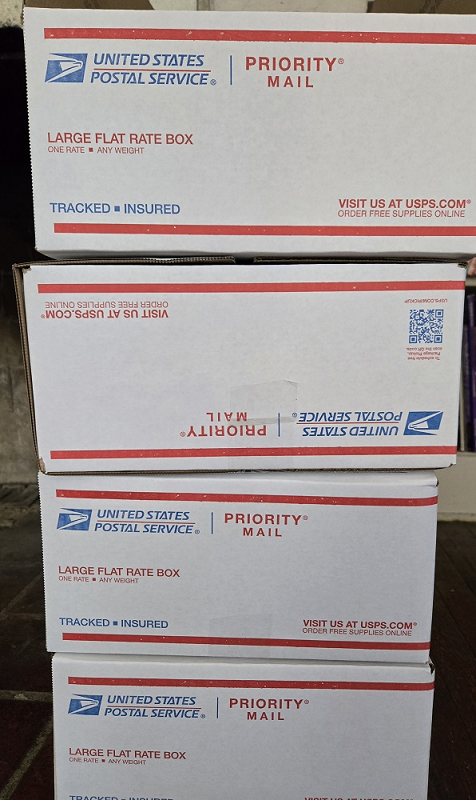
3 Large USPS Flat Rate boxes.

Shipping rates have gone up, but I’m trying to keep these boxes the same range of prices. The goal here is to clean stuff out!

Large Box 1 – $60- Claimed
Large Box 2 -$50 Claimed
Large Box 3– $50 Claimed

***

To be eligible to buy a Lucky Box, follow these instructions carefully. Please. Thank you. Failure to follow all of these instructions will disqualify you. It’s not personal, they are all claimed pretty quickly and I don’t have time to track you down for a piece of information.

1. You must live in the Continental USA (contiguous 48) only, no APO/FPOs. This is disappointing for me too, so I apologize.

2. You must be over 18, I am not policing books or recipients.

3. Email me with the Yuricon Contact Form with the subject “Lucky Box.” Use an email you check regularly, because I will reply asap. The first person who responds to my email gets the box.

4. *****Please include your name, age, mailing address. ***** Tell me which box you want. Even if you’ve given me your address previously, please include it, I am very lazy.

5. I will contact you at that point and give you details about payment by Paypal. Please be prepared to check your email and get payment out so this post doesn’t linger. Thanks in advance. These will be shipped out asap, as well; the whole point of this is to get these out of my house. ^_^

Thank you and enjoy!


The All-Consuming World, by Cassandra Khaw

February 9th, 2025

On a deep darkness, two figures lit with gold, tumble surrounded by red and purple gases implying a nebula in space.I did not know words could do that.

As I read this book, I kept highlighting individual sentences because I was just so impressed with the way Khaw uses words. She had me at “Her casual numinosity is frankly offensive.”

But I begin in the middle, let me start from the beginning. I am recently on a quest to find books about angry women hurting things. I read and adored Red Sonja by Gail Simone and, in continuing to look for other stories about angry women beating the shit out of terrible people, I found Cassandra Khaw’s The All-Consuming World.

Content Warning: This is an exceptionally violent novel, even by my standards. “Gouging out someone’s eyes with one’s thumbs as a greeting”-level violence. It was great.

Here is the summary from Amazon: “In space, everything hungers.

Maya has died and been resurrected into countless cyborg bodies during her dangerous career with the Dirty Dozen, the most storied crew of criminals in the galaxy before their untimely and gruesome demise. Decades later, she and her team of broken, diminished outlaws must get back together to solve the mystery of their last, disastrous mission and to rescue a missing and much-changed comrade . . . but they’re not the only ones in pursuit of the secret at the heart of the planet Dimmuborgir.

The highly evolved AI of the galaxy will do whatever it takes to keep humanity from regaining control. As Maya and her comrades spiral closer to uncovering the AIs’ vast conspiracy, this band of violent women—half-clone and half-machine—must battle both sapient ageships and their own traumas, in order to settle their affairs once and for all.

That about covers that what. The who takes up the bulk of the book. What drives Maya and her former comrades takes up the rest. And holy shit is this a really good, really compelling, really queer book.

The queerness here is fascinating. There is no romance and no sex in the main relationship, only a highly toxic Stockholm Syndrome, but it is still very much a relationship and deeply queer, not just because the people caught in, up, and by it, is are women and non-binary people. This is a story rooted deeply in pain and trauma and in different ways to move past it, to let it fuel you, and to keep it around, to keep burning up with anger. There is one happy ending here and it’s very sad.

My only complaint, as such, is that I hope there is a sequel, as there is a lot left undone at the end that I would like to see done.

Ratings:

Overall – 8

If you are looking for the anger of angry queer folks in fiction to fuel yourself, I can highly recommend The All-Consuming World by Cassandra Khaw. Once again, I link to Amazon here, but I read this on Libby, though my library system. Get your library card and get into Libby or Overdrive or whatever digital resources they have and get reading! Using your local library is the best way to advocate for it.


Lycoris Recoil, Volume 1

December 8th, 2024

In two vertical panels, we see two girls in similar Japanese school uniforms. One, a blonde with a red bow in her hair, wears a red uniform, with grey skirt. The other a girl with long black hair, wear blue with a grey skirt. Both hold guns.Lycoris Recoil is the story of two young women, both contract killers, who have been burned by the organization that uses them as tools. One of them has secrets she cannot share and a mysterious past, one has very little memory at all. As they work together, they will see in each other something important for themselves, and will protect one another – even against the people that made them the perfect instruments of death that they are.

Oh, sorry. That’s Noir, isn’t it?

Well…it is also Lycoris Recoil, Volume 1. We meet Takina, who is clearly too good for the organization who uses her, DA, to control. So they exile her to a cafe front for their best and least-controllable agent, Chisato. Togther, they will serve coffee – here it would be great to say “and justice,” but that is not what it is – and do jobs for DA and whomever they serve.

It’s no accident that Lycoris Recoil is similar to Noir. It’s a winning formula, after all. Fans are always willing to pencil in the details that they think ought to be there, when they are give a general storyline – girls with guns, in this case, sort of on the run, is a broad, but popular, concept. Yuri fandom is, of course, happy to equate intimacy with romantic interest, even if the series itself does not commit, e.g. Noir. ^_^

To continue the comparison, where Noir gave us a “beloved Mirielle” that was instantly downplayed by Bee Train. Lycoris Recoil gave us a Chisato willing to put herself on the line to save Takina, and a dream sequence in the novel in which Takina literally awakens to her feelings. No actual relationship, just intimation of intimacy. Which is why when I noted on the Internets that I do not think of them as a couple, a lot of fans took that very personally. I could certainly see that they might one day become a couple, but as the series ended they are partners probably on the run for all eternity. You know, like Noir.

I’ll stop now. ^_^

Volume 1 cleaves pretty closely to the anime, but fills in enough info that if you haven’t seen the anime, you can follow the manga easily.  (Except the obvious, and never-answered questions about the existence and functioning of DA, but we just have to accept that it is.) There is a lot of action, and the art by Yasunori Bizen really holds up to those scenes.

If you are a fan of the anime, this is a fun way to relive the story that got you hooked the first time. The translation by Kiki Pitkowska is solid and where Adnazeer Macalangcom could replace the s/fx, they did, which I always think adds readability to a manga.

It’ll make a nice gift for that friend who love cute girls with guns, for sure.

Ratings:

Art – 9
Story – It’s all plot to drive action. In that, it succeeds 8
Character – 8 Except, Mizuki being a drunk is still not funny
Service – 3 Chisato in underwear because
Yuri – 0

Overall – 8

Thanks very much to Yen press for the review copy!