
 by Frank Hecker, Staff Writer
The baihe (百合) genre, sapphic media in Chinese, is becoming increasingly popular in China and elsewhere, but, as with yuri manga and anime in the early days, translations of baihe works into English and other languages have thus far been mainly produced by fans. That situation has been slowly changing. For example, Seven Seas Entertainment has followed up their publication of danmei (BL) novels by licensing the baihe historical novel The Beauty’s Blade: Mei Ren Jian (美人剑).
Now comes Baiheverse, a recently launched site proclaiming itself as “Your Gateway to Baihe . . . Literature and Media.” It features a variety of licensed baihe works in English translations, including two manhua/webcomics, two audio dramas, one novel, and a short film. The last two of these are particularly worthy of note.
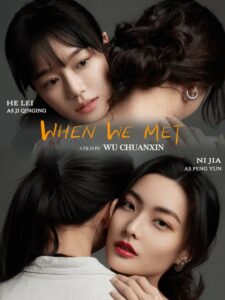
The film When We Met (去年烟火), written and directed by Wu Chuanxin, is a drama set in present-day China. It’s available in an “official” version and an “uncensored” version that’s ten minutes longer; both are free to watch if you register with the Baiheverse site. (The official version is also available on YouTube.) When We Met is the story of two women in a (relatively) small Chinese town, 32-year-old Peng Yun, who owns a small shop she runs by herself after her divorce, and 22-year-old Ji Qingqing, who sets up her BBQ stand outside the shop. (Avoid reading the official synopsis of the film if you don’t want to be spoiled about their back stories.) The two women find themselves growing closer together, but ultimately face a decision on the future of their relationship. I won’t spoil the ending, except to say that the uncensored version provides a clearer resolution.
Ni Jia as Peng Yun and He Lei as Ji Qingqing both deliver solid performances. Ni Jia is especially good in portraying Peng Yun’s conflicting emotions: recognizing her growing feelings for Ji Qingqing but afraid to break out of the comfortable but confining cocoon she’s spun for herself as a single woman in a small town. The writing, direction, and production are also of high quality, and the English subtitles are idiomatic and grammatically correct; however, with a couple of exceptions, on-screen text is not translated. This can especially cause confusion for viewers who can’t read the Chinese text at 1:51 (in both versions) and 30:53 (in the official version), and thus may not realize that the main body of the story is a flashback from the opening and closing scenes.
Ratings:
Story — 7
Characters — 8
Production — 7 (one point off for not translating important on-screen text)
Service — 5 ( a scene involving bras)
Yuri — 10
LGBTQ — 4
Overall — 8
Despite its relatively short length, When We Met tells a complete and satisfying sapphic story. It’s especially recommended for fans interested in realistic contemporary dramas that avoid manufactured melodrama and excessive angst.
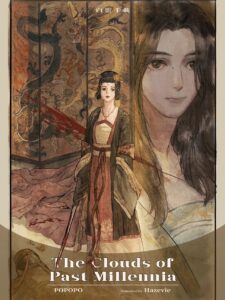 Unlike When We Met, which solely depicts lives in present-day China, The Clouds of Past Millennia (白云千载), written by popopo, straddles past and present. Originally published as a web novel, it comprises 28 chapters plus an afterword; the first three chapters are free to read while the rest can be purchased using a coin system ($1 US for 100 coins).
Wei Zai was the supreme ruler of an ancient Chinese dynasty, but now she’s dead. Even worse, she‘s stuck being a ghost in her own mausoleum. She decides to take a rest, wakes up after a long sleep, and finds that the world outside her tomb has utterly changed. Being a ghost, no one can see or hear her, except for Xu Jianyou, a university student who’s the spitting image of Xu Qingchu, Wei Zai’s previous right-hand woman and lover, and even shares her courtesy name. The remainder of the novel alternates between Wei Zai and Xu Jianyou’s life in the present (including Wei Zai’s amusing encounters with Chinese social media and shipping culture) and the story of Wei Zai and Xu Qingchu a thousand years ago. Is there a way for the two lovers to be united once more? And does anyone doubt what the answer will be?
The English translation of The Clouds of Past Millennia (by hazevie) is generally readable. Its main quirk is that many Chinese terms, especially those involving kin relationships, are left unlocalized and glossed with a translator’s note. However, fans of Asian media have shown themselves willing to acquire a fairly extensive vocabulary from other languages, and it’s possible that they’ll one day recognize and use terms like a-jie as easily and freely as they do now with terms like onee-san.
Ratings:
Story — 6 (I would have liked more contemporary scenes)
Characters — 7 (present-day Xu Jianyou is less fleshed-out than the other two characters)
Service — 8 (a couple of steamy sex scenes)
Yuri — 10
LGBTQ — 2
Overall — 7
The Clouds of Past Millennia is an entertaining read targeted at fans interested in the historical settings and court intrigues that are the stock in trade of many Chinese novels, enlivened by the interspersed contemporary scenes and their occasional metatextual humor.
The Baiheverse site itself is a young enterprise still finding its way, and is dependent on support from fans to allow it to acquire and host more baihe works. I encourage all fans of sapphic media to check it out. For updates on new works, follow @baiheverse.com on Bluesky or @baiheverse on X/Twitter.




I was absolutely blown-away by this film. I gave it a 10/10 simply because everything was done perfectly: acting, directing, production, soundtrack…
It’s main limitation, to me, was the story itself. It’s hard to do much when adapting a short story, but they maximised what the visual medium could bring and, from what I understand, the whole thing was a passion project that wasn’t intended to bring any profit.
I’m excited to see what else the creators do, I’m not sure how to track it down, though. (I know one of the leads starred in another GL that just aired on WeChat but there’s no English subtitles)