
 Baihe (Chinese yuri) is having a mini-moment. Seven Seas Entertainment just released its first baihe novel, the Baiheverse site is making steady progress on its project of licensing baihe manhua, novels, and other works (including the short film When We Met), and enough other works are being teased for licensing that what has been a mere trickle of official English translations promises to become a growing stream (albeit nowhere near a flood).
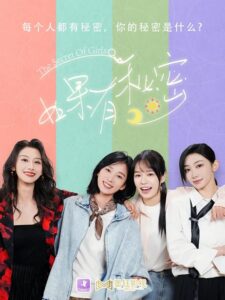
Unlike baihe novels, which (like their danmei/BL cousins) mostly seem to traffic in historical fantasy, The Secret of Girls (original title 如果有秘密) is a realistic contemporary baihe drama, now available on the GagaOoLala premium service. As it begins, young Xu Jingxi (He Lei) is laid off from her job, decides to go traveling (for a reason that the GagaOoLala synopsis spoils, but I will not), loses her wallet, ID, and phone while helping another woman, and ends up prevailing on older hotel employee Wen Shan (Sun Cailun) to let her have a room in exchange for working at the hotel.
At first glance the setup is reminiscent of many other yuri works: a free-spirited extrovert who’ll end up softening the frosty exterior of an introverted tsundere. However, Xu Jingxi’s outgoing persona is a cover for her suffering, the nature of which is slowly revealed as her romance with Wen Shan progresses. But the series is about more than the ills of one woman: the back stories of both Xu Jingxi and Wen Shan, and their relationships to their mothers in particular, form a sharp critique of a patriarchal society that demands that daughters show filial piety but offers them little or nothing in return.
Suffice to say, The Secret of Girls is not a series with a “happily ever after” ending, but it’s far from being “tragedy porn.” This is in large part due to the performance of He Lei, who takes what could have been a simplistic character and makes her richer and more complex. (As it happens, He Lei also starred in When We Met, another tale of a younger woman winning the heart of an older one.) Sun Cailun is a worthy companion to her, portraying Wen Shan’s slow and subtle opening up to friendship and then love. I should also mention Li Keyi and Wang Miao, who play hotel owner Ling Yung and bar manager Qin Bei respectively. Their characters support Xu Jingxi and Wen Shan in their evolving relationship and contribute a more light-hearted tone and a very sapphic vibe: The two women live together and are clearly in a relationship of their own, and Qiu Bei’s bar “Her” is advertised as being “Where Ladies Meet.”
My main complaint with The Secret of Girls is with its packaging: It was originally released as 24 five-minute episodes on the WeChat app, and the amount of actual content is such that it could have been (and I think should have been) released as a feature film. However, GagaOoLala is presenting it as 16 episodes, with multiple minutes in each episode taken up by a lengthy OP (which spoils many of the scenes in the series and is untranslated to boot) and even more time taken up in several episodes by an equally lengthy credits sequence. Regarding other aspects, the GagaOoLala version has at least one scene that was almost certainly excised for the Chinese domestic audience; it makes explicit what was already very much implicit in the portrayal of Xu Jingxi and Wen Shan’s feelings for each other.
Rating:
Story – 7 (a potentially clichéd and maudlin plot redeemed by the writing and acting)
Characters – 9
Production – 6 (points deducted for chopping up the material)
Service – 3
Yuri – 10
LGBTQ — 5 (not explicit but very queer-coded)
Overall – 8
The Secret of Girls is not an easy watch at spots, but it’s definitely recommended for viewers who are tired of relatively superficial or melodramatic yuri series (looking at you, Thailand) and want to see a more realistically emotional human drama. It also marks a welcome second outing for He Lei, whom I hope to see more of in future baihe series.




Not a bad series. I thought it was pretty explicit – I am still confused if it was produced and broadcast in mainland China as the love scene is unashamedly gay. And “When We Met” is a little gem more people should watch.