Archive for the inori Category


Watashi no Oshi ha Akuyaku Reijou.,Volume 10 (私の推しは悪役令嬢。)

August 28th, 2025

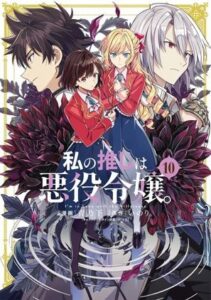
On a background of a dark reflecting pool of water, with a dark-red leaved plant Two girls stand with the arms crossed, wearing the red jackets and blue skits of a school uniform. Behind them are the heads of two princess, one with dark hair, one with long silver hair. All the figures look determined.  The “Revolution” arc is moving inexorably towards a climax. In Watashi no Oshi ha Akuyaku Reijou.,Volume 10 (私の推しは悪役令嬢。) we have set aside almost all of the happy-go-lucky Rae, as she shepherds her friends into what she knows must be a new world order. She is driven to make this the right new world order.

Rae, accompanied by Clare and Lily, have completed their investigation and Rae now knows who is behind the corrupt nobles….but there is a lot standing between her and her desired outcomes.  Rae still knows what the game has in store for her, for Clare and for Bauer Kingdom. Time is running out.

Together they confront Salas, and find themselves at a dead end. They go to the leader of the Revolution, Arla Manuel, where Rae negotiates terms the others cannot understand. And it becomes clear that Salas did indeed have an affair with the former Queen, and Thane is indeed his son, which makes Lily his sister. Thickly knotted ropes of fate pull tighter around our principles.

And then – too early by Rae’s calculations – Mt. Sassal erupts, throwing everything into chaos.

There is no more goofing around in this story, we are at the edge of the precipice and the ground beneath us is about to crumble. We know what will happen, in the larger sense. Individual scenes are changed slightly and additional content is given to us with every volume. Arla’s underlings have stories and faces, and that, and being able to see Arla as she talks about the corrupt noble who destroyed her family brings a lot of the horror of commoner life to the front. That forces both Clare…and us…to really look and think about it.  Which is all that more effective as we watch as our world stands on a similar and just as precarious edge. 

Ratings:

Art – 9
Story – 8
Characters –  9Thane is very relatable
Service – Not really
Yuri – 7 The love stories here have to be shelved. Revolution is coming.

Overall – 9

This volume is not an easy read, not if we’re paying attention. But it is an excellent, and deeply moving volume. I know we have a little more very hard stuff to read, but I can’t think of anyone better to tell it than inori.-sensei or better to illustrate it than Aonoshimo-sensei.


The Girl Who Wants To Be A Hero And The Girl Who Ought To Be A Hero

July 14th, 2025

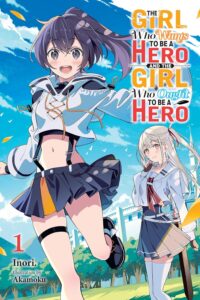
A girl in a school uniform that shows her abdomen, runs towards us smiling, small fangs visible in her mouth, her arms wide, and black hair blowing in a breeze. Behind her a girl in a similar, more conservative version of the same uniform with long silver hair, looks at the girl in the foreground.At the beginning of 2024, I reviewed inori.-sensei’s Yuusha ni Naritai Shoujo To, Yuusha Narubeki Kanojo (勇者になりたい少女と、勇者になるべき彼女). Of it, I said, “Everything I want in a Dengeki Bunko read – a “light” novel in the broadest sense. It’s small, quickly paced, not entirely predictable and ends just where you want it to.” Now it is my pleasure to review this same novel as The Girl Who Wants To Be A Hero And The Girl Who Ought To Be A Hero, by inori., illustrated by Akamoku and published by Yen Press under the YenOn imprint. 

Demon girl Ruchika has come to the Hero Institute in order to become stronger. Daughter of the world’s greatest hero, Leone has spent her entire life training to be a Hero. At the Institute they will face hardships in training, but also bullying by teachers and students…and a system that almost seems designed to destroy them.

This story is fast-paced. inori.-sensei includes a lot of familiar themes about society within the narrative. Systemic inequity is something we’ve seen in all her work, and this book takes a moment to make some very sharp points about both bias and societal inequity in ways that are very clear and cogent. Laws against marriage equality are addressed from the perspective that it is weird to limit who can be with whom…as it is, in truth.

Non-conformity and getting out from under the weight of expectations is the main plot driver, one that I welcomed. This is clearly stated by Ruchika, both to Leone and to us, that should and must are simply not as important as want to her, and she is strong enough as a character to carry it off right to the very end. There are a number of plot points that are left hanging in case we do see a Volume 2, as I hope we will. This would hardly be the first time countries outside Japan drove one of inori-sensei’s series, while a Japanese publisher dithered.

As I said in my original review, Akamoku’s art illustrates the scene, but as is so typical in light novels, everyone looks much younger than the ages we must assume based on the descriptions. I am pleased to see the scenes illustrated over the usual static pin-up.

Yen has done a nice job with this. The bonus book cover from Melonbooks has become a folded-out two-sided poster, a nice touch. Yen doesn’t list credits beyond author, illustrator and the very readable translation by Geneveive Hill-Kamanishi. It was an interesting not to me that she also went with Ruchika and Leone and with Hero Institute for her translation choices, as I had struggled with those for my initial review and also chosen Ruchika and Leone. ^_^

Ratings:

Art – 7
Story – 8
Characters – 9
Service – 0
Yuri – 9

Overall – 9

Overall, a fun read and with enough untied ends to offer an opportunity for a sequel, perhaps more. 


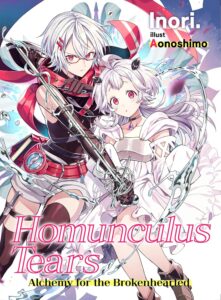
Homunculus Tears: Alchemy For the Brokenhearted

May 4th, 2025

Stories from the perspective of “other” are not uncommon – and especially so in the context of queer literature. Indeed, much of what we have read from inori.-sensei is from the perspective of “other.” In I’m In Love With The Villainess, Rae Taylor, isekaied into her favorite otome game, was not only not of that world, and a gay woman in love with an apparently straight woman, and a 21st century mind in a feudal society, as the story played out, we learned how she was in fact even more “other” than that. The sequel series and inori.-sense’s subsequent novel, The Girl Who Wants to Be a Hero and the Girl Who Ought to Be a Hero (EN release in June, reviewed here on Okazu in JP,) include the ultimate in-world “other,” introduced to us in the form of young women who are, in whole or part, demon.

In Homunculus Tears: Alchemy For the Brokenhearted, we are asked to contemplate the idea – what if there is only “other?”

In our world, including among the readership of Okazu and folks that hang out with me on a regular basis, I count few, if any, people whose lives are unconditionally privileged. I am happily surrounded by creative folks, queer folks, and women of many classes other than elite. We are all – inexplicably, as we are the majority – considered “other” in a society in which the presumed standard is, weirdly, a small minority. In Homunculus Tears, inori.-sensei presents us a world in which any possible not “other” person is invisible, some unseen (possibly non-existent) elite. Instead, we follow people whose lives are treated as “other” to the extent that an entire military exists for the purpose of being eventually eliminated.

We meet Maha, a woman brought into the world to fight, to die, by a soldier mother who values her who only for that fighting skill. The same mother creates another young woman, an alchelmical homunculus, Ruri, to be an even better fighter. They are trained by yet another outcast, a woman who can read minds, which allows her to, yet again, be a strong fighter. None of these people belong in the context of the society in which they live. The members of the society we do see are the poor, the orphans – the outcasts of a society at war. At no point in the story are we privy to the existence of anyone who is not “other.”

The story makes a point of this, too, so it’s not that we are to infer any of this. Maha is not alone as she ponders why she exists at all, why she was given life and why she continues to struggle. Ruri likewise, when faced with the voices of the “other” around her, struggles with the value of life. Why was I brought into this world? Why do I continue to live? are questions that many of us ask during the hardest times.

The answer here is that we are loved, even if it’s not what or how or by whom we expect. A community might be part of a world at war, but it is community, nonetheless. Throughout Homuncuus Tears, we are told this over and over. And may I remind you that, although the not-othered insist “other” is a problem, they are the weird minority, not you, not us. As “other” as we feel sometimes, we are the majority. If we can band together, the demons don’t stand a chance.

The use of the word “anti-natalism” in the author’s note has been commented on in discussions of this book online. Use of “-ism” usually indicates a belief system. In the context of anti-natalism, it would be a belief that procreation itself is unjustifiable. In this specific scenario, it is not a group or society, community or sect with this belief, not a generalized belief system that procreation is bad, but two individuals who question why they, personally, were brought into the world. However – and this is actually quite relevant to our world right now – the only children we meet in this story are war orphans. The question of “why would anyone want children, or desire them to live in our current society” is valid one. It is a valid one in 2025 on the planet earth, as well. Perhaps more people ought to ask that “why.”

The illustrations by Aonoshimo-sensei miss the chance to illustrate any of the excellent battle scenes, favoring pin-up poses and service. I am always disappointed when, rather than seeing Ney and Maha going head to head in a complicated battle of will and magic, I get to enjoy underwear. Again. This is light-novel tropiness that I would not mind losing. I did not feel that either a bath or beach scene added anything of value. I am ambivalent about the Yuri, as well. Both Maha and Ruri are brought into the world by the same woman, and Yuricest is never appealing to me. The loli jokes fall flat for me as well. Maha and Ruri as a couple is simply unconvincing.

What definitely did work for me was the alchemy. I’m fond of magical systems that are consistent within themselves. This alchemy and it’s trappings of tomes, vials, and attacks worked incredibly well. To that point, the character of Metako, (‘meta’-ko, which works really well across three languages) was the most interesting character to me. Her story, the way she worked and her functional relationship with Maha, were high points of the narrative. How Maha uses alchemy is presented as a kind of standard behavior, but in reality it was very cleverly handled throughout. Also solid is Kevin Ishizaka’s translation, which keeps the narrative running smoothly and provides excellent alchemical magic attacks.

Overall, this was a fast-paced light novel that delved into some tough questions about existence, but missed a few opportunities to be great.

Ratings:

Art – The art is excellent, it’s just of the wrong things
Story – 7
Characters – 8
Service – 4 It will never add anything to a story for me
Yuri –  As above, so below.

Overall – 7.5

As a self-published light novel, this book was poised for success. I hope this allows inori.-sensei some room to work her own way. And I look forward to her next original work.



Watashi no Oshi ha Akuyaku Reijou., Volume 9 (私の推しは悪役令嬢。)

February 6th, 2025

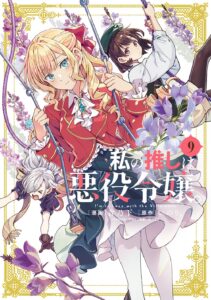
A girl with blonde curls in a red fantasy school uniform jacket and blue skirt and a dark-haired girl in a white blouse and dark slacks, swing on metal swings, surrounded by lavender irises. Watashi no Oshi ha Akuyaku Reijou., Volume 9 ( 私の推しは悪役令)。picks up in the middle of Cardinal Lily’s delusion that she has a chance to be someone in romantic relationship with Rae.

I know I am in a minority of one when I say that this Lily is my least favorite character in the story. And because she is the overwhelmingly most popular character in polls, this volume adds extra Lily and Rae shenanigans into the narrative. So we accompany Lily and Rae on what Lily thinks is a date and Rae thinks is just part of their investigation into corruption among the nobility. Rae teaches everyone about plea bargains and she, Lily and Claire work their way up the hierarchy. After confronting Prime Minister Salas, who is apparently unnecessarily rude to his daughter Lily, Claire is left to imagine the worst about her own father.

BUT, this is not really what this volume is about. This volume is about Rae dragging Lily to underground MMA bouts and a magical circus, where Lily saves a giant griffon, thus making a friend for life. It’s about goofy reactions and action scenes and running away from mayhem. In all of this, the volume excels. Aonoshimo’s art is absolutely fantastic enough to carry even the absurd plot line of “in the course of an investigation of corrupt nobles, while Rae is also tracking down the Resistance leaders, she and Cardinal Lily end up at a magical circus.”

Silly mayhem in the middle of an otherwise quite grim arc? Sure, why not. It breaks up interrogating boring corrupt nobles and Salas’ sneering.

The volume ends on an oddly personal conflict. Prince Rod has a proposal for Rae…that is to say, he asks her to marry him. Her reaction sets Rae and Claire at odds for the first time since before the Scales of Love. What will happen to them? Volume 10 is currently ongoing, with no release date, but I expect to see it soon.

I know I am asking a lot, but I would love for this manga series to extend past the Revolution arc into the Demons and Nur arc. Aonoshimo-sensei drawing Dorothea would be breathtaking. The idea gives me a(nother) reason to live. ^_^ So everyone run out and keep buying this series so we can meet Aleah and Mae and see the cooking contest and the Demon Queen and Dorothea. Please. Thank you. Volumes 1-7 of I’m In Love With The Villainess manga are available in English from Seven Seas.

Ratings:

Art – 9
Story – 8
Characters  – I really struggle with Lily
Service – A bit here and there?
Yuri – 11 Lily needs an off switch

Overall – 8

If you love inori.-sensei’s work, don’t forget her newest self-published book Homunculus’ Tears: Alchemy For The Broken-Hearted is available for digital pre-order with an April release, and Yen’s print and digital EN edition of  The Girl Who Wants to Be a Hero and the Girl Who Ought to Be a Hero, Vol. 1 is also available for pre-order with a June release date!


I’m in Love with the Villainess: She’s so Cheeky for a Commoner, Volume 3

December 2nd, 2024

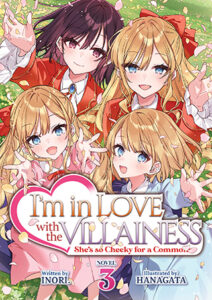
Two girls in red fantasy school uniform and two little girls, one in pink and one in blue look up as they hold their heads up and out to us.By the time we get to Volume 3 of the Villainess’ side of the story, is there even anything left to learn? Well, in I’m in Love with the Villainess: She’s so Cheeky for a Commoner, Volume 3, the answer is a resounding “Yes.”

This final volume of the series once again takes us through key points in the main story, from Claire’s perspective. Although we already know what Rae was planning – and why – watching Claire struggle against what she had to see as blunt force manipulation is both powerful and frustrating. In a sense, now we are able to understand Rae’s desperation fully. But, also, we are given much deeper insight into the person whois and who became Claire François.

We learn the full story of her youth, the loss of her mother and the ripples from that death that continue through and after the revolution. To fill the backstories with details we would not otherwise understand, we get the perspectives of Claire’s father, and mother, Pip and Loretta, Manaria, Lene, Misha and more.
The epilogue let’s us look both backwards…and forwards to see what becomes of some of our noble cast.

I have been a huge fan of this series from the first moment I read it, back in 2020. As a reverse-perspective, this spin-off series manages to provide a lot of insight and new information, a promise that reverse-perspectives often don’t live up to.

As I said, of my review of the JP volume (which wasn’t even a year ago…wow) if you enjoyed the main series, whether light novel, anime or manga, I highly recommend you read this iteration. It’s going to add a lot of new information to what has happened.  And may even move you to tears.

Ratings:

Art – 7
Story – 10 Outstanding writing, yet again
Characters – 10 I cannot express to you how *good* the characters are here
Service – 3? 4? A bit, sometimes
Yuri/LGBTQ+ – Why yes, actually.

Overall – 10

I’m sorry to leave this series behind and hope there will be a published sequel one day.