Archive for the Artists Category


Hayate x Blade Manga, Volume 6 (English)

June 28th, 2010

In most gag manga, the moments of seriousness are brief and are quickly broken up before they can build to anything threatening the general hilarity.

In dramatic manga, the moments of comedy are brief, breaking up the tension with a soft smile from time to time.

In most action manga, the emotions are brief, building up in a fireworks climax during a battle, driven by the need to win.

In most romantic manga, the action is brief, confined to bursts of energy in order to move the characters from one situation into another.

In Hayate x Blade, Volume 6, none of these are brief. We are sated on action, comedy, emotion and drama and by the end of the volume…we want more. Or, well, I want more!

First, there’s the climax of the A-Team’s nefarious plot to blackmail Hayate into leaving the school, culminating in a 80 vs 8 randori. Maid costumes, ladles, cheesy lines and Michi suddenly being awesome! And finally, the entire A-team slayed where they stand by the appearance of their belove Akira. In a maid costume.

Then, we start to get some insight into the relationship between Ayana and Yukari and even as we are told what we are told…we’re given some hints that nothing in this relationship is what it seems.

And finally, in the middle of a school festival that is full insanity, the Hoshitori bell rings and a very, very serious fight begins.

Speaking as a reader, this is one of my favorite volumes in any language. Artistically, Hayashiya-sensei’s art has really coalesced by now and you can practically feel the impact as sword hits sword.  As a copy editor, this volume was *brutal*. The editor and adapter had a lot of work to do – this is a volume full of really obscure references. But damn, what a volume!

Ratings:

Art – 8
Story – 9
Characters – 9
Yuri – 4 (Ayana x Yukari and Maki x Yukari for the win here)
Service – 4
Overall – 9

I can’t tell you at this point whether we’ll see a Volume 7, but I know that I, at least, hope and pray that we will. If there was ever a fight that we deserve to see the end of, it’s this one.


CANAAN Light Novel, Volume 1 (上)

June 17th, 2010

If you have watched the Canaan anime, you have read the Canaan Light Novel.

The Light Novel is very much a novelization of the anime series, written by a competent writer and enhanced with pleasing pencil art illustrations.

The LN series is in two parts. This first volume is, like the anime it shadows, a nice mix of exposition interspersed with action. We meet young photojournalist Ohzawa Maria and her mentor Mino, see a lot of Shanghai both above ground and below. We learn about the UA Virus,  and a bioterrorism threat by the terrorist group the Snakes, just as Shanghai hosts an International Conference on Terrorism. And we meet Canaan and Alphard, our foils that are the same in every way, except that they are not the same at all.

If you have not watched the anime, you will find no difficulty following the story – it is well told and well-executed. There is a lot of moral ambiguity – governments are terrorists, just as much as the terrorists are and the only truly innocent in the book is the title character, the assassin Canaan. Her synesthesia was one of the most visually striking qualities of the anime – I wasn’t sure it would translate well into text. I’m pleased to note that the author is competent enough to communicate it well. It works.

As I sat down to synopsize the plot, I find that it’s actually too complex for me to do it simply without losing much of its appeal. On the other hand, if you haven’t watched the anime and don’t really care about Canaan a priori, I’m also not sure I could convince you to pick this book up without it.

So I’ll do what I always do and focus on the Yuri. ^_^

Maria and Canaan’s relationship is a difficult one to nail down simply. They love each other – so much so and so obviously so that crazy villianess Liang Qi comments on it. But, then, Liang Qi herself is obsessed with the love of Alphard, the apparent villain of the series. And Alphard is obsessed to the point of monomania with Canaan, someone who she believes stole everything she had, even her name. (I’m still not convinced she’s entirely wrong.)

Canaan is, as I said, an innocent. She absolutely, unreservedly loves Maria and there’s a sense that, were she actually aware of things like “love” in the adult sense, she might actually be “in love” with Maria. But…she is not. Her love is like a child’s, or a puppy’s. Not because she is stupid or childish, but because Canaan does not yet know desire – and there’s no real way to know if she ever will at this point.

Maria’s love for Canaan is less perfect/more human, but is also, at the beginning at least, more admiration. She sees Canaan as something unearthly, like a superheroine. Yes, they are friends, but until she sees what she considers to be a flaw in Canaan, Maria is unable to regard her as an actual human. She is very much a Lois Lane to Canaan’s Superman and ultimately, Maria’s desire to bring them both onto an equal footing is what will drive the plot in the second volume – and change them both forever.

I was very, very vexed with the anime for bringing both of them right up to the moment of recognizing that they love each other, then providing what I saw as a rather lame excuse for “not that way, though.” As the novel has been, so far, an exact duplicate of the anime, I expect no less in the second volume. But, for the moment, Maria and Canaan yearn for each other more as the series puts them through increasingly dangerous situations.

This novel ends with the Snakes’ takeover of the Terrorism conference and Alphard’s plan to infect all of the world representatives with the UA Virus. The final scene in the book is Alphard fighting Canaan in the tunnels below the building.

So, basically, if you liked the Canaan anime and want to re-experience it through a text format, this is a good, compelling action story. If you like action flicks, and want to practice your Japanese reading skills, this book is an excellent choice – it has a fair amount of furigana and even the technical/scientific stuff is not impossible to understand.

I think this novel would have a chance to sell reasonably well, were it to be brought over here in English, as long as the translation was competent. (I don’t know if Seven Seas has a Kadokawa contact, but this would not be a bad match for them. A little Yuri, high gaming interest on account of it being Type-Moon, moe, action. I think they could make it work, since they have decent translators and adapters.)

Ratings:

Art – 8 (the pencil art mitigates what is otherwise typical moe)
Story – 8
Characters – 8
Yuri – ??? You could pretty much put any number on it, from 0 to 10 and be right. Let’s split it down the middle and say 5
Service – 4, but like 85% of that is Liang Qi

Overall – 8

It’s a good read and I’m glad I took a chance on it. Nice mix of character and plot, action and emotion, comedy and tragedy. Kind of the best of all possible worlds for a Light Novel and one of the best of breed I’ve seen in a blatant franchise extender.


Yuri Manga: Kimi Koi Limit

June 7th, 2010

Kimi Koi Limit is one of the Yuri Hime cell-phone manga releases by Ichijinsha. Drawn and written by Momono Moto, it tells the story of Sono, one of the most selfish cretins to ever inhabit a manga.

We start the manga with a scene late in Sono’s high school life when she confesses her feelings to, and is rejected by Satomi, who is leaving after graduation to go to school in Tokyo.

Time flies and we see Sono, now also in Tokyo, with a lover Hiroko. Sono contributes nothing at all to the household – she’s a slob, a slacker and a jerk. Hiroko can tolerate all that but when, not for the first time, Sono says someone else’s name as they make love, Hiroko has had it – she throws Sono out.

Sono quickly becomes homeless, because she’s a slacker. And in a crazy, unbelievable, but nevertheless predictable, handwave she is found and rescued by none other than Satomi.

To her credit, Sono moves into Satomi’s life as if she has been given a chance to find happiness by the gods. She starts to clean, cook, she even gets a job at which she perseveres. She knows she can’t stay with Satomi forever, but she can at least get herself straightened out to be worthy of her. She still lusts after Satomi and this proximity isn’t lessening that one bit.

In yet another unbelievable yet predictable handwave, not only do Hiroko and Satomi attend the same university, they work together at the same library on the same shift. In a casual conversation about Hiroko looking unhappy, Hiroko spills that she just threw her lover out and is worried that she is homeless. Satomi mentions why, how odd, she just found a friend who had been homeless, thrown out by her lover! But it’s not until Satomi *sees* a picture of Hiroko and Sono toghether that they put it all together. Hiroko’s feckless lover and Satomi’s roommate are both Sono! zOMG!

Before I go on, I have to say that, at this point, I absolutely loathed all three of them. There was no ending that was going to make me happy, unless it ended with Sono going the hell away. And what were the chances of that?

Through a series of even more handwaves, uncomfortable situations and cliches, Sono leaves Hiroko for Satomi who decides inexplicably that she’s suddenly in love with her. Honestly, getting Sono out of her life was probably the best thing for Hiroko.

In the end, we’re to believe that because she attained her dream, suddenly Sono found ambition, skills, a career, etc. We see her in typical careerwoman get-up, while Satomi plays the role of wife. And they live happily ever after.

Bleah….

While this manga is nicely drawn, extremely well-toned and really, really well-executed as compared with, say, Gokujou Drops, Kimi Koi Limit had so many things I had to just accept, so little plausibility, that *my* Koi Limit was stretched. And on top of that, Sono was just an unlikable little prat. If Sono had been a good lover to Hiroko, a kind friend to Satomi, I might have been able to hack it. But she wasn’t. She was a selfish, narcissistic jerk right to the very end.

Ratings:

Art – 8
Story – 6
Characters – 4
Yuri/Lesbian – 10
Service – 4

Overall – 5

This is probably the best-looking of the YH cell-phone manga. I just wish I liked the story a bit more than I do.

And, in the way of such things – I have an extra copy to give away! Yes, you too can be annoyed by Sono and her inability to appreciate what she has.

To enter you must be 18 and this time, I’m keeping it domestic – contiguous 48 states only. Not because I don’t love you overseas folks, I just want to cut back on shipping.

So – if you are from the US (not Alaska or Hawaii) and would like a copy of this beautiful, but emotionally unsatisfying manga, please tell me in the comments where *you* draw the line. Keep the comments non-pornographic please. I’m not asking for your least fave sex position, I just want to know what behavior stretches your love to breaking point.


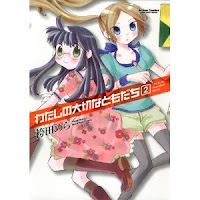
Watashi no Taisetsuna Tomodachi Manga, Volume 2

June 3rd, 2010

In Volume 1 of Watashi no Taisetsuna Tomodachi (わたしの大切なともだち), we met Ebisawa Shouko (Ebi-chan), a geek girl who failed to get into a university and is taking courses at a design trade school in the meantime. We also met Tachibana, a former childhood friend of Ebi-chan’s, who has lost her memory – right down to words and concepts. What’s left, Ebi-chan learns, is a ridiculous superhuman strength and a unending hunger. In Volume 2, we also learn that Tachibana has some lingering memories of her and Ebi-chan’s time together. But, not right away.

First we must deal with the possible professional success of a classmate, wherein we learn that success – and a professional career doing what you enjoy – is a double-edge sword. And we must weather the trauma caused by an apparent meeting with a precocious and vicious child, who turns out to be a new teacher and a popular manga artist. All of the tension built up in these stories explodes when Ebisawa quite accidentally plagiarizes the teacher’s work, to her utter mortification.

Ebi-chan undergoes a significant crisis of identity, finally confronting the low self-esteem we’ve seen from the start. To Ebi-chan’s surprise both her “rival” and Tachibana step up to help her out of her funk. Even more surprising, when Tachibana’s cool friends from high school drop by and beg her to join them at college, Tachibana blows them off, because she remembers a promise she and Ebi-chan made when they were young. Surprised to realize that she has more friends than she realized, and deeply moved by Tachibana’s rare smile, Ebi-chan redeems herself beautifully.

This volume was sort of problematic. The set-up of the story had to take a back seat to the work needed to fix the holes in it, before it could actually work.

Ebi-chan’s little lie – that she and Tachibana were best friends – wasn’t ever a huge issue; it was made huge by the gap between Tachibana’s apparent status as a “cool” girl and Ebi-chan’s low self esteem. Ebi-chan’s worry that Tachibana would remember everything and castigate her was also only significant because she had such a poor image of herself.

But the Tachibana we see is straightforward, a little loopy and obsessed with food. The kind of person who we can see being best friends with in kindergarten, and going out to karaoke with. It’s hard to imagine that she would be outright mean. When her cool friends come by, we can see that she was kind of fun and goofy with them too, so other than her memory loss, we can assume that she hasn’t changed all *that* much.

Ebi-san’s feelings for Tachibana are confused, because they are tied up with her own feelings of inadequacy. And that inadequacy complicates her studies, as well. Frankly, if we didn’t get that cleared up, this manga would remain a series of pretty thin gags. Now that it’s all behind us, and we already know that some of Tachibana’s memories have returned, hopefully we can move on with the story. Yes, we’ve had to give up the original premise, but it was already getting thin after a volume. So, plotwise, this was a good move. Unfortunately, story-wise it was pretty much a bore. I found it really hard to care about someone else’s issues in the middle of Ebi-chan’s crisis du page, and was not amused at the overused “apparent child who is really an adult” gambit.

Nonetheless, we are past what was a pretty big hump and have received Tachibana’s benediction in the form of a smile. So, hopefully volume 3 will be better than this one.

Ratings:

Art – 6
Characters – 6, but there’s hope for better
Story – 6
Yuri – 1
Service – 0

Overall – 6

On the whole, I’m finding Hakamada Mera’s current Yuri Hime and Yuri Hime S stories more enjoyable at the moment, but I’m fascinated by the shift in her story-telling from throwaway shorts to trying to tell something that has some staying power.


Canaan Radio CD and Aoi Hana Sweet Blue Radio CD

May 29th, 2010

I’m still making my way through the last of the items I bought while in Tokyo. Not surprisingly, the Light Novels take the longest. And since I’m now working from home, I no longer have a commute during which to listen to my Drama CDs. (I know, I know, poor me….) Today I happened to be driving down the office, so I had a chance to listen to the Aoi Hana: Sweet Blue Radio CD. It has very little Yuri. I had listened to the first Canaan DJCD a while back, but as it also has only the vaguest hint of Yuri, I decided to not review it.

Well, while it’s true that both of them have very little Yuri, they both have something much more important in common – the content is primarily the voice actors and actresses screwing around and cracking themselves up. I figure that’s worth mentioning.

To start with, the Canaan Drama Cd was backwards. That is, although Maria and YunYun are on the cover, the content actually features Tanaka Rie (Liang Qi) and Ohkawa Toru (Cummings.) The two of them really don’t need us during this CD, because they are perfectly capable of amusing themselves without us. There were times during the conversations where they had themselves laughing so hard I couldn’t for the life of me understand a word.

They also both slip in and out of their roles freely so, when Ohkawa-san makes a bad joke, Qiang Li suddenly threatens him with punishment. I recall (it was a few months ago that I listened to it) that there were at least a few scenarios in which Tanaka-san, as Qiang Li, moaned with desire over Alphard. That was pretty much what Yuri there was.

Likewise, in Sweet Blue Radio, Gibu Yuuko (nicknamed “Gibuling”) and Takabe Ai (“Rabuling”) really didn’t need us so much. :-) The bulk of the radio CD was the two of them doing their best impressions of other kinds of voice jobs – AM and FM radio announcers, the person in a department store that calls for lost people, the women on all those ubiquitous food shows who ooh and ah over mundane items like the sandwich she gushes over. Of these scenarios, the one in which Takabe-san does her impression of an AM radio DJ actually made Gibu-san snort out loud. That was worth hearing.

Also amusing was the next to last track in which Okudaira Akira was a special guest and when she “leaves” the studio and “forgets’ her handkerchief, Gibu-san “runs after her” and “misses” guest Manjoume Fumi when she comes to visit the studio. It was idiotic, but they were having fun with it.

In this CD, there is a ‘memory’ of Fumi telling Akira that she likes her and Akira responding that she didn’t mind, no…she was happy about it. That’s about it. But it was a sweet moment.

Both CDs are more silly than special. If you love the series and/or the voice actors and actresses, its worth it for the giggling, the puns, the utter goofiness when people who get along screw around in front of the mic.

Ratings:

Canaan DJCD – 7

Sweet Blue Radio CD – 8