
Archive for the Artists Category


Yuri Anime: El Cazador, End of Season Review

October 24th, 2007

Reviews are going to be very anime-heavy for the next few weeks, as I have a huge backlog of anime that I haven’t had time to watch, while I’m busy watching new stuff that I will review eventually.

But today I wanted to do a long-overdue review of a series from the Spring season. I had watched it raw but, I wanted to refresh my memory on what happened before I reviewed it. I happily watched it all over again, and am now ready to go on the End of Season review for El Cazador de la Bruja. ^_^

You might want to read my initial review of El Cazador to compare and contrast (and also to see how, ironically, that review began in almost the exact same way that this one did. And I can assure you that it was not at *all* on purpose! I didn’t remember that I had written that until I just read it now.) Okay, so I just re-read it and, I have pretty much nothing to add, except, I think Bee Train came through for us Yuri fans on this pretty darn well.

There is a contingent of people who liked Noir best and therefore did not like El Cazador because it was too fluffy, too silly, not serious enough, not angsty enough. And there probably is a group of people who liked Madlax better, although I haven’t encountered any, yet. I just assume that there’s always someone who has a different opinion *somewhere.*

But I can’t say I liked any of them better than any of the others. They were three different takes on a theme – girls with guns on the run. I commented in my original review that El Cazador almost seemed a parody of itself and you know, I think that that was exactly what they were going for here. It’s much goofier than any of the previous Bee Train series. In-jokes abound, even within the context of the story. Tacos will never look the same to any of us again. :-) And the opening and closing theme animation had just about nothing at all to do with the story, which was nice and pointless. No guy in a mask, no sniper cat. Thank goodness. LOL

Ai Shimizu was fantastic as Ellis. Without ever once sounding less flaky or ethereal, she managed to mature her character in such a subtle, magnificent way that it almost came as an afterthought. Itou Shizuka was great as Nadie, remaining pretty clueless and not-subtle from beginning to end. :-) I found them quite charming and am glad to tell my past self that yes, I came to care about them, as I hoped I might.

Their relationship was total win for me. In the beginning, the idea of the two of them as a couple squicked me out the door. There was no one moment where it changed and became something else – it was a slow process. It was, in fact, the point of all that stuff that other people saw as fluff episodes – they were there entirely to allow the characters to develop a relationship naturally, leisurely. And it wasn’t an even process either. Ellis comes to like Nadie, later Nadie starts to care about Ellis as more than a job. Ellis starts to fall in love, Nadie starts to realize that Ellis mean more than just friend to her. And on and on. Ellis, surprisingly, becomes the seme, the agressor, here; making her case for them as a couple long before Nadie clues in. And it is Ellis who declares her love first, and last. She shoots straight from the hip, too, no implication or ambiguity.

None of the larger plot is particularly shocking or revelatory. The conspiracy is never developed as well as it might be – where in Noir we spend episode after episode poring over Soldats, in El Cazador we spend more time with the people who represent the witches and Project Leviathan, than with the details of the organizations themselves. Which is perfectly fine with me. Rosenberg, the bad guy, is loathsome and his death was way too late in the series. And he treated poor Melissa terribly, something I’m not prepared to forgive, since she was so nice. LA, this series’ crazy stalker character, was loathsome AND annoying and his death was also way too late in the series. But I will forever think of him in conjunction with Ellis setting his crotch on fire, so that sort of evens things out.

Jody “Blue Eyes” Heyward was awesomeness and not *just* cause she was voiced by Hisakawa Aya, who for once wasn’t the creepy stalker character. She was sort of a “good” stalker this time. lol Mitsuishi Kotono, who seems to be working more often these days, which makes me happy, was wonderful as the chief witch, even if she never got a name or a story. Echo and the Bunnymen were never explained, nor were Jody’s henchwomen. But that’s okay. Soldats and Enfant never really made any sense, either. :-) Just go with it.

Ricardo and Lilio. I’m still not at all sure what their roles were – acting as foils, I suppose. The four of them were a kind of oddly functional alternative family for a while there. Or would have been if Nadie had had a clue about Ellis’ feelings for her. Which she didn’t, yet.

And then there was the epilogue. It was pretty much as I expected, in fact, as I would have demanded, with two exceptions – the motivation for the confrontation that would catapult Ellis and Nadie back into their real personas was much stupider than I expected, so that was pretty funny.

In the end, as Ellis once again makes her declaration of love – with an audience this time – there is a HUGELY wooja-wooja beat-you-over-the-head love song playing in the background that is a *strong* indication that this is not meant to be seen as ambiguous or plausibly deniable. The fact that the last line of the song is “My immortal love” helps with that. And so does Pedro’s reaction. (Don’t worry if you don’t know who Pedro is – he’s there to be defeated by Ellis’ love. That’s all you need to know.)

Oh, wait – three exceptions. Jody’s ingenuous comment about her assistant being identical to Rosenberg by chance….yeah, sure. It was a off-beat note that I liked *because it has no explanation.* It just is. Go with it.

So, no, its not Noir with its intense film Noir-ness. And no, its not Madlax with its alternate existences and war-torn world. In the end, it is simply El Cazador, with Nadie and Ellis on the road. And for that, I liked it bunches.

Ratings:

Art – 6 Not good, no. But not “AAAHHH!” either
Story – 7 Sure it had huge holes. Who cares.
Characters – 9 They just grew on me
Yuri – 7 If you weren’t grinning at the end, love song and all, you fail.
Service – 5 – Almost as an afterthought – oh, yeah, we could do an ass shot here…

Overall – 8

Tacos, tacos tacos, oi-ishi-i tacosu. Iketeru tacos ha oi-i-shi ta-co-su. Tee Hee.
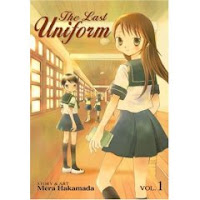


Yuri Manga: The Last Uniform, Volume 1 (English)

August 13th, 2007

My sincere thanks to the folks at Seven Seas for providing me a copy of The Last Uniform for today’s review. Your generosity is sincerely and greatly appreciated!

As you may know, if you have been reading my reviews of the Yuri Hime magazines for the past few months, I do not like Hakamada Mera’s art. And the recent entries by Hakamada in those magazines have outright repulsed me. Nonetheless, I am going to say that The Last Uniform is, in every other way other than the art, an enjoyable manga. (My original review of Saigo no Seifuku says pretty much the same thing – if the art was better and the characters looked their age, I most likely would love this manga. But they don’t. So I don’t.)

The manga takes place at the ubiquitous girl’s school in one of the dorms, where the rule is that everyone must share a room. There can be no single-person rooms. So, when a new student transfers in, she is placed with roommates Ai and Fuuko. Ai is exceptionally upset about this – more than she can even deal with. By the time she realizes why, so has her new roommate, who goes out of her way to stay out of their way and even encourages Ai.

In addition to Ai and Fuuko, an older pair of students, Tsumugi and Beniko, are also involved in a gavotte around their feelings for one another. Their relationship is complicated by an upperclassman who openly courts Beniko, but to no avail.

These two relationships are the main focus of the manga, with some side stories and a key flashback.

The plot, such as it is, revolves around normal school life, with the trials and tribulations twisted only slightly to reflect the student’s feelings for one another. There are some kisses, but no outright confessions in this volume. By the end of Volume 1 the couples are neither together, nor are they apart. It’s a story of beginning more than endings though, so the reader can remain hopeful that things might progress.

As with all of the Seven Seas books I’ve reviewed so far, the translation and adaptation are nearly seamless, which makes for a pleasant and smooth read. If only the art wasn’t so darn unappealing…oh well. (And remember that this is *my* opinion. You might not be bothered by it as much as I am. I am bothered by it a great deal. I don’t like the oversize, misshapen heads and the little-girl bodies.)

Of all of the so-far released books in 7S’s Yuri imprint, remembering that Kashimashi is NOT part of their Strawberry line, Last Uniform is pretty much the only one with actual Yuri. The others have “Yuri-service,” where the two female protagonists are shown in a variety of posed positions in still art or screencaps as if they are potentially lovers, but there’s no actual emotional connection. Like the Newtype effect, many people cannot discern the difference between two women in love with one another or two women who are merely posed to look as if they desire one another. (Thinking about it, this explains the popularity of lesbian porn for men – the viewers can’t differentiate/don’t care about the fact that they are just two women being paid to have sex on one another. But I digress.)

In any case, the strength of this book is the characters’ feelings for one another, which reads pretty convincingly and not at all unpleasantly.

Ratings:

Art – 3
Story – 5 (nothing new or earth-shaking, but nothing taxing or horrible)
Characters – 8
Yuri – 8
Service – 1 (but only on the basis that someone, somewhere will always get off on something, as the author clearly does on school uniforms.)

Overall – 6

As the only manga with actual Yuri in the Strawberry imprint, I think it does a fair job. I’ll never sing paeans of praise to this series, but you could do worse….


Yuri Manga: Claudine

July 30th, 2007

In the late 1960’s, women began entering the manga industry in Japan with a vengeance. Until then manga – even manga for girls – was drawn by men. The women best known for making a splash in the manga market are known collectively as the Magnificent 49ers, because they were all born in the year 1949. The 49ers made a huge impact, and they are frequently credited with the creation of shoujo manga, that is, comics by women for girls.

In the early 1970’s many women experimented within this new genre – it is at this time that the first manga that would later be seen as the origins of today’s Boy’s Love (Tomas no Shinzou) and Yuri (Shiroi Heya no Futari) were drawn. Following these were many manga in which gender roles, crossdressing and same-sex love were dealt with. We now look at many of these stories as early examples of the Yuri genre.

Ikeda Riyoko, the author of two of those manga, Oniisama E and Rose of Versailles, was clearly fascinated with gender. In both of the above there is a main character who is a woman, but dresses and acts like a man. In both cases this character is seen as physically attractive to the women around her. Both Sainte-Juste and Oscar have tragic endings, but both die free from regret and in love – Oscar with her long time friend and lover Andre’ and Rei, known as Sainte-Juste, with the young girl Nanako, who had freed her from the bonds of an abusive relationship with her half-sister.

Ikeda wrote another series dealing with a women who dresses like a man, Claudine. It is quite possible to call this a manga about a transgender character, as much as it is a Yuri manga. There’s no way to know whether Claudine’s desire was to be able to love women freely and dress in the clothes of and have the prerogatives of a man – like many butch women of her time – or whether she truly wanted to become a man. Either way, this classic Yuri manga is a pretty amazing, but painful, character piece.

The manga begins as a doctor of psychiatry discusses the case of Claudine, a patient of his for many years. She was brought to him as a young child, when her proclivities for dressing and acting like a boy were already well established. The doctor is very sympathetic – he never really tries to “fix” her, instead providing her with a non-judgmental ear for her to vent to.

Claudine’s first love is a servant, Maya, who returns her love unconditionally. But they are discovered and Maya is sent away, leaving Claudine to begin to loathe herself and her attraction to women. As a young woman, Claudine heads to the city where she once again falls in love with a woman and is once again betrayed – this time by the girl herself. Claudine, who comes from a family of power and wealth longs only for love. But she will not find it and in the end, she can only see one way out. The doctor learns of her suicide on the phone and mourns the passing of the tormented girl.

It’s a very Well of Loneliness type story, in which the “moral” of the story appears to be that women who love women will die horrible deaths. An ending that was stock in the world of lesbian romance until … erm … okay, it’s still pretty stock. But for any women who were loving women in the middle of the sexual revolution of the 70’s, reading Claudine must have come as a “whoo-hoo!” moment. Think about it – what’s the one thing everyone wants from the universe? Everyone wants to see themselves reflected in some form of media. Whether it be TV, movies, song, manga, what have you – the one thing we all want is to see some sign that we *exist.* That’s why gays and lesbians trawl through media pointing out even the “are they or aren’t they?” characters. Because the more examples of our selves we can find, the more validated we feel.

And in the 70’s, in the middle of a burgeoning wave of manga for girls, to those women who had loved or did love another woman, something like Claudine would be a life-line of external validation.

No, it didn’t have a happy ending – manga rarely had happy endings in the 1970’s, regardless of the romance. Or at all until the 90’s really. And even now, the majority of anime and manga favor ambiguity and resets over actual happy endings with resolutions. (There’s all sorts of cultural reasons for this that I won’t get into here. Ask me about them some day when we meet.) The bottom line is, Claudine probably made a bunch of early otaku lesbian and transgender (or those who wished they could transition) folks very excited.

So, whether you perceive Claudine as a lesbian narrative or a transgender one, it’s a pretty significant manga. Personally, I like it. Like Well, with which it has so much in common, it holds a special place in my heart.

Ratings

Art – 8
Story – 6
Characters – 6
Yuri – 8
Service – 2

Overall – 7

I like to think that, when young Satou Sei was combing literature for reflections of her own feelings and she came across Well, she might have also come across Claudine and, like myself, rejected the tragedy, even as she acknowledged its place in her personal history…. Us Comp. Lit. majors must stick together after all. ^_^


Yuri Manga: Iono-sama Fanatics (English)

May 25th, 2007

Today’s review was brought to you by Infinity Studios, the publisher of the English-language adaptation of Iono-sama Fanatics.

I reviewed this book originally on November 11, 2005. For a discussion of the plot and characters, please read my original review. For today’s review I am going to focus solely on the adaptation to English.

Unusually for me, I’d like to start with some of the good things. I am exceptionally pleased with the general level of reproduction (although my review copy was a PDF and not an actual book, so I can’t tell you how it will look on paper.) Color pages have been retained, which pleases me no end. The notes for the story are mostly very decent. I particularly liked the glosses on the notes about the characters and the roles from Mito Koumon upon which they they were loosely based. That worked for me and I felt that the translators were doing a decent job of keeping us readers included in the in-jokes within the book.

On the other hand…other than the “-sama” for “Iono-sama” they left out honorifics (and we all know how I feel about that.) If you could leave in one honorific, I am at a loss as to why you wouldn’t just leave in the others? The names of the characters are transliterated, which works fine for me (except that Aruje will inevitably be pronounced ah-rooj instead of ar-gee, but oh well…) and I admited a certain amount of uncertainty about some of the names myself when I reviewed it originally. But…Frechet (name transliteration taken from the 2007 Fujieda Miyabi Calendar I got at Comike, so the author’s own choice) is transliterated to “Fletch.” That’s just…I dunno…yucky. Frechet-san just seems tons cooler than Ms. Fletch, doesn’t it?

2015 Update: I was wrong here, but so was Infinity, IMHO. Flèche is her name, and while “Fletch” is the English translation…we don’t usually translate names. Argent was not “Silver.” And we’re past that Victorian “Princess Jade Perfume” bullshittery.

In general, the translation is decent, but the one or two times it isn’t, it’s horribly, disturbingly jarring. The first time it is not the translator’s fault.

There is a scene, late in the book, when Frechet (yes, I am going to continue to use the author’s version of the name) and Arata are making googly eyes at one another – obviously enough that everyone else can see it. Iono-sama jarringly asks if they are on the “L Word” together. I took a look back at the original Japanese and honestly, that particular passage would have been a bear to translate without being, well, crude. The points I take away for mentioning a current (and copyrighted…what’s the chances that they got permission?) TV show I give back because the actual sentence…ugh.

The second horribly egregious translation will not go unnoticed, however. Inexplicably, in the author’s note comic in the back of the book, where the word “moe” was used, it was left untranslated, but the word “Yuri” was translated – as “girl on girl.” Thank you, Infinity, for rendering the genre I live and love into a porn term. I wrote them and let them know that it offended.

It’s always nice to *politely* let companies know that the word “Yuri” can remain untranslated as well as “moe” can or, if they insist on translating it, to please use something less connotative of a porn movie, perhaps something like “lesbian stories” or “girls in love”.

Begin digression/

And while we’re on the topic, let ADV Films know that it annoys you when THEY did that very same thing in Best Student Council, Volume 1. You can reach them here: http://www.advfilms.com/FILMScontact.asp

I encourage you all to explain – politely, please – that Yuri fandom is well established enough that there’s no need to be so crude.

I have already contacted both companies, of course, and asked folks on the Yuricon Mailing List to do so as well. ADV sent me an apology for having offended and said that they’d send my message along to the translators.

In both cases I have no doubt that they did not *mean* to offend, but seriously – Yuri fans are the main audience for Iono-sama. It was, as Fujieda says in his comic, originally created as a Yuri story. (Not surprising, as he does quite a lot of Yuri – click his name in the category sidebar to see some of the others. A fact that, apparently, most other reviewers somehow missed.) I just feel that the companies would never have translated “Yaoi” as “gayboy sex” or “gay porn” and realistically, “girl on girl” is a porn term, not a reasonable way to describe Yuri.

\End digression.

One last bad thing about the translated Iono-sama is that there was a rather large typo on one of the character bios. Not a book killer, but I was kind of surprised it got past the editors, since it was really obvious. And yes, I emailed them about that, as well.

So. What do I think of the English adaptation of Iono-sama? I think it’s a nice attempt, but it falls flat in some key places. I would still recommend the book to Yuri fans, because the characters and story shine through the roughness of the adaptation on their sheer force of wonderfulness. ^_^

Ratings:

Art – 8
Story – 8
Characters – 9
Yuri – 10
Sevirce – 2 (it is, indeed, moe))
English Adaptation – 6 (without the Yuri issue, it would have definitely been higher.)

Overall – 9

Dear English manga companies – Yuri fans really don’t like being condescended to. Please treat us with respect. This may mean that you have to police the FanBoyness of your own staff. “Yuri” means lesbian images and narratives – not just girl on girl action (which if it were a porn anime, would be completely understandable!) We’re not prudes, we’re just certain that Yuri is more than hot lesbo sex. Thanks, Erica

For a Yuri manga that treats Yuri fans with respect, try one of our 100% Yuri manga from ALC Publishing! All honorifics intact and no insults to your intelligence! Yuri Monogatari 4, 5 and 6 – on sale now!


Yuri Manga: Hayate x Blade, Volume 6

April 23rd, 2007

What do you get when you cross independent, strong female characters who tend towards violence and are more than a little cracked, a school festival, maid costumes, a kidnapped kindergartner, 80 eyeglass-wearing fangirls and a whole lot of sword fighting? Why, you get Hayate x Blade, Volume 6.

We left off in Volume 5 at the start of Tenchi Gakuen’s school festival. And right away, something is wrong. One of the kids visiting from Hayate’s orphanage has gone missing – Miki, the very same one we saw in trouble in the very first chapter. Hayate’s frantic rush to find Miki gets completely sidetracked when a ransom note informs her that the child is not lost – she was kidnapped! (Every scene we see from this point on of Miki, involves her stuffing her face with candy and demanding to be spoiled or she’ll make a scene. We’re never worried about her.) The ransom note demands Hayate show up on the north field, where she is confronted by the Mikado Akira Fan Club, who call themselves the A-team. To “protect” their beloved Akira-sama, they demand that Hayate leave the school, or they will be forced to hurt Miki.

But Hayate is not alone for long – first Ayana, then the Kiji-Michi and Momoka-Isuzu teams come running up (complete with Momo-chan and Kiji arguing about which one of them gets to stand in a high spot and declaim “wait right there!”)

The six are soon joined by two more, as Suzuki, haunting Ayana’s steps as always, joins the group with her partner Sou. And, all of a sudden, the 80 bespectacled fans of Student Council member Mikado Akira suddenly realize that they are horribly outnumbered by the 8 that face them.

It is one of the school rules that fighting cannot take place except when the bell rings – otherwise disgruntled kentousei would be fighting constantly. So, Hitsugi and Shizuku go running over to the north field to make sure that the fight is not held illegally. Hitsugi, being Hitsugi, decides that, rather than stopping the fight which would be dull, she’ll rearrange things a bit to her liking. The A-Team are given wooden practice swords to fight with – and Hayate and her friends, who are mostly in maid costumes (except for Hayate who is dressed as a chick and Momoka who is dressed as a cartoon wolf) get ladles as their weapons. Hitsugi tells them that if even *one* of them gets their star taken, the entire team loses. Or they have to defeat all 80 of the A-team. Before the bout is over, Hitsugi makes sure that Jun gets a bit of the spotlight, by pointing out that the battle is being projected over the whole school. Jun, who had been content to watch up to that point, jumps into the fray.

It’s no contest.

When Akira herself shows up to take on the last of her fan club, they merely collapse in exhaustion. But not before Akira pulls off her studly Student Council long overcoat to reveal…a maid costume. She’s pretty pissed at the point loss on cool.

Following this melee, the second day of the festival begins quietly. Hayate, Jun and Ayana have a frank, but no less violent than usual, conversation about Ayana’s feelings for her ex partner, Yukari. And over on Yukari’s side, she’s wondering why her current partner, Maki, chose her in the first place. Maki’s own thoughts on the subject are rather sweet – she wants Yukari to look at her the way she used to at Ayana. And we see happier moments from before Yukari and Ayana broke up.

Maki and Yukari face an incredibly difficult match. The gong will sound today, and in the enclosure for A-rank fighters, they will be taking on the formidable “Special A’ ranked pair – En Suu and Mei. This is a particularly poignant bout for Yukari – it was this pair that she and Ayana were fighting when she was wounded and scarred.

Back at Ayana’s class’s cafe, Ayana is asked to leave when her reminiscences about that past battle gives off an evil aura that is scaring away the customers. Ayana thinks that she and En Suu share a darkness within them – and that darkness scares her. When she hears the bell, Ayana, then Hayate and the others go running off the to “A” enclosure, but are stopped at the gate by Sae, Akira’s partner.

Inside the enclosure, the battle is fierce. Techniques are fast, and advanced. Maki is hurt in her right arm, while Yukari is pinned to the ground by a ruthless Mei. After a moment, Yukari and Maki both find something important in themselves – and in their relationship – and stand up to fight again.

Who will win…?

You’ll have to tune in next volume! (Uunless you read the monthly chapters, like I do, because I can’t go that long without an episode of this manga. )

Action, love, friendship, violence, deep emotion, incredibly dumb physical gags. Hayate x Blade is the *best* manga on the market and it’s criminal that it’s not an anime yet.

Ratings:

Art – 8
Story – 9
Characters – 9
Yuri – 5 (Ayana x Yukari for the win here)
Service – 4
Overall – 9

No, really, I don’t think it gets better than this.