Archive for the Artists Category


Yoshiya Nobuko 130th Anniversary Exhibit at the Kanagawa Museum of Modern Literature

June 28th, 2026

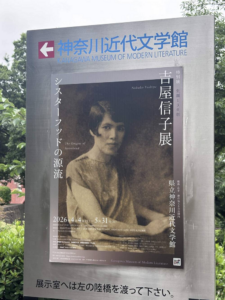
Poster of Yoshiya Nobuko exhibit at the Kanagawa Museum of Literature. Seated Yoshiya in a dressy blouse and fashionable short hair, looks at the camera with a slight smile. Today we have a special report! At my request, our Japanese Correspondent, Sasori took her and us to the Kanagawa Museum of Modern Literature for a special exhibit celebrating the 130th anniversary of Yoshiya Nobuko, a foundational writer for the Yuri genre.  Her book Yaneura no Nishojo established many of the most common tropes of Yuri. Yoshiya-sensei also built a house in Kamakura (in Kanagawa) with her partner, Monma Chiyo, where they lived their lives out.  That house is now a museum, which I visited.

So please give your attention to Sasori as we spend some time with Yoshiya-sensei’s life!

by Sasori, Okazu Staff Writer

It was time to take a trip to Kanagawa, Yokohama, to learn about origins of yuri and the “founder of the “S”(slang for sister/deep female friendship) relationship novel”, Yoshiya Nobuko. The exhibit. “Yoshiya Nobuko: The Origins of Sisterhood” was held from, 4/4-5/31, at the Kanagawa Museum of Modern Literature, the museum specializes in historical works from Japanese authors. This exhibit was a focus on her life’s work in novels and her history from (1896-1973). I did know a bit about Yoshiya’s yuri influences, thanks to sister/Catholic school yuri themes from series Marimite, Strawberry Panic, as well as Dear Brother and her being a pioneer of shoujo manga.

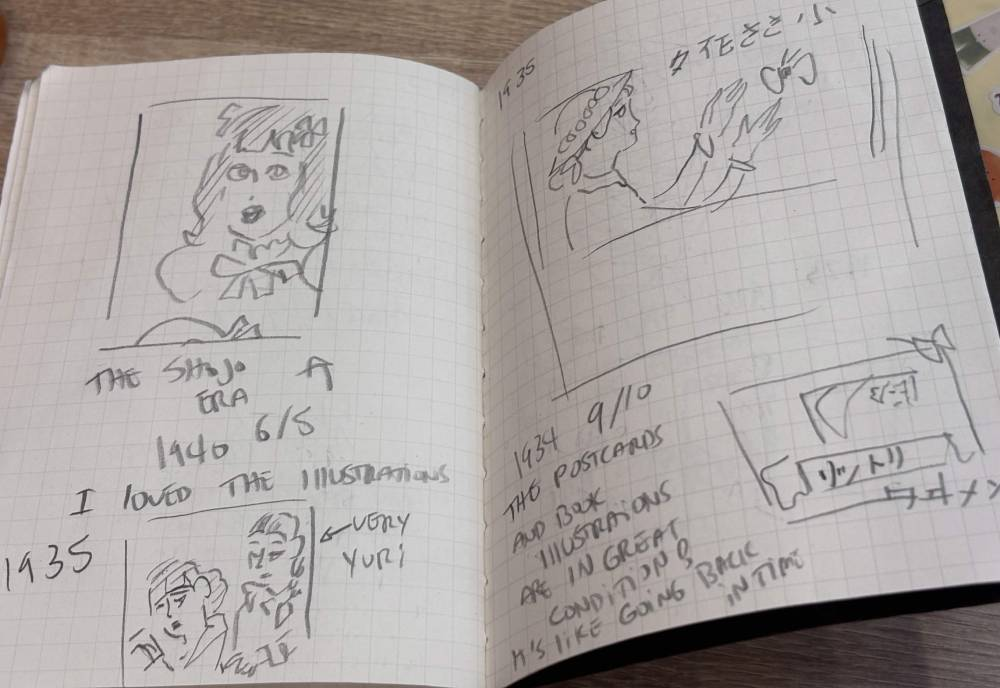
Hand drawn art and words in a notebook, image and at by Sasori.No pictures were allowed in the exhibit, but I was enchanted by all the preserved books and novels from the 1920’s and 30’s. There were also newspaper and activism articles, my favorites being about female political movements. I tried to scribble out a few memorable ones in my notebook!
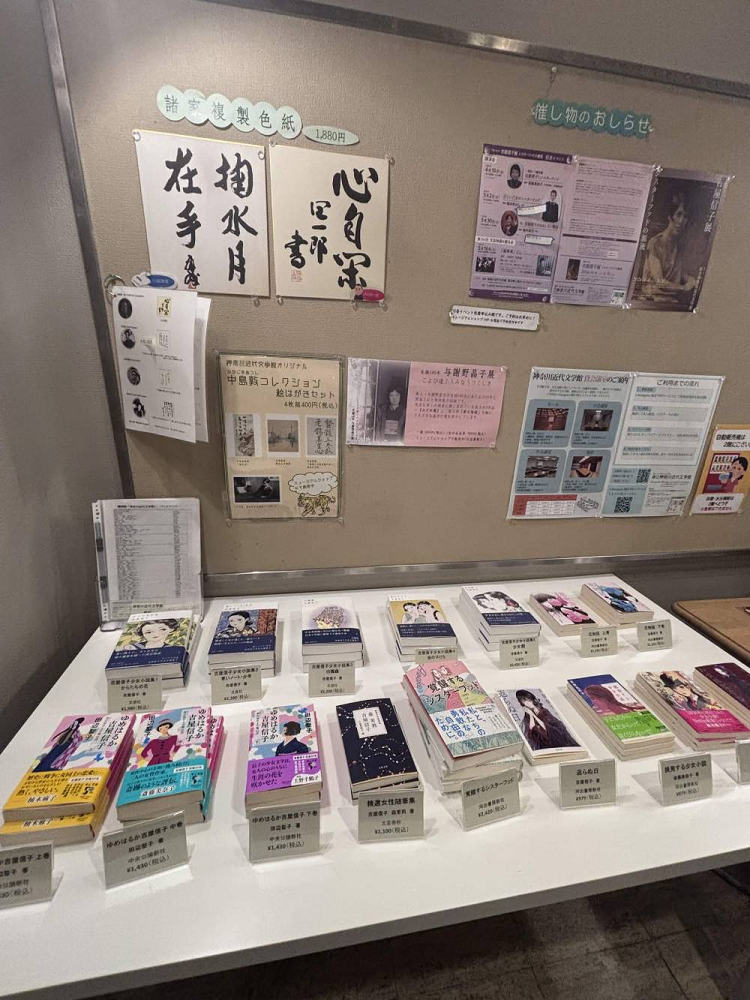
The close friendship of women longing for other women, being the theme of many covers, as well as flowers, really reminded me of how modern yuri came to be today.

I also enjoyed spotting parts of Yoshiya’s Hana Monogatari, flower stories, lined up together. Her novel “Yellow Rose”, is one of the few from that series translated into English, and something I plan on reading to broaden my historical yuri knowledge.

As for the museum goers, it was quite busy for a weekday, and many patrons were older and some seemed to be historical scholars.

After the exhibit, there was a display of many Japanese novels influenced by her writings.

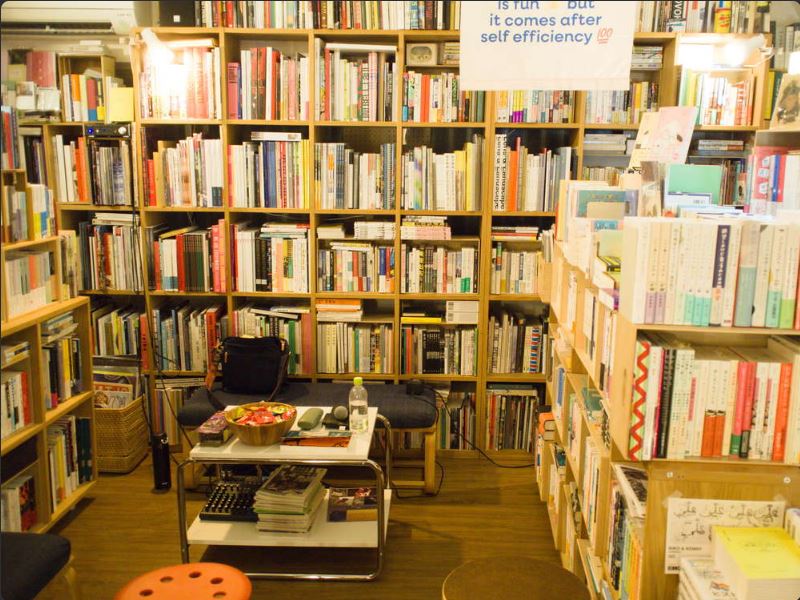
Image of exhibit space, featuring many of the novels and story collections influenced by Yoshiya Nobuko's work.
The museum is very Japanese text heavy, it is a literature museum after all, but if you are up for the challenge, be sure to stroll through their rose garden and stop by the museum!


Erica here: Thank you Sasori! One of the reasons I was particularly interested in this exhibit was,  for the first time, a retrospective of Yoshiya-sensei’s work was acknowledging Monma Chiyo as her life partner. One of the items on display is a letter sent to Monma-san. 

If, as you read this, you are interested in the items on exhibit – a few of which are shown on the Museum page linked above  – you can purchase the exhibit catalog on Amazon JP. None of us love Amazon, but it was a lot easier than trying to get the museum a bank transfer (which is what they suggest… ^_^;)

Some of the items, like Yoshiya-sensei’s desk accouterments really make her feel like she just got up and took a walk, but will be back in a sec. If you’d like a glimpse into the life of the woman who is in large part responsible for so much of what we think of as “Yuri,” the catalog will be just that.


Atelier Lilium Cafe Report

June 24th, 2026

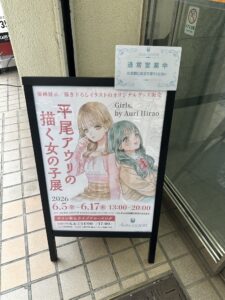
A signboard for Yuri Cafe Atelier Lililium, showing art by Hirao Auri for the inaugural art exhibit.Hello, this is an overachieving potato from the Okazu Discord, and I’m here to talk about my recent visit to Atelier Lilium, a book cafe in Ikebukuro.
First off, I have a fun anecdote regarding the place. I had a hard time finding the venue at first, but a person wearing a Japan football jersey directed me to the place.

It was nice of them to help out, considering I was entering random open buildings based on the pin in Google Maps. Turns out, it was underground at a hole in the wall.

I went down the steps to the first basement to find the cafe. Inside, the space is surprisingly big and very chill, featuring plenty of open seating with cafe tables and cozy chairs, plus much-needed air conditioning.

I suspect, though, that I caught the cafe at a lull, given it was 2:00 pm when I arrived.


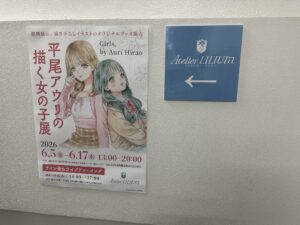
In any case, I had an idea on what to expect beforehand. A reddit thread had explained A hallway wall, with a poster for the Hirao Auri exhibit and a business sign in a cadet blue with white letters that read Atelier Lilium, and a shield with a lily in white.the process, namely that you have to register on their website prior to visiting. This is to generate a QR Code to be scanned upon entry. This generates a QR code that gets scanned upon entry. They do accept walk-ins, but it’s best to keep the registration in mind. Also, it’s worth noting that they are completely cashless.
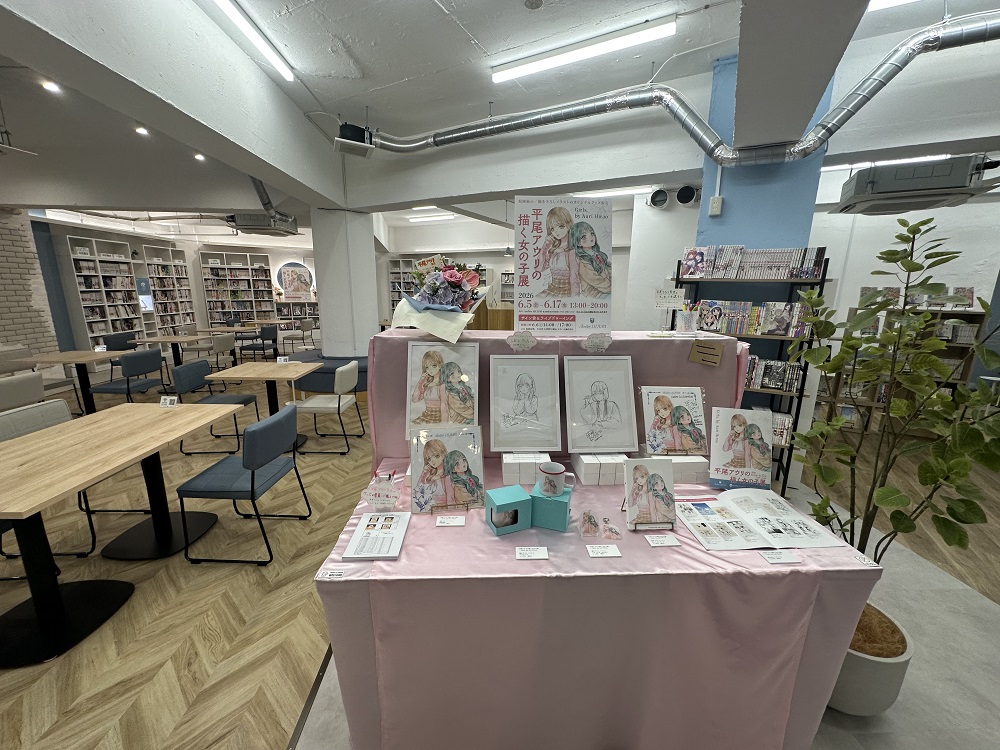
As for the cafe itself, getting in and understanding the rules were much easier than actually finding the place. There were instructions in English at the front desk, and the staff guided me through the whole process. Their guide neatly details how browsing works: you pick up a bag at the front counter, fill it with the books you want to read, and simply return the bag with the books inside when it’s time to check out.

The cafe featured a small exhibit showcasing the art of Auri Hirao, creator of If My Favorite Pop Idol Made It To The Budokan, I Would Die. The display featured her colored illustrations, alongside some sketches and black-and-white images set up right by the counter seats. The main draw of the cafe, though, is the sheer number of books inside. They have selections from all sorts of publishers, including Ichijinsha, Kodansha, Kadokawa, and more. They even have older books, light novels, and copies of Galette!

As for what I did, I spent about an hour at the cafe relaxing and reading muromaki’s JK-chan and Tomodachi no Okan (JKとともだちのオカン), about a high school girl who falls for her male classmate’s mother, cola float in hand. I took advantage of their amenities, such as the free WiFi and charging stations. If I had to describe the atmosphere, it was incredibly quiet and peaceful. I was able to fully relax before I had to leave for my next stop. I would have loved to stay longer, but I had other things on my itinerary.

A view of the cafe and book space for Atelier Lililum. In the front is a table with a pink cloth featuring work and goods by Hirao Auri. Wooden tables on the left, feature gray and white chairs. Bookshelves along the wall are filled with books, in a well-lit white-walled and ceilinged space.

I really enjoyed my time at Atelier Lilium. If I were to make any suggestions for them, it would be to include an even larger selection of yuri, perhaps even incorporating yuri from other countries. I remember remarking when I saw their selection that if this wasn’t All The Yuri, it certainly was a massive chunk of it. I highly recommend visiting, even for a short while, just to experience reading yuri while enjoying the other features, like the art exhibits. For anyone planning a visit, it’s worth noting that Atelier Lilium is incredibly close to Otome Road. It makes for a perfect rest stop if you are spending the day shopping at the nearby animate Ikebukuro, azone Ikebukuro, and other surrounding hobby shops. Like ANCHOR rainbow port tokyo in Shinjuku, this is a permanent fixture.

I’m still not used to rating cafes, but here we go:

  • Atmosphere: 9 – Very quiet, peaceful, and perfectly air-conditioned. The ideal reading environment.

  • Library/Selection: 8 – A massive chunk of yuri from major publishers and even some older titles and Galette.

  • Amenities: 9 – Free WiFi, charging stations, and a seamless cashless system. Plus, a lovely Auri Hirao exhibit.

  • Service: 9 – English instructions at the front desk and incredibly helpful staff who guided me through the entry process.

  • Yuri: 9 – It might not be “All The Yuri,” but it’s pretty darn close.

  • Overall: 8.5 – A highly recommended permanent fixture for anyone looking to relax and read a good manga with a cola float.


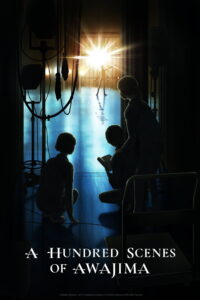
A Hundred Scenes of Awajima, streaming on Crunchyroll

June 17th, 2026

From a dark backstage, three girls look out upon a brightly lit stage where a young woman acts as a male character, blindingly bright as she lifts her arm.Are you comfortable? Have a drink, maybe a snack? Good, because this review is going to be 95% exposition and 5% review. Okay, maybe 85/15. But still. 
To understand A Hundred Scenes of Awajima, let us begin with a rather famous book called Fugaku Hyakkei, (富嶽百景) One Hundred Scenes of Mt Fuji, by the rather famous artist Hokusai. And, the equally famous Meisho Edo Hyakkei (名所江戸百景) the One Hundred Famous Views of Edo by the equally famous Hiroshige. From these titles, we see that hyakkei (百景) means “one hundred views.” This is clearly a trope. One understands that this word means “various perspectives from various angles.”  Hachiko used this trope in their Yuri Hyakkei (百合百景) volume in 2017.

Awajima Hyakkei, the manga series for which today’s subject is an anime adaptation, began in 2015.  I reviewed Volume 1 and Volume 2 here on Okazu and, although I kept reading I did not review other volumes. Yuri, while a part of this manga, is not a major part.  But it is a fundamental part, as we shall see.  The story is set in the preparatory school for girls who want to perform with the all-female famous Awajima Revue. 

Some of you will have understood immediately that this is mean to represent a fictionalized version of the second cultural relic in this series…a very famous, very real, all-female Revue Troupe school.  In a long ago post, scholar Rachel Thorn did a breakdown on the many visual, cultural, linguistic, geographical and organizational similarities between Awajima Revue and the real school. There are also other similarities, as well.

One of the similarities of the Awajima Musical Revue School and the school upon which is is based, is the constant refrain of bullying and power harassment within the organization. This is a real, and very front-facing issue in the story, but it has a sad truth to it. Unfortunately both the school and the troupes themselves have a history of power harassment against junior students and members, likely stemming from the para-military organization of the student body. This bullying is alluded to in the documentary Dream Girls, where one can visibly see actresses struggling as they remember their “strict” seniors at the school. So, as we watch our characters move from first to second year in the anime, speaking of being better seniors to their underclassman, we understand that the bullying was significant. 

Another similarity is the intense, intimate and sometimes romantic relationships formed by the students. Jennifer Robertson’s 1998 book Takarazuka: Sexual Politics and Popular Culture in Modern Japan, touched on this topic and, for her efforts, she was banned from the organization’s archive. The organization has still avoided any formal recognition of lesbian performers, bun there is a less rigid perspective in fandom where queer readings and female intimacy are more acceptable. (Nobuko Anan’s “Performing Female Intimacy in Japan’s Takarazuka Revue” and “Transcultural Desires and Lesbian Fandom: Takarazuka Revue in Taiwan” by Lucetta Y.L. Kam are interesting in that regard.) In that old and lost (and if you find it anywhere, DO NOT POST A LINK, this was deleted by Thorn and should remain lost out of respect. I have the original, but I will not share it, nor should you) post, Thorn noted that the real school was not at all comfortable with the idea that any of their girls form pairs, despite at least one well-known out lesbian who was a member. You may remember Higashi, who was one of the women whose marriage at Tokyo Disneyland caused the resort to change their policies. 

The manga, written and drawn by Takako Shimura, is available from Yen Press in English as Scenes From Awajima. This title is, in part, why I take time to explain the meaning of “One Hundred Scenes”. Sure you could read the book without understanding the whole thing behind “hyakkei” but if you know what it means and where we know it from, the series makes more sense. Knowing is half the battle. ^_^

All of which brings us, finally, to A Hundred Scenes of Awajima, streaming on Crunchyroll, the anime adaptation of the manga. The manga suffered a bit, as Shimura had not yet quite matured into the storyteller we saw in Even Though We’re Adults. This anime adaptation is the best adaptation of a Shimura work to date. 

Artistically, the animation captures her watercolor pen art in a way that feels true to her work and also somehow feels realistic. Each episode begins with a “scene” that moves into a story that is multi-layered. First-year students, their parents, the teachers, and predecessors all move through the school in one time or another. Shadows from prior years’ successes and failures, loves and losses are all presented as they impact the present. The present, however is treated differently. Students, current and former, try to heal wounds, and change the culture for the future. We see girls who were loved and hated, girls whose family was supportive, and those who were not.

The story begins and ends with a girl who was bullied into leaving the school and ultimately taking her own life. It’s a sad story made sadder when you see how strong she was, and how good she might have been. That shadow lingers into many other of the stories, even when the girls in them don’t know that. 

These are the “one hundred scenes” of Awajima. A place, a person, a story may look different when seen from another angle, but Awajima, like it’s real-world analog, is still there. Still dealing with the good and the bad.

Ratings
Art – 9
Story – 8 
Characters – 8
Service – 0
Yuri – 2?

Overall – 9

I would never suggest this story for someone new to anime, but if non-linearity and beautiful art is enough to interest you, I especially recommend watching the anime before reading the manga. It’s easier to follow for having been simplified a bit.  One Hundred Scenes From Awajima is streaming now, on Crunchyroll.


Watashi no Oshi ha Akuyaku Reijou, Volume 12 (私の推しは悪役令嬢。)

May 21st, 2026

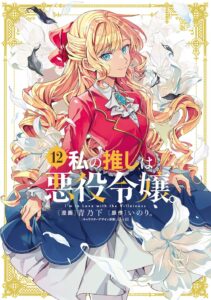
Cover of Watashi no Oshi ha Akuyaku Reijou, Volume 12 / 私の推しは悪役令嬢。Story by inori., art by Aonoshimo. Surrounded by white lilies, a young woman with long blonde curls, in a red fatasy-style school blazer and dark blue skirt with voluminous white petticoats, turns towards us as if to curtsey, her blue eyes and smile very gentle.The end draws inexorably nearer, in Watashi no Oshi ha Akuyaku Reijou, Volume 12 (私の推しは悪役令嬢。) Salas holds the Revolutionary Government in his hands, while the Provisional Government lead by Dole and the nobles seem intent upon driving the commoners to rebellion….

…which was the plan, Rae finally admits to Claire. Claire finally learns that everything Rae and her father have done is to save her, and all she has to do is stand with the Revolution. But Claire is a noble through and through. And she’s always been the “Villianess,” willful and obstinate. Claire turns herself in to the Rebel forces, know that she is going to die. 

Rae becomes despondent. Everything she has done, all the allies she has made, has failed to save her love. But those allies are stronger than Rae knows, and when Misha gets into her face and say, “hey you’re not the only one who gets to interfere with friends’ love lives.” And then a wild card shows up and suddenly, we have hope once again. 

 Watching Salas manipulate everyone (and gloat about it) is enraging, but as horrifying as it is, we must acknowledge that Dole was, in his own way, just as manipulative. It’s easy yo see him as a good guy masquerading as a bad guy, but…he also was, genuinely a bad guy, too. 

This is a powerful and deeply emotional volume, then sets up all the pieces for Rae and Claire to face one another from opposite sides of a philosophical gap for the final time.

Ratings: 

Art – 9 Aonoshimo’s art is wonderful.
Story – 10 This is still one of the best climaxes in Villainess media
Characters – 10 Claire practically grows wings here
Service – 1 A kiss. A sad, bittersweet kiss.
Yuri – 10

Overall – 10

Based on the timing, I expect this to go about 14 volumes, unless there is a coda…which I hope there is. Let’s not forget to write Comic Yuri Hime and ask for more!


Ayaka is in Love with Hiroko!, Volume 2

May 11th, 2026

A blonde woman in pink, whispers into the ear of a woman in a grey suits and white button down shirt, who is visibly cringing with embarrassment, under the words Ayaka is in Love with Hiroko (echoed)In Volume 1, we were thrown into a torrent of emotion as beloved and competent office sempai Hiroko, has a passionate, if awkward, junior, Ayaka, who is doing everything she can to catch Hiroko’s eye. 

When Ayaka finally just tells Hiroko how she feels…Hiroko rejects her. As Ayaka grieves, her best friend Risa asks if Ayaka couldn’t find a way to going out with her. But, no, Ayaka is not able to give Risa what she wants. Everyone is unhappy. 

And then something important happens. The ladies at the lesbian bar unpack Hiroko’s baggage.. They explain to Risa and Ayaka just how much different things were 15 years ago and how being out carries a lot of weight for an older generation of lesbians. This is a crucially important bit of storytelling. Hiroko has her own personal heartbreak and the consequences that she’s been carrying, but also a lifetime of society forcibly rejecting queer people. Not like the conservative extinction burst attacks we’re seeing now, but the full confidence of a majority of society being queerphobic. Hiroko’s beloved sempai, a woman she admired and loved, took the fall for her and she cannot let that go lightly.

I love that this has to be explained…how genuinely wonderful for younger queer folks who rightfully see transphobia and homophobia as the problem, rather than themselves. But it does have to be explained, because while that kind of queerphobia still does exist-  people are still regularly thrown out of homes, lose jobs, access to family, children, housing, – it is nowhere as common as it once was. So for folks who have not experienced it, here is an example.

And, having learned the whole truth, Ayaka, Risa, and Hiroko are ready to move on. No, wait, Risa and Hiroko are, but Ayaka has other ideas. She’s still convinced that Hiroko just need convincing. In Ayaka fashion, that means she’ll choose the wackiest way to go about it.

Ratings:

Art – 8
Story – 8
Characters – 10
Service – 6 When Ayaka stops dressing for attention, it’s actually pretty funny
Yuri – 7
Lesbian – 9

Overall – 8

This volume manages to be funny and poignant with Sal Jiang’s fabulous reaction expression art. A good read, a fun read, and a read that I hope in 15 years will make almost no sense at all to the next generation of queer youth, who will be befuddled by anyone who doesn’t just automatically acknowledge their right to exist.