Archive for the Artists Category


Rain and the Other Side of You

May 3rd, 2021

Back in 2019  the folks at Galette Works gave us the problematic Ame to Kimi no Mukou (雨と君の向こう) written by Sakuraka Yukino with art by Momono Moto. I kind of wished they hadn’t. ^_^;

How surprised then, was I to find that Lilyka had picked it up and translated this volume it as Rain and the Other Side of You. When Lilyka ran it’s recent Sakura season sale, I figured that was as good a time to pick it up as any and so here we are looking at a problematic manga for a second time. It hasn’t aged well at all.

Mudarame Aki is a dead-eyed middle-schooler whose aggressive sexual behavior toward her teacher ought to have been the occasion for a house call from Youth Services, Teacher Kanou Yuka is presented as a woman who has no plan for her life, has been unsuccessful with men. When Mudarame-san throws herself at Yuka, she finds herself incapable of resisting.

In my review of the volume in Japanese, I wrote:

Aki[‘s] dead eyes and romantic overtures to her teacher scream “sexually abused” to this reader.

Yuka and Aki’s relationship is not a healthy one, not from the very beginning. Aki is manipulative and uses things like Yuka’s virginity as a weapon against her, which is just gross. Yuka tries going out with a guy and just finds herself going back to seek Aki’s company. When she and we see that our guess that Aki has been abused is correct, it still doesn’t make anything that’s happened okay.

If anything, it was worse on re-read, because it was in English and I couldn’t pretend I misunderstood Yuka’s justifications for not running for a phone and calling Youth Services.

What is good is Momono’s art, which captures Aki’s existential misery so well that it makes it thoroughly impossible to feel anything but pity for her and contempt for the adult who is not strong enough to help her. This is belied by an epilogue in which we see them some years later, looking happily domestic, but the mental gynmastics of this are too much to contemplate.

Okay, let’s set the dumpster fire of the story aside. Momono’s art is one of two reasons I read this book in the first place. She absolutely favors mopey, sad, traumatized characters as we may recall from her books Liberty, Volume 1 (リバティ), and Kimi Koi Limit. But the other reason is also the reason that this book being picked up by Lilyka is a good thing – this was the first of the books from Galette WORKS, the folks behind quarterly crowd-funded Yurimagazine, Galette (ガレット). If Lilyka can get some of those, I will be very pleased for us.

If you do pick this book up, let me warn you that the lettering is a little unsophisticated and the editing a bit shoddy. I’ve written to them to ask that the typos be fixed so if you do pick it up and they haven’t, let them know you think this is important, as well.

Ratings (same as the JP volume):

Art – 8
Story – 3
Characters – 5 No one would get a lunch invitation. Well, maybe the guy who goes out with Yuka, he seemed okay.
Yuri – 8
Service – The whole concept of an adult being attracted to a sexually abused child is a level of creepy I am unwilling to accept as anything other than criminal.

Overall – 5

It was not to my taste at all, where Liberty totally is. I hope you’ll all get to see that one day!



Ride or Die on Netflix

April 16th, 2021

Ride or Die on NetflixIf you are a regular reader here at Okazu, you know that I have loved the darkly violent Yuri manga GUNJO from the day I received a message about it on Japanese social platform Mixi, back in 2008ish. I’ve written reviews of various chapters I read in Morning Two magazine and all three of the volumes in Japanese in my GUNJO category here on Okazu.  In 2018, I was able to meet with Nakamura-sensei (over what was possibly one of the hilariously worst lunches I can remember. This was supposed to be a BLT. It was inedible.) At the time, we worked out how we might do a translation for GUNJO into English. And she mentioned that she was in talks about a live-action adaptation.

Translator Erin Subramanian and I have completed the translation for Volume 1 of GUNJO, into English, which is purchasable by the chapter on Nakamura-sensei’s website. We’re hoping to see a collected Volume 1 on ebook sellers near you one day soon. As we completed Volume 1, the pandemic hit and the project was paused. Today’s review was, in large part, why it paused. Last night Netflix released Ride or Die, the live-action movie based on the manga by Nakamura Ching.  Ride or Die, directed by Hiroki Ryuuichi, is not GUNJO. It is, however, within spitting distance of it.

Like GUNJO, (I ended up using this spelling when Morning Two magazine chose it over Gunjō, so forgive me) Ride or Die contains graphic violence and marital abuse. Unlike the manga, the movie also contains several explicit sex scenes, both straight and lesbian. If any of this makes you feel uncomfortable, you may well want to give this movie a pass. Interestingly, for the lesbian sex scene at the end of the movie, the staff brought in an “intimacy coordinator,” which Max Gao writes about in his article on NBC, Stars of Netflix’s lesbian thriller ‘Ride or Die’ on their on- and off-screen connection. This intimacy does change the end of the story considerably, but whether you think it works better or worse will be an entirely personal decision. In my opinion the end of the manga is very hard to beat for perfection. ^_^

Another change from the manga is that the characters – who remained nameless and were referred to as “Megane-san” and “Lesbian-san” by Japanese fandom – here are named. They get to share moments of genuine joy in this movie, which was probably the most disconcerting change for me. I don’t think it was a bad change, it merely signaled that we would not get that manga ending. Overall, I think both Sato Honami as the abused Nanae and Mizuhara Kiko as Rei, the woman who loves her enough to kill for her, did an excellent job. There were moments when Sato looked so like Megane-san that it was quite extraordinary and I found myself commenting on it every time.

As you may remember in my other movie reviews, I dislike the slowdown of pacing that seems to be to be a common occurrence in Japanese live-action manga adaptations. In the case of Ride or Die, it was the sex scenes that I felt went on too long, and the movie would have benefited from them being cut slightly. But this was pretty much my only complaint. This, I think, came from the choice of director whose career began in pink films and whose body of work tends to favor graphic sex and violence. 

Some of you may wonder about the title, Ride or Die, which I’m sure many of us see as an already tired trope. Nakamura-sensei mentioned that the title change was something she approved of and I’m inclined to agree. It allows us to view the movie as something separate from the manga…but also to see this is a subversion of the trope itself. This is not a “ride or die” scenario in the most typical sense. The characters are, yes, being followed by the police, but not hot on their heels. There’s just no urgency as they wander randomly through their lives together until they and we have all the pieces.

Ratings:

Cinematography – 9
Story – 9
Characters – Portrayed beautifully, so 9 but they are sometimes deeply unlikable
Service – 10
Lesbian – 10

Overall – 9

I’ll watch it again, for sure. If you get a chance to watch it, let us know what you think in the comments!


I’m in Love With the Villainess Manga, Volume 1

March 31st, 2021

If you’re reading this, you’re probably aware that this particular isekai series has been given a lot of space in Yuri fandom’s head these days. With the successful light novels (Volume 1 and Volume 2 of which are available in English, Volume 3 on the way in July and Volume 1 through Volume 4 out in Japanese), a 5th place win in the recent survey asking what series fans want most to see as an anime, as announced at AnimeJapan, I think we can just agree to call this series an iconic series for Yuri in the early 2020s. ^_^ This point is key to today’s review, because this series, written by inori, with character designs by hanagata, has almost instantly become important to us. This emphasis will become relevant shortly, as we take a look at Volume 1 of the I’m in Love With the Villainess manga which was released this week digitally on Global Bookwalker.

Like the LNs on which the manga is based, we begin with Ohashi Rei, a worker at a company who finds herself reborn in to the world of her favorite otome game where she, as the protagonist, is finally free to romance the villainess, Claire François. There are a lot of things to like about this series. Much of fandom is thrilled to have an openly (and as it goes on, increasingly) queer Yuri work. I’m delighted to have an isekai work that addresses social and income inequities, government accountability, as well as surfacing gender and sexuality minority issues. Additionally, I really like that the protagonist is an adult, so their thoughts about these issues aren’t too simplistic. All of these things are part and parcel of why this particular series has made such a huge splash in Yuri fandom.  The fact that fandom has embraced this series with such passion is, in part, why the editing issues that lead to a excision of a passage in the first Light Novel (which has been restored already in digital editions) caused such a major uproar.  As I discussed in my recent article about Queer Representation, when we get more and better representation in media, we become more demanding, not less.

I really enjoy the manga iteration of this story overall. The art seems more lively/less moe than the original LN art, and there’s enough inconsistency in that art to highlight the comedy aspects. The nudity is entirely egregious, but it is also relevant to the story…not because the nudity itself is important, but what it says about the character. This is the core of the passage which had been deleted, in fact; the motivation of why Rae is the way she is. Those of us who have read past Volume 2 of the LNs will understand that this feels so long ago and almost irrelevant, but it had an impact on readers who were just beginning to love the story. To be perfectly honest, I assumed the story was originally a “comedy” that just morphed into a drama, and never felt Rae’s behavior needed explaining. But that’s just me.

Which is why it pains me to say this: The translation for the manga is not, in my opinion, very good. (Ironic, as I was just accused of being an apologist for Seven Seas last week. ) Jenn Yamazaki does such lovely work on the Light Novel translation.  Rae and Clarie’s voices are clear and appropriately translated.  As I read this manga volume, I became increasingly uncomfortable with the translation here. Given how absolutely critical Claire’s awareness of herself as a daughter of the nobility is to this story, some of the things that she says are crude, things said about her are uncouth and, ultimately in one of the final pages, she is seen to say, “bloody commoner.” 

I hate to be that person, but I am about to be that person. Not only is that not what she says in Japanese, which was 「本当にこの平民は・・・」 and not what is implied,  which I understood more as, “Really, this commoner is [just so]…”, it is wholly, unpleasantly vulgar. I  do not know if this was a failure of translation or editing, but it left me feeling absolutely bereft.

I’m with Rae. Claire high-handed arrogance is incandescent and her descent from that arrogance is a magnificent story which does not deserve greasy fingerprints of vulgarity. It left me thinking that neither translator nor editor care about this story and that is something I have not felt about a Seven Seas book in a very long time.  As I said at the beginning, this series has become important to us. It needs to be important to Seven Seas as well. I was so distraught at Claire saying “Bloody commoner” I woke up this morning and immediately composed an email to Seven Seas, letting them know what I would be saying here, so they were not blindsided. This translation did not feel as if it was done with love.

Surely one might assume that someone there would have thought to go over this before releasing it this week, after the problem last week?  A deleted passage is a problem that is fixable. An entire volume translated by someone who missed the point entirely may be fixable, but could have been prevented, if someone had been paying attention.

Ratings:

Art – 8
Characters – 9
Story – 8 It will improve over time. ^_^
Service – 5 Nudity and bathing
Yuri – 10

Overall – 8, with 1 off for the translation, which makes it a 7

If you don’t care about “voice” the way I do, it might not rub you the wrong way.  And, translation aside, this is still a fun manga, with great expressions and fun art and, of course, a terrific story. I’m still very eager to see the school festival cafe drawn by Aonoshimo-sensei. It was a scene that we all deserve to see realized. ^_^


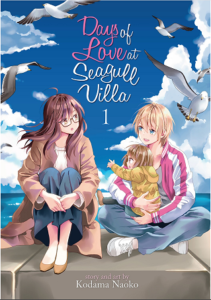
Days of Love at Seagull Villa, Volume 1

March 29th, 2021

Mayumi has left her life in the big city behind. She knows she’s running away, but she’s committed to running as far as she can from the circumstances that have left her feeling empty. At the beginning of Days of Love at Seagull Villa, Volume 1, instead of of dealing, Mayumi has moved to a small seaside town to become a teacher. As she contemplates her future, she is accosted by a young woman who looks like a tough who thinks she is trying to do herself harm. One hilarious hijink later and Mayumi finds herself at the Seagull Villa, with a cast of characters and people with whose lives Mayumi will become involved.

When I read this series in Japanese, I felt very much that there was some kind of war going on between the artist and the story. Over and over it veers into the kind of dark territory so much of Kodama-sensei’s work is known for, and over and over it just sort of rests itself and tries again. It’s a very plucky story.

Mayumi comes across as a mope, but it quickly becomes apparent why and we do kind of root for her. But for my money, without landlady Rin’s jocularity, this story could and probably would have bogged down. That said, it doesn’t bog down and every turn for the worse, somehow pulls around into what will become an unlikely tale of alternate family and, (obviously, because this is a Yuri romance!) love. ^_^

Ratings:

Art – 8
Story – 7 It has moments.
Characters – 6
Service – Yes. It is a Kodama Naoko story, there is service
Yuri – 5

Overall – 7

Days of Love at Seagull Villa, Volume 1 by Naoko Kodama is available on Amazon and Global Bookwalker. Volume 2 is also available.


Watashi no Oshi ha Akuyaku Reijou. Volume 4 (私の推しは悪役令嬢。)

March 15th, 2021

Watashi no Oshi ha Akuyaku Reijou., Volume 4 (私の推しは悪役令嬢。) is a wild ride of a novel that has more twists and turns than the newest roller coaster at your local amusement park. It was awesome.

At the end of Volume 3, we left Rae and Claire in the Nur Kindgom, having made a heck of an impression on the despotic rule of Nur, Queen Dorothea, in a battle against the Demon Rulers. They also made an impression on the Demons.  Both of these are understood to be ambiguous in nature and will surely come to a head. But first, we have some much more important stuff to deal with….

…including an Iron Chef-like cooking contest between the greatest chefs of Nur, and Rae and Claire’s 6-year old daughter Aleah. And a formal ball. Also a act of incredible magical skill handled by their other 6-year old daughter, Mei. Rae and Claire help foment rebellion, change the diet of the entire army, solve a murder mystery and three other mysteries, only one of which was in the least predictable. Then a kidnapping. And then, about 2/3 of the way through this book, the story slams down on us with a vengeance.

Inori carefully weaves their way through the various plotlines and pulls out exactly the right ending for the book. It could not have been handled better without making concessions to what we knew of everyone.

This felt like a long book, and we had a number of new characters, several of which are undoubtedly going to be key in Volume 5. It was no surprise that I like Hilde, the hyper-competent bureaucrat with a monocle, but almost despite myself, I also like Frida, the Princess’s “Merikan” friend.  This story still remains wholly queer and deeply rooted in social and political activism. This volume takes some time to get there, but when it does, it does.

Every single one of my questions from Volume 3 were answered, save one, and that clearly is going to be a plot in Volume 5. There are a lot of loose ends yet to be tied up. I’m constantly fighting with myself whether to read the chapters on inori’s Pixiv Fanbox or not but I have chosen to not do so, and hope you will respect that by not spoiling anything for me, as I have tried to not overly spoil this for others. Thank you. ^_^ I still have hope that two of the things left undone will be done by the end of the series and one other new thing also gets followed through with, but I admit that this last is simply because I really like Dorothea and want to see more of her.

The art was the best so far of the series. I’ll never adore moe-fication of characters like Dorothea, but I felt that everything in this book was way more finished and solid than in previous books and a few of these were extra lovely. (I did mention the formal ball, yes?) ^_^

Volume 3 is slated for a July release in English, which feels so far away, and Volume 5 is not yet listed in Japan, but I remind you that Volume 3 and Volume 4 are available in Japanese on US Kindle. They are so worth it.

Ratings:

Art – 9
Story – 9
Characters – 10
Service – Yes. Still perfectly okay.
Yuri – 10
Queer – 10

Overall – 10

Oh, the boot I kept waiting to drop in V3? It dropped in V4. And it wasn’t a main plot point, just one more crazy arc that lead somewhere else entirely and was even worse and better than I imagined.

If you’d like spoilers or have read it and want to shout with me about it, please join me on the Okazu Discord. ^_^