Archive for the Artists Category


Yuri Light Novel – Bloom Into You: Regarding Saeki Sayaka, Volume 1 (English)

February 23rd, 2020

“…even though I was a kid, I didn’t want to feel like I was lagging behind. ”

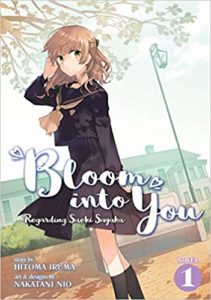
When we meet her, in Bloom Into You: Regarding Saeki Sayaka Volume 1, Sayaka is a very intelligent and privileged child, experiencing her own life at a remove. She does things because not doing them seems like more of an obstacle than doing them. She wants to continually push herself to be better than those around her. Not to feel that she is more than them, but just to be the best at that thing. She’s used to praise and strives to get more of it. To be the best, she’s sacrificed experiences she didn’t know she was missing. Normal things like playing with friends and reading novels are not things that have much value to young Sayaka.

In the first part of the novel, Sayaka encounters a girl of her age in swimming class who clearly finds her fascinating. Sayaka, being very intelligent, comes very close to understanding why, but she she avoids facing the issue head on. When the girl tries to become someone Sayaka might like, Sayaka has to face the fact that the girl is a better swimmer than her. And when the girl and she share an intimate moment, Sayaka runs away. Something inside her has opened and she is afraid to face that, too.

The second half of the novel flips the story. When a sempai confesses to Sayaka, it’s her turn to try and become someone her Sempai will like, which requires her to do things she might not otherwise care about.

A part of myself I hadn’t known about had been laid bare, exposed to the wind.

We watch as Sayaka convinces herself that she is in love with her sempai – knowing, from our perspective that the older girl’s affection isn’t more than a passing fancy. When she is spurned, Sayaka becomes, for the first time, angry at having been used. Sayaka decides that she won’t be used again, but when she changes school, she learns another important lesson – that the universe thinks vows like that are hilarious. And once again, Sayaka is not the best in her class.

The work for this book by Seven Seas is seamless, with credits for everyone who put their time into the production. The translation by Jan Cash & Vincent Castaneda nicely preserved Sayaka’s measured form of expression. It was easy to hear this in her voice.

Speaking of which! Thanks to Seven Seas, I had a review copy of this book and I found that Microsoft Exchange has a read-out-loud feature with several voice options…including, oddly, two different choices of “Japanese” woman’s voice. You are probably familiar with the kinds of odd intonation and syllabic mis-emphasis that one encounters in machine reading. In this case it actually increased the uncanny valley of the whole thing. Imagine a Japanese Sayaka reading this English-language translation of her journal, if you will, out loud, with all missed emphasis and missed pronunciations that come with reading a language one is not wholly fluent in and you’d not be far off what the e-book sounds like read by Microsoft “Ayumi.” So that was a little surreal. ^_^

As a tone piece that beautifully captures the inner voice of a young woman with a tendency to think deeply about things without providing herself the context, this book is excellent. The voice with which Sayaka is presented is exactly the voice we hear from her in Bloom Into You. As the story of a young lesbian, it rings true, and lacks most of the kinds of service I feared we’d be subjected to.

Ratings:  the same as the Japanese edition

Art – 10, by Nakatani-sensei
Story – In and of itself, not riveting, but since Sayaka is the reason I follow the series…8
Character – 10
Service – 3 bathing suits and changing rooms
Yuri – Well, now…this is hard. I’m calling it a 5 because it’s so complicated

Overall – 9

The only weakness in the book was within Sayaka herself. I wish she had been encouraged to read more fiction….she might have found everyone’s behavior far more comprehensible if she had. ^_^

Thank you very much Seven Seas for the review copy of this book and for everyone’s hard work. Additionally, thanks to Hitoma Iruma, who did a very decent job of portraying Sayaka as we understand her.

I will be getting the third volume of this novel series in Japanese as soon as it comes out – I’m really looking forward to meeting college-age Sayaka!


Genjitsu Touhishitetara Boroboro ni Natta Hanashi Manga (現実逃避してたらボロボロになった話)

February 9th, 2020

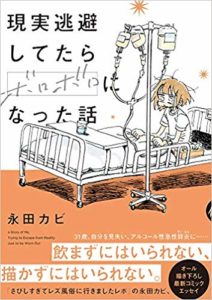
Who could have imagined in 2016, when we all first discovered Nagata Kabi-sensei’s honest and touching diary of her struggles with mental health, that we’d be tuning back in repeatedly, like a manga reality show, hoping to see her feeling healthier, happier, more whole? And yet, here we are, reading the fourth volume of this real-world epic saga of a journey through her own life.

In Genjitsu Touhishitetara Boroboro ni Natta Hanashi (現実逃避してたらボロボロになった話), which has the English subtitle “A Story of Me, Trying to Escape From Reality Just to Be Worn Out,” Nagata-sensei finds herself at a new crisis point. She is suffering physically from her habit of self-medicating with alcohol, and ends up in the hospital with pancreatitis.

This book has shifted to a new color palette – using what my wife insists is the color of dayglo circus peanuts….a color schema which is correct, but perhaps a bit obscure as circus peanuts are a dying confection (“for good reason,” my wife insists, “since they are gross.”)

We’ve watched Nagata-sensei struggle with food, with alcohol, with depression, and now with her pancreas. It’s all very heavy going, but as a reader I don’t feel like I have the luxury of wallowing since, for any bleak feelings I might have, I have to believe that it’s harder for her. To some extent, the only thing we can do is be distant, abstract cheerleaders on the sidelines of the parts of her life she chooses to share with us. We have to know were not getting the whole story – and we have to be okay with that. So we mentally pull for her and send good thoughts.

And, in a way that means something to the universe, at least, there is some good news. She is getting work as a cover artist; her cover for Saotome Kanako’s Pants ha Haiteoke, (パンツははいておけ) is coming out this month, she’s got a lot of recent work on her Pixiv…including quite a bit of 18+  and lesbian work (which, to my mind, at least, mean’s she’s got some interest in sexuality and sensuality,) and a story in Shueisha’s Grand Jump Mecha, (sample available in Japanese on the Mecha website.) We know – we all know – that productivity does not equal health or happiness. But I hope that if she can concentrate on something that is not herself long enough to produce work that is not a diary, that something has shifted, if not improved. I’m interested to see what she creates when freed from her own story.

As a reader, I’m also torn between wanting to see how the rest of her life goes, and hope that it becomes enjoyable enough that she forgets to chronicle it. As per my last review, there will be no ratings, as it seems bizarre at best to rate the contents of a life being lived.

I note that this book is back with East Press and her other work is with Shueisha. I have no assumptions to make about that, I’m just noting it.


Yuri Anime: If My Favorite Pop Idol Made It to the Budokan, I Would Die (English)

January 26th, 2020

Dear Everyone Watching If My Favorite Pop Idol Made It to the Budokan, I Would Die (streaming on Funimation.com),

You have not had to sit through a Hirao Auri series before, so you have hope that what you are seeing in If My Favorite Pop Idol Made It to the Budokan, I Would Die, will resolve in some fashion.

Let me assure you that there is no hope. 

***

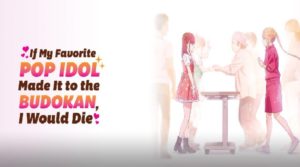
Eripyo is the only fan of a minor member of an “underground” pop idol group. While the management is clearly pushing the “top three,”  ChamJam member Maina is always in the background. But Eripyo is determined to contribute to Maina’s success…and would totally tell her, if everything in the world didn’t conspire to keep them apart.

I’m not trying to be a downer. I have been following this creator for about a decade, beginning with Manga no Tsukurikata, a “Yuri manga” with little to no Yuri. I have been following this manga series, Oshi ga Budokan Ittekuretara Shinu, since it debuted in 2016. I recommend you read my reviews, because they detail exactly why this series is not a comedy, it is a tragedy, dressed in a clown nose and funny wig. This story is a brutal look at the pop idol industry from the point of view of the fans who are willingly manipulated by it. It’s harsh. It’s hopeless. And yet, because Eripyo and Maina could love one another, if they could ever manage to speak to one another, it strings you along, like Eripyo herself, with unfounded, idealistic hope.

Yuri is complicated in this series. Eripyo is clearly besotted, and she and Maina might, in some other reality, be able to fall for one another. In some ways, the more interesting relationship is hinted at between Maki and Yumeri (although I thought it was Yumeri and Yuka in the manga. Maki is one of the few characters I can actually recognize in the manga, where everyone’s hair looks similar.) In any case, Yumeri is the queer girl in the mix. Since Maina’s story is not within the group itself, it isn’t really something they discuss. There’s the group’s collective internal life, which has it’s own drama, and Maina’s little issue, which is droll and unrelated.)

The animation here is not terrible. I was super pleased that ChamJam got an actual song to sing for the first episode and the animated dancing looked pretty much like the kind of minimal choreography one might actually expect from a group like this. The voice acting is very decent, Ai Faoruz is doing a genuinely fantastic job as Eripyo.  In fact, all the voices are spot on. It’s just that I have no hope that there can be a happy ending. Certainly not for the anime, as the manga is ongoing. If you’re really enjoying it, hang on, because one of the next few episodes is breathtakingly horrible and once past that, it settles down into an low-level existential dread-filled hope/disappointment cycle. This is a direct quote from my review of Volume 5: “Their eyes meet, they have a conversation, no plants fall and Eri doesn’t end up injured. They are practically married.”

Ratings:

Art – 8
Story – I don’t know what to say
Character – 8
Yuri – 10 and 0 as only Hirao-sensei can manage it.
Service – Because animators can’t just not.

Overall – I don’t know. I don’t know anything anymore. Just leave me alone and let me sulk.

Watching this series is even worse for my blood pressure than reading it. I’ve had to stop joking about strangling the author in a comedic fashion, because it’s no longer funny.


Yuri Manga: Hello, Melancholic!, Volume 1 (ハロー、メランコリック! )

January 9th, 2020

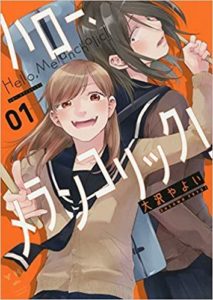
Today I wanted to review something that made me happy. And, for several reasons, this book was just the ticket. Ohsawa Yayoi’s Hello, Melancholic!, Volume 1 (ハロー、メランコリック! ) is an emotional rollercoaster with a sound track. ^_^

Asano Minato is hiding in plain sight. She’s tall, but she’s very quiet, and very withdrawn. She keeps her hair over her face and her head down. It’s not hard to see that she’s avoiding being seen. While eating lunch alone in her secret spot, she hears what is obviously an instrument. She immediately wonders why, since this high school doesn’t have a band. She knows that…because that’s why she transferred here.

Despite every attempt to hide, Minato is spotted by an upperclassman who begins to dog her. Hibiki-sempai, it turns out, can tell that Minato is a good musician…and she wants her for her band. It’s not an official school band, just for fun. Minato says no, but ends up in the clubroom anyway, where one of the other students makes a joke about her not coming to practice with her instrument. “Read the atmosphere,” she says and Minato panics and runs away.

Hibiki follows and learns why Minato is at this school. A talented and enthusiastic trombone player, Minato was chosen for the competition band in middle school over an upperclassman….and was ostracized by the other band members for it. “Read the atmosphere” was the flail they used to torture her until she just gave up music and, apparently, life.  She explains all this to Hibiki who is very kind, but tells her to bring her instrument and come back to the room tomorrow, anyway. They’ll play, just the two of them.

Despite the stares as she carries her trombone around, Minato does come back and the two of them play a free form duet. Hibiki is once again very kind and notes that Minato isn’t just good, she’s got an exceptional ear. And once again, Minato runs away, this time because it’s too much, it feels too good.

But there she is again, the next time and she meets the rest of the band, Sakiko on flulte and Chika on guitar and Emma, a half-Russian student who can play everything. With Hibiki on drums, they’d like to perform in a local festival; Hibiki is determined to get Minato in their group. Minato concedes and her life changes radically with her new group of friends and Hibiki-sempai who makes her experience and feel all sorts of things she had given up on.

When Minato realizes that Hibiki-sempai’s hand is injured, it’s her turn to be strong enough to make demands. And she demands Hibiki care about her own body. Will they be able to play in the festival? Where is the Yuri in this Yuri manga? Tune into Volume 2 to find out! (If you’ve read ahead, please do not feel the need to spoil. I get the magazine too. This is a review of Volume 1. Thanks for understanding how this works. ^_^)

Hello, Melancholic! is a story of a life redeemed from the darkness. It’s a joy to experience sneaking out and jammimg with Minato and a delight to see her lifted by Hibiki and given space and imprimatur to spread her wings and fly.

But, even more of a delight, in the author’s note, Ohsawa-sensei commented that the first chapter has been released as a voiced manga promotional video on Youtube by Ichijinsha, who calls it a “PP” for “power push.” I immediately ran over to catch it and found myself tearing up as I watched. It was quite wonderful. The art was given color washes that were very impactful and as Hibiki and Minato play, the frames go from B&W to a kind of rainbow ink for a fantastic visual parallel to Minato’s emotional state. And they even wrote actual music for us to listen to for the jam session. It was a lovely touch for a manga so wrapped up in the idea of music. Top marks all around. Take a look and enjoy!


Ratings:

Art – 9
Story – 8
Characters – 8
Service – 2 A bit, but Hibiki’s doing it on purpose
Yuri – 1

Overall – 8 because it’ll get better and needs room to go up. ^_^

This was definitely the manga I needed today. ^_^


Yuri Light Novel: Bloom Into You Regarding Saeki Sayaka, Volume 1 (English)

December 22nd, 2019

When you watched the Bloom Into You anime, you saw it. Maybe you understood it. Probably if you were queer, you had lived it.

You saw the way Sayaka held her coffee cup, the way her fingers tightened around it before she asked what was clearly one of the most difficult questions of her entire life to date, “Are you and Hakozaki-sensei dating?” You saw it and maybe if you’re queer, you knew what it felt like on a visceral level. The first time you said the thing. You probably knew the tightness in your muscles when you first saw someone looking at you and understood that they were looking at you that same way that you were looking at them. That you had something in common. The thing.

This is why it was so important to me that Bloom Into You: Regarding Saeki Sayaka, Volume 1 captures Sayaka’s inner voice so well. Not because I identified with her (although we are all her, in some way,) but because of this.

As I read the first of what I hope will be three novels, this was the moment when I knew I why her voice was so important:

As my senses sharpened, the path ahead grew brighter and clearer. My defenseless heart was exposed to the picturesque sunlight. And as I observed my current self neutrally as if from the outside, I finally realized something.

I was angry.

Right now, I was incensed. But why? I plumbed the depths of my heart for the answer.

Sayaka has spent the first 14 years as a spectator in her own life. This is the moment when she ceases to observe and begins to participate.

In this volume, we learn about Saeki Sayaka from two key moments in her life. The first part of the novel follows 11 year old Sayaka’s encounters with a girl her own age who, we can see from our distance, is in love with – or more probably correctly, desires – her. Sayaka has a bit of a sense of it, but it’s not until she experiences desire that it make sense to her. The second half of the book follows her when she is approached by someone who claims to love her, who she comes to love and who, ultimately, hurts her. And when she begins to understand herself, finally.

Saeki Sayaka and I differ in one very concrete way. I read a lot of fiction as a child. This is not an aside, or an irrelevant comment. Sayaka guesses at and correctly identifies her emotions as she experiences them. Had she read fiction, she would not have needed to guess. ^_^ But we know, because we are told it, that she doesn’t care for fiction. It is a testament to the author’s grasp of Sayaka’s voice, that we can be inside her head as she objectively discusses the range of emotions she’s experiencing. It was so wholly consistent with what we knew of her, I had to be impressed. As I’ve said in previous reviews, I consider Iruma’s writing inconsistent and wasn’t sure that the Sayaka we knew would be reflected here. When I reviewed the Japanese edition, I was happy to note that it was.

I’m even more pleased to report that the translation, by Jan Cash and Vincent Castaneda, with adaptation by Jenny McKeon, and editing by Nibedita Sen and Jenn Grunigen, preserved that voice in the English edition. (I’m also chuffed as heck to see my friend Julie Davis as Managing Editor on this volume! For one thing that means that Seven Seas has gotten to the point of size, volume and sophistication as a publishing company to be hiring managing editors which is a very good thing.) I trust this team to do the best possible job with a character I actually want taken care of. ^_^

Their hard work means I don’t have to spend my energy making the novel work and can instead spend my energy resenting Yuzuki-sempai and enjoying Sayaka watching herself swear to never fall in love again, then almost immediately fall in love with Nanami Touko. ^_^

Which is how it should be.

Ratings (same as the Japanese volume):

Art – 10 well, since the creator of the original did the illustrations, that stands to reason
Story – 8 In and of itself, not riveting, but it nails the character’s voice.
Character – 10
Service – 3 bathing suits and changing rooms
Yuri – Well, now…this is hard. I’m calling it a 5 because it’s so complicated

Overall – 9

For the interior life of a young lesbian, told in a way that is completely consistent with the character as we know her, Bloom Into You: Regarding Saeki Sayaka, Volume 1 is a very good book.

Thanks to Seven Seas for the advanced review copy!