Welcome back to Guest Review Wednesday here on Okazu! Today we have a special Guest Review by Christian Le Blanc of 3DComics! His love for Kiss & White Lily is infectious. Let’s all be whisked away by his enthusiasm!
“Love is not gazing at each other, but looking in the same direction together.”
So opens Volume 8 of Canno’s Kiss & White Lily for My Dearest Girl from Yen Press (translation by Leighann Harvey, lettering by Alexis Eckerman), and it’s as romantic a spin as can possibly be put on this volume’s tsundere vs. tsundere cover stars. Hikari Torayama (reddish-brown hair, Tiger type, Ayaka analogue with her long hair and headband) and Nagisa Tatsumi (silver hair, Dragon type, Yurine analogue with her cool personality) are rivals for the position of Student Council President. Who can’t stand each other. And who also, as luck would have it, live together – a twist of fate has landed Hikari as a guest in Nagisa’s house. We need this plot device to force them to spend time together, because otherwise they’d avoid each other like the plague and we’d have a different pair of girls on the cover. Which would be a shame, because once I got over the fact that these two are not going to be acting lovey-dovey and give me anything to swoon over, I started to enjoy their relationship, which exists as a mirror for Ayaka and Yurine. Ayaka and Yurine are rivals who want to be more than just that, while Hikari and Nagisa can’t think of anything they’d rather be than rivals with each other. “Even if we stop being rivals someday…we might eventually see eye-to-eye,” Ayaka tells Hikari…”But just as classmates, of course!” she adds, still in denial.
The Tao of Canno
It’s easy to suppose how Canno came up with Hikari and Nagisa – start with the idea of tsundere vs tsundere, and then inform their personalities and rivalry with Tiger vs. Dragon, the eternally-opposed yin and yang of Taoist mythology (the kanji in Hikari’s last name means “tiger” and “mountain,” while Nagisa’s means “dragon” and “sea”). Both are symbols of strength, of course, and both girls dominate over the rest of Seiran High School: they excel in academics, they’re in competition for Student Council President, and they feel ‘larger than life’ compared to everyone else; they’re the boss characters, if Kiss & White Lily were a video game brawler (now there’s a thought!). Of Tiger traits, Hikari demonstrates protection: “She’s good at taking care of people.” She’s concerned about the smaller, more vulnerable clubs, and picks up after Nagisa at home. Of the Dragon traits, Nagisa demonstrates prosperity: she favors the larger clubs, and acknowledges that “My family is relatively well off.” They hang out on the forbidden school roof a lot (the heavens); naturally, the little white cat they’re looking after together adores Hikari and hates Nagisa. Maybe they complement each other, maybe they even need each other, but it’s no accident that we don’t see them exchanging chocolates in next volume’s Valentine’s Day back-up story. All the same, through their three chapters together, it’s fun not only watching them bicker, but also seeing how they react whenever something threatens to send them in different directions.
Our Returning Champions, Ayaka and Yurine
The book opens with Ayaka considering her own run at the presidency, which organically introduces our cover stars who go on to enjoy the spotlight in the next three chapters. Yurine has started to act goofy and awkward around Ayaka, a result of her growing and changing feelings towards her, especially after Ayaka helped her out of her depressive episode last volume. She’s torn between wanting to support her friend, knowing she could help the school as much as she helped her, but also knowing she won’t get to see as much of her if she wins. When Ayaka tells her her decision concerning the elections, it helps Yurine realize her true feelings for her, and grow out of her selfish and simplistic ‘deredere’ (constantly, clingingly affectionate) archetype. She can finally be honest with herself, something Ayaka is still struggling with when we see them again in the fifth and final chapter.
Speaking of this last chapter, Ayaka’s cousin and roommate Mizuki has had just about enough of Ayaka’s blitheness. She’s graduating soon, and, having been her emotional support for the past several years, wants to make sure Ayaka will have someone she can talk to after she’s gone. When she realizes that Ayaka still doesn’t even have so much as Yurine’s phone number, she demands that she asks her for it first thing in the morning, later hinting that she needs to be way more honest with herself.
It isn’t until the walk home from school that day that Ayaka finally does clumsily take the next step, managing to ask Yurine for her number. She tells her “Sorry. I kept you waiting too long” when she makes her miss her crosswalk light, but I think it’s meant to apply to more than just that.
This entire chapter, Yurine has been the model example of supportive. She knows Ayaka’s been trying to tell her something, and gently gives her the opportunity. Instead of making a huge embarassing deal out of getting her number, she just lets her know that she can call her anytime. Which is good, because Ayaka’s mom phones her that very night, triggering one of those depressive episodes that Mizuki was so worried about. Yurine handles it like a frigging champ, though. She didn’t really know what she was doing when she helped her out of a similar episode in vol.5 (we see an allusion to this episode on this chapter’s title page), but between that experience, and the help she got from Ayaka last volume, she’s become the epitome of everything you’d want in a friend helping you out when you’re at your lowest.
Lastly, we’re treated to two bonus stories at the end of the book. I didn’t really need an origin story for how Nagisa was recruited into the student council, but it did at least give Canno an excuse to bring back the eternally beleagured treasurer from vol.3 (who Yukina kept butting heads with…she even gets a name in this volume!). The other story brings back Amane, Ryou and Nina, the cover stars from vol.6, to show where the little white cat came from.
In fact, there’s a ton of returning characters this volume, obscure and otherwise: Rika “not good with her hands” Kouno is in one panel, who was only ever in two pages in vol.4. Tsubasa and Karin appear in one panel at the dorm, who likewise were only ever on two pages from vol.2 (Tsubasa was the one who accidentally locked Chiharu and Maya in the dorm’s storeroom together). We see members of the public relations committee again from vol.5, and, charmingly, their club sign that’s still only taped up over the more permanent “science” placard underneath. Characters who had leading roles in previous volumes play supporting roles here as well (we only get the back of Izumi’s head in one panel, but she’s there!). Not only does this provide more of an ensemble feel for the book, but it’s a good bit of world-building that makes Seiran High School feel more ‘real’ and lived-in. Further realism is established via small details like how Nagisa has a ‘lazy’ version of her hairstyle when she’s lounging at home, and how she and Hikari are on a first-name basis, sans honorifics, when noone else is around. This all makes re-reads a lot more interesting for me, because it always feels like I’m catching some small detail or other that I hadn’t noticed before. We’ll be seeing more adherence to continuity, as well as progress on Ayaka and Yurine’s relationship, in the penultimate Volume 9, due out very soon on May 21st, 2019 from Yen Press.
Ratings
Art – 7 I feel so petty bringing this up, but the English edition again uses significantly thicker blacks than the Japanese version, which causes tones and shading to suffer on occasion. Worse, however, are the jpeg compression artifacts visible on the front and back covers. As for the art itself, it is as detailed and charming as ever. Hair in particular has a great deal of definition and shading, rendering it with a great deal of volume and depth, and the snow and moon in the last chapter are rendered beautifully. (I’ll admit that maybe…in the right light…Canno isn’t all that great at drawing cats, but that just adds to the charm for me)
Story – 9 I average an 8 for Hikari and Nagisa, and a 10 for Ayaka and Yurine. We’re nearing their endgame, and watching Yurine be there for Ayaka was one of my favorite chapters in the series. Leighann Harvey has done a wonderful job translating every word, barring a weird side note concerning the quotation at the start of the book: my wife recognized the quotation, which is from Antoine de Saint-Exupéry’s Le Petit Prince (uncredited here). The quotation at the start of the Japanese edition is already in English, and is closer to the more proper quotation “Love does not consist in gazing at each other but in looking outward together in the same direction.” I think Leighann Harvey must have translated the Japanese version of the quote into English, ignoring the English version that was already there, all of which says nothing of the original French version of the quotation (!). Not a big deal, just a neat peek behind the curtains of translation.
Characters – 9 There’s a ton of character development going on in this volume.
Yuri – 7 That might seem like a high number considering three out of four main characters are tsundere, but you have to keep in mind that nearly everyone at Seiran is in some form of Yuri relationship.
Service – 1, by default. (I thought it was a cute touch when Nagisa’s mom told her to stop laying around in her underwear, but Canno withheld such salaciousness from the visuals)
Overall – 9

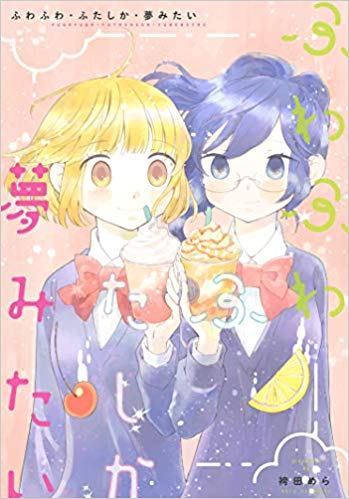 Fuwafuwa・Futashika・Yumemitai, Volume 1 (ふわふわ・ふたしか・夢みたい) by Hakamada Mera is an incredibly pleasant, low-drama story of a high school romance.