Archive for the Artists Category


Yuri Manga: Oya ga Urusainode Kouhai (♀) to Gizoukekkonshitemite (親がうるさいので後輩(♀)と偽装結婚してみた。)

September 13th, 2018

Today we’re looking at Oya ga Urusainode Kouhai  to Gizoukekkonshitemite (親がうるさいので後輩(♀) と偽装結婚してみた。) by Kodama Naoko. Compared to her last series, NTR: Netsozou Trap, this isn’t problematic at all, but that doesn’t meant there aren’t problems! ^_^;

Machi is a fairly typical office worker. She’s got a male co-worker who keeps regaling her with tales of domestic bliss with his girlfriend and questions about her own future. Doesn’t she want to get married? Machi doesn’t particularly want to get married, but her parents aren’t listening. They are pounding her with eligible men and demanding she do the right thing. Machi is painfully aware that her parents have always demanded she do what will embarrass them least and she’s always acquiesced. But not this time.

Machi’s roommate and kouhai, Hana, thinks she has a solution. Shibuya is now offering same-sex partnership certificates. If they sign up, then Machi’s parents will have to get off her back, right?  Unsurprisingly, Machi’s parents do not feel that this acceptable and they are instead very rude to Hana, which finally forces Machi to take a stand. She demands her parents apologize to Hana, and the two women leave. 

But if the idea of a fake same-sex marriage of convenience isn’t going to bother us, then the idea that the actual relationship between Hana and Machi is horribly unfair, is just fine. (-_-) 

Because Hana is actually in love with Machi. And Machi is, but has no idea she is. Yes, she likes that Hana is there when she gets home, that there’s food and companionship. She’s pleased that Hana’s design business is taking off, but she’s taking her time figuring out that Hana means more to her than just a roommate. 

It’s not until Hana goes out to drink and speak with a former girlfriend that Machi finally groks her own feelings. But now, she’s got to cope with the embarrassment she’s feeling. She’s legitimately embarrassed at how’s she treated Hana, BUT, because if Kodama-sensei can’t make us feel uncomfortable, she’s not doing her job, apparently, Machi’s even more embarrassed because she’s has no idea what a same-sex relationship should be like. When Hana starts to make love to her, Machi immediately reacts with detachment, so Hana backs off. Hana’s the real hero here – she understands Machi in a way that Machi herself has no clue about. And, unlike “nice” guys everywhere, she’s very clear right from the very beginning about her interest in Machi, so there’s no confusion AND she accepts Machi’s boundaries without question.

Slowly, Machi unravels her discomfort, her embarrassment, her emotional armor and Hana’s perfectly content to be there with supportive love. As the story ends, we can see them with a relationship that is no longer a sham.

A second story about an athlete in a slump and the best friend who is there for her is nice, and reinforced the problematic narrative of “just wait and eventually they’ll come around to noticing you.”

I enjoyed this volume, despite the fact that the plot drivers aren’t really appropriate in the real world. 

Ratings:

Art – 8
Story – 7
Characters – 9 for Hana
Service – 2 Some light romance/sexual discomfort
Yuri – 7
LGBTQ – 4 Mention of the real-world same-sex partnership certificates, but no discussion around it

Overall – 7

In comparison to her previous work it was a light-hearted gag, a comedy movie, a lark. 
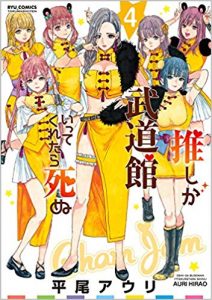


Oshi ga Budokan Ittekuretara Shinu Manga, Volume 4 ( 推しが武道館いってくれたら死ぬ )

August 30th, 2018

Here we are at Hirao Auri’s latest attempt to drive me into an early grave. In Oshi ga Budokan Ittekuretara Shinu, Volume 4 ( 推しが武道館いってくれたら死ぬ ) nothing happens. Nothing happens in the most dramatic and frustrating way possible, which I grudgingly admit is the creator’s style, after all. A style I named manga interruptus, in between fantasies of strangling the author while reading Manga No Tsukurikata.

On their way to Budokan (which is the end goal, as the title clearly states) the ladies of Cham Jam participate in other group idol festivals, including one in far-off Hiroshima. Tickets are hard to come by and super-fans’ lives are put on hold to make it possible for them to be there to root their special idols on. 

Cham Jam runs into a former member who now has a new act, and we spend time with a few of the idols – Maki gets a lot of page count this time – getting a better idea of their internal lives, so the author can derail his own story and delay any conclusion. Manga interruptus indeed.

Superfan Eripyo and idol Maina are all pained, intense, needy looks from about 8 feet apart, but every time they are standing face-to-face, touching hands for the prescribed number of seconds allowed per purchase, they become tongue-tied and incoherent. That happens several times this volume, so it can be more and more fun as the story creeps along. 

Ratings:

Art – 8
Story – Argh
Character – 8
Service – 1
Yuri – Argh

Overall – Argh

I never learn, do I?


Yuri Manga: Bloom Into You, Volume 5 (English)

August 22nd, 2018

Bloom Into You, Volume 5 is a fairly major turning point in this story – characters are starting to be more honest with themselves and about themselves and, as a result, running into far more complicated questions about who they really are.

Touko and Yuu spend some time together during summer vacation. For a little while they get to be just two teens having a nice day together. It feels good. But once back at school the school festival is getting close and Yuu has become even more convinced that ending of the play must be changed – for Touko’s sake and for the sake of the play.

Which brings about an unusual shuffling of allegiances in the student council. Sayaka, who likes Touko and has always been by her side, betrays her for her own good. As they wait for their time on the stage to begin, Touko finds Yuu demanding she leave the idea of her sister’s unrealized legacy behind and be who she is. Forced by the play, and her best and closest friends, to give up everything she though she was, Touko has nothing but belief in Yuu left.

This volume feels different in a lot of ways. We and Yuu have been watching Touko define their relationship, but in this volume this changes. Now it’s on Yuu and she’s never seemed more confident. I’ve said from the beginning that I want to believe in the creator and hope that she will carry this story through. In this volume I think I can see where she’s going. Touko had no idea who she was, and neither did Yuu. Once Touko finds herself, if Yuu finds that she does have feelings for Touko it won’t feel like nearly so much of a punt. Ultimately, I really kind of hope that this isn’t a manga that ends with Yuu and Touko together, but I expect to be in a minority of one on that. ^_^

There’s also a side story about playwright Koyomi learning that her favorite writer is a woman and being surprisied by that. She’s forced to rethink her own expectations about meeting the author. I wonder, every time I have read that scene, just who it was for. I feel so strongly that there’s a semi-private conversation gaining on between Nakatani-sensei and someone specific there. 

Ratings:

Art – 8
Story – 8
Characters – 8 As they become more complicated, I like them more
Yuri – 3
Service – 1

Overall – 8

Quoting from my review of the Japanese volume, “This is the first volume we’ve seen Yuu push back at Touko and my interest in this series grew three times as a result. I guess I’d been waiting for Yuu to be an active participant in the narrative; 5 volumes into it, she finally has become one. I now look forward to seeing what becomes of her.


Shoujo Kakumei Utena After The Revolution Manga (少女革命ウテナ After The Revolution)

July 25th, 2018

When Tenjou Utena disappeared from Ohtori Academy, life for the students moved on.

Or, did it?

In Shoujo Kakumei Utena After The Revolution  (少女革命ウテナ After The Revolution) twenty years have passed. Touga and Saionji have become competitive art dealers. But a simple card telling them that “those who seek the power to revolutionalize the world, should return to Ohtori” inspires them to come back and discover that what they had forgotten on the dueling ground.

Juri has spent 20 years as a competitive fencer so she will be a worthy prince to the princess she’s chosen to protect, her Shiori. A competition is crashed by Ruka, who promptly attempts to steal Shiori from her. He must be defeated on the dueling ground in order for Juri to find herself.

Miki has become a concert pianist, but he is facing a crushing artistic block since Kozue fell into a coma, after her husband beat her. Miki and Kozue find themselves on the dueling ground facing each other and attempt to rebuild their relationship from scratch.

In each case Utena appears as both a child harbinger of crisis and as Dios falling from the castle, signalling resolution. But it’s not until Kozue and Miki create a staircase of music, that Utena can ascend to find Anthy – still crucified – and free her at last so they can be together.

The end of the manga sees them all freed, (again,) but in doing so, it gave each of them a completely new history, a backstory that differed from either of the previous manga versions or the two animated versions. To make this manga make sense, we have to ignore the title – this is not really “after the revolution at all.” Sure, they’ve aged, but they haven’t grown. It takes one last duel to push them forward.

Ratings: 

Art – 9 I *have* mentioned that Saitou-sensei’s art is amazing.
Story – 8 One point off for not giving Utena and Anthy the time and page count lavished on the student council
Characters – 8
Yuri – 5 
Service – 3 Naked Anthy still a thing.

Overall – 9

These are not the choices I would have made for a 20th anniversary story, but I respect that these were the choices made by the original team. I just wish we had been able to see both Utena and Anthy 20 years later, as well.


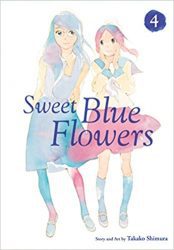
Yuri Manga: Sweet Blue Flowers, Volume 4 (English)

July 9th, 2018

Of Volume 3, I wrote “This volume is, in my opinion the strongest of what Viz will release as four volumes. We can see the progress the young women make as people, before the story turns back into itself to fulfill the requirements of a romance series.” 

Volume 4 of Takako Shimura’s Sweet Blue Flowers, begins with a  problem. Akira is dating Fumi. They have a physical relationship and she’s not unhappy with it, but…she’s not happy, either. Fumi’s interest is sincere and intense, but Akira is going along with it to make Fumi happy, not for herself. This is not a problem that will go away with time.  

The ladies of Fujigaya and Matsuoka schools are all heading into their third year. Once again, the focus is on the school festival, the play and, this time, the class trips. Fumi and Akira’s friends all scramble to find themselves as high schoolers, before they are asked to become adults. Lives and loves are in turmoil as they decide at 18, what will affect them for years to come. 

Akira goes to London, where she seeks out Sugimoto, who seems to have found herself at last. Sugimoto gets Akira to admit that there is a problem with her relationship, but it remains unaddressed – and Sugimoto walks any criticism back.  Which, as an adult reader, made me want to storm into the room and sit them both down. 

The problem builds quietly until, just as quietly, Fumi and Akira break up. Once again, as a reader, I was relieved. And I was thrilled to see, through Akira’s eyes, Fumi with someone else. If the book had ended there, I would have been satisfied. But it didn’t. Was Shimura-sensei pressured by her editor or the fans? Did she have no particular conviction? Or was this the plan all along? I don’t know. 

As I said in 2013 when I reviewed the end in Japanese, “Without spoilers, I will assure you that you the ending does not bring closure. It has the one thing I had hoped for – ambiguity.”

Other relationships, however, get my blessing. Ko and Kyouko, having gone through so much, maybe have a chance, but the one wedding that I wish we had spent more time on was Yamashina-sensei and Ono’s big sister, who come out to family as a couple, even if their families aren’t ready to accept them.

Ratings: 

Art – 9
Story – 9
Characters –  9
Service – 3
LGBTQ – 10

Overall – 9

Here’s the the thing that’s amazing about Sweet Blue Flowers – it started serialization in 2005. It’s 13 years old. More than a decade ago it was a beacon of Yuri. In 2018, it’s an important stepping stone to where we are now, and now that we have a definitive edition for this in English, it’s time to move forward into a genre that has matured.