Archive for the Artists Category


Yuri Manga: Ani no Yome to Kurashiteimasu. Volume 4 (兄の嫁と暮らしています。)

May 15th, 2018

As we make our way through Ani no Yome to Kurashiteimasu, Volume 4, (兄の嫁と暮らしています。) we find ourselves literally forced to see both Shino and Nozomi as fully developed humans apart and aside from the presumptive affection that is building between them. It’s fascinating, it’s awkward confronting my own laziness as a reader and it’s refreshing. 

Let’s address the awkwardness.

When I attended Yuriten last month, I took quite a lot of photos. I posted them publicly on Facebook, for folks to share. People did, which was nice. And, I learned something really important. I’ve been running Yuri-focused online communities for 20 years now and have always demanded a high standard of behavior from commenters. I hadn’t realized how civilized you all are, until folks shared out the pictures from Yuriten with people elsewhere. In fact, I had never before encountered such demanding incoherence in a community of my own. One of the pictures is a spoiler for the “other” girl-falls-in-love-with-her-sister-in-law story Tatoeto Dokonu Itoda Toshitemo (たとえとどかぬ糸だとしても ) which runs in Comic Yuri Hime. The point was not the incoherent grunting of animals the picture caused, but my response to that grunting. I had a long conversation with my computer screen which went like this, “Why are you all reacting like /probably some  negative word/s? It’s a Yuri manga. Of course they will get together. Duh.” 

Which brings me to this volume. I, as a reader, am as lazy and entitled as any other reader. I expect manga by Kuzushiro-sensei to be Yuri.  Furthermore, because I have determined to approach this manga as a “Yuri” manga, I assumed that Shino and Nozomi will naturally get together. But, what if they don’t?

Good question there, Erica. 

In Volume 4, Shino gets a job and Nozomi has a crisis about it. Shino is becoming her own person. She’s adulting. And Nozomi is quietly flipping out because she had put her sister-in-law in a box in which she stayed forever the same, half dependent and half independent and now she has to acknowledge change. As a guardian, as family, as a friend….and, if there is anything else, we don’t yet know and can’t because neither of them are ready to think about that. And, on the other side, they are actually becoming more touchy, more relaxed around each other. Not-quite-friends, not-quite relatives. Definitely not-quite-something-more.

Shino gets to see what other people’s obsessive crushes look like from the outside and Nozomi remembers that’s she really good at being a teacher. They come home to each other, and remind each other of what they have and what they’ve lost. If there is going to be a relationship, what’s going on in this volume will be good for it, as they stop thinking of each other in relationship to themselves and start thinking about each other as people.

Any presumptive Yuri aside, this is a really good story. Should the Yuri no longer be presumptive, I’m okay with it. In the meantime, I’m trying to be a better, less lazy reader. Kuzushiro-sensei’s work deserves that.

Ratings:

Art – 8 It is getting mainstreamy-er
Story – 8 It’s not quite compelling, but is quite good
Characters – 8 Becoming human
Yuri – 2 Going down, not up
Service – 3 Also less than previously, and unusually little for Square Enix

Overall – 8

I don’t know if I know where we’re going, but I’m definitely all in for the journey.


LGBTQ Manga: Claudine (English)

May 8th, 2018

Claudine, by Riyoko Ikeda, is a tragic, yet sympathetic, story about a transgender man. Originally serialized in Margaret magazine, this story is touching and agonizing in equal measure. The story is presented to us as a case study from the perspective of a kind and empathetic psychiatrist who becomes Claudine’s confidant and knows there really isn’t anything wrong with his patient that full acceptance by society couldn’t cure.

The psychiatrist is himself an interesting character and reminded me greatly of the equally kind psychiatrist in Pieta. While this doctor was only able to watch and record Claudine’s life, the doctor in Pieta were able to intervene, allowing Sahako and Rio a chance at happiness. I wonder, sometimes, if Claudine had been written 20 years later, would this doctor have done the same? I feel sure he would have.

Riyoko Ikeda is well-known for the otherworldly beauty of her gender non-conforming characters and anyone who knows Dear Brother or Rose of Versailles, will be used to the character type presented here. Claudine is beautiful and women are attracted to him, but he is not able to maintain a relationship through no fault of his own. And, while there is a Well of Loneliness feel about the conclusion, the end of Claudine’s life is presented not as an inevitability, but a crime committed upon Claudine by society.

For 1978, this was an extraordinary portrayal. It reads a bit old fashioned now, as society moves towards greater awareness and understanding of transgender people, but it’s not stale in the least. 

Of course Seven Seas has done a lovely job of reproductio,n as one expects. I was thrilled to see the talented Jocelyne Allen translating this particular volume. I knew she’d handle it all with skill.  This is a top-notch English edition of a 40-year old classic that I have wanted you all to read for years. ^_^ I recommend it highly. Pre-orders are live; the book is slated for release in late June.

Ratings: 

Art – 8
Story – 6
Characters – 6
LGBTQ – 8
Service – 2

Overall – 7

As I wrote in my 2007 review of the original, “I like to think that, when young Satou Sei was combing literature for reflections of her own feelings and she came across Well, she might have also come across Claudine and, like myself, rejected the tragedy, even as she acknowledged its place in her personal history…. Us Comp. Lit. majors must stick together after all. ^_^”

Seven Seas is branching out into more queer narrative; in upcoming days you’ll also see The Bride Was a Boy, which is a comic essay by transgender creator Chii, as well as My Solo Exchange Diary: The Sequel to My Lesbian Experience With Loneliness. This seems like a perfect start to this week, which will end with TCAF. And, ss we all know, everyone is queer at TCAF! ^_^

Many, many thanks to Seven Seas for the review copy! The original volume of this is one of my prize possessions, it’ll be nice to have it in English!


Hayate x Blade 2 (Nyan), Volume 6 Manga (はやて×ブレード2 6) Farewell Hayate x Blade!

April 15th, 2018

Today we are gathered to praise the the end of one of the greatest manga to ever be drawn, Hayate x Blade. It is with bittersweet tears that we say farewell to this series. I don’t want to be morose, though, this was an amazing series and I had fun every second I spent reading it.

I was introduced to Hayate x Blade by Touko_no_doriru-san in 2005, and have been reading ever since. Statistically speaking, one volume should have been less good than the others, but none ever were. 

Hayate x Blade taught me that physical comedy could actually be funny. 

Hayate x Blade gave me characters fighting in bloody, crazy, amazing action scenes, characters committing their hearts and minds to the act of beating the crap out of one another.  I loved every second of it.

Hayate x Blade gave us characters who would do anything to support and strengthen their partners.

Hayate x Blade shed blood, sweat and tears both figuratively and literally.

In the final volume of Hayate x Blade, Hayate and Nagi finally have the fight they needed to have. 

And most of all, Hayate x Blade 2 (Nyan), Volume 6, (はやて×ブレード2 6), ended on a joke that made me snort my drink through my nose.

Thank you Hayashiya-sensei for this amazing series. Thank you for 24 volumes of manga, 9 Drama CDs (!!!) an animated commercial and 13 years of great fun!  林家先生、ありがとうございました。お疲れ様でした~~!

Ratings:

Art – 10
Story – 10
Characters – 100
Service – I could hear the swords colliding and the screaming. That’s a kind of service, too.
Yuri – 3 hints, jokes, Jun is a lesbian, Yuri-ish pairs, it was always fun and never mattered that there were no relationships.

Overall – 10

I hate to be “that fan,” but I cannot wait to find out what Hayashiya-sensei’s next project is. Hopefully the Yuriforce will be with us. ^_^ (In the fantasy in my head, I’m kinda hoping she’ll have some time to do something for Galette.)

If you have thoughts about this series you want to share, hit me up in the comments. I just want to say that Amachi Hitsugi might be my favorite character in all of manga for all time. 


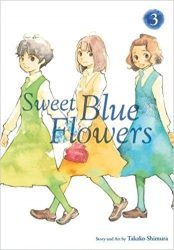
Yuri Manga: Sweet Blue Flowers, Volume 3 (English)

April 11th, 2018

Today’s review is a special sneak peak at a piece of writing for the “Big Book o’Yuri”! Thank you to all my Okazu patrons for making this possible. If you want to support my work – and to get another patron-only sneak peek from the book this spring, be part of the Okazu family! 

Deborah Shamoon, in her introduction to Passionate Friendships writes, “Prewar girls culture created a private space of girlhood, a community of friends insulated from the pressures of a restrictive patriarchy.”

By the late 20th century, the readership of shoujo manga and literature had been well trained to admire – and desire – this “private space of girlhood,” as epitomized by sex-segregated schools festooned with the accouterments of western religious orders. In the year of Maria-sama ga Miteru‘s apotheosis from popular novel to anime series, another equally influential series was being serialized in Ohta Publishing’s Manga Erotics F magazine, Shimura Takako’s Aoi Hana/Sweet Blue Flowers.

Okudaira Akira has herself admired and desired admission to an all-girls’ school, where students walk slowly so as to not ruffle skirt pleats and greet each other with old-fashioned greetings. On her way to school, the modern world intrudes on her idyll and she rescues another girl from a groper on the train. The other girl turns out to be a childhood friend of Akira’s, Manjoume Fumi. They pick up their friendship as if they’d never been apart.

Fumi is going to another girls’ school, more modern than Akira’s old-fashioned one, but no less fraught with the passions that infuse the kind of Yuri story that I have labeled a “descendant of S.”

Even though it was written for the adult readership of Manga Erotics F (an eclectic manga magazine) Aoi Hana embraces the interior lives of its adolescent female characters. The focus is not on sex, but on sexuality and the maturation of the characters’ personalities as they go through the paces of high school life. Joining clubs, making friends, school festivals remain the focus, as is common with much of manga but, after some perfunctory crudeness in the first volume, there’s a surprising lack of voyeurism; an almost an enforced naiveté, in the way the girls view – and are viewed by – the world.

Fumi is very much the embodiment of Shamoon’s “the shoujo,” with her shy personality and verbal reticence, she “does not appear as a threat,” and is meant to be seen as a Yamato Nadesiko, “pure and virginal.”

Fumi comes out several times in the course of the series, in a much more realistic example of “coming out” than usual for manga of any kind. She “comes out” to Akira early on, when she explains that she’s going out with an older student, Sugimoto. She follows this in a later volume by clarifying that she likes girls generally, has had a physical relationship with another woman prior to Sugimoto and reinforcing that she likes Akira in a romantic and physical sense. As Fumi matures, her confidence grows, as we can see in an even later volume, when she comes out again to friends and yet again to a grandmother. This kind of repeated “coming out” to different groups with differing levels of intimacy would be familiar to most sexual and gender minorities. (We can amuse ourselves imagining her later coming out to her parents, as well, although that is not addressed in the manga directly.) For this series of repeated coming out scenarios, Aoi Hana deserves a place of honor. As we’ve mentioned in the trope chapter (reference needed), although coming out is possibly the defining trope of western LGBTQ literature featuring teens (especially in YA literature) it’s largely absent from Yuri manga as a standard trope.

In the end, Sweet Blue Flowers, which gained its own apotheosis into an anime in 2009. It was dressed in the trappings of an ‘S’ tale, but was ultimately a same-sex romance told with a modern sensibility and for an audience which preferred happy endings over the “death or marriage” of early Yuri.

***


In Volume 3 of  Sweet Blue Flowers from Viz,  we are treated to the spectacle of Fumi’s repeated coming out and the affect it has on her circle of friends, most especially on Akira, who must find a place within herself to understand what Fumi’s feeling mean to her. 

The second-years are maturing, rather quickly. Mogi is dating Akira’s brother, and Kyoko seems to have all of a sudden sprung fully into adulthood. With the even more condensed omnibus format, time seems to have contracted here and we’re almost left breathless at the changes from the beginning of the volume to the end. 

This adaptation is exceptional. Reproduction and translation are all seamless, and we’re able to have a very authentic manga reading experience. The only downside of this is that it highlights the creator’s inherent weaknesses in story telling. Shimura creates character-driven narrative, but sometimes the narrative needs slightly more than just interior monologue to drive it. ^_^;

What this volume is, without question, is very lesbian. Fumi isn’t the only gay character any more now that we know that Tamashina-sensei is Ono’s older sister’s lover. And, while the impact of that is hardly touched upon in the narrative, the addition of a role model is important for Fumi. To have someone to talk to…the value of that in a young lesbian’s life cannot be overstated.

This volume is, in my opinion the strongest of what Viz will release as four volumes. We can see the progress the young women make as people, before the story turns back into itself to fulfill the requirements of a romance series.

Ratings:

Art – 8
Characters – 8
Story – 7
Lesbian – 6
Service – 1

Overall – 8

The fourth and final volume of Sweet Blue Flowers in English has a June release date. And then, we’ll be able to talk about the ending. ^_^ There’s a lot to discuss.


Yuri Manga: Yagate Kimi ni Naru, Volume 5 (やがて君になる )

March 29th, 2018

It’s summer vacation and the Student Council is very busy. Between organizing the school festival and practice for the Student Council’s original play, Yuu doesn’t have much time to spend with Touko. They do squeeze in one date, but for the most part, Yuu’s spending her time with Kanou, who is struggling to find an appropriate end to the play.  In the middle of a crisis, Kanou meets one of her favorite writers and is surprised to find that the author is a woman.  Kanou writes a letter to Renma-sensei and, with renewed vigor approaches the script. 

This is not a side chapter. Kanou struggling with a script is really very much the core of Volume 5 of Yagate Kimi ni Naru (やがて君になる ). I say that because, when Kanou decides on a course for the play, it’s Yuu who stomps it down. Why, she asks, no, demands, should the lead even have to be any one of the people that the people around her insist she be? It’s a shockingly profound thought, to Kanou. Even though we can see that Yuu is thinking at least as much of Touko herself, it’s a massive breakthrough for Yuu, not just in how she thinks about Touko, but how she approaches their relationship.

Yuu’s breakthrough leaks into other parts of her life. She encounters a classmate who is crying after her feelings are rejected and says and does the right things. But not only is Yuu shown being supportive and humane, a male classmate joins them and also says and does the right things. This scene was worth my money as it’s an excellent example of a really decent guy handling a woman’s emotions with empathy and decency. A how-to on embracing non-toxic masculinity. It was really sweet.

Ultimately, the only one Yuu has not made any changes for is herself. Until, in the tension before the play, Touko grabs her and pulls her to a back of the building for a kiss. Yuu holds Touko off. She explains that she’s not for Touko, but she does support her, and will continue to do so, but will not be used by her. At which I sat back and said “Finally!” Yuu also demands Touko shed the burden of living up to her deceased older sister and do the play for herself. Which she does. 

A final chapter covers Yuu trying to decide where to hang the charm she got at the aquarium on her date with Touko and all the situations in which it would become awkward. ^_^

Ratings:

Art – 8
Story – 8 
Characters – 8 As they become more complicated, I like them more 
Yuri – 3
Service – 1

Overall – 8

This is the first volume we’ve seen Yuu push back at Touko and my interest in this series grew three times as a result. I guess I’d been waiting for Yuu to be an active participant in the narrative; 5 volumes into it, she finally has become one. I now look forward to seeing what becomes of her.

Bloom Into You, Volume 5 will hit shelves in June 2018 in English so you’ll be reading this pretty soon!