Archive for the Artists Category


Torikaebaya Manga, Volume 11 (とりかえ・ばや)

May 1st, 2017

I just finished Torikaebaya, Volume 11. I’m also reading the new deluxe Revolutionary Girl Utena manga from Viz, Both are by the same artist, Saito Chiho, and I was thinking how very much Koyasu Takehito (Touga’s voice) would be *brilliant* as the Emperor if they ever did an anime. (They won’t. Nothing happens for long stretches). So I sort of happily sat there imagining Hisakawa Aya as Yuzuru-Shinou and Mitsuishi Kotono as Umetsubo and on and on and suddenly it all came crashing down in my head when I realized that the person who should be – deserved to be – Suiren and Sarasoujuu, Kawakami Tomoko…is dead. And that ended that little fantasy. :-(

In Volume 11, some very important things happen and some Very Important Things happen. After spending a lot of time following Sarasoujuu as Suiren, we turn towards Suiren, acting as Sarasoujuu. He has gone off to track down the curse on the Emperor created by the evil priest Ginkaku and although he and his men have been attacked, they recover the curse.

Back in the capital, Toguu-sama completes a beautifully rendered ritual to Amaterasu.

A letter and proof of the curse arrives and she runs off to find Suiren…and find him she does. She comes upon a beautiful young man in a hut and immediately, she recognizes that this is her Suiren, although she has mostly known Suiren as her lady in waiting. Calling Suiren’s name, she rushes to him. They spent a night blissfully together and I got to grin my head off. Yay for Toguu-sama and Suiren.

In the meantime, Sarasoujuu as Suiren, in conversation with the Emperor, accidentally quotes a waka that she had, some years previously, composed as a young lord. Suddenly, the tumblers fall into place and the Emperor can see what has always always been in front of his eyes – the young lord he kept so close and the woman he loves are the same person. He can see that much, but does not (and cannot) understand that this switch is not a switch, but a switch back to her birth sex. He’s Byronically confused through the rest of the volume. (Which is about when I thought Koyasu Takehito would be brilliant as his voice.)

Toguu-sama returns to the capital and is told that she is no longer the heir. Ichinomiya-hime, as she will now be called, couldn’t care less because she has her Suiren. She tells the Emperor that she has always admired Sarajoujuu. I love her. She’s absolutely my favorite character, hands down. (Today in Erica’s imaginary alt-Torikaebaya, Ichinomiya-hime becomes Empress with Suiren as consort. Screw this story’s established literary canon. I want what I want.)

It all looks like things might be turning for the better but Ginkaku has one last evil-eyebrowed trick to play. Before his removal from the palace, he sends a letter to Umetsubo-sama, one of the court women who is Ginkaku’s equivalent of evil doings in the women’s quarter. Umetsubo hates Suiren and has had a feeling all along that Sara and Suiren had switched places. Ginkaku’s letter confirms this. And now she thinks she’s armed to bring the hated Suiren and Ichinomiya-hime down. 

It also means we can see, with complete clarity, what the climax of this series will be, as she forces a sex reveal to “prove” that Suiren and Sara have switched places. But, of course, no one realizes that the initial switch was in childhood and they are currently passing as their own birth genders. Umetsubo is doomed to fail. I hope she’s terminally mortified.

So, with an end in sight, but not necessarily close, I guess the happy end we’re gunning for is Suiren as Sarasoujuu with Ichinomiya-hime and Sara as Suiren with the Emperor, Yuzuru as heir to take the pressure off all four. And hopefully Ginkaku and Umetsubo condemned to a horrible death or something.

That’s my story and I’m sticking with it for now, but I welcome an even better alternative if you have one!

Ratings:

Art – 10 This volume was exquisite
Story – 9 Yay! Suiren and Ichinomiya-hime!
Characters – 9
Service – 2

Overall – 10, but it’s still killing me. ^_^


Yuri Manga: Secret of the Princess (English)

April 28th, 2017

Sometimes, you hope something is finally translated into English, only to find it wasn’t nearly as good as you remembered. And sometimes, it’s the opposite! In Milk Morinaga’s The Secret of the Princess, we split the difference – it weathered the last two years since I first reviewed it relatively well and ended up being a more decent read in English than I expected. ^_^

Miu’s mother has told her repeatedly that the most important thing a girl can do is to devote her energies to being attractive to “her prince” – whomever that may ultimately be. But in the meantime, Miu’s stuck in an all-girl school without so much as a guy to be asked out by. Fortune puts her in the way of some mildly damning information about Fujiwara, the school sports star and, once in a position for some light extortion, she jumps to it. She asks Fujiwara to become a practice prince for her. And, as uncomfortable as the idea makes her, Fujiwara is in no position to protest. So, Miu and Fujiwara begin “dating.”

With a set up like this, in a single-volume Morinaga series, there can be little doubt that the two girls will come around reasonably quickly to having actual feelings for one another. And so they do. Despite the fairly obvious path the narrative takes, it’s not a terrible story. Miu, who might easily have been exceptionally unlikable, changes considerably during the course of the story and Fujiwara, who begins the book as a cipher, ends up equally as sympathetic. For a one-shot, this is a pretty enjoyable read. Even when the tables turn and Miu could easily become a one-dimensional sympathetic bad guy, Morinaga’s writing finds a happier path for the characters and the readers. ^_^

The production is, as one expects from Seven Seas, clean and easy to read. Translation and adaptation by Jennifer McKeon and Shannon Fey give us a pleasant, authentic reading experience. Just what one hope from Yuri manga from Seven Seas. 

Ratings:

Art – 9
Story – 7 Problematic in the beginning, by smooths out over time
Characters – 7 
Yuri – 7
Service – 3 bits here and there

Overall – 7

Miu’s mom, though, phew. What crappy advice to give to your kid!

Many thanks to Seven Seas for the review copy!


Yuri Manga: Kiss & White Lily For My Dearest Girl, Volume 1 (English)

April 24th, 2017

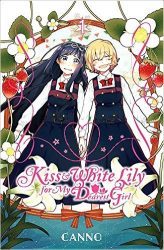
Anoko ni Kiss to Shirayuri wo broke into the Yuri marketplace in 2014. Although it recycled well-worn Yuri tropes, it found a willing audience with the (primarily male) readership of Comic Alive. Subsequent volumes ran with the “Yuritopia” idea and used it to tell increasingly complex and interesting stories centered around relationships at a fantasy all-girl school. I find that, as the stories move away from the first volumes, they have become more interesting – even the relationship of the main couple has moved past it’s initial boundaries.

And here we are, able to enjoy those volumes in English, with Yen Press’ release of the series as Kiss & White Lily for my Dearest Girl. In Volume 1  we meet pathologically hardworking  Shiramine Ayaka and slacker genius Kurozawa Yurine. 

As I’ve said several times recently, this particular set up is somewhat teeth grinding for me. ^_^ I’m not saying it’s unrealistic or anything, au contraire, I know several of those geniuses and let me tell you how *vexing* it is to work one’s ass off only to never be as good. ^_^ So, despite her melodrama, I’m on team Ayaka, all the way. And, if it weren’t for the fact that Yurine was also on team Ayaka, I would have chucked this series away a long time ago. ^_^

But there we are, Yurine has that even more vexing quality of being sincerely lovely as a person. Ayaka is wholly unprepared for liking her rival and even less prepared to be liked in return. Nonetheless, as their like slips causally into “like” like, Ayaka becomes somewhat less unprepared for everything.

A side story starring Ayaka’s cousin Mizuki and her closest friend and track team manager Moe, adds a little typicality to the story and gives the volume another well-worn path to walk through the lilies.

On the negative side, this series inhabits that all-female fantasy world in which adults and men exist only as shadows and barriers to happiness. It’s all a little tiresome. But, ultimately, despite the fact that this series is a “pair-’em-up” it works because none of the characters are unlikable. No matter how well-trod the paths might be, when we can sympathize with the characters, we’ll want them to be happy. We want them to give hope to all the girls who might read this series and imagine that kind of happiness for themselves and hope that some of the guys reading might just get that this is a valid way to be that doesn’t actually involve them and is still okay.

Overall, this series translated well to English. again thanks to the deft touch of Jocelyne Allen (who apparently is the current queen of Yuri translation!) I wasn’t sure if the screaming and melodrama might work, but I’m well-satisfied with the results. Technicals are otherwise well done and once again, I feel that this volume offers the kind of authentic reading experience that fans crave. 

Ratings:

Art – 8 
Story – 8
Characters – 7 
Yuri – 8
Service – 1 on principle only

Overall – 8

This ran in Comic Alive, but it could have run in a girls’ magazine as art and story are firmly rooted in shoujo stereotypes. Volume 2 will be out at the end of May!

Many thanks to Yen Press and Brgid Alverson for the review copy for this volume. ^_^


Yoshiya Nobuko’s Hana Monogatari, Part 2 (花物語 下)

April 6th, 2017

Today I award myself a Yuri History Achievement Badge. I have finished Yoshiya Nobuko’s Hana Monogatari, Part 2 (花物語 下).

So many dead girls.

Girls died from starvation, illness, train accident, ship sinking, and at least one threw herself off a tower. It would be creative if it were, say MURCIÉLAGO, but as it it wasn’t, it was actually a little distressing.

The second half of the series continues the trend we saw in the first half of the collection, as stories became longer and longer as the series went on. In some cases, it worked and others not so much. I will say this about Yoshiya-sensei’s writing – as she has more time/page count to spend on story, she never fell back into lazy writing. Characters get more developed and fleshed out and while large, overarching themes repeat, none of the stories are themselves repetitious.

This second half is notable for containing the fascinating, yet ultimately depressing, Yellow Rose (which has been wonderfully translated by Dr. Sarah Frederick and is available digitally. I recommend it highly and hope you’ll all consider picking it up  For a mere $2.99, you can read one of Nobuko’s best-known, and genuinely interesting stories.

Of the two stories that stick with me, most I have completely failed to remember which flowers they were attached to. ^_^; One, exceedingly long story, spoke of two sisters, one plain and of average intelligence and accomplishment who sacrifices everything to help her musically talented and attractive younger sister to thrive after they are orphaned. It was such a massive ball of misery that just kept dragging on. It never became hopeless, it just didn’t end, and then she died. Well, then. But her sister, at least, did thrive, and I suppose that made it all worth it. Somehow. 

My second-favorite tale was about a young woman who lived alone with her mother and younger sister who quits school to begin working. The description of the office workplace, with the female secretarial and typist pools working with the male staff was fabulous. It was if suddenly we were catapulted from the turn of the century into a 20th century background that we would instantly find recognizable. Men and women smoking in the office(!) and the young typist forming a strong affinity for the woman who ran the typist pool. It was all so 1930s urban. I could picture the clothes very clearly. ^_^ This stood out because, along with Yellow Rose, it portrayed a young woman becoming a professional typist as a kind of freedom and also as a kind of bondage.

Also very interestingly, the second half includes bullying at school – of the sniping behind one’s back kind – and a few stories which were built around betrayal.

If there was one theme, though, that kept repeating, it was the way in which young women interacted with the technologies of the day. From a steam train ride through a horrible frightening storm, to war-time telegraphs, to typing, this books is set firmly in the 20th century in a way that the first half just wasn’t. City vs country was another motif. A number of the stories contrasted urban vs rural. It was pretty obvious that Yoshiya-sensei herself favored the city, but that meant that she often had her characters defend the rural areas with vehemence.

Hana Monogatari was less inside it’s own head than the dense and self-absorbed Yaneura ni Nishojo. The short-story format gave Yoshiya-sensei a chance to really delve into creating different scenarios and the characters who would inhabit them. We spend enough to time with characters, to (in many cases, ) predict the character’s reactions. There’s less frivolity and phantasm in this half, but instead it is filled with a loving look at modern Japanese life in the 1930s through the eyes of young women who lived or died during that time.

Ratings:

Overall – 9

I’m pretty sure that, despite the privation and deaths, I enjoyed the collection as a whole. ^_^ But “Moyuruhana” from the first half still wins and I hope one day to read that in translation. 


Card Captor Sakura, Clear Card Arc Manga, Volume 1 (カードキャプターさくら クリアカード編)

March 14th, 2017

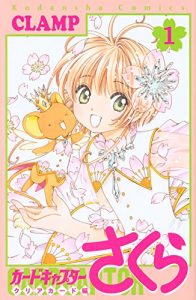
In the middle of series getting reboots and homages,and re-mastering, Card Captor Sakura is back with a honest-to-goodness sequel.

Card Captor Sakura, Clear Card Arc, Volume 1 (カードキャプターさくら クリアカード編) begins a year or so after the original series ends, as Sakura is about to begin middle school. 

The arc begins with a dream, as the other arcs have. A cloaked and masked figure appears. Sakura’s cards are all lost to a storm and a new key appears.  She wakes to find the new key in her hand and all her cards gone. Clearly, she will be tasked with gathering cards once again. 

Almost immediately, she encounters her first card. She and Kero-chan are old hands at this now, there’s no confusion about what to do and she nabs “Gale.” The card has a front and back design, but the background is transparent, and the other side is invisible. Cool. I know there’s a set for sale, I wonder if it works!

Not much has changed in this year that has passed. One major difference is that Yukito and Yue seem comfortable now sharing a body. When she needs to speak with Yue, Sakura asks Yukito if it’s all right. And it is always all right. 

Another is the lack of confusion about how to handle the Clow Cards. It’s all very business-like. Tomoyo, of course (!) is thrilled beyond belief that she can design new costumes for the Card Captor.

And finally, Li Syaoran has returned. The year has been good to him. He’s taller and calmer and clearly more mature. When he and Sakura reunite, they embrace like they really mean it. He’s still carrying the bear Sakura made for him and, although Sakura does not know this, is in touch with Eriol.

The backup cast is the same as well, although class assignments have shuffled them around. Yamazaki and Naoko are in Syaoran’s class, so the stories are even weirder and less pleasant than ever before, to Chiharu’s chagrin. Yukito and Touya are still inseparable.

As the final chapter wraps up with Sakura capturing the Siege card, we and she have no idea at all who the cloaked figure is or what the story is this time. More importantly, neither Yue no Kero-chan know either. (I’ve read the magazine chapters, so I have a little better idea what’s going on, but I’m not telling. ^_^)

If you like the original series for exactly what it was, (as I did), you’ll enjoy this new series. If you’re hoping for something more “adult” you’re not getting it. One year went by, not a decade. But if you did like it, you can also look forward to the new anime, which will premiere in 2018!

Ratings:

Art – 9
Characters – 9
Yuri – 1 Tomoyo is the same as ever
Story – 7
Service – 2 Inevitable slashing of Touya and Yukito.

Overall – 9

Oh, wait…there was one other difference. When Sakura said good-bye to her mother as she does every morning, Fujitaka did not see Nadesico, as he usually does. Hrmmm….