Archive for the Artists Category


Yuri Manga: Watashi no Muchina Watashi no Michi. Volume 2 (私の無知なわたしの未知 2)

February 2nd, 2016

WMWM2Now here’s a thing we don’t see much any more – a review of a Volume 2 of a series for which Volume 1 was never discussed. Remember this kind of thing from back in the day, where we’d get a side plot in a long series? Like Loveless, or Usotsuki Lily? Only this is not like those at all.

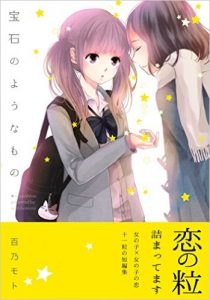
Momono Moto is a Yuri artist who specializes in adult life series. Her Kimi Koi Limit exasperated me and her sequel Rainy Song redeemed her in my eyes.

Well last year, she began a short two-volume series titled Watashi no Muchina Watashi no Michi. Volume 1 followed Minato, a typical woman in a typical office who is slowly being strangled to death by boredom. Until she meets Asami, a moody coworker. I did not review it, because the story centered mostly on Minato realizing how she was dying a little each day and Asami was more or less the catalyst. I wasn’t sure if this series was going anywhere.

In Volume 2, Minato and Asami are starting to break down walls between them. They become lovers, but almost immediately it becomes apparent that there is a dark secret that involves them both. Asami used to study music with Minato’s father…until he claimed her music as his. When it becomes apparent that Asami knew Minato’s relationship with the man who stole her music, and was trying to “get revenge” of a sort, it splits them up. However, Asami realizes that she’s been a dolt and has actual feelings for Minato.

Having nothing left to care about, Minato leaves work and takes a job doing something menial that she can give a shit about. Three years pass and she never stops looking for Asami. I won’t give away the ending as it’s basically the the most interesting bit of the story.

Momono’s work has visibly matured. The art is assured and in places, even delicate. A professional’s work.

And the story too, has matured. Where Kimi Koi Limit took broad strokes at human nature, this series has finer lines and more subtlety. Where I loathed Sono, because of her unremitting selfishness, I could not dislike Asami. Although – in real life, I would not root for Asami and Minato to get together, I would want Minato to grow beyond the relationship and find herself someone without baggage, but of course in the manga we are supposed to want them together.

Another strong quality of this manga is the fact that everyone has society. As moody as Asami is, she has friends, nor is Minato isolated in her world. They exist outside the role they are given in their relationship. That is part of what, for me defines, this as an “adult life” manga, versus a “romance”, like Yagate Kimi ni Naru.

Ratings:

Art – 8
Story – 6
Characters – 7
Yuri – 8, there is no discussion of their relationship as such at all.
Service – 1

Overall – 7

Watashi no Muchina Watashi no Michi is a good, if ephemeral, josei Yuri series from Kodansha.


LGBTQ Manga: Torikaebaya (とりかえ・ばや ), Volume 8

February 1st, 2016

TKBY8For the first time ever, I read a volume of Saitou Chiho’s amazing version of the Japanese classic Torikebaya and thought…maybe, just maybe, there’s a light at the end of the tunnel.

If you recall, Suiren and Sarasoujuu have switched back, as it were, to take up the roles assigned to the gender they were born with. They are, in effect, masquerading as each other, rather than being themselves.

In Volume 8, the person in Sarasojuu’s role, Suiren, is having a slightly easier time of it, as he is not under a lot of scrutiny, but the person in Suiren’s role, Sarasojuu, has yet *another* problem on her plate which is already fully crammed with problems.

Sarasoujuu, as a Naishogami, a lady in waiting, has come to deeply admire and love Toguu-sama, but of course is not in love with her. She is still drawing the frank and open attention of the Emperor, who used to look at her too longly and deeply as a male courtier and now desires her as a female one. This is complicated for many reasons. Sarasojuu as Naishogami has befriended San-no-hime, the elder sister of her own wife (argh!) and while she wants to support her friend in front of the Emperor, ends up taking his attention away from San-no-hime, thus betraying her. (Argh!) And worst of all, Sarasoujuu-as-Suiren has fallen in love with the Emperor (who is extremely handsome, as one might expect in a Saitou-sensei manga.) (ARGH!)

Toguu-sama I think has figured out the charade  but says nothing until she falls ill and asks to see Suiren-as-high ranking courtier, Udaisho. To get Suiren into the women’s quarters an elaborate scheme is concocted, but as the volume closes, Suiren is discovered and the ruse falls apart. (AUGH!)

Despite my protestations, I managed to read this volume without groaning once, because I thought I saw a way out. It’s an absurd, complex way out. BUT.

If Suiren remains in her place as Naishogami by day, but takes Sarasojuu’s place as Udaisho at night, and vice versa, they could be who they really are by day and also sleep with who they want to at night. It would horrible to have to switch back and forth and undoubtedly complicated and doomed to failure, but it’s a story and maybe could work. Probably not. But there you go, as dim a light as it is, I am fixated with the idea.

Obviously it would be amazing if they just were allowed to be happy as is. I just don’t see that happening ever. Even the Tengu switching them permanently isn’t a fix, because Suiren as Naishogami can’t sleep with Toguu-sama and Sarasojuu as Udaisho can’t sleep with the Emperor. Hrm.

Ratings:

Art – 9
Story – 8
Characters – 9
Service – 1
LGBTQ – 1

Overall – 9

Once again a luscious and lovely and emotionally wringing volume of this Heian classic. I’m enjoying the heck out of every single panel!


LGBTQ: Okaasan Futari Itemo Iikana!? (お母さん二人いてもいいかな!?)

January 18th, 2016

2momsIf you read a lot of manga, especially shoujo and shounen manga, you’ll have encountered author’s notes and quite possibly you’ll have thought something like, “Really? You’re writing a note to millions of fans and all you have to say is that you like jelly?” But, when you think about it, we all know manga creators are put through a grinder of deadlines and appearances and it’s probably not all that surprising that they have relatively bland personal lives. If you’re out partying, you’re not at the drawing board, so…. But yeah, it would be nice sometimes to know a little more about the manga artists we love. Maybe the name of their lover, or about a hobby besides drawing manga.

In Okaasan Futari Itemo Iikana!? (お母さん二人いてもいいかな!?), Nakamura Ching-sensei, writing here under her real name, Nakamura Kiyo, gives us an  unprecedented honest and intimate look at her personal life. She lives with her wife (in name only, as Japan does not legally recognize same-sex marriage), Satsuki, and is stepmother to Satsuki’s three sons.

The book takes a good hard look at Kiyo’s and Satsuki’s relationship, opening up a few cans of worms along the way. We learn of Kishie-san, Nakamura-sensei’s deceased first wife, and about abuse in Satsuki’s  and Kiyo’s past (Of which we knew some from Dare mo Korinai.) This books includes thoughts about the tentative legal standing their relationship has and the importance of acceptance by the people around them.

But mostly, this is a book about life with a wife and three sons. An intimate, sometimes touching, look at the personal life of a lesbian couple in Japan today, and an extraordinary look into the life of a favorite manga creator.

Ratings:

Overall – 8

In places this volume is very difficult, in others triumphant…just like life.


Yuri Manga: Seesaw Game (シーソーゲーム)

January 13th, 2016

81H-KM7F5yL-275x388Takemiya Jin has been a Yuri demon, putting out a couple of strong volumes a year, working for multiple publishers and generally churning out Yuri that is not only pleasant to read, but also inclusive of lesbian culture and experience. It’s a hell of a benchmark to keep hitting over and over. So, when I say that Seesaw Game (シーソーゲーム) is not her best book, I don’t mean it’s bad at all, I just mean after a couple of years of a crushing work schedule and an intense multi-volume Yuri series, it’s more relaxing than brilliant.

“Sakasama Onigokko” follows Momo, who still has dreams of her childhood first love, so when, miraculously, Mio transfers into school, Momo can’t believe she doesn’t remember her. To make matters worse, Mio beats her at *everything.*

Hana and Mustuki are best friends. Hana is unusually short and Mutsuki is exceptionally tall. When Mutsuki joins the basketball team, she suggests Hana join too, as manager. But while Hana enjoys watching Mutsuki, she finds herself feeling…something…as her friend gains fame and notoriety.  When Mutsuki admits that she likes Hana, Hana realizes that that was what she felt too. They still have some stuff to work out, first.

I absolutely love “Hatsunatsu Souhi,” a story of reuniting with a dead lover on Obon, and the beginning of a new relationship. The final chapters of this volume follow Hatsunatsu protagonists Misaki and Sa-chan afterwards, as they take a few steps forward together without the ghosts of the past holding them back.

Every story in See-saw Game is pleasant, well-executed and fun. I thought “Hatsunatsu” was quite touching, as well.

Ratings:

Art – 8
Story – 8
Character – 8
Yuri – 8
Service – 2

Overall – 8

Nothing really world shaking, but it absolutely doesn’t have to be to be a good Yuri read. And Takemiya-sensei is always a good read. ^_^


Yoshiya Nobuko’s Hana Monogatari, Part 1 (花物語 上)

January 10th, 2016

HMono1If I bothered to make New Year’s Resolutions at all, my one resolution for 2016 would have been that the first Japanese novel I completed would be Yoshiya Nobuko’s Hana Monogatari, Part 1 (花物語 上). It was, for most of the 20th century, the definitive collection of girl’s literature in Japan, as Laura Ingalls Wilder’s Little House series was in the 20th century for American girls, and as The Babysitters Club is to people younger than I am. ^_^ It is also considered by many people to contain early proto-Yuri work.

And so, after many days of diligently plowing through some amazing – and some amazingly awful – stories, I have fulfilled that non-existent resolution. ^_^

Hana Monogatari, “Flower Tales,” were originally serialized in girl’s magazine Shoujo Gahou from 1916-1924. Each story is named after, and sometimes refers in the story, to a specific flower. The stories follow young women in their teens and early twenties, most often in school, but sometimes as they strike out into adulthood.

The first part of the collection begins with a ribbon story – that is, a scenario that is meant to tie the stories together. In this case, it is a number of middle-aged women, sitting together and reminiscing about their youth. The first dozen or so stories are presented as a flashback, but about midway through the volume, the ribbon story slowly fades and we’re left with a remarkable collection of stories about girls and young women, written by a young woman in Japan in the 1920s.

I’m not going to summarize every story. I honestly couldn’t, simply because there were some where my comprehension was tenuous, to say the least. And I’m kind of on the side of grumpy old folks who say Japanese kids’ reading comprehension has gone down, if this was what was popular with middle school kids in the 1920s! Compare this to most Light Novels being published for adult otaku and Hana Monogatari is practically college-level reading. ^_^;

After reading a number of stories, I started taking notes when a piece really stood out. The first such story was “Cosmos,” sometimes noted as a clearly proto-Yuri story. I’d disagree with that, but that’s an argument for another time.  Cosmos is made up of a girl’s letters to her onee-sama as her mother is in the hospital, ending with her mother dying and the girl having to leave school forever. My note says only “Brutal.” It’s not the only one. Death is a common factor in many of the pieces. The worst of these often had a red shirt on the character from the get-go, such as the younger brother in “Tsuriganesou.” It was instantly obvious the kid was gonna die, but still, the news was presented without a hint of feeling or compassion and I actually flinched when the neglectful uncle bothered to tell his sister. “Ah, um, so…he’s dead.”

“Shiroyuri” was sweet and hopeful, while “Fukujusou” is one of the few stories with what can be considered a “happy ending” when a girl who was parted from her onee-sama meets her again as a young adult.

“Hinageshi” started really beautifully, with two girls meeting at school, dancing in a patch of red poppies flowers and talking while in the rocking chairs in the waiting room, but ended up rather emptily.

“Himomo” was a strange little tale of a girl who is giving and kind, so of course the other girls make fun of her for her sense of responsibility. She has a habit of taking care of what we might think of as a lost and found box. In it, she finds a little set of bookshelves, with lovely letter from a teacher who had to leave the school. I believe this was the first story I read that did not end in a melancholy fashion.

The first story with anything approaching what I would consider to be Yuri, was “Tsuyukusa.” Akitsu and Ryouko love each other, they “yearn” for each other. When they are parted it is harsh and abrupt – and rather cruel on Ryouko’s part. I immediately note the use of the name “Akitsu” – the same name given to one of the protagonists of Yaneura no Nishojo. I wonder who Akitsu was, and what she meant to Yoshiya-sensei. ^_^

“Benibara, Shirobara” was a sweet story that was sweet without melancholy. With the Red Rose/White Rose contrast, I of course saw the kernel of the Rosas of Lillian Academy. ^_^

There were two stories that were really the standouts for me. Of these, we’ll start with “Dahlia,” as I have already brought up Maria-sama ga Miteru. ^_^ This story follows a woman out of school, Touko. Touko has become a nurse in the town in which she attended school. When a former classmate is admitted to the hospital, the former classmate’s rather wealthy and prominent family asks Touko to be their daughter’s private nurse. The head of the hospital strongly encourages her to do that, as it will be good for her both monetarily and prestige-wise. But that night Touko is on the ward comforting a small child whose mother isn’t there and she realizes that this was why she became a nurse. She rejects the offer in order to help people who really need the comfort and companionship. Shades of Marimite‘s Matsudaira Touko lay heavily over me as I read this story, remembering Touko’s own story of early life in a hospital and the nurses there who were kind to her.

The last story of note was really noteworthy. Called “Moyuruhana,” which Dr. Frederick (the scholar who brought us the superb translation of Yellow Rose from Hana Monogatari, which I reviewed in February 2015) suggested be translated as “Smouldering Flower”. This story was…well, it felt sort of like a vampire story without any vampires. Midori becomes infatuated with “Mrs. Kataoka” a new teacher at school. The use of the English “Mrs.” is emphasized, rather than calling her Kataoka-fujin or -sensei. Midori comes to Mrs. Kataoka’s  room one night, where the teacher is described like a “Snow Queen”, pale in the reflected light of the snow outside. Mrs. Kataoka embraces Midori, whispering that young girls like her “are the best.” At this point I read the rest of this story as if it were a kind of Carmilla-esque tale and it worked *perfectly*.  Midori becomes increasingly obsessed, but when she tries to see Mrs. Kataoka again, she’s stopped from entering by a mysterious older woman who strokes a black cat (!).

A guy in a black suit arrives to try to pay off the principal, Wagner-sensei (ya see what I mean about Carmilla, yes?), to hand Mrs.Kataoka over, Wagner-sensei tells Mr. Suspicious to bag off, he threatens the school.

The climax of the story is in fine Gothic form as the school buildings go up in flame and neither Mrs. Kataoka nor Midori can be found and both disappear from the story completely. In the final pages, Wagner-sensei suddenly becomes the protagonist of the story by saving the school.

This was so eyebrow-raisingly amazing a story, I couldn’t wait to tell you about it. ^_^

The initial chapters/stories are short, but as her work grew in popularity, clearly she went from shorter stories to longer ones. As a point of contrast early stories run about 6 pages in this edition and the later stories go as long as 30 or more pages.

Color, too, plays a big part in the stories, as one might expect. Frequently the color of a flower is one of it’s significant qualities. Red roses, violets, tiger lily, daisies, and so on, so you can imagine the scene quite spectacularly clearly when I say “a field of red poppies” or “violets in the garden.” The mood of the story is often tied up in the color associated with it. Lavender twilights and melancholy, golden sunshine and daises, that kind of thing.

My admiration for Yoshiya-sensei jumped up by significant amounts reading this book. While many of the stories were tinged with a melancholy, she manages to play around with tone and voice quite a bit – especially as the stories progress.

Ratings:

Overall – 9

This was not an easy read, there were any number of deaths to deal with, but as I read her work, I’m coming to appreciate it more and more. Hana Monogatari deserves it’s status as the definitive example of early 20th century Japanese girls’ literature. I’m really looking forward to getting to Volume 2!