Archive for the Artists Category


Homunculus Tears: Alchemy For the Brokenhearted

May 4th, 2025

Stories from the perspective of “other” are not uncommon – and especially so in the context of queer literature. Indeed, much of what we have read from inori.-sensei is from the perspective of “other.” In I’m In Love With The Villainess, Rae Taylor, isekaied into her favorite otome game, was not only not of that world, and a gay woman in love with an apparently straight woman, and a 21st century mind in a feudal society, as the story played out, we learned how she was in fact even more “other” than that. The sequel series and inori.-sense’s subsequent novel, The Girl Who Wants to Be a Hero and the Girl Who Ought to Be a Hero (EN release in June, reviewed here on Okazu in JP,) include the ultimate in-world “other,” introduced to us in the form of young women who are, in whole or part, demon.

In Homunculus Tears: Alchemy For the Brokenhearted, we are asked to contemplate the idea – what if there is only “other?”

In our world, including among the readership of Okazu and folks that hang out with me on a regular basis, I count few, if any, people whose lives are unconditionally privileged. I am happily surrounded by creative folks, queer folks, and women of many classes other than elite. We are all – inexplicably, as we are the majority – considered “other” in a society in which the presumed standard is, weirdly, a small minority. In Homunculus Tears, inori.-sensei presents us a world in which any possible not “other” person is invisible, some unseen (possibly non-existent) elite. Instead, we follow people whose lives are treated as “other” to the extent that an entire military exists for the purpose of being eventually eliminated.

We meet Maha, a woman brought into the world to fight, to die, by a soldier mother who values her who only for that fighting skill. The same mother creates another young woman, an alchelmical homunculus, Ruri, to be an even better fighter. They are trained by yet another outcast, a woman who can read minds, which allows her to, yet again, be a strong fighter. None of these people belong in the context of the society in which they live. The members of the society we do see are the poor, the orphans – the outcasts of a society at war. At no point in the story are we privy to the existence of anyone who is not “other.”

The story makes a point of this, too, so it’s not that we are to infer any of this. Maha is not alone as she ponders why she exists at all, why she was given life and why she continues to struggle. Ruri likewise, when faced with the voices of the “other” around her, struggles with the value of life. Why was I brought into this world? Why do I continue to live? are questions that many of us ask during the hardest times.

The answer here is that we are loved, even if it’s not what or how or by whom we expect. A community might be part of a world at war, but it is community, nonetheless. Throughout Homuncuus Tears, we are told this over and over. And may I remind you that, although the not-othered insist “other” is a problem, they are the weird minority, not you, not us. As “other” as we feel sometimes, we are the majority. If we can band together, the demons don’t stand a chance.

The use of the word “anti-natalism” in the author’s note has been commented on in discussions of this book online. Use of “-ism” usually indicates a belief system. In the context of anti-natalism, it would be a belief that procreation itself is unjustifiable. In this specific scenario, it is not a group or society, community or sect with this belief, not a generalized belief system that procreation is bad, but two individuals who question why they, personally, were brought into the world. However – and this is actually quite relevant to our world right now – the only children we meet in this story are war orphans. The question of “why would anyone want children, or desire them to live in our current society” is valid one. It is a valid one in 2025 on the planet earth, as well. Perhaps more people ought to ask that “why.”

The illustrations by Aonoshimo-sensei miss the chance to illustrate any of the excellent battle scenes, favoring pin-up poses and service. I am always disappointed when, rather than seeing Ney and Maha going head to head in a complicated battle of will and magic, I get to enjoy underwear. Again. This is light-novel tropiness that I would not mind losing. I did not feel that either a bath or beach scene added anything of value. I am ambivalent about the Yuri, as well. Both Maha and Ruri are brought into the world by the same woman, and Yuricest is never appealing to me. The loli jokes fall flat for me as well. Maha and Ruri as a couple is simply unconvincing.

What definitely did work for me was the alchemy. I’m fond of magical systems that are consistent within themselves. This alchemy and it’s trappings of tomes, vials, and attacks worked incredibly well. To that point, the character of Metako, (‘meta’-ko, which works really well across three languages) was the most interesting character to me. Her story, the way she worked and her functional relationship with Maha, were high points of the narrative. How Maha uses alchemy is presented as a kind of standard behavior, but in reality it was very cleverly handled throughout. Also solid is Kevin Ishizaka’s translation, which keeps the narrative running smoothly and provides excellent alchemical magic attacks.

Overall, this was a fast-paced light novel that delved into some tough questions about existence, but missed a few opportunities to be great.

Ratings:

Art – The art is excellent, it’s just of the wrong things
Story – 7
Characters – 8
Service – 4 It will never add anything to a story for me
Yuri –  As above, so below.

Overall – 7.5

As a self-published light novel, this book was poised for success. I hope this allows inori.-sensei some room to work her own way. And I look forward to her next original work.


If My Favorite Pop Idol Made It to the Budokan, I Would Die, Volume 5

April 10th, 2025

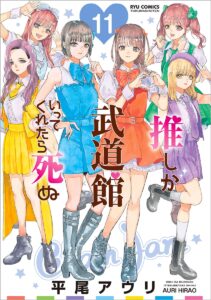
7 young women dressed in cute clothes with purple skirts, different blouses and accessories pose on the cover, looking at us, as if doing a photo op.In If My Favorite Pop Idol Made It to the Budokan, I Would Die, Volume 5, the members of Cham Jam make it to Tokyo. And, while they do not get to perform at the Budokan…or even the other, smaller, Budokan…they are filled with a renewed sense of purpose and gain some new fans.

Eripyo is glad the group has new fans, she is no longer Maina’s only fan…but that puts her in awkward place. Yay, Maina is more popular!, but Eri’s not her one and only any more. Of course, yes, she is and Maina has eyes for no one else. Even though they manage to have an almost normal conversation over a handshake, neither Maina nor Eripyo manage to sake anything of importance, leaving everything they want to say hanging. As always.

It has been six years, *six* years, since I read this book in Japanese. And yet, the sense of desperation and obsession clings to me, still. So when I picked up this volume, I sat down to it much as one does to a meal of leftovers that were just alright the first time and won’t be better now. ^_^; Of course, I know what we’re in for and want to warn you that the next few volumes are just going to double, triple and quadruple down on Eripyo and Maina just not being able to communicate and Volume 7 is, enraging, because it is *almost an excellent volume.* And then, once out of the well*, the story starts to get better somehow.

But as I read this volume, my words from 6 years ago come back to haunt me. “The more I read this story, the more I desperately hope it’s meant to be a cutting commentary on the utterly brutal idol industry, and the equally brutal hobby of being an idol group otaku. Otherwise, it fills me with despair. (Yeah, I know, I know, I keep bringing it on myself.) The idea that this manga is getting an anime is already annoying, but it will probably be meant to be a comedy and I will just want the world to burn.” As we know, to make it a comedy, the anime removed much of the worst parts of the manga to leave us feeling as it was actually a comedy. So if you watched the anime and came to manga from that…the next few volumes are gonna be rough, I’m sorry.

Ratings:

Art – 8
Story – There is one, yes
Character – 8
Service – 1
Yuri – 3 I was convince when I read this the first time that there was another couple among the members of Cham Jam, I know now that, yes, there is.

Overall – 7

I’ll end with another quote from that review 6 years ago, ““Their eyes meet, they have a conversation, no plants fall and Eri doesn’t end up injured. They are practically married.”

*Many ages ago my father told me of a story in which a person was stuck in a well, with no way to get out, at which point the next chapter began, “Once out of the well…”. This parable reminds us that there is lazy writing and there is lazy writing.


Wicked Spot, Volume 1 / ウィキッドスポット

March 20th, 2025

On a vivid yellow background, a woman with wild pink hair in hot pink and black, sits cross-legged, manicured long nails visible on her hand, smiling broadly with fangs showing and an intense look in her green eyes as looks a us.Sal Jiang’s newest manga, Wicked Spot, Volume 1 (ウィキッドスポット) is a classic case of a story beginning in one place and ending way far away from there in many different ways. I love it. ^_^

This begins with a bunch of witch hunters up in the mountains, in a dark, terrifying cave, streaming about their hunt for the unknown. When the unknown pops up to say hi, they pass out from fear, leaving witch Sadako, who has grown up up hidden away from humanity, alone with a cell phone. Fascinated by humans as Sada is, she finally leaves her people and walks into town, using her powers to grab clothes, food, drink, and followers online. Now, she is an influencer.

Hana, a woman with unusual strength and trauma about being called a “witch” as a form of rejection, is 100% a fan of Sadako’s, until she announcas to the world that she is, in actual fact, a witch. Hana goes from super fan to anti in seconds. Sadako tracks her down to see what the deal is.

And then they are both kidnapped by the “Sabbat,” a council of witches and dumped in the one place on this planet witches aren’t uncommon. They have no idea where they are, but, my friends, I was married only a little bit away from that very statue. In fact, our dinner afterwards, was in the same plaza.  So when they awake in Salem, Massachusetts, right in front of the Bewitched statue featuring Elizabeth Montgomery as Samantha Stephens, I smiled. It also makes me smile that this is not the first time the series Bewitched has appeared here on Okazu as a reference!

Ratings:

Art – 8 sometimes beautiful, other times messy
Characters – 8 Yes, this kind of off the wall, please
Story – 9 Awesome so far
Service – Cute clothes are about it
Yuri – Could go any way right now, but I trust

Overall – 8

What will become of Sadako and Hanako? I don’t know and can’t guess and I’m excited about that! Go! Go! Sal Jiang! Write a story that completely does stuff I can’t predict. I love it.


Otona ni Nattemo, Volume 10 (おとなになっても)

February 28th, 2025

Two adult women, painted in watercolor style, embrace as they smile brightly. One, with long dark hair wears a blue and white striped sweater and white slacks. The other has short blunt-cut red/orange hair, wears a green blouse, and red skirt. There are a lot of lose strings to tie up here at Shimura Takako’s Otona ni Nattemo, Volume 10 (おとなになっても). And, while the final bow is a bit messy, everything is tied up even if it means tucking in the aglets wherever there is space.

The story began with Ayano and Wataru married. Here they will, maybe for the first and only time in their lives, speak to each other like equal adults unencumbered by expectations. They can move on freely. Wataru’s mother has a long-needed awakening. There’s no way to know if it will be good or bad for her in the long run, but as a narrative choice, it was crucial. Eri’s story goes slightly pear-shaped, but it leaves Eri out of it. She deserves an epilogue of her own.

Ayano and Akari are fine. They move through this volume lightly, almost as second thought, meeting up with other characters, collecting and tying up all those loose ends.

I don’t know how to talk about the most interesting and weirdest piece of this volume without spoilers, so consider this a warning. Our three middle-schoolers have finally, fully resolved their concerns. When it turns out one of them has written a story about all the characters in the story, the other two jump in to help. What happens is a weird bending of the story itself as they narrate the various pieces of the story…even bits they could not know. 

Was all of this always a narrative told by these three girls? I actually hope so.

I have said this very often, but Shimura’s work is always a little problematic for me. Even beyond the specific kinks/fetishes/issues/whatever,  Shimura mines queer lives for drama, but does not identify as a gender or sexual minority. Does that make the work exploitative? It kind of does, but also, there is clearly a sense of telling genuine stories that heal and promote queer joy, so maybe exploitation is not the right word. Maybe Shimura is closeted, maybe something else, but the body of Shimura-sensei’s work is pretty neck deep in queerness, which seems odd for a person who is not queer. I always want to assume the best, and just hope that this is all a desire to find interesting characters and tell uplifting stories that include queer folk.

This story is queer in a real way. Akari continues to be a lesbian role model, Ayano becomes more comfortable talking about being bisexual, or perhaps always lesbian, but sucked into societal norms. And in the end, pretty much everyone gets the ending they deserve. Whatever the motivation, in both art and story, Otona ni Nattemo has been the best work I’ve seen from Shimura-sensei and the ending being a little bendy at the end, did not disappoint.

Ratings:

Art – 8
Story – 8
Characters – 8
Service – 0
LGBTQ+ – 10

Overall – 8


Hitorimi Desu 60-sai Lesbian Single Seikatsu (ひとりみです: 60歳レズビアンノシングルセイカツ) , 1-3

February 12th, 2025

An older woman in a long gray skit and yellow cardigan kneels down to water  plant in her apartment.Hitorimi Desu 60-sai Lesbian Single Seikatsu (ひとりみです: 60歳レズビアンノシングルセイカツ). is the newest project from Morishima Akiko-sensei. This chapter-by-chapter series looks at the lives of senior lesbians who are single.

Chapter 1 begins with Imamura Miyuki, celebrating her 60th birthday. She’s known she was a lesbian since she was young, and has had lovers, but at this point in her life, she is alone. She’s not unhappy about it, definitely the positives outweigh the negatives. When her sister has her over her parents’ to clean up a few boxes, going through them reminds Miyuki of her dear friend, a girl she now considers to be her first girlfriend. She finds something that connected them, and starts to read a book from Renon.

A round woman in a red coat sits in a wheelchair in front of a house mailbox, looking up at a bird on a flowering tree branch above her.In Chapter 2 we meet Renon. She is 59 years old. Life threw her a curveball when a year ago, on the day she planned on her big gay bar debut in Shinjuku she was struck by a truck and injured. She uses a wheelchair to get around, mostly, is a little ambulatory, but her life is less thrilling than she hoped. Renon lives with her elderly mother and appears to have few hobbies except going out and eating cake. Upon returning from meeting an old friend who is getting married, Renon realizes that she had fallen for that friend thinks about how realizing that she had fallen for her friend changed her life, for good and bad.

This chapter starts on a hard edge. Renon is not a very happy person and we can see that she has given up to some extent. Having had her hopeful gay days taken out of her plans, she just kind of…stopped.

In Chapter 3, we learn more about Miyuki and Renon’s realationship. Renon receives that loaned book back from Miyuki, only 43 years late. Upon reliving her childhood memories of how they met, Renon finds the energy to write her old friend and invite her out. It is clear they were close friends, and felt deep affection for one another. When they meet up at last, they talk of the old days, but when the new days come up, the conversation lags. Maybe they don’t have anything to say anymore? Then the conversation starts up again – they both agree that each other was their first girlfriend….which crosses the hurdle of coming out to each other. The conversation comes more freely now and Renon pours her heart out.

Two girls in Japanese style school uniforms of blue, stand back to back. The wind blows their hair and skirts back as the cherry trees above them blossom.They part, agreeing to see each other again. Miyuki wanders off thinking about the future for the first time in a while and Renon finds the motivation to return to physical therapy. Maybe this reunion will spark something new for both of them.

As our favorite manga artists are ageing up (most of my fave artists are around my age – I have been following many of them for 20+ years now), it is not surprising to find that stories of older women are hitting harder for them, and me. ^_^ In her notes. Morishima-sensei says that she was wanting to write about lesbians who were single and also older lesbians, so this series came out from those desires.

Morishima-sensei is self publishing these chapters through Blic’s Cross Folio label. Blic is the same printer used by Galette Works. All three chapters are available on Amazon JP Kindle, Bookwalker JP and Amazon in English where you can get Chapter 1, Chapter 2 and Chapter 3 in English as THE SINGLE LIFE: The single lives of 60-year-old lesbians.

Ratings:

Art- 9
Story – 9
Character – 9
Service – 0
LGBTQ – 9

Overall – 9

I hope she keeps working on these chapters. I love her art and the characters. She’s got a really solid grip on how people actually think. It’s always motivating for me to read her work. I definitely hope you’ll all take a look at this short story by an amazing storyteller and artist.