Archive for the Artists Category


Yuri Manga: Inugami-san to Nekoyama-san Volume 2 (犬神さんと猫山さん)

May 8th, 2014

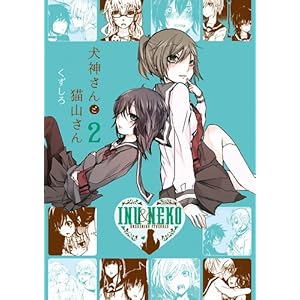
Volume 1 of Inugami-san to Nekoyama-san, (犬神さんと猫山さん) introduced us to the animal-themed cast of a “typical” Japanese high school. Inugami Hachiyo who likes cats and Nekoyama-san and Nekoyama Suzu, who likes dogs, but maybe not Inugami-san, their classmates Ushiwaka (“ushi” means cow, so she is big-breasted, har har), teeny little Nezu Mikine (“nezumi” means mouse) and their zookeeper, Inugami’s friend Aki (whose name means “autumn” and is wholly unrelated to animals.)

In Volume 2, we add a monkey and a bird to the menagerie. The bird is sickly, ghostly, flightly Torikai Hibari, the monkey is class rep Sarutobi Sora. It is with perpetually irritable Sarutobi (who does not get along with Inugami-san, despite her most puppy-like attempts at friendship) that we encounter the one genuinely laugh-out-loud gag of the book.

Sarutobi really cannot stand when people ascribe the characteristics of her animal name to herself. So she says, quite seriously to our resident mouse (who is, apparently, the most worldly of the bunch and the most likely to use sex appeal to get her way.) Quite seriously, Sarutobi explains that their names are just their names and really, people should stop saying she’s like a monkey, she insists as she picks up her schoolbag and pulls out a banana. I laughed as Nezu-san calmly pointed out that that would have been a lot more more convincing without the banana.

I’m struck again at how bananas are intrinsically the funniest of fruits.

Anyway, we do get a shocking amount of Yuri in between the excruciating gags and Kuzushiro’s typical fake-y Yuri. Nekoyama hallucinates (she thinks, she hopes) that Inugami-san kisses her while feverish and we’re told that Nezu and Ushiwaka are an item. And, as unsubtle as Inugami-san is, she’s going to have to be less subtle than this to get her actual interest across.

Ratings:

Art – 7
Story – 6 Slice of life
Character – 6
FanService – 6
Yuri – 7 Slightly more  in the real world-ish

Overall – 7

The Sarutobi gag all by itself notched this up a point.

Tl;dr:


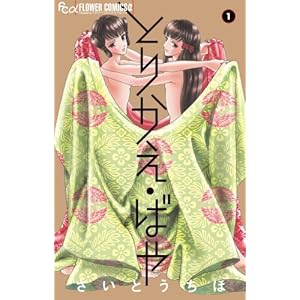
LGBTQ Manga: Torikaebaya (とりかえ・ばや) Volume 1

April 16th, 2014

The Heian period was a period of intense artistic creation in Japanese history. Like the Italian Renaissance or the Chinese Tang period; the cycle of life quality for the well-to-do hit a high and with it came the leisure and drive to create. So much of what we in the West consider “Japanese” culture flourished in that period. Mostly everyone is familiar with Murasaki Shikibu’s famous serial, the Tale of Genji. Fewer people are familiar with the ambiguously comedic/tragic/erotic Torikaebaya, which would probably translate to something like “If only they could switch.” You may recall this story from the 4th season of Maria-sama ga Miteru, in which the Yamayurikai’s school festival play is chosen around Yuki and Yumi’s uncanny resemblance.

When it was announced that veteran manga artist Saitou Chiho, the creator of the Revolutionary Girl Utena manga, would be working on a manga adaptation of the Torikaebaya  (とりかえ・ばや), I was downright ecstatic. Saitou-sensei has repeatedly shown interest in trans* characters and this manga deals not with one character or two who merely switch clothes, but who are entirely suited to the gender expectations of the opposite sex.

The story follows two siblings with the same father and two different mothers, born on the same day. The daughter is active, lively, good at sports, rhetoric and other masculine pursuits. The son is retired, shy, good at music and other feminine skills. Circumstances conspire to allow them to switch clothes – and lives.

I have not read the original in either translation or Japanese and before I even read the manga, I realized that my only encounter with the Torikaebaya was as a comedy, when the Lillian and Hanadera Student Councils had some fun with it. But, I wondered, was it actually a comedy…or a tragedy? As it turns out, we don’t actually know the answer to that. It has been interpreted as comedy, tragedy, social commentary and erotic romp by varying critics in varying ages. That actually made me more interested in it than before! We don’t know what this story is, how cool is that?

Saitou-sensei has specifically set out to treat this story as a story of transexuality. This is stated plainly on the cover and the relationship between gender roles and one’s sex is explored within. The daughter, Sarasoju is painfully aware that she really is not suited to be a girl, and her brother Suiren, likewise, really would do so much better as a girl. They switch clothes and roles and as far as I am in the first volume, their father is complicit in this, having just introduced his “son” to the Emperor.

I have not finished Volume 1, but I know that Sarasoju will play her part as a male well, but that that will not stop her from falling in love with a man, or having intimate relations with him. Her pregnancy is a major part of the original story. But she will also be married to a woman, and in one of the two versions of the tale (known as the Ima Torikaebaya Monogatari), both she and her brother end the tale in functional homosexual relationships.

I’m frequently asked for recommendations on trans* manga, and I usually don’t have much to offer, as trans folks are not well represented. This book will be going on my short recommendation list.

Ratings:

Art – 9 Gorgeous, but how could it not be? Saitou Chiho-sensei doing Heian period. Duh~
Story – 8 I’m intrigued, fearful, hopeful all at once
Characters – 8 Not bad, actually. Dad’s not a bad dude, and Sara and Suiren are sympathizable
Service – 4 Nudity, not nakedness
LGBTQ – 4 We meet them just as their self-identity is forming.

Overall – 9

Saitou Chiho-sensei’s version of the Torikaebaya may well become my go-to version of this Heian classic. Here’s hoping!

If you are interested in a garbled version of the story and a mixed bag of scholarship, here’s the Wiki entry on the Torikaebaya. It’s rather less helpful than I had hoped.


34-sai Mushoku-san Manga Vols. 1-4 (34歳無職さん) Guest Review by Bruce P.

April 2nd, 2014

34-saiIt’s Guest Review Wednesday once again on Okazu and I couldn’t be happier…but that’s because I’ve already read today’s review and I can’t stop laughing. Once again it is my sincere pleasure to welcome back Okazu Superhero, longtime friend, traveling companion and amazing Guest Reviewer Bruce P Yaaaayyy!   

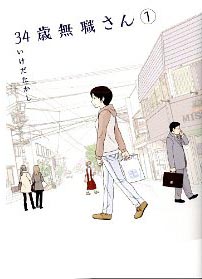
I picked up a copy of 34-sai Mushoku-san (The Unemployed 34-Year Old), (34歳無職さん) Volume 1, by Ikeda Takashi, with the not unreasonable thought that the author of Sasameki Koto might have included some Yuri along the way. I was wrong; four volumes later, and there hasn’t been a hint of Yuri. Instead what we are given is a viciously drawn-out interior monologue of boredom, hopelessness, and personal failure. It’s cruel, peculiar, glacial, and grindingly depressing. Plus it makes me laugh. What a great manga.

The protagonist, who is never named, is a 34-year old woman who lives alone in an apartment and who has lost her job. The first chapter starts right off with a gag–she wakes up and can’t find her glasses (they’re on top of her head). The jokes continue. She doesn’t get up in time to take out the recycling. Her vacuum cleaner falls over. And then it falls over again. What we have here is a wacky slice-of-life story, as our madcap heroine searches for love and employment in the big city! Except…she doesn’t actually ever do any searching for love, or for employment, and as the same jokes begin to repeat, and repeat, it becomes clear that they are not jokes at all. They are symptoms, and despite her best excuses she is a woman in serious trouble.

Though able to deal marginally with others, even if there aren’t many others she ever deals with, at home she lives in a state of almost total paralysis. She cannot pull herself out of her futon until late afternoon, or up from under the kotatsu – Yui from K-ON! all grown up when it is no longer cute. You get the sense that losing the job may not have had much to do with the economy after all. She’s isolated from her family (including a daughter) and has only one acquaintance, a woman she meets occasionally for dinner and who is blatantly drawn with eyes always shut. Her only real companion is her apartment. She just swirls slowly, sleepily around in the drain of her well-vacuumed world. And if that doesn’t make you want to shell out for the multi-volume set, be assured that in Volume 2 she takes dramatic steps to change her life, by contemplating possibly taking dramatic steps to change her life. Contemplation of these steps continues in Volume 3 and Volume 4.

It sounds grimmer than kidneys on toast. Why read it?

(1) Asymmetric though she is, her character is strikingly realistic, and in more spots than are comfortable I can see, in her, a reflection of some of my own unlovely edges. This is both disturbing, and of value when I’m trying to get out of bed in the morning.

(2) It’s beautifully and brilliantly drawn, which nicely counters the subject; some chapters contain no words at all, but are simply picture plays as she bleakly and languorously contemplates her empty life. It’s like mime, in two dimensions, though not as depressing.

(3) Ikeda-sensei has a nice comic touch, and it really is quite funny. Even if laughing at all the pratfalls feels somehow misdirected, like appreciating the Hindenburg disaster on account of it being all bright and sparkly.

(4) Nothing has changed in four volumes. I’m still waiting for the thing to happen.

***

Subcribe with Patreon Enjoy today’s post? Subscribe to Okazu with Patreon and keep it coming!

***

Ratings:

Art: 9. Brilliant. Just brilliant.

Story: 5. Not so much a story as a slowly deteriorating situation. I’m betting on something happening; it eventually did in the classic gently-paced series Yokohama Kaidashi Kikou when Kokone reappeared. My suggestion is to add robots.

Character: 18. She’s not honestly sympathetic, but credit for every year over the age of 16.

Yuri: 0. Unfortunate, but ideally Yuri requires a second character.

Service: 2. A few sponge bath scenes, if you’re desperate enough.

Overall: 8. 34-sai Mushoku-san will not be to everyone’s taste. However, I have never been a fan of action series, and with this one I hit the jackpot.



Yuri Manga: Okujou PikaPika Romance (屋上ぴかぴかロマンス)

March 31st, 2014

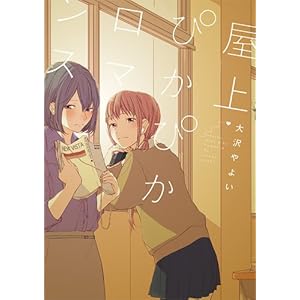
You know what? I think I really, really like Ohsawa Yayoi. Last year I was blown away by her Black Yagi to Gekiyaku Madeline /Strange Babies series, but here we are in her totally grounded in reality collection of shorts, Okujou PikaPika Romance (屋上ぴかぴかロマンス) and I still really like her work. A lot.

In “Shoshin Metronome,” Kawai-san does not like snare drummer Ichibashi-san, but as a trumpet player, she has to sit directly in front of her.  Their relationship changes from prickly dislike to reluctant friendship to maybe just a little more.

Hana and Nozomi have been friends since childhood, but new school friends are pulling Hana in one direction, and she’s not sure if Nozomi is holding her back or not. I didn’t much like this story, as Hana forces herself on Nozomi in a very un-friendly way and a happily ever after does not actually make it okay.

“Double Bind” is probably the realest story in the book, which follows a deeply uncomfortable breakup between two adult  women. Mayu breaks up with Emi to go out with a guy. We follow Emi’s grieving and have to recoil a bit when Mayu shows up again and again, so Emi can’t move on. Worse, Mayu sleeps with Emi as a piece on the side, which enrages Emi. Emi pulls herself together and is starting to get her life back together when Mayu shows up, again, this time having left the guy because she realizes she was an idiot. The story does not have an end, leaving us with Emi’s tearful face. Will they get together again, or not? We don’t know…which is exactly why I think the story works.

In “in secret…?” a student learns there is more to her doofus-y teacher than can be seen on the surface. Carole King’s version of You’ve Got a Friend plays an important role in this story, which immediately made me think of nawoko’s Voiceful.

The final story is an original for this collection which returns us to the somewhat fraught relationship between Kawai-san and Ichibashi-san, as they find more than just a friend in one another.

Ratings:

Art – 8
Story – Variable, but 7 overall. “Double Bind” is hard to read, but really the standout story at a 9
Characters – 7 You like some more than others, just like life. ^_^
Yuri – 9
Service – 2

Overall – 8

Yet again, I find that I connect better to these stories as a collection, rather than individually in Comic Yuri Hime. And I strongly hope we’ll be seeing more from Ohsawa Yayoi-sensei.


New Yamaji Ebine Manga in Feel Young Magazine

March 23rd, 2014

ScanIn the February volume of Feel Young (フィール・ヤング) magazine, Yamaji Ebine has a new series starting that, at least at first glance, warrants our attention. “Binetsu no you na” (微熱のような), which I’d translate as “Like a Mild Fever” begins rather abruptly, in the middle of a conversation between Nao, a typical Yamaji-esque protagonist, and Mifuyu, an acquaintance at university, on their way to discuss a book with the author.

During the discussion, Nao finds herself suddenly quite tired. She wakes up in Sensei’s home, wearing a negligee, with no memory of how she got there or what happened. Sensei says that it was Mifuyu who undressed her and put her to bed.

Nao confronts Mifuyu, who thinks it all quite funny. After a conversation about Nao’s best friend in high school, Taki, who has gone to college in England, so Nao is feeling a bit lonely, Mifuyu also contrives to get Nao alone with her boyfriend, Yoshiaki. Yoshiaki hits on Nao, not in a bad way and, lonely, disappointed in her friend Taki, for becoming “just another normal woman and getting a boyfriend,”  Nao sleeps with him. Again, Mifuyu find this very amusing.

But it isn’t until Mifuyu hugs her that Nao feels anything. She’s suddenly aware of the electricity between her and Mifuyu, even as she is completely aware that there is something quite broken in the other woman.

In chapter two, things become even more complicated. Mifuyu still positions herself as Nao’s friend and it’s increasingly obvious that Nao is attracted to her, even as she’s leery of her. But Mifuyu is setting Yoshiaki and Nao up more and more…and we learn, (perhaps not surprisingly) that she’s watching when they have sex.  The second chapter comes to an end with Nao visiting Sensei and having her work critiqued. She asks not to be sent home that night, and Sensei obliges.

So far this story is, as many of Yamaji’s recent stories have been, uncomfortable. The attraction Nao is feeling and the actions she’s taking are in pulling in two opposite directions. And I can’t help but feel that Mifuyu is pulling the strings for some reason of her own. I wonder where this story will go, but I’m kind of not willing to think about it, either. ^_^;

Ratings:

Art – If you like her bare style, then 9
Story – Longer chapters and more direction that recent Yamaji works, but still kind of “uhhmmm”
Characters – I couldn’t begin to tell you yet, waiting for the boot to drop
Yuri – 3, maybe
Service – 4

Overall – Big ole, “I’ll wait and see”

The last few Yamaji works have felt more like her working something out than actual stories. This one feels more like a story, but imbued with a struggle I’m not able to understand.