Archive for the Artists Category


Yuri Anime: Inugami-san to Nekoyama-san (English)

June 3rd, 2014

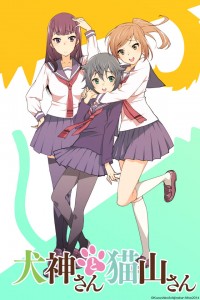
InutoNekoInugami-san to Nekoyama-san by Kuzushiro-sensei is an entertaining, not very emotionally taxing manga series that runs in Comic Yuri Hime. I’ve reviewed the first two volumes of the manga here on Okazu: Volume 1 | Volume 2.

When the anime for Inugami-san to Nekoyama-san was announced, I had no compelling drive to run to see it, but since it is streaming on Crunchyroll (regional restrictions may apply), I had a chance to check it out while I was on the road this weekend – and I was pleasantly surprised. ^_^

The story,  such as it is, is the non-adventures of girls at a school who have animal names, and appear to have the temperamental characteristics of the animals they are named for. The leads are Inugami Yachiyo (a name which is mostly likely a pun on the famous faithful dog statue at Shibuya, Hachiko. 八千代 – Yachiyo ハチ公- Hachiko) and Nekoyama Suzu (whose given name implies to the small bells on a cat’s collar.) True to their names Inugami-san is dog-like, while Nekoyama-san is cat-like. Ushiwaka, (cow) Nezu, (mouse) Sarutobi (monkey) and Torikai (bird) have all joined the cast in the episodes so far.

The voice cast gives the characters a cuteness that I was not reading into their voices in the manga, a quality that lightens the mood and makes the anime more enjoyable than it might be. The gags in this series are low –  sexual innuendo, bad puns, and snort-ful cheap laughs, so I’m perfectly happy to have the tone lightened throughout. The one thing that really stands out in the first half of anime episodes is that Inugami-san and Nekoyama-san actually have an interest in one another. There’s a cheap laugh bit at the end of the 6th episode in which they find themselves clearly talking about themselves as a couple.

Episodes are 3 minutes long, and focus on some of the most suggestive scenes in the manga and you know, I’m not really going to bitch about that. ^_^ It’s being sold as “Yuri”, and the anime audience in Japan is a subtle as a brick to the forehead, so whatever works. As I said in the Kill La Kill ANNcast, it’s easier for me to deal with grossly overplayed service than coy pretend-innocent BS, of the kind one finds in Sakura Trick.

Ratings:

Art – 8 More consistent than the manga, sorry Kuzushiro-sensei
Story – 6 There isn’t one, but that’s okay
Character – 7 Whittled down to ther essence as they are here, I find I quite like them.
FanService – 6 Mostly lustful fantasies
Yuri – 7 Still mostly lustful fantasies, with the addition of the Inu/Neko and Ushi/Nezumi couples

Overall – 8

More entertaining than I expected and kind of cute in places; the anime captures Kuzushiro-sensei’s narrative style well.


Yuri Manga: Rainy Song (レイニーソング)

May 25th, 2014

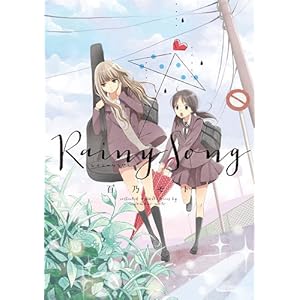
We start today’s review with a “well, I never expected that” moment. ^_^ In 2010, I was exasperated beyond tolerance by Momono Moto’s Kimi Koi Limit. The protagonist was, I felt, unlikable and selfish and the most interesting character was treated poorly. I never expected to see poor Hiroko again. Well, here we are 4 years later and there’s Hiroko again!

We begin the first story in Momono-sensei’s current collection Rainy Song (レイニーソング). with “Aru Shoujo no Gunjo”, a bittersweet story about a girl who shares in the relationship highs and lows of fellow train commuters, and her attempts to cheer up Eri, a woman who loses her female lover to marriage. It’s not  happy story, but I quite liked it – and it’s the strongest story of the collection

Following this, we turn to “Kurayami no Asterisk,” the story of underachiever Tendou Nozomi, known as ‘Ten’. She’s gone through school and just hasn’t found her purpose in life. Right now she is unmotivated by a job at a cafe and sees no particular goal for herself. So when she meets, and falls for attractive, polite and slightly sad Hiroko, she find herself in turmoil. I found myself amazed that 4 years later we were finally learning what happened to Hiroko after Sono left her.

***

Support Yuri Reviews –  Subscribe to Okazu withSubcribe with Patreon

***

Hiroko has an office job where she does her work competently, but doesn’t connect with anyone, and she works nights at a friend’s “ladies” bar. She, like Ten, is moving through life on automatic. When the two of them meet, it will throw them both into confusion. But ultimately they find each other and, we hope, happiness.

In “Snow Frakes” a long-delayed confession is finally conveyed, to the delight and sadness of a best friend.

And in the title story, “Rainy Song” a persistent fan in school becomes a friend to an aloof musician.

What a change in personality-types from Kimi Koi Limit! For one thing, there are none of Sono’s hideously selfish behaviors here, and while Hiroko starts of sad, there’s only a little moping to be dealt with. This collection has surprising depth, despite the reliance on shorts, especially given how superficial the story in Kimi Koi Limit was with all that length. Momono-sensei has a much more mature feel in this volume and her ability to convey complex emotions is touching and entertaining.

Ratings:

Art – 8
Story – 7
Characters – 8
Yuri/Lesbian – 8
Service – 1

Overall – 8

A much, much better sequel than I could have ever expected. And, it was an unexpected pleasure to see Hiroko happy.


LGBTQ Manga: Torikaebaya, (とりかえ・ばや) Volume 2

May 20th, 2014

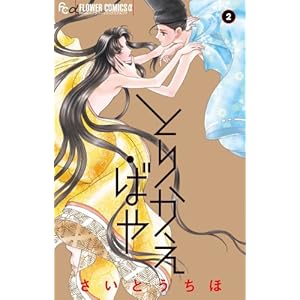
In my review of Volume 1 of this gorgeous manga version of the classic Heian story, Torikaebaya (とりかえ・ばや), I discussed the story’s history. Today, we’ll talk about the protagonists of the story.

Two children born on the same day to the same father, but different mothers – a girl, Sarasojuu, who is now living as a young man in the Heian Imperial court and her brother, Suiren who is living as a woman in the women’s quarters. They look so similar, they could be twins, and they are both beautiful. They are also, however, unsuited to the sex into which they were born, and as Volume 2 begins, both of them are passing with their father’s and his older brother’s knowledge and consent…and I want to take a moment to say, Dad’s kind of awesome, really. He’s gotta know the chances of this going well are slim. But he’s owning it. As we shall see.

Sarasoju befriends another young courtier, Tsuwabuki and they, like guys do, have contests of arms and talking smack. Tsuwabuki loves his dear friend, but Sarasoju is never able to truly relax around him. How could she? The moment she’s discovered, it’s all over. (Note: If this were a story in a modern context, I would be referring to Sarasoju and Suiren by the sex that they present as, but for the moment, since the idea that they are passing in world in which trans* people do not exist is the conflict at the heart of the story, I will continue to use their birth sex pronouns. My sincere apologies to anyone who disagrees with my choice.) To complicate matters,  Sarasoju receives a marriage offer from the Fourth Princess, Shinohime. At a very fraught discussion with her uncle and father, Sarasoju goes all in and agrees to accept the offer.

Tsuwabuki is livid at the news – how dare Sarasoju get married without telling him! They have a fight, which they heal up in the time-honored way of beating the crap out of each other and Tsuwabuki confesses that he wants to get married, too…to Suiren. Erk! Erm, Sarasoju tries to put him off, but it’s not happening.

Sarasoju takes up the position of husband to Shinohime, but their relationship is, for the moment, platonic. However, Ume-tsubo, one of the ladies of the court is convinced that Sarasoju is female and has several times tried to catch her out. She corners Shinohime and asks about the sex with her new husband…. Shinohime chalks up their lack of sex life to Sarasoju’s age, since they are 7 years apart. But seeds of discontent are sown.

In the meantime, Suiren has taken up a position with Toguu-sama, the Crown Princess and has been requested to write stories for her entertainment. He is up late one night writing when Tsuwabuki barges in and forces his attentions upon Suiren. Suiren counters with a hysterical reaction about hating men, and beans him with an inkstone. Tsuwabuki retreats, feeling like a heel. Sarasoju tries to console him by explaining that Suiren has a deep aversion to men, but Tsuwabuki has a different problem now.

Having seen Suiren, he’s decided that Sarasoju is better looking…a thought that freaks him out. Homosexuality is not unknown, but it is considered the purview of Buddhist priests and creepy dudes. He encounters Shikibukyo no Miya, a metrosexual sodomite wearing a wisteria flower in his cap, swallows his pride, and asks about homosexuality. Shikubukyo is pretty much as creepy as possible, leaving Tsuwabuki even more uncomfortable with his desire for Sarasoju than before. Unable to sleep, tormented by his own desires, Tsuwabuki sees Shinohime in her garden and again, does the unthinkable by barging in on her in her quarters as the volume comes to an end.

This description makes Tsuwabuki seem like the bad guy in the story, but he’s really not. If there is indeed a bad guy, it’s Ume-tsubo.

The question I had when I began reading this series was “Will this be a comedy or a tragedy?”. As I finish Volume 2 I am no closer to an answer, really. But now I’m annoyed as heck I didn’t just pick up Volume 3 when I had the chance!

Art – 9
Story – 8
Characters – 9
Service – 2
LGBTQ – 4

Overall – 9

Saitou Chiho’s art is gorgeous, of course, and the story remains elusive as of yet. Volume 3 will have to be where we address at least one of the multiple impending crises. Yikes, but you know I’m going to read it. ^_^


Yuri Manga: Inugami-san to Nekoyama-san Volume 2 (犬神さんと猫山さん)

May 8th, 2014

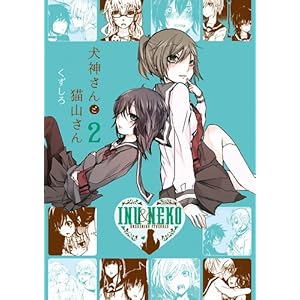
Volume 1 of Inugami-san to Nekoyama-san, (犬神さんと猫山さん) introduced us to the animal-themed cast of a “typical” Japanese high school. Inugami Hachiyo who likes cats and Nekoyama-san and Nekoyama Suzu, who likes dogs, but maybe not Inugami-san, their classmates Ushiwaka (“ushi” means cow, so she is big-breasted, har har), teeny little Nezu Mikine (“nezumi” means mouse) and their zookeeper, Inugami’s friend Aki (whose name means “autumn” and is wholly unrelated to animals.)

In Volume 2, we add a monkey and a bird to the menagerie. The bird is sickly, ghostly, flightly Torikai Hibari, the monkey is class rep Sarutobi Sora. It is with perpetually irritable Sarutobi (who does not get along with Inugami-san, despite her most puppy-like attempts at friendship) that we encounter the one genuinely laugh-out-loud gag of the book.

Sarutobi really cannot stand when people ascribe the characteristics of her animal name to herself. So she says, quite seriously to our resident mouse (who is, apparently, the most worldly of the bunch and the most likely to use sex appeal to get her way.) Quite seriously, Sarutobi explains that their names are just their names and really, people should stop saying she’s like a monkey, she insists as she picks up her schoolbag and pulls out a banana. I laughed as Nezu-san calmly pointed out that that would have been a lot more more convincing without the banana.

I’m struck again at how bananas are intrinsically the funniest of fruits.

Anyway, we do get a shocking amount of Yuri in between the excruciating gags and Kuzushiro’s typical fake-y Yuri. Nekoyama hallucinates (she thinks, she hopes) that Inugami-san kisses her while feverish and we’re told that Nezu and Ushiwaka are an item. And, as unsubtle as Inugami-san is, she’s going to have to be less subtle than this to get her actual interest across.

Ratings:

Art – 7
Story – 6 Slice of life
Character – 6
FanService – 6
Yuri – 7 Slightly more  in the real world-ish

Overall – 7

The Sarutobi gag all by itself notched this up a point.

Tl;dr:


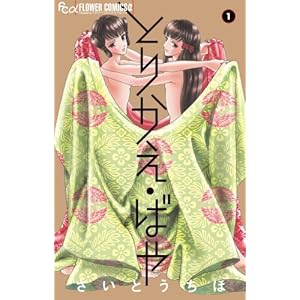
LGBTQ Manga: Torikaebaya (とりかえ・ばや) Volume 1

April 16th, 2014

The Heian period was a period of intense artistic creation in Japanese history. Like the Italian Renaissance or the Chinese Tang period; the cycle of life quality for the well-to-do hit a high and with it came the leisure and drive to create. So much of what we in the West consider “Japanese” culture flourished in that period. Mostly everyone is familiar with Murasaki Shikibu’s famous serial, the Tale of Genji. Fewer people are familiar with the ambiguously comedic/tragic/erotic Torikaebaya, which would probably translate to something like “If only they could switch.” You may recall this story from the 4th season of Maria-sama ga Miteru, in which the Yamayurikai’s school festival play is chosen around Yuki and Yumi’s uncanny resemblance.

When it was announced that veteran manga artist Saitou Chiho, the creator of the Revolutionary Girl Utena manga, would be working on a manga adaptation of the Torikaebaya  (とりかえ・ばや), I was downright ecstatic. Saitou-sensei has repeatedly shown interest in trans* characters and this manga deals not with one character or two who merely switch clothes, but who are entirely suited to the gender expectations of the opposite sex.

The story follows two siblings with the same father and two different mothers, born on the same day. The daughter is active, lively, good at sports, rhetoric and other masculine pursuits. The son is retired, shy, good at music and other feminine skills. Circumstances conspire to allow them to switch clothes – and lives.

I have not read the original in either translation or Japanese and before I even read the manga, I realized that my only encounter with the Torikaebaya was as a comedy, when the Lillian and Hanadera Student Councils had some fun with it. But, I wondered, was it actually a comedy…or a tragedy? As it turns out, we don’t actually know the answer to that. It has been interpreted as comedy, tragedy, social commentary and erotic romp by varying critics in varying ages. That actually made me more interested in it than before! We don’t know what this story is, how cool is that?

Saitou-sensei has specifically set out to treat this story as a story of transexuality. This is stated plainly on the cover and the relationship between gender roles and one’s sex is explored within. The daughter, Sarasoju is painfully aware that she really is not suited to be a girl, and her brother Suiren, likewise, really would do so much better as a girl. They switch clothes and roles and as far as I am in the first volume, their father is complicit in this, having just introduced his “son” to the Emperor.

I have not finished Volume 1, but I know that Sarasoju will play her part as a male well, but that that will not stop her from falling in love with a man, or having intimate relations with him. Her pregnancy is a major part of the original story. But she will also be married to a woman, and in one of the two versions of the tale (known as the Ima Torikaebaya Monogatari), both she and her brother end the tale in functional homosexual relationships.

I’m frequently asked for recommendations on trans* manga, and I usually don’t have much to offer, as trans folks are not well represented. This book will be going on my short recommendation list.

Ratings:

Art – 9 Gorgeous, but how could it not be? Saitou Chiho-sensei doing Heian period. Duh~
Story – 8 I’m intrigued, fearful, hopeful all at once
Characters – 8 Not bad, actually. Dad’s not a bad dude, and Sara and Suiren are sympathizable
Service – 4 Nudity, not nakedness
LGBTQ – 4 We meet them just as their self-identity is forming.

Overall – 9

Saitou Chiho-sensei’s version of the Torikaebaya may well become my go-to version of this Heian classic. Here’s hoping!

If you are interested in a garbled version of the story and a mixed bag of scholarship, here’s the Wiki entry on the Torikaebaya. It’s rather less helpful than I had hoped.