Archive for the Artists Category


Yuri Drama CD: Shishunki Seimeitai Vega, (思春期生命体ベガ)

July 15th, 2013

Special Edition With Drama CD The deluxe edition of Hayashiya Shizuru-sensei’s manga,  Shishunki Seimeitai Vega (思春期生命体ベガ) comes with a Drama CD.

As with so much of Hayashiya-sensei’s writing, it’s pretty much beyond my language skills, so don’t expect a coherent review. ^_^

First up, The Cast: Vega was played by Hikasa Youko, Arisa by Yahagi Sayuri, Ariide by Kobayashi Yuu (in crazy mode,) and poor Tanabe by Hayami Saori.

The first track is primarily a nasty rant by Ariide about how lovey-dovey Vega is about Arisa-sempai. It *really* pisses her off. ^_^ There’s some Vega x Arisa love, which pisses Ariide off more.

The bulk of the story follows the four on a camping trip, I think, where they make curry, get yelled at by Ariide and Arisa learns that Tanabe has a first name.

Third track is a Cast Talk and the Bonus Track involves more Vega getting kissed and fighting monsters – as it should.

It’s definitely worth your time if you like the kind of vocal gymnastics and acting a Hayashiya script forces from the actresses – there’s no cutesy-poo stuff going on here, for sure. ^_^

Ratings:

Overall – 8


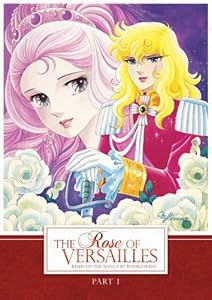
Rose of Versailles Anime, Part 1, Disk 2 (English)

June 30th, 2013

The second disk of part 1 of Ryoko Ikeda’s Rose of Versailles, is chock full of court intrigue and setting up the story by introducing many of the players in upcoming episodes. Oscar is now captain of the guard to the impulsive, vain and child-like Marie Antoinette. While she admires her Queen’s faithfulness to her emotions, Oscar is very well aware of the fact that those emotions unchecked will lead the people around her to disaster.

Madame DuBarry might have won the battle, but she loses the war. When the King dies she has no allies, no resources and nowhere to turn. By the time she leaves Versailles, she’s already an afterthought. Kids, this is why when you sign on to a start-up, make sure your exit strategy is in the contract.

Almost immediately we move on – two skeins will combine to create one tragedy. A poor family; a good daughter and an evil daughter, and a doomed love affair will set the scene for the next disk. France, as the narrator keeps pointing out, is heading towards a crisis.
Ratings:

Art – 8
Story – 9
Characters 9
Yuri – 0 (So far. Wait for it.)
Service – 5 Oscar swearing to die for Andre and Marie was pretty service-y

Overall – 8

In my 21st century reboot of this story, Rosalie is a hard-working college student and Jeanne is sleeping her way up a corporate ladder. ^_^ I’m taking bids, cable TV networks. This will be a hit!


Yuri Manga: Shishunki Seimeitai Vega, (思春期生命体ベガ)

June 24th, 2013

Special Edition With Drama CDFrom beginning to end, there’s a lot to like about Hayashiya Shizuru-sensei’s Shishunki Seimeitai  Vega, (思春期生命体ベガ).

First off, there are two editions available, a special edition with a Drama CD and a manga-only edition. They have different covers, both of which are pretty nice, so good luck choosing. ^_^

Secondly, Hayashiya-sensei does something that I’ve seen rarely, but that I really like. Way back, when Rakuen Le Paradis had her in for a test run, she did a one-shot Yuri manga about two women who are reunited as adults on a celebrity cooking show. While they discover that they were mutually interested in one another in school (which they attended together when they were young) the other host is forced to frenetically cook today’s dish, all the while rooting the two women on in her head. It’s zany and romantic and silly as hell.

In another issue, Hayashiya-sensei drew a really nice color picture of a female bodyguard and her charge. On Twitter she and I talked about how we’d both like to see her draw the story behind that picture. ^_^

And then she began Shishunki Seimeitai Vega, a story about an alien and the Earthling she loves – with all the slapstick wackiness ensues, drama and bloody noses one expects from her work. And here it is, collected into a single volume, in which she’s included – and integrated – the two one-shots in a way that is both highly amusing and gratifying.

The cooking show becomes the first chapter, which turns out to be something Arisa is watching on TV. Arisa heads to school and is met by her kouhai, Vegako – Vega, for short.Vega is an alien who protects this little seaside town from encroaching giant monsters. Her power recharges when Arisa kisses her. Unfortunately for Vega, Arisa doesn’t like to be asked to kiss her. Vega starves herself for power, trying to avoid annoying “sempai” until her lack of power threatens the town and herself. While Arisa runs to recharge Vega, she finds the girl being soundly kissed by an older woman. So soundly, in fact, that Vega transforms into her original giant alien form, one that Arisa and the town people haven’t seen in years.

The older woman is Ariide Swan, a Hollywood celebrity, who has come to town for the Japanese premiere her sci-fi movie “Deneb.” Ariide clearly knows Vega – and claims to possess her. Arisa instantly becomes jealous, but has no idea how to express it. After denying Vega kisses for so long, she just starts avoiding Vega who, predictably, feels rejected.

Their inability to discuss the issues and Ariide’s possessiveness has them all in a tizzy until a monster targets Arisa, specifically. Vega remembers how sempai glowed when they first met and Arisa realizes that Vega will glad sacrifice herself to save her…and they kiss. Vega blasts the giant monster to kingdom come, while Ariide (and poor Tanabe – a club member with Arisa and Vega –  who wonders, not for the first time,  why she’s  suddenly hanging out with a famous Hollywood actress?) watches.

In the epilogue, Ariide is telling Arisa about her reasons for running from Hollywood, when Reason #1 shows up at the door. Abby Albireo is another actress, much younger than Ariide, with whom she fell in lust, while working on “The Bodyguard 2029.” (Hence the smexy picture of her as a bodyguard…)  The epilogue ends with typical Hayashiya-style – comedy, i.e., punches and bloody noses all around.

The extras are a comic about the characters reacting to the news of a Drama CD (with more blood) and and an interview with the actresses for the Drama CD, which I haven’t had a chance to read. ^_^

The final nice touch on this book is that it has silver edging for a really sharp look. (No pun intended.)  The book is complete experience –  visually, emotionally and professionally.

Ratings:

Art – 9
Characters – 8
Story – 9
Yuri – 8
Service – 3 (+1 for Ariide being my “type.” ^_^)

Overall – 9

Reading Seijukuki Jinmei Vega was the manga equivalent of a really excellent meal. With dessert.

BTW, Vega is a star in Lyra, Ariide is (I’m guessing) short for Aldeberan, a star in Taurus, “Deneb” is a star in Cygnus, the Swan, hence Ariide’s family name. And Abby’s family name Albireo is also a star in Cygnus. Just a bit of star-spotting in the pages of what was in every way a great read. ^_^


Rose of Versailles Anime, Part 1, Disk 1 (English)

June 17th, 2013

There is no question in my mind when I call Ryoko Ikeda’s Rose of Versailles a classic. Historical drama is always “timeless”, but centuries after the French Revolution and decades after the debut of the anime, we are still compelled by the story of Lady Oscar Franciois de Jarjeyes and her Queen, Marie Antoinette. Now that Part 1 has been released by Nozomi/RightStuf, there are synopses and reviews all over the place, I reviewed the series once, way back in 2004. The story of the French Revolution is well-known. ^_^ I will confine myself this time to talking about the captivating and charismatic lead of the series – Oscar.

We begin the anime introduced to the peculiar circumstances of Oscar’s upbringing, raised as a boy although her sex is not a secret. With  this simple plot device, Oscar is disassociated from her predecessor, Princess Knights Sapphire. No one is being fooled by Oscar, everyone is content to take her as she appears – young, beautiful, as talented at sword fighting as any man, a natural leader who just happens to be a girl.

So, it struck me very hard that, in the first disk, both her father and Andre’ misunderstand Oscar so badly.

Her father hears Oscar reject the role of Captain of the Royal Guard and takes it as a personal insult. His argument is “Don’t you understand what you’re doing to my reputation?” But of course, she doesn’t care – and why should she? He doesn’t care about her. That much is obvious when he chooses a life and a name for her. Her father is clearly using Oscar as a pawn in his game. This is not to say he isn’t proud of her accomplishments (and, no doubt takes credit for her looks and athleticism, as well). To some extent it’s understandable that he has no idea who she is – what father knows who his 14 year old daughter is?  And so, while he completely misunderstands, even when she tells him she does not want to “babysit a girl”, he can be vaguely forgiven.

But Andre’. He has been by Oscar’s side from the time they were small. Surely he understands that Oscar is not objecting to the position or the life of a soldier, but being relegated to caretaking a *girl*? Apparently not, because as she rides away, he calls out to her, telling her that this is her last chance to regain her womanhood. I gaped at his cluelessness. But then, he’ll be clueless about a lot of things for a while yet to come.

What makes Rose of Versailles work as a story once the characters are established and they get to Versailles,  is that it is laid out with plausibility. So plausible, in fact, it came as a shock to learn how much Ikeda’s characterizations deviate from reality. I have tremendous sympathy for both Marie Antionette  and Madame du Barry and would love to see a story built around them that cast them in the roles of celebrity and CEO respectively, to see how their story might play out in the 21st century.

Speaking of 21st century, let’s look at how distance makes us see Oscar differently than she might have appeared when she debuted in the 1970s. Ikeda writes her without any recognition of the influence of the Church on things such as gender roles, but then it had been more than 300 years since Joan of Arc was killed in France and Europe was fully engaged in the Age of Reason. So the Oscar we see in the anime is a girl raised as a boy and who is both capable and competent enough to wear the privilege she has been given. At no point in time in Disk 1 does she appear to pine away for more feminine accouterments, nor does anyone attempt to shame her for her appearance or position. We, from our distance from the Revolution (and from  the original manga and anime) can look at Oscar’s adaptation of the male role and argue whether we might consider her merely cross dressing or transsexual (and later we can argue a bit about her sexuality, as well, for fun. ^_^)

What I think is plain is that Oscar, with her white uniform, represents a kind of ideal, a “pure” nobility. She believes in her word and in the social compact. The excesses and politics of Versailles repulse and bore her, but she will do everything she has to to do to do her job as well as it can be done. Here in Disk 1, the theme of “Duty” is established and this concept, more than anything else, will drive the rest of the story.

I’m reminded once again that I can only take a little of Rose of Versailles at a time. Like Oscar, I prefer to be out in the field or woods than watching court gossip. ^_^ But you know, once I started watching this story again, I’m also reminded just why it’s a classic. It’s that good.

Ratings:

Art – 8 Strongly 70s. Gotta love those eyes.
Story – 9
Characters 9
Yuri – 0
Service – 6 Even the women of the Court know Oscar’s uniforms are all service, all the time. ^_^

Overall – 8

When much of what we like in anime now is long forgotten, Rose of Versailles, and the drama of the French Revolution, will remain.


Yuri Manga: Kisses, Sighs, and Cherry Blossom Pink (English) Guest Review by Melissa M.

June 12th, 2013

Kisses_ssWoo-hoo!  It’s Wednesday and we got ourselves a Guest Review! As I mentioned in last week’s YNN Report, “I’ve reviewed it 3 times already (when it first came out from Yuri Hime and Volume 1 and Volume 2 of the new edition when Futabasha put them out.” By all means feel free to read those and get the first and middle looks at this series. Now we’ll take one last look at the series.

Sine I’ve reviewed this story a bunch of times, I think it’s time for someone else to get a turn. ^_^ Melissa M. has stepped up to the plate with her very first Guest Review here on Okazu! I just love when that happens.  Please welcome Melissa to the stage. /applause/

Morinaga Milk’s Kisses, Sighs, and Cherry Blossom Pink follows Hitomi and Nana, longtime friends and new lovers, through high school and their developing relationship.

KSCBP was written in 2003, several years before the series GIRL FRIENDS, by the same author. Unlike Akko and Mari, Hitomi and Nana have to deal with their crises largely alone. Nana mentions that she and Hitomi have had sex but also wonders what counts as sex between two girls, and is upset that she has so many questions and nowhere to turn. It makes me wonder just how few resources there were for the LGBTQ community in Japan ten years ago. Hitomi is afraid that her love is preventing Nana from living a normal life and overcompensates by trying to be “manly.” Both are terrified of being found out, and near the end, they run away together, deciding that their relationship is more important than their friends and families. Their circumstances make KSCBP a more angsty series than GIRL FRIENDS, but also perhaps a more realistic look at the problems and misunderstandings a lesbian couple could have in a society that offers them no role models. It’s nice to see Morinaga addressing issues like these, which seems a bit unusual for her stories. But it’s not all sorrow and fear. The girls have plenty of good times together as they and their relationship mature, and they find that some friends are supportive. I think they have a good shot at keeping their promise to get married and to have their story continue forever.

My only real quibble with this story is the ending, in which everything is suddenly resolved. Hitomi and Nana move into their own apartment together with the blessing of their parents, to face college and life together. It seemed a bit too abrupt and magically-happy-ever-after, almost dismissing all of their earlier fears. But who am I kidding, it turned me into a puddle of squee on the floor. ^_^

The anthology also includes five one-shots set in Hitomi’s and Nana’s high schools, interspersed through and mostly unrelated to the main story. They generally include Morinaga’s stock character designs, the taller outgoing long-haired blonde and shorter quieter short-haired brunette, so it can be a bit difficult to tell in flipping through the pages whose story you’re in. The relationship chart in the back is a big help here. I didn’t like any of these quite as much as the main story since the one-shot format leaves little room for character development, but your mileage may vary.

Seven Seas did a great job with this anthology. I particularly appreciate the fact that they left the larger sound effects in place and added a small translation, almost like furigana, above them – it seems less disruptive than replacing them with English or putting a list of translations at the back.

This is a heartwarming story that belongs on every Yuri lover’s shelf, and a comparison with GIRL FRIENDS makes it clear how far Yuri and (hopefully) society have come in the past few years.

Ratings:

Art – 8 (Being older work, it’s not quite as polished as GIRL FRIENDS)
Story – 9 for the main story; 6-8 for the one-shots
Characters – 9
Yuri – 10
Service – 4

Overall – 9

Hitomi is a cat person! That makes me smile. ^_^


Erica here again: Yuri Shimai, the original magazine in which Nana and Hitomi’s story began, was the very first magazine of its kind.  The whole wallowing in angst about “does she feel the same way?” of the early chapters was very typical of stories at the time. The later chapters you’re referring to were all written recently – not in 2003, but in 2011, for the Futabasha edition.

That having been said in 2003, there was LGBTQ life in Japan, but that mostly meant bar life. Resources are way more abundant now, even in smaller cities. Which is all to the good. ^_^

Thank you Melissa for weighing in with your point of view!