Archive for the Baihe Category


Cage of Shadows

August 3rd, 2026

Okazu turns 24 this year! Help us keep you up to date on Yuri, Baihe and GL by supporting us on Patreon or Ko-fi.

On a white background, the Okazu mascots feed each other, while say "I love Yuri" in English and Japanese. Orange letters say "Become and Okazu Patreon today! https://www.patreon.com/Okazu

Looking for a little Baihe in your Wuxia? Let me recommend Cage of Shadows, which you can watch with English subtitles right now on Youtube.
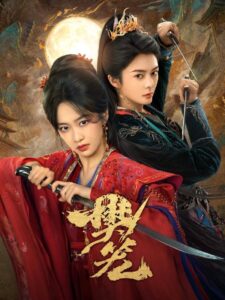
Title image of Cage of Shadows. A woman in black and a woman in red, stand back to back, wielding swords. The story dumps you right into the middle of itself, and the official synopsis is uniquely unhelpful, so let me edit both into a more chronological format. 

Nan Yanzhi is a young woman whose mother has been imprisoned in the infamous Lingya Tower, where women are sentenced to participate in Life and Death contests for the pleasure of male customers. Those who lose may die in any number of ways. One of those ways is to be poisoned slowly so that one effectively becomes a statue occupied in a typical activity. When she was younger, Yanzhi encountered a martial artist by the name of Zhuang Wujiu, who takes her as a disciple. When Yanzhi learns that the antidote to her mother’s illness is in Lingya Tower as well, Yanzhi commits a crime to be setn there. 

There, among the other women forced to fight to the death in various rigged games, Yanzhi meets Dao Niang a former noble’s daughter, Jiang Man, a washerwoman whose husband sold their child to pay off his bets, so she killed him, and Tuya, a centurion of the Chilan, a fierce fighter. She also meets her old teacher, Wujiu, who appears to be working for the ruler of Lingya Tower. 

The entire story could not work if the men were not vile. Every man here is rapacious, a liar, betrayer and ultimately pathetic, stupid and weak. In fact, it’s basically a feminist tract that men cannot be trusted even if they appear to be decent, they are all bullshit when it comes down to it. That is certainly a position I did not expect in a Chinese period fantasy. But it is an inescapable position the story takes, and repeats over and over as we learn why women are here in Lingya Tower. Women who work for Lingya have been violated, sold as chattel to men, then given a chance to work for their captors to gain back a grain of their agency.

Of these stories, the hardest is that of a famous historian, who is set up and sold to Lingya where she is repeatedly sold to rapists before being given a chance to run a “school” that functions as one of the Life and Death contests. If you ever though that Joo Dee from Avatar the Last Airbender was a bit creepy, then this level of the Tower will creep you out fully. Both the acting and makeup make some hella convincing masks of the women’s faces.

At Episode 20 or so, we seem to be at our end. Having met Wujiu again, her former master confesses her own miserable story, and she and Yanzhi fight. Having failed her last contest, due to betrayal, Yanzhi and her sisters-in-arms are split. There doesn’t seem to anywhere to turn, but the final chapters bring us a great joining of all the women in the Tower who stand up against the men, successfully. 


Okazu Supporters and Patrons make it possible for us to bring you Yuri, Baihe, GL news and reviews from the global Yuri network!On a aqua blue background, the image of Sailor Uranus and Sailor Neptune themed cans of Ocean Bomb sparkling water with the words, "Buy Us A Senshi Sparkling Water." Sponsor Okazu on Ko-fi. https://ko-fi.com/okazuyuri

Yanzhi and Wujiu have a contentious, but intimate, relationship. As master and disciple, they are like parent and child. Let me digress for a moment. I spent many years studying Chinese martial arts and there were often discussions of the term Sifu (師父) for women, as the second character is that of “father.” In traditional MA, the master is respected at the level of a father, who imparts wisdom, guidance, and in some schools, (not mine) punishment. My teachers never seemed to want to be called Sifu, even when they were Chinese and, over the years, we all sort of developed an allergy to non-Chinese teachers who were called (or referred to themselves! ugh) with that honorific. During the decades I was actively training there was endless conversation about what to call masters who were women. It is unsurprising that we all defaulted to “It’s not “father”, it’s like wiser older person,” i.e, “male words are default” reasoning.

Here, Yanzhi uses Sifu for Wujiu, and their relationship is quite familial, although I might suggest Wujiu acts more like a big sister at times, and others like a lover in that comfortable pot-lust phase of a relationship. The most intimate moment between them comes before they head back into the Tower one last time. They eat and drink together, imagining their lives without Lingya Tower and the multitudes of betrayals by men. Yanzhi says to Wujiu, let us pretend this one night that there is no Tower, no betrayal, no Life or Death… just us. Then they go in and, after a few Uno reverses, lead a rebellion. It was solid stuff. ^_^

This scene is shown twice. The first time I was saying “say  ‘just us'” over and over, but the final words were translated as “just Master and disciple.” Which I thought fair. In the final episode, it was translated as “just us” and I cheered. ^_^

The opening and closing credits are basically the whole story in short, so I knew we’d get a few scenes of spinning with swords (which passes for foreplay in danmei so often ^_^). 

Overall, a fun series that was worth watching all the way through. Very light strokes of Baihe,  but I 100% loved that Yanzhi was never a shrinking flower and we had Tuya, a full-blown woman fighter. By the end, all the women are wielding weapons with some well-earned bloodlust and that worked fine for me.

Ratings: 

Cinematography – 7 solid, a little reuse of footage
Story – 7 Messy af, full of double-and triple crosses and rigged “contests”
Characters – Men-0, Women-9, coincidentally, bascially the same as the number of survivors. (Not, really, but yeah)
Service – 5 In that coy “we know what you mean way, lots of “hurh hurhurh” laughing and implication of torture and rape
Baihe – 5 mostly subtext, but still there

Overall – 8

Very pretty costumes and very fantasy weapon use, and a few looks full of emotion and longing. Cage of Shadows worked for me.


The Beauty’s Blade: Mei Ren Jian

December 4th, 2025

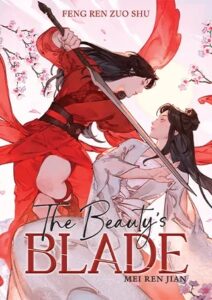
A woman in flowing red robes holds a long sword at the neck of a woman in white robes, who calmly parries it with her hand.Where to begin with The Beauty’s Blade: Mei Ren Jian, the first Baihe licensed by Seven Seas? This is not a rhetorical qestion, as many readers picking this up might not be all that familiar with the tropes of the Wuxia genre. The book itself gently suggests that, if you are unfamiliar with Wuxia, Chinese “historical” fantasies about martial arts heroes, whose arcane practice and studies of martial art using inner energy – qi – have given them almost magic skills – that beginning with Crouching Tiger, Hidden Dragon,  streaming on  Apple TV, for rent or purchase on Amazon Prime) which was a gateway for many into Wuxia. The word itself is relatively-ish new, and while old kung-fu flicks used some of the same tropes, Wuxia has developed along a separate path from martial arts movies.  (Xianxia is a related genre that deals with immortal heroes and there can be overlap as a lot of the “cultivator” – i.e. “qi cultivator” – stuff can feed into the martial stuff.)

To a very great extent, Feng Ren Zuo Shu’s The Beauty’s Blade (美人剑 [Měi Rén Jiàn]) assumes a certain knowledge of Wuxia in the reading audience. Ideally, you know about the wire-work that allows those warriors who use qingong to fly through the air, or at least leap so far that its much the same. You’ll understand that qi can be used not just offensively, as a kind of energy discharged through a weapon or by hand, sometimes even by eyes and, in significantly over-powered characters through mere will, it can be used defensively by hardening or warming or healing the body. I have trained qigong exercises named “golden bell” and “warming the triple burner” to develop those specific skills. Sadly, I am still soft flesh and blood and often cold. I guess I never trained hard enough.^_^;  All joking aside, the martial art I practice is an “internal” art that would be exactly the kind of thing the warriors in this novel work on. Of course, their powers are hyperbolic and sometimes hilarious.

I don’t follow specific fandoms much and haven’t paid attention to Baihe as much as it deserves. I will say that The Beauty’s Blade reminded me a great deal of The Untamed, a (50-episode! I deserved a medal for watching all of it!)  danmei (m/m) Wuxia story on Netflix in specific structural ways. Chapters here are terse, it often feels as if we were supposed to understand what is going on, although the characters just show up, then have a lot of expository conversation to explain what is going on. I imagine that keeping track of the various houses might not be easy for folks unused to the genre. Visually, Wuxia stories help you along with different colors for different houses/sects and you can see that a little here.  We are told repeatedly that the Diancang Sect wears blue, for instance.

If a reader is not comfortable with the sects or the family names, it might feel much like reading a Russian epic. It’s not *that* complicated if you just remember the three main groups: The Lightpath Alliance, the Jadewater Guild, aka the demonic guild, and the Weiyang Company. Regardless of which group, basically everyone is a complete asshole, so forget “light” and “demonic” as meaningful markers. ^_^

To make this more complicated for western audiences, scenes sort of happen. There’s no lead up, or phase out. We’re in a place, the scene happens. Next chapter, repeat.  The Untamed did that a lot – I assumed it was stuff cut out from the novels, but now I am not so sure. Maybe the serialization of these novels make for choppy story telling. But, by the end of the story, you can at least put it all together, so that was good. 

Because most scenes were presented with no open or close, and no specific weight – almost every scene is full of shouting, cursing, fighting, leering and a bit of exposition. It can all feel very the same, with the exception of Fu Wangqing and Yu Shengyan’s scenes together which break up the rest of the scenes, but also feel much the same as a whole. There is a distinct sense of this being written in the style of or for a short form serialized live-action adaptation.

Many times the overdramatic martial arts come off as plain funny, but my favorite line comes at the very end of the book, after Fu Wangqing injures a man who tries to force his way into her room. Yu Shengyan asks her who it was and Wangqing says “Whoever has a cut on their right hand, duh.” Fu Wangqing was so often incredibly childish and wholly capricious, this suited her perfectly. 

Also, despite the fact that both Gu Yu and Guo Ju are utterly ridiculous in origin and execution, I liked them anyway and were glad for the one-line resolution to both their convoluted stories. Although I would have preferred if the Zhong brothers ended up among the many corpses in the story, they were vile.

I have read only a little Baihe, and what I have read sounds much the same as Yu’s translation, so I will call that satisfactory as far as it goes.   Overall, I cannot say The Beauty’s Blade: Mei Ren Jian is a “good” book in terms of skill of character building or writing, but I found it highly entertaining for 381 pages of Wuxia fun that I would pay good money to see turned into a live-action series. ^_^

Ratings: 

Art – 7 Both covers are quite nice, the interior art by Gravity Dusty gets the point across and thankfully never bothers to illustrate any of the shouty men, only the shouty woman. ^_^

Story – 7 Convoluted, full of shouting, but it eventually made sense and all the lesbian couples live happily ever after.

Character – 8 Fu Wanqing was all over the place, Yu Shengyan had almost no personality, but that was the point.

Service – yeah, a little

Yuri/Baihe – 10

Overall – 7

The Beauty’s Blade: Mei Ren Jian would make a fun gift for the Wuxia fan in your life, especially if they watch danmei for the inevitable one warrior woman character. ^_^


The Secret of Girls

November 19th, 2025

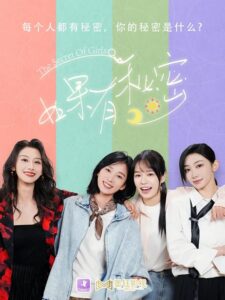
Promotional poster for the Chinese baihe drama The Secret of Girls, showing the four main characters.Baihe (Chinese yuri) is having a mini-moment. Seven Seas Entertainment just released its first baihe novel, the Baiheverse site is making steady progress on its project of licensing baihe manhua, novels, and other works (including the short film When We Met), and enough other works are being teased for licensing that what has been a mere trickle of official English translations promises to become a growing stream (albeit nowhere near a flood).
Unlike baihe novels, which (like their danmei/BL cousins) mostly seem to traffic in historical fantasy, The Secret of Girls (original title 如果有秘密) is a realistic contemporary baihe drama, now available on the GagaOoLala premium service. As it begins, young Xu Jingxi (He Lei) is laid off from her job, decides to go traveling (for a reason that the GagaOoLala synopsis spoils, but I will not), loses her wallet, ID, and phone while helping another woman, and ends up prevailing on older hotel employee Wen Shan (Sun Cailun) to let her have a room in exchange for working at the hotel.

At first glance the setup is reminiscent of many other yuri works: a free-spirited extrovert who’ll end up softening the frosty exterior of an introverted tsundere. However, Xu Jingxi’s outgoing persona is a cover for her suffering, the nature of which is slowly revealed as her romance with Wen Shan progresses. But the series is about more than the ills of one woman: the back stories of both Xu Jingxi and Wen Shan, and their relationships to their mothers in particular, form a sharp critique of a patriarchal society that demands that daughters show filial piety but offers them little or nothing in return.

Suffice to say, The Secret of Girls is not a series with a “happily ever after” ending, but it’s far from being “tragedy porn.” This is in large part due to the performance of He Lei, who takes what could have been a simplistic character and makes her richer and more complex. (As it happens, He Lei also starred in When We Met, another tale of a younger woman winning the heart of an older one.) Sun Cailun is a worthy companion to her, portraying Wen Shan’s slow and subtle opening up to friendship and then love. I should also mention Li Keyi and Wang Miao, who play hotel owner Ling Yung and bar manager Qin Bei respectively. Their characters support Xu Jingxi and Wen Shan in their evolving relationship and contribute a more light-hearted tone and a very sapphic vibe: The two women live together and are clearly in a relationship of their own, and Qiu Bei’s bar “Her” is advertised as being “Where Ladies Meet.”

My main complaint with The Secret of Girls is with its packaging: It was originally released as 24 five-minute episodes on the WeChat app, and the amount of actual content is such that it could have been (and I think should have been) released as a feature film. However, GagaOoLala is presenting it as 16 episodes, with multiple minutes in each episode taken up by a lengthy OP (which spoils many of the scenes in the series and is untranslated to boot) and even more time taken up in several episodes by an equally lengthy credits sequence. Regarding other aspects, the GagaOoLala version has at least one scene that was almost certainly excised for the Chinese domestic audience; it makes explicit what was already very much implicit in the portrayal of Xu Jingxi and Wen Shan’s feelings for each other.

Rating:

Story – 7 (a potentially clichéd and maudlin plot redeemed by the writing and acting)
Characters – 9
Production – 6 (points deducted for chopping up the material)
Service – 3
Yuri – 10
LGBTQ — 5 (not explicit but very queer-coded)
Overall – 8

The Secret of Girls is not an easy watch at spots, but it’s definitely recommended for viewers who are tired of relatively superficial or melodramatic yuri series (looking at you, Thailand) and want to see a more realistically emotional human drama. It also marks a welcome second outing for He Lei, whom I hope to see more of in future baihe series.


Into the Baiheverse: When We Met and The Clouds of Past Millennia

July 4th, 2025

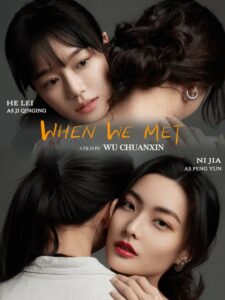
Poster for the short baihe film When We Met, written and directed by Wu Chuanxin. The poster shows the two main characters embracing, the top half showing a younger woman (He Lei as Jin Qingqing) facing the camera, the bottom half showing an older woman (Ni Jia as Peng Yun) facing the camera.by Frank Hecker, Staff Writer

The baihe (百合) genre, sapphic media in Chinese, is becoming increasingly popular in China and elsewhere, but, as with yuri manga and anime in the early days, translations of baihe works into English and other languages have thus far been mainly produced by fans. That situation has been slowly changing. For example, Seven Seas Entertainment has followed up their publication of danmei (BL) novels by licensing the baihe historical novel The Beauty’s Blade: Mei Ren Jian (美人剑).

Now comes Baiheverse, a recently launched site proclaiming itself as “Your Gateway to Baihe . . . Literature and Media.” It features a variety of licensed baihe works in English translations, including two manhua/webcomics, two audio dramas, one novel, and a short film. The last two of these are particularly worthy of note.

The film When We Met (去年烟火), written and directed by Wu Chuanxin, is a drama set in present-day China. It’s available in an “official” version and an “uncensored” version that’s ten minutes longer; both are free to watch if you register with the Baiheverse site. (The official version is also available on YouTube.) When We Met is the story of two women in a (relatively) small Chinese town, 32-year-old Peng Yun, who owns a small shop she runs by herself after her divorce, and 22-year-old Ji Qingqing, who sets up her BBQ stand outside the shop. (Avoid reading the official synopsis of the film if you don’t want to be spoiled about their back stories.) The two women find themselves growing closer together, but ultimately face a decision on the future of their relationship. I won’t spoil the ending, except to say that the uncensored version provides a clearer resolution.

Ni Jia as Peng Yun and He Lei as Ji Qingqing both deliver solid performances. Ni Jia is especially good in portraying Peng Yun’s conflicting emotions: recognizing her growing feelings for Ji Qingqing but afraid to break out of the comfortable but confining cocoon she’s spun for herself as a single woman in a small town. The writing, direction, and production are also of high quality, and the English subtitles are idiomatic and grammatically correct; however, with a couple of exceptions, on-screen text is not translated. This can especially cause confusion for viewers who can’t read the Chinese text at 1:51 (in both versions) and 30:53 (in the official version), and thus may not realize that the main body of the story is a flashback from the opening and closing scenes.

Ratings:

Story — 7
Characters — 8
Production — 7 (one point off for not translating important on-screen text)
Service — 5 ( a scene involving bras)
Yuri — 10
LGBTQ — 4
Overall — 8

Despite its relatively short length, When We Met tells a complete and satisfying sapphic story. It’s especially recommended for fans interested in realistic contemporary dramas that avoid manufactured melodrama and excessive angst.

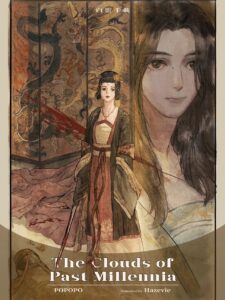
Cover of the baihe historical novel The Clouds of Past Millennia. It features a full-length portrait of the main character Wei Tai in traditional dress in the foreground, with a portrait of the other main character, Xu Jianyu, in the right background.Unlike When We Met, which solely depicts lives in present-day China, The Clouds of Past Millennia (白云千载), written by popopo, straddles past and present. Originally published as a web novel, it comprises 28 chapters plus an afterword; the first three chapters are free to read while the rest can be purchased using a coin system ($1 US for 100 coins).
Wei Zai was the supreme ruler of an ancient Chinese dynasty, but now she’s dead. Even worse, she‘s stuck being a ghost in her own mausoleum. She decides to take a rest, wakes up after a long sleep, and finds that the world outside her tomb has utterly changed. Being a ghost, no one can see or hear her, except for Xu Jianyou, a university student who’s the spitting image of Xu Qingchu, Wei Zai’s previous right-hand woman and lover, and even shares her courtesy name. The remainder of the novel alternates between Wei Zai and Xu Jianyou’s life in the present (including Wei Zai’s amusing encounters with Chinese social media and shipping culture) and the story of Wei Zai and Xu Qingchu a thousand years ago. Is there a way for the two lovers to be united once more? And does anyone doubt what the answer will be?

The English translation of The Clouds of Past Millennia (by hazevie) is generally readable. Its main quirk is that many Chinese terms, especially those involving kin relationships, are left unlocalized and glossed with a translator’s note. However, fans of Asian media have shown themselves willing to acquire a fairly extensive vocabulary from other languages, and it’s possible that they’ll one day recognize and use terms like a-jie as easily and freely as they do now with terms like onee-san.

Ratings:

Story — 6 (I would have liked more contemporary scenes)
Characters — 7 (present-day Xu Jianyou is less fleshed-out than the other two characters)
Service — 8 (a couple of steamy sex scenes)
Yuri — 10
LGBTQ — 2
Overall — 7

The Clouds of Past Millennia is an entertaining read targeted at fans interested in the historical settings and court intrigues that are the stock in trade of many Chinese novels, enlivened by the interspersed contemporary scenes and their occasional metatextual humor.

The Baiheverse site itself is a young enterprise still finding its way, and is dependent on support from fans to allow it to acquire and host more baihe works. I encourage all fans of sapphic media to check it out. For updates on new works, follow @baiheverse.com on Bluesky or @baiheverse on X/Twitter.


Who Knows Girls’ L

March 26th, 2025

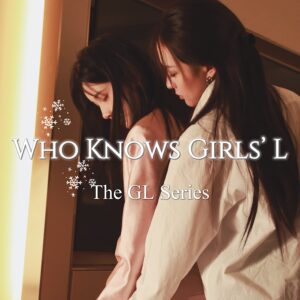
Poster for the Chinese series Who Knows Girl’s L, showing the lead characters Cheng Zhijin (left) and Gu Yi (right).Once a rarity, live-action yuri series have now spread throughout East and Southeast Asia, most famously to Thailand but also to Taiwan, South Korea, and Cambodia. One major exception to the trend has been the People’s Republic of China, where the publication of LGBTQ-related works has been discouraged by cultural norms and government policies. Small wonder then that baihe (yuri) works (including many of those scheduled to be published in English) often are set in past times and make considerable use of subtext.

Thus it was a surprise to see Who Knows Girls’ L (谁知锦意) pop up on YouTube, set in present-day China and proudly billed as “the 1st Chinese gl series . . . for sapphic ppl like you and me!” As one might expect, it was not created and distributed by a mainstream Chinese production company. Instead it’s being produced and released by a group of film students in Shanghai, who have been very forward about promoting the series and raising funds for its production. (Their initial budget was the equivalent of only $2,700 US.)

Who Knows Girls’ L is still ongoing: it’s projected to be 28 relatively short episodes (up to 15 minutes long), with eight episodes available thus far; completion of the series depends on the success of the fundraising efforts. I’m reviewing now to bring it to the attention of fans who might be interested in following it, and also as a hedge in case the series goes on indefinite hiatus for lack of funds or other reasons.

But enough throat-clearing, how does Who Knows Girls’ L stack up against the many other yuri series currently airing or scheduled to be aired? Let’s go to the tape:

The plot is a weak point of the series, combining as it does a noxious trope, an implausible plot turn, and a power-gap romance: Cheng Zhijin, a young film studio project director who’s struggling with problems on her production, drowns her sorrows at an industry party and afterwards encounters an older woman, Gu Yi, busking on a public street. Zhijin meets her again at a bar where Yi works as a singer, drinks some more, then goes home with Yi and proceeds to have a drunken one-night stand. In the office the next day Zhijin is flabbergasted as the previous night’s fling turns out to be the chief shareholder in the studio, who’s now decided to actively involve herself in the company’s operations. The plot proceeds from there, as Zhijin and Yi try to navigate the troubled waters of an employee/employer relationship.

The production values are uneven but improving, marred by occasional lapses: a slightly off camera angle here, a brief mistake in focus pulling there, problems with color grading between some scenes, and some non-idiomatic translations. (There are also several scenes in which the faces of Zhijin and one of her friends at work look unnaturally white; I don’t know if that’s a production problem or reflective of a cosmetics fad among young Chinese women.) However, the series looks significantly better than one might expect of a student production. It makes good use of multiple location shots and has an effective soundtrack, with a banger OP introduced in episode 7.

Working actor Kaiyi portrays Gu Yi, while Cheng Zhijin is played by law student Qianyue. Kaiyi gives a solid performance, while Qianyue reminds me of Yoko Apasra Lertprasert of Blank: The Series—not so much in the characters they play (Aneung’s teasing and flirtation is 180 degrees away from Zhijin’s sullen passive-aggressiveness), but in seeing a striking debut from an unexpected source. As for the scenes between Yi and Zhijin, the director and actors have clearly closely studied GAP and its successors and strove to emulate their steamier aspects; if the results don’t quite come up to Freen and Becky at their finest, it’s not for lack of trying.

Ratings:

Story — 5
Characters — 8
Production — 6
Service — 5
Yuri — 10
Overall — 6

Its status as the self-proclaimed first Chinese yuri series and a crowd-funded student project is the hook, but Who Knows Girls’ L has an appeal beyond that, based on the increasing sophistication of the production and the performances of Kaiyi and Qianyue. It’s definitely worth watching the series, following the saga of its production, and (for those so inclined) financially supporting its creation.

P.S. Some final trivia: The Chinese title of the series, 谁知锦意 (Shéi zhī jǐn yì), contains some untranslatable wordplay that puns on the characters’ names: 谁知 (Shéi zhī) is “Who knows”, 知锦 (zhī jǐn) is the given name of one of the characters, and 意 (yì) is pronounced the same as 忆, the given name of the other lead character. Also, 意 has “intentions,” “thoughts,” and “feelings” among its meanings. So, the title can be read in multiple ways: “Who knows [Zhi]jin/Yi?” or “Who knows [Zhi]jin’s intentions/thoughts/feelings?” (Thanks go to Reddit commenter _fancy_pants for pointing this out.)