Archive for the Western Cartoons Category


Lesbian Space Princess

January 14th, 2026

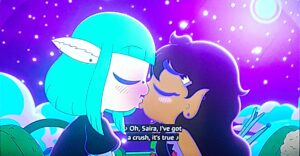
Screencap from Lesbian Space Pirate, with humanoid and alien girls kissing under the light of an alien star in a purple sky. The alien girl has white skin, and aquamarine hair, the human girl has medium-brown skin and dark long hair. by Burkely Hermann, Guest Reviewer

In this 87-minute mature sci-fi fantasy film, with space opera, comedic, and romantic elements, an introverted princess, Saira (voiced by Shabana Azeez), goes out of her comfort zone of safety and shelter. She leaves her home planet of Clitopolis and travels outside the confines of protected Gay Space so she can save a woman that means everything to her.

This Australian film, Lesbian Space Princess, is more than a fun ride, that can be comedic and heartfelt at times, involving Saira confronting her anxieties. At first, I was drawn toward this film through the media that influenced it. On social media, it was noted that the film was directly inspired by six animated films and three live-action films. This includes Steven Universe: The Movie and Revolutionary Girl Utena: The Movie(otherwise known as Adolescence of Utena). The film’s directors, Emma Hough Hobbs and Leela Varghese, praised the first film for its emotional truths and space lesbians (Garnet and Pearl for one). They said that the second is a “great reference” for queer anime that hits hard emotionally, while “not taking itself too seriously, and…[is] really clever with its budget.”

They further listed the film Blue is the Warmest Colour, which is briefly referenced in the film, and an adaption of a comic by Jul Maroh, as an inspiration. In their view, although that film does not have the best lesbian representation, it has remained influential to many queer people. They note that Lesbian Space Princess is, in contrast, “a more authentic and positive take on queer culture.” Although the Steven Universe film is only a few years away from being eligible for the National Film Registry (it will be eligible starting in 2029), it remains a cultural touchstone in many ways, not just for fans, but for queer representation as a whole.

In a Q&A with Hobbs and Varghese, they further described the film’s world, and character design, as influenced by Sailor Moon, Utena, Invader Zim, and Adventure Time, adding that “LGBTQIA+ flag colour schemes” are shown throughout the film. Both directors stated that they were inspired by French lesbian filmmaker Céline Sciamma, Canadian screenwriter Emma Seligman, and gay Korean-American screenwriter Andrew Ahn. Sciamma is known for, among other works, her acclaimed and majestic historical drama film, in 2019, entitled Portrait of a Lady on Fire (Portrait de la jeune fille en feu). Seligman is a queer filmmaker known most recently for the satirical black comedy, Bottoms. Ahn, on the other hand, had his directorial feature debut with a crowdfunded film, Spa Night, set in Los Angeles’s Koreatown, about a closeted, gay, and Korean-American teenager named David.

The queer themes start from the get-go. The film begins with Saira’s scrapbook for her girlfriend, Kiki (voiced by Bernie Van Tiel), who have only been together for two weeks. She notes her struggle with getting attention since people are obsessed with her two moms, Queens Leanne and Anne, voiced by Jordan Raskopoulos and Madeleine Sami respectfully. These queens are the rulers of the lesbian planet of Clitopolis. The on-the-nose name makes me think of C.L.I.T. (Center for Lesbian Information & Technology), a collective lesbian archive in the 1996 classic queer film, The Watermelon Woman. Saira is determined to not be single, even though she is scared to go anywhere, or do anything, while Kiki is an adventuring bounty hunter. Her girlfriend cannot take this anymore, not liking how clingy she is and for openly expressing her emotions (mainly through crying and apologizing), while admitting that Saira is “good with her hands” in bed.

Kiki leaves despite Saira’s pleas. It turns out that this is happening on an open stage that anyone can observe. It’s part of her parents’ birthday celebration for her, parents who forget how old she is. Saira is the lesbian space princess in the film’s title. The crowd and her parents pressure her to summon her labrys, a lesbian feminist symbol referring to self-sufficiency and strength, the same symbol which Marceline’s ax bass likely resembled in Adventure Time. However, when Saira is unable to summon the labrys, everyone declares that she is useless and worthless, including her own parents.

Following this disastrous celebration, the film’s main conflict begins. While Saira is feeling sorry for herself, falling into despair, her now-ex-girlfriend, Kiki, is kidnapped by a group of three beings, Known as the Straight White Malians, and voiced by Mark Bonanno, Zachary Ruane, and Broden Kelly respectfully, they kill the three women she is having sex with. These beings have been ostracized in the galaxy. They have one goal: to have her as bait so they can use Saira’s royal labrys to draw in women to their “chick magnet.” These characters are not only the film’s villains but are supposed to resemble boring and awful straight White men, particularly male podcasters. Although the film could have been written differently without them, their presence drives forward the story.

Due to their threat, Saira is forced to rescue Kiki. She leaves her protected surroundings and rolls into a “problematic ship” (rather than a perfect one) that is male-centered, sexist, and racist, and voiced by Richard Roxburgh. Her galactic adventure begins. After she exits the Safety Bubble (voiced by Reuben Kaye) surrounding of Gay Space, she crash-lands on a planet. Soon thereafter, she meets Willow (voiced by Gemma Chua-Tran), a bisexual free-spirited goth girl, songwriter, and musician, who uses they/them pronouns.

Willow’s entrance makes the film more exciting, rather than a sad adventure, especially when Willow and Saira begin flirting with one another and enjoying one another’s company. Willow sometimes sings her heart out, often playing her guitar, almost akin to Marceline the Vampire Queen in some ways, but different in many other ways. Willow and Saira bond in a deep way, especially after Willow explains that she escaped the horrifying prison of gay pop and went indie instead. This part of the film’s exploration of allosexuality. 

Willow serves as a positive influence on Saira, who falsely believes that she is nothing without Kiki. She even begins a makeover montage, which pales in comparison to the montage involving Adora, Glimmer, Catra, and Scorpia in the “Princess Prom” episode of She-Ra and the Princesses of Power. Afterward, Saira and Willow enter S Club, that is run by a drag queen named Blade (voiced by Kween Kong). At first, Saira is terrified, especially after Willow leaves her side when they enter the club.

I liked how the film depicts her as confronting her inner demons, manifested as a dark version of herself, continue to haunt her, telling her she isn’t good enough. This includes her moms, who hate single people. This first comes to a head when she helps DNM Girl (voiced by Demi Lardner), with her words about loving someone ringing true to how she feels about Kiki. Blade, a drag queen whose real passion is weapons, declares that you have to empower yourself. She tells her that she is not broken, encouraging her to begin mediation.

Thus begins one of the film’s best sequences, when she enters her mindspace, overcoming her strong mental barriers that are holding her back, with trauma from bad friends, abandonment, and parents which are neglectful and arguably emotionally abusive. She is able to unlock her labrys, that is chained and locked inside this mental space. A ball of light comes from between her legs and in Utena-like fashion, the labrys comes out of her lower body as she leans back, moaning in ecstasy. At that moment, when she feels that she won, Blade reveals her true goal. She yanks away this special weapon, almost equivalent to a heart-sword in Utena, from her hands.

After a battle, in which Willow saves her with a pineapple, she ends up beheading Blade, who had tried to kill her. Later on, back on the ship, Willow sings the obvious in a song about her having a crush on Saira. They end up kissing, a scene shown at the beginning of this review, and have sex with one another, after clicking the incognito button, so the ship can’t judge them. This relationship does not last. The lesbophobic Malians, in their man cave, continue to hold Kiki hostage, dangling above an acidic, toxic brew, with terrible jokes and accidentally killing a thespian, with one Malian falsely thinks is a lesbian, followed by a discussion of The L Word. They plan to killing Kiki sooner, since she keeps arguing them and calling them out, as she begins to slowly lose it, with many failed attempts to escape. In a heartbreaking scene, Saira dumps Willow, friend-zoning her, believing that she can get back with Kiki.

In the film’s final part, Saira saves Kiki at the last second, with the ship inspiring her to go forward. In the process, she destroys a phallic ship which resembles male genitalia. She gives up a personal part of herself, her labrys, in order to save Kiki. Despite this, and the fact she has changed on this journey, Kiki falsely declares nothing has changed. She leaves the man cave like a jerk, remaining emotionally unavailable. She is barely even thankful she was saved nor does she recognize the journey Saira had ensure in order to get there. As a result, her labrys fades away. Doubts and mental blocks cause it disappear. While Saira’s inner insecurities take over at first, she soon defeats them, realizing that her parents are bad and that Kiki is a “narcissistic asshole.”

Using her inner power, she transforms, in a somewhat magical girlesque way. Her crown moves to another part of her head and she summons her labrys once more. She leaves the suffering Malians on their own, especially after their “chick magnet” ends up killing a woman. She proposes they date one another and they take up her suggestion, beginning a polyamorous throuple. What follows is one of the best scenes of the film: she leaves behind Kiki, despite her ex-girlfriend’s continued claims that she is still in love with her, declaring that she can’t be with her anymore. The film ends happily: there’s family therapy, Willow writing a hit album about her, and Saira beginning new adventures with Ship, which is now an ally. She has no partner but is confident in herself instead.

Even before the film released in the U.S., the queer themes were evident. The film’s directors described their film as a queer love story, championing queer voices and people of color, seeing it as a step forward for “queer voices in adult animation,” and describing the film’s characters as epitomizing queer fashion trends, with a focus on self-love and self-acceptance. They hoped that the film would become an example for queer art to be seen “as more commercial and valuable” than in the past, particularly in animation. The film’s directors were committed to continue telling funny queer animated stories which provide a “safe space for the community,” including a possible sequel, perhaps in a game format. More than that, the film’s message is unique.

Many films like Lesbian Space Princess would have Saira begin a romantic relationship with someone, either involving, in this film’s world, Saira resuming a relationship with her controlling ex-girlfriend (Kiki) or with her free-spirited rebound (Willow). Whether reviewers picked it up or not, the film has the message that you can be confident by yourself, with self-love, rather than having to be with someone. Similar themes of self-empowerment are a key part of Steven Universe, while anime series, particularly A Place Further than the Universe, Wandering Son, and Skip & Loafer, focus on self-discovery.

Furthermore, the film’s diversity is reflected in the voice cast, which is primarily composed of Australian actors, and a few New Zealanders like Madeleine Sami. Specifically, drag queen Kween Kong, lesbian actress Madeleine Sami, trans lesbian comedian Jordan Raskopoulos, bisexual comedian Demi Lardner, and drag artist Reuben Kaye voice characters. This film was the first film voice role for Raskopoulos and Sami. Both had voiced characters in animated series before. Sami voiced characters in multiple episodes of Bro’Town, which featured a faʻafāfine school principal. Raskopoulos provided voices in the animated series The Team. For Lardner and Kaye, this film serves as their first-ever voice roles. This was also the case for Shabana Azeez, who is of Fujian and Indian heritage.

– Ratings

Art: 8

Story: 7

Characters: 8

Service: 4 or 5 (some occasional nudity at certain points in the film)

Yuri: 7 (there’s at least two sex scenes shown off screen, plus multiple kisses, blushing, etc.)

Music: 8

Overall: 8

Postings on social media have indicated that this film may be continued in some form. If it is continued, I’m not sure what storyline will be followed, since all the conflicts were already resolved in this film. I wouldn’t say that Lesbian Space Princess could ever become a “cult classic” as some have claimed. Nor would I say it is a “serious arthouse drama,’ is “peak queer comfort cinema,” or simply delightful, splendid, and unapologetically queer. Some might say it “behind the curve” by echoing Adventure Time, Steven Universe, Twilight, BoJack HorsemanFuturama, and Rick and Morty, or that it is designed for those once involved fan discussions on AO3 or Tumblr. Those discourses are not to be simply sneered at and pushed away as some would like to do. Lesbian Space Princess is worthwhile queer film in its own right, with its own charm and overt queerness, even if it is irreverent at times, or clunky at others.

Lesbian Space Princess is presently available, for purchase or rent, on PrimeVideo, AppleTV, Google Play, and Fandango at Home, and streaming on Fandor. The film’s Blu-ray can be pre-ordered from Umbrella Entertainment, with a collectors edition also available for pre-order.

Burkely Hermann is a writer, researcher, and former metadata librarian. His reviews can be read on Pop Culture Maniacs or his personal WordPress blog. He can be followed on Instagram, Bluesky, or on Mastadon communities such as library.love, glammr.us, genealysis.social, and historians.social.


Ark: The Animated Series Part 1 Review, Streaming on Paramount Plus

May 28th, 2025
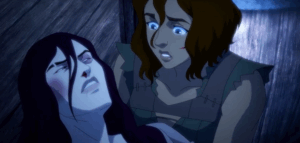
A woman with shoulder-length messy hair looks down at a woman with pale skin, and facial bruises with concern.by Burkely Hermann, Guest Reviewer
Helena Walker is a renowned paleontologist in the 21st century. She suddenly finds herself in the ocean, escapes monsters which try to devour her, and washes ashore on a strange, and vibrant, island, filled with prehistoric plants and animals, going far beyond the dramatic dinosaur breeding theme park in Jurassic Park. Helena has to survive, make new allies, and avoid being killed. This mature sci-fi series is bloody and brutal in some ways, with trauma forced upon on her through death, violence, and spilled blood. At the same time, Ark: The Animated Series is inspiring, with Helena choosing science rather than cruelty. People from a variety of cultures, whether Inuit, Lakota, Chinese, or African-American, fight alongside her for what is right and against the forces of oppression. The latter is primarily led by two White men: power-hungry General Gaius Marcellus Nerva, originally from Ancient Rome, and his right-hand man, a former disgraced and egocentric scientist from the Royal Academy,  Edmund Rockwell. The latter dubs the island “the Ark,” hence the series name. This series is the first animated adaptation of the 2017 video game Ark: Survival Evolved.
Ark: The Animated Series, which originally began streaming on Paramount Plus in March 2024, has more going for it than its star-studded voice cast. The series serves as a bit of an antidote for the current, and terrible, political environment in the U.S. where anything and anyone claimed to promote diversity, inclusion, or equity is under attack. Gareth Coker’s music score is a driving force, seamlessly connecting with the superb animation, voice acting, and writing, which helps the compelling character dynamics and visual storytelling come alive. The voice cast is headed by Aboriginal Australian actress Madeleine Madden as Helena Walker. It also includes Malaysian actress Michelle Yeoh as Chinese warrior-leader Meiyin Li (or Mei Yin Li), part-Lakota actor Zahn McClarnon as Lakota warrior Thunder Comes Charging (or John), Devery Jacobs as Inuit teen Alasie (also John’s adopted daughter), and Jeffrey Wright as Henry Townsend, a Black Revolutionary-War-era spy for the Patriots. Apart from other well-known actors in the voice cast, Aboriginal Australian and Maori actress Deborah Mailman voiced Helena’s mother and Chinese actor Ron Yuan voiced Meiyin’s brother, Han Li.
The voice cast is not the only place there is diversity: showrunner Jay Oliva is of Filipino descent. Actor Devery Jacobs is part Mohawk and queer. Canadian actor Elliot Page is a trans man. Ark: The Animated Series serves as the first voice role (as Victoria) for him since his gender transition, in 2020, and his first-ever major voice role in an animated series. Voice actor Cissy Jones previously voiced Theoda, one of the two moms of Akila Theoris in Cleopatra in Space, and Lilith Clawthorne in The Owl House. One series writer, Kendall Deacon Davis, is a Black man. The other, Marguerite Bennett, is a queer woman known for her depiction of female relationships. She previously said she wants to write queer relationships which are honest, sincere, and real, with “tenderness, loss, joy, motherhood, [and] partnership.” In another interview, she expressed her enjoyment of writing stories about complicated heroines, “body horror, historical fiction[,] and queer romance,” some of which are present in Ark: The Animated Series.
This series is queer from the very beginning. In the first episode, Helena, after she has been isekai’d to the Ark, has flashbacks of her with her wife Victoria. For instance, she centers herself by looking at her at least twice when she is under pressure while making a presentation. Both women are a lovely couple who support one another, with the implication they are about to have sex with one another, as they walk into their bedroom together. Victoria is a humanitarian aid worker who travels to war zones and Helena is an acclaimed paleontologist. Helena wants Victoria to stay with her, rather than putting her life on the line to help others, saying other people can do the work instead. This mentality becomes part of Helena’s arc through the series, as she goes from being a thinker, an intellectual to be precise, to a fighter putting her life on the line to fight oppression.
In a heart-wrenching flashback during the 47-minute first episode, Helena is informed that Victoria is presumed dead. She sees her die and disappear. Due to their deep emotional connection, she becomes depressed, drinking wine to an excess. She ends up overdosing on prescription pills and dies. Perhaps the latter is a trope, but you cannot blame Helena. Her actions go far beyond Rei or Kaoru taking painkillers in Dear Brother. There’s the implication Victoria somehow brings Helena back to life in the Ark. In a social media post about Ark: The Animated Series some years ago, Bennett highlighted the music score for the relationship between Helena and Victoria, saying she was heartened by “queer stories of love, conviction, and survival that persist beyond space and time.” While the latter doesn’t apply to Helena and Victoria directly, it is still a story of survival, justice, conviction, and love.
Helena has no chance to stay depressed, nor does she struggle through her trauma as Korra did in The Legend of KorraInstead, she is thrown into yet another life-threatening situation, after she flees a camp where she is held captive by Nerva, Rockwell, and their soldiers, barely escaping with her life, after they injure her with a spear. This is when Meiyin comes into the picture. She saves Helena from soldiers out to get her and from a sabertooth tiger. They are both drawn to each other. Their connection goes beyond any intimate friendship. It is clearly romantic and sexual. While they fight together as comrades, arachnophobic Meiyin blushes when Helena saves her from a spider, inside its lair. In what echoes scenes from the newest yuri-ish Lara Croft animated series, they uncover secrets about the Ark and find a new fancy weapon, a gun with tremendous power, and blast their away out of the cave. Once outside, they are soon surrounded by warriors led by the aforementioned John, setting the stage for the third episode.
Later episodes bring them even closer. Helena and Meiyin join John in the nearby Indigenous village. Helena quickly becomes friends with the spunky Alasie, a teen who would be at home in the interlinked words of Avatar: The Last Airbender or Korra. She takes a liking to the moniker for Meiyin (Beast Queen) even though she isn’t sure why people name her this (she learns why in the fourth episode when Meiyin rides a dinosaur). Seeing Meiyin’s amazing skills, she can’t help but compare herself, even though Alasie cautions her to not do so. In one scene which hints at their growing feelings, Helena begins sketching in her journal. One page has a dinosaur and another has a portrait of Meiyin. Soon thereafter, Helena and Meiyin fight side-by-side, to liberate a mining camp, even after Helena’s movie-inspired plan fails. Meiyin becomes disappointed when Helena does not kill a messenger who escapes. This is a constant theme Ark: The Animated Series: whether to kill oppressors or let them live. Meiyin favors the former, but Helena supports the latter, as someone who cares about life.
The fifth episode is a bit of a turning point. Meiyin and Helena come from different time periods, the first from the 3rd century and the second from the 21st century. So, it is no surprise they have different ideas for how to fight oppression. Putting aside their back-and-forth banter on this, Meiyin’s command of forces gathering against Nerva and Rockwell is put under question. A man named Henry (noted earlier) says that she is a great warrior, but not a good leader. Despite Henry’s sexist undertone, Helena continues to support her. She reminds her that it is okay to ask for help and treats Meiyin’s wounds.
This is a key moment: Meiyin shows that even though she is a skilled warrior, she has her own weaknesses and vulnerabilities. Before this, she is a bit closed off, with her red-colored armor serving as barrier-of-sorts. Acting as a healer, Helena allows these weaknesses and vulnerabilities to melt away, while she still has her own. She respects Meiyin as a fighter and asks Meiyin to teach her, which surprises her. Meiyin takes her up on it, putting her through tough training. Helena continues to treat Meiyin and they have good times together. They get so close that Helena sleeps on Meiyin’s shoulder. This does not last. Meiyin and Helena realize the village is under attack from enemy forces. Despite a valiant effort, during which General Nerva is injured, Meiyin is captured after she’s shot with a tranquilizer dart by Rockwell. While Helena wants to follow, she takes John’s advice, and decides to fight another day.
The final episode brings Meiyin and Helena closer. Meiyin refuses to answer questions about where Helena is hiding and she is roughed up in the process (i.e. tortured), showing the pain she is willing to endure, even though she incorrectly believes she has nothing. Perhaps she thinks that no one will come to save her. This can’t be further from the truth. Back at their makeshift camp, Helena sings Meiyin’s praises, remains scared for Meiyin and everyone else, and helps put together a plan to save Meiyin. Later on, once Helena gets inside the enemy palace. She discovers something horrifying which shows the sadistic nature of the series villains: Meiyin is tied up on a crucifix, a common Roman punishment aiming to publicly humiliate victims. Meiyin is glad Helena came for her.
As it turns out, it is all a trap set by Nerva. He likely believed, as other Romans did, that lesbianism was a “degenerate Greek perversion…an absurd impossibility” rather than something that should be “accepted as normal.” In contrast, Meiyin is from the time of the Yellow Turban Rebellion, a 21-year peasant revolt during the reign of the Han Dynasty in Ancient Time. During that era, the dynasty’s ten emperors were “openly bisexual.” As such, she likely knew what a lesbian was, even if she had never had romantic feelings for another woman before Helena, or had never heard the term “lesbian” in her life (the term isn’t used by any character in the series). In the video game that Ark: The Animated Series is based on, Meiyin later has girlfriend named Diana Altreas.
His plan soon falls apart: John saves the day, setting off explosions, allowing them to escape with help of Henry and others. John’s sacrifice, in a violent death, after he kills the favorite T-Rex of General Nerva, is in vain. Rockwell’s hand is chopped off and the palace is ablaze. While the series villains had hoped to exploit Helena’s love for Meiyin, instead their actions allowed the love between them to blossom. While riding a parasaurolophus, named Scary, Helena and Meiyin realize their feelings for one another. They look each other in the eyes and kiss, while tears stream down Helena’s face, reciprocating their love.

Ratings:

Art: 9
Story: 9
Characters: 8
Service: 3 or 4, the main outfit Helena wears on the Ark can be a bit revealing and the same can be said for some outfits Victoria wears, or when Helena is treating Meiyin
Yuri: 7 or 8, since there are kisses, sexual innuendos, and implied sex between Helena and Victoria in a flashback
Traumatic situations: 10, as this series can be very bloody at times, with people dying, getting stabbed, shot with arrows, or trampled, plus substance abuse, torture, discrimination, and the like
Music: 7

Overall: 9

The next part of Ark: The Animated Series, set to come later this year, promises to be even more queer. If the preview at the end of sixth episode, is any indication, viewers will see Helena’s first meeting with Victoria, Meiyin getting new armor, Meiyin praising Helena for saving her, Meiyin and Helena training and having good times together, and Helena having short hair. The latter is common across queer media, whether Sage in High Guardian Spice, Korra in Legend of Korra, Vi in Arcane, Amaya in The Dragon Prince, Rei Asaka in Dear Brother, Kase in Kase-san and the Morning Glories, Lynn Lambretta in Bodacious Space Pirates, Haruka Tenoh in Sailor Moon, Catra in She-Ra and the Princesses of Power, Ruby in Steven Universe, or Rei Hasekura in Marimite, to give some examples. I am curious to see what else will happen in the second part of Ark: The Animated Series, and hope it continues in the future.

Burkely Hermann is a writer, researcher, and former metadata librarian. His reviews can be read on Pop Culture Maniacs or his personal WordPress blog. He can be followed on Instagram, Bluesky, or on Mastadon communities such as library.love, glammr.us, genealysis.social, and historians.social.


Arcane: League of Legends, Season 2 on Netflix

December 18th, 2024

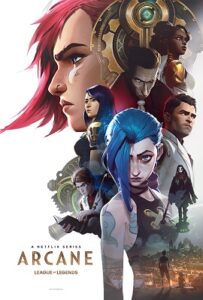
Promotional poster for Arcane: League of legends, Season 2. A girl with blue hair looks at us from the bottom of the poster, Her read-haired sister looks to the left from the top of a cast of characters.by Eric P., Guest Reviewer

Back in 2021, a certain animated series called Arcane: League of Legends debuted on Netflix. It made a certain mark, and fans eagerly anticipated the inevitable follow-up in those three years since. The trailer for it dropped, with the announcement of it being the Arcane storyline’s final season coming as a shock of those fans. Would just one more season really round out to a finale that did justice to the story they followed and felt was something special? All they could do to find out was wait until Season 2 finally arrived.

Where last we left off, councilwoman Mel and hextech creator Jayce called together the special council of Piltover to finalize a peace treaty with the counterpart undercity of Zaun. Meanwhile, sisters Vi and Jinx had reached the point where seemingly too much irreparable damage was done to save their relationship. The only response Jinx could unearth from her loss and anger was aim her powerful hextech cannon at the special council, and all Vi and her potential girlfriend, enforcer Caitlyn, could do was watch it happen.

Picking up right where Season 1 stopped, most council members have been severely injured or even killed in the explosion, Caitlyn’s mother included. Jayce and Mel stand as the only two survivors without a scratch, but how is that possible? That is just the first mystery introduced, and Season 2’s narrative wastes no time in getting going as the characters of both Piltover and Zaun react to the domestic terrorist act in their own separate ways, growing a whole new chaos. Ambessa, Mel’s mother and warlord of the nation of Noxus, seems to take special interest in taking advantage of it all by influencing Caitlyn to lead a military rule. Mel contemplates where she should stand, Jayce grows more convinced hextech itself was a grave mistake, and Vi and Jinx go through their own struggles in figuring out where they now fit or can fit in everything.

One of my favorite subplots is where Vi and Jinx’s childhood friend, Ekko, is transported via hextech to an alternate world—and offered a glimpse of what could have been. This is where hextech was never created, Piltover and Zaun live in relative peace, people that died in the past are still alive, and Jinx is still Powder. She and Ekko were allowed to blossom a whole new relationship that was just not possible in the original world, and yet it is that world Ekko makes it his mission to return to. Is it partly because the original world is the “right” one, and this 2nd world is “wrong”? Ekko admits there is nothing wrong at all with the 2nd world—he just cannot stay for the simple reason that he did not earn it, as well as due to his own responsibilities that anchor him to his home world.

This is just one of several narrative elements to appreciate and enjoy about Season 2, and I mean several, delivering much more than just the star relationship relevant to Okazu. Mystery and complication keep following one after the other like a running stream, with new and returning characters continually being added to and taken out of the mix from the beginning all the way to its epic end. Upon reaching the start of the final episode itself, it especially left this reviewer wondering as well as worrying—can this really stick the landing? Yes, it has been announced that there will be branching spin-offs, but with everything they have already done on this one series alone, can they properly wrap up the Arcane storyline on a reasonably satisfying closed loop before making way for new bonus chapters?

Short answer—I would say yep. After the wild, crazy, often unbelievable ride the animation took its viewers on, after all the tragedies that often bluntly overtook the triumphs, we get payoffs and full-circle resolutions galore that hurt so good like they should, just as much unexpected as well as partly expected. One of many things I appreciate about this story’s ending is that it makes clear regardless of whoever wins the final battle, it does not mean peace and harmony of any kind will follow. As long as humanity exists there will forever be conflict, and for that we can only do the best we can and never be off our guard. That kind of message is especially resonating in our world now more than ever, for better and for worse. This message is also what helps set up (along with the ambiguity of a couple characters’ fates) the promised future stories that could go literally anywhere from this point, and I have no doubt plenty of fans are already intrigued to see what the creators cook up next.

Ratings:

Art-10 This is said to be the most expensive animated series ever made, which absolutely shows and is well-spent on a handful of gorgeous imagery I certainly have never seen before—while also illustrating no matter how brutal and grim the world is, there remains an underlying beauty regardless

Story-10 Almost overwhelming while just succeeding in not being messy, it is really hard to imagine what could be improved when all is said and done. Then again, I heard somewhere that the final episode was originally a full 90 minutes, which I never would have guessed but makes me hope we might get the uncut version for this season’s possible Blu-ray release

Characters-9½ There was a traitor reveal toward the end that I did not care for, but I may well be in the minority on that. Otherwise, the characters all have their moments of making morally questionable choices, but it shows they are just people doing what makes sense to them and their personal circumstances, rather than just simply be protagonists one unconditionally roots for

Service-4 There are really only two scenes of serious intimacy I can recall offhand, but they pack quite a bit especially in the second one while managing to stay confined within its PG-13 rating

Yuri-7 Vi and Caitlyn are inevitably canonized. Beyond that, it is a payoff (amongst many) one should see for oneself

Overall-10 Once again, just see for yourself—assuming you have not already


Kageki Shojo!! on Funimation

November 7th, 2021

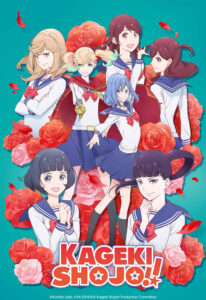
Watanabe Sarasa is a young woman with a dream. She is entering the Kouka School, in hopes of becoming a Kouka Musical Revue Top Star. Exceptionally tall and outgoing, Sarasa will make allies and enemies in her next two years.

Based on the manga of the same name, which is put out by Seven Seas, Kageki Shojo!! is…well, it’s really quite fantastic. I read and reviewed the earlier manga, Kageki Shoujo!! The Curtain Rises, in 2020 and so knew about some of the distressing events in the beginning of the anime.. Trigger warning for sexual abuse, and body dysmorphia/eating disorders in the first few episodes.

After that story has been told, we move on to the events of the manga after it moved publishers in Japan. It progresses into changing the lives of Sarasa, Ai and the rest of the 100th class at Kouka Academy. When Sarasa encounters her own limitations, and we get background as to why, specifically, she sight reads other people’s performances, the story deepens. As the students in her class get a chance to perform, the entire story takes off in flight. The last few episodes are sublime and triumphant and worth every second they take to watch, even if like me, you are watching Funimation for free and getting the same ad 28 times per episode. ^_^

Most readers here on Okazu are probably familiar with the Takarazuka Revue and it’s school, on which the Kouka Revue here is based. You may wonder about the bullying we see in the story. Sadly, Takarazuka had a long-standing tradition of exactly the kinds of bullying you see here. In previous years, first-years were assigned a specific area to clean and, if a second-year was particularly nasty, could make them clean and re-clean over and over, or force them to do extra homework, even so far as losing sleep. Of course, I feel that this kind of hazing should have been grounds for removing the second-years, but you know adults. They look they other way and don’t see what is right in front of them. In 2020, the school changed some of the written and unwritten rules, in an attempt to curb this kind of bullying and to modernize the school. Students are no longer assigned to cleaning just one spot for the year, and things like natural hair color is allowed.

We’re only getting a taste of the story in this anime series, but it was a great watch and has a manga that continues the story, so it’s something I can whole-heartedly recommend.

Ratings:

Art – 7 It’s good when it has to be
Story – 9
Characters – 9
Service – Not really
Yuri – 0

Overall – 8

I’m interested to see if the story gets as far as choosing otokoyaku/musumeyaku roles, which in this early part of the story seems more or less personal inclination. I’ve read that in Takarazuka, the defining characteristic is pretty much just height.


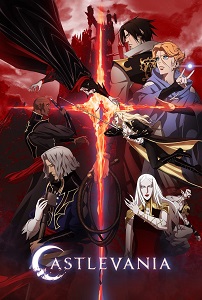
Castlevania on Netflix

October 31st, 2021

Happy Halloween! For tricks this year, I found myself watching Castlevania, streaming on Netflix, because we all know how much I love vampire stories. ^_^

The descendants of vampire hunters, the descendants of vampires, humans (almost all of whom deserved an ugly death) and magic users all become involved in two grand plans that will essentially destroy humanity. It…wasn’t bad.

Castlevania has decent enough animation, lots of blood, sex, some creative magical nonsensery and enough cursing to satisfy even this Jersey Girl. In fact, I have added Carmilla’s frustrated and exhausted “What the FUCK is going on?” to my store of mottos. ^_^

Okazu readers are smart enough to know that I am not reviewing this animation because I think vampires are a nifty Halloween tie-in. Clearly there must be some reason I felt it’s appropriate for Okazu? Indeed there is.

In the later half of the story, as our attention turns from Dracula’s decrepit legacy toward Carmilla’s scheme for a new age of vampire supremacy, we are introduced to Carmilla’s vampire sisters, Lenore, Striga and Morana. When we meet them, Striga and Morana are and have been, a couple. Striga is also highly amusing, voiced with brutal sarcasm by Ivana Miličević, which balances beautifully with Yasmine Al Massri’s highly ironic, and only slightly idealistic, Morana.  The two of them are delightful and their fate is a high point of the what is objectively a very, messy, if slightly dewily romantic plot. (I mean romantic in both senses here. The plot tends toward romanticism and Romanticism, if you take my meaning.)

The voice cast was quite good, with the exception of the heavy mumbling by Richard Armitage as Trevor Belmont, and James Callis as Alucard. I kept shouting “What? Speak up!” at the TV, despite the fact that I watch everything with captions now. It’s not that I’m losing my hearing, I just read faster than people talk and I have no patience. ^_^ Nonetheless, mumbling is not a personality.

I particular loved Alejandra Reynoso’s voice work for magic using Speaker Sypha.  She was a delight. Jaime Murray’s Carmilla was also brilliant – angry, imperious, violent. Kind of my perfect woman, except for her being a vampire, which I would find just so tiresome. And last, but not least, everything about Lenore, from her cute blushy cheeks to Jessica Brown Findlay’s masterful voice work, was fantastic.

For the rest of the story, expect lots of body parts, blood, and copious amounts of heavy cursing written in a way that kind of almost sounds like I wouldn’t mind being around these people, except for the stench and the threat of death and undeath. Other than that, they seem kind of fun.

Ratings:

Animation – As good as 8, as bad as 5
Story – It was three or four messes worth of mess, but does it matter? 7
Characters – 9 The main reason I kept watching, honestly
Service – 10 I did mention, the blood and violence and sex, yes?
Yuri – 9  It’s only one little piece of the story, but a nice one

Overall – 8

Alucard was all out of luck
Human lives were all in the muck
Magic and mayhem
Meant monsters and brain stems
And all anyone really wanted was a good…roast duck.

And maybe a beer. And a shower. And fewer undead monsters trying to kill them.
