Archive for the Western Comic/Comix Category


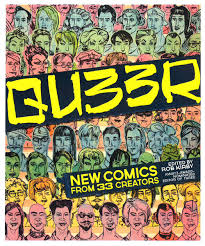
LGBTQ Comics: QU33R Anthology

February 4th, 2014

QU33R“LGBTQ characters are also appearing in mainstream comics, and the code of silence that [Mary] Wings fought against  has been broken. But there still remains a profound need for distinctly queer comics.” – Justin Hall, from the Foreword of QU33R.

Where No Straight Lines, Hall’s historical retrospective of western LGBTQ comix and comics, told us where we came from and  how we got here, Rob Kirby’s new anthology, QU33R: New Comics from 33 Creators, tells us where “here” is.

I’m frequently asked whether western comics have an equivalent of Yuri or BL and I always reply, “Of course! There have always been LGBTQ comics artists and therefore there have always been LGBTQ comics.” But the question is not – and really has never been –  “do they exist?” but “Where can I find them?” There are fewer and fewer weekly gay papers and more and more webcomics, which makes it both much easier and much, much harder to find anything to read. I used to read “This Modern World” by Tom Tomorrow in the Village Voice, now I follow him on Twitter.

A search engine search on “gay comic” or “lesbian comic” actually turns up some excellent stuff…it also doesn’t turn up really excellent stuff that gosh, it would be great to know about, but if Google doesn’t show it above the cut on Page 1, it’ll never get seen. And you may not know about Diane DiMassa, because you weren’t a lesbian in the 90s. Heck, you may not have been born in the 90s. It’s perfectly okay to not know a 30-year old series, but how much cooler is it to read Jennifer Camper, or Kris Dresen or Ivan Velez, Jr. or Carlo Quispe and then meet them at a comics event and think, “Holy crap! I just met a legend!”

This book is full of today’s comics, some talking about yesterday, others about tomorrow and a few delving into an alternate today. With my deep and abiding love of ridiculous lesbian tropes, my favorite story was Jennifer Camper’s hard-boiled assassin story, “Another Night in Carbon City”. I was also deeply moved by Steve MacIssac‘s, “Vacant Lots,” a story of coming back to his hometown, a completely different guy than he left, and seeing how life had changed those who motivated him to become who he is. (Oddly, enough, my mother just brought up one of the two people who function the same way in my life. It’s always bizarre when Mom mentions her, because she remembers I didn’t like her, but not that she emotionally tortured me for years, or that I have long, long ago let it go. All that is left is Mom’s memory that I didn’t like her that she always has to remind me about.)

The book cover reminds me of comics collections of my youth; colorful, densely packed with art and giant words over the art. The interior pages have a feature that all anthologies everywhere ought to include – a visible reminder of the artist’s name prominently displayed on every page. I really liked not having to flip back and forth to remind myself who I was reading. I also liked (and always like) when the contributors get a bit of space to talk about themselves in the back.

If you have ever asked yourself something along the lines of “what do LGBTQ comics in America look like?” you’ll definitely want to pick up QU33R, available in 3 digital formats, hardcover and paperback from the terrific folks at Northwest Press (for whom I have to thank for this review copy. Thanks Zan!) Northwest consistently puts out terrific LBGTQ comics and I hope that, if you’re interested in LGBTQ comics as well as Yuri manga, you’ll give QU33R a chance.

Ratings:

Overall – 8


Lesbian Comic: Blue is the Warmest Color (English)

October 9th, 2013

BlueIsTheWarmestColorIf you pay attention to lesbian-themed media, you already know that the winner of the 2013 Palme d’Or at the Cannes Film Festival was Blue Is The Warmest Color, based on a French bande dessinée Le Bleu est une couleur chaude by Julie Maroh. Arsenal Pulp Press has put out an English translation, which is the subject of today’s review. The movie has been the object of much talk and considerable controversy – the actresses have stated that they hated doing it and the director has said it should never be released. Most damning, Maroh has repudiated the movie, claiming it was no more than porn. 

Blue Is The Warmest Color is not an easy book, no matter how you view it.

It begins with a setup similar to June Kim’s 12 Days. Clem has passed away and her lover Emma seeks some solace, perhaps closure. Emma visits Clementine’s family to read a diary that was left for her. The diary begins at the beginning of the story with Clementine, 15, as she starts to navigate the thorny path of human sexuality, love and friendship and, as she sees, meets and falls for Emma.

Right from the beginning, theirs is not a good relationship. Emma has a girlfriend, Clem is hiding her relationship from most of her friends. And when they finally seem to put it all together – we skip more than a decade into the future. Emma is distant, Clem is abusing alcohol and drugs and their relationship is a dead and rotting thing. Clem’s illness and death brings the two of them together in a way that her life never had.

Maroh’s art is very good, very moody. Flashback scenes are done in kind of sepia wash, which I appreciated as a nice cinematic touch. Emma’s blue eyes and hair stand out as a stark, vibrant spot of bright color in an otherwise dull world. The glimpses of Parisian student life struck me as very La Bohème or, perhaps, Rent. ^_^

The translation is good in the way that I define good – everything is perfectly understandable, but the rhythms of the words are just ever-so-slightly not American English enough to make me hear accents. Like watching a foreign movie with subtitles. Speaking of subtitles, I absolutely hated the fonts chosen for the English edition. They were both wholly appropriate, but hella hard for me to read – too thin for my taste.

Watching Clem handle her situation and her life so badly, I was reminded very forcefully of my first years with  my wife. It could have gone more like this; either one of our families could have made it impossible for us. I am once again mindful of the blessings which we have been given in our years together.

Ratings:

Art – 8
Story – A hard 8
Characters – I found both Clem and Emma hard to like, but they were both real – 8
Lesbian – 10
Service – Tough to score. There is sex, but it’s not mean to be – or be read as – titillating, which is why Maroh hated the movie, which had long, lingering sex scenes for the sake of sex scenes. Let’s say – 5

Overall – 8

Don’t expect a delightful tale of coming out, or emotional redemption – this is an excellently well-crafted, well-executed story of a reality in which there is no happily, much less an ever after.


Summer Reading: LGBTQ Comic Anthology – Anything That Loves

July 26th, 2013

Northwest Press, publisher of The Legend of Bold Riley is once again bringing it, this time with a comic collection that looks at non-binary sexuality, Anything That Loves.

This was a fascinating – at times, uncomfortable-making – book. Folks who are lesbian and gay are just as likely to be awkward or rigid when demanding  the appropriate label be applied to a person’s sexual identity. But what does it mean when a person doesn’t fit the 0 or 1 model? What happens when a woman who likes women falls in love with a man, or a man who has always considered himself gay falls for someone transitioning to female? This book is for everyone who feels under-served by “gay” or “straight.”

“The anthology features work from  Erika Moen, Ellen Forney, Randall Kirby, Jason Thompson, Kate Leth, Leia Weathington, MariNaomi, Bill Roundy and many more.

The comic artists here are not apologizing; they are exploring, poking, asking questions (that may or may not have answers) of themselves and their readers.  As society is largely all about coupling people, we tend to focus on the other half of the relationship, saying “Oh, you’re gay” or “Oh, you’re straight” because partners are one sex or the other. It’s not hard to see how annoying that would be to someone who was neither straight nor gay (or, as NWPress’s buttons say, “wibbly-wobbly sexy-wexy.” Fascinatingly, when Zan Christensen of NWP gave me one of those buttons at TCAF, I received a lot of interesting looks from people. Mostly approving nods…maybe some interest? Lots of people who gave it the ol’ eyebrow wiggle/”me-too” nod.  ^_^)

It is clear to me, after reading this book,  that “bisexuality” has much less to do with who specifically a person is attracted to and is much more about self-identification.

I called the book “uncomfortable-making,” as well. It was. All of these comics are intensely personal. Like The Big Feminist But, these artists were letting me inside their heads to explore some of their most intimate ideas about themselves. And, like TBFB, there were more questions than answers. Whatever your sexuality, Anything That Loves will pose a few questions that will get you thinking.

Ratings:

It’s an anthology, so everything is variable and personal taste is going to determine whether you like any of it or not.

Overall – 8


Summer Reading: Strong Female Protagonist and Khutulun, the Wrestler Princess

May 31st, 2013

I’m cleaning up around the house (again) and I find I have piles and piles of books I picked up at MoCCA, TCAF and various doujinshi from last year and I haven’t really had a chance to tell you about much of it. Not all of it has a place here, like Lance Tooks’ The Student  (Or, Nude Descending a Staircase…Head First), but at least some of it does.

Last summer I read and reviewed classic literature that I had somehow missed reading in my youth. This summer I’m going to look at the future and review some of the stuff that you should know about.

Today we’re starting off with a major contender for someone you should know about.

Molly Ostertag is a name I’m seeing more and more in the comics news. She’s another graduate of the SVA, and another smart, talented young woman doing stuff of interest to me. ^_^

sfp-coverIn Strong Female Protagonist, created with Brennan Lee Mulligan, we are introduced to Alison, a typical NY college student…only she’s not. She’s a former super-hero, now retired, facing pressure to be what she was from her former allies, to be what she can be from her former enemy and a desire to be who she is now, from herself.

Mulligan and Ostertag deftly lay down Alison’s life in the middle of contemporary socio-political  issues, and layers it with superheroes and villains, then neatly twists it into a conundrum with a nasty stick in the spokes. Like Alex Woolfson’s Young Protectors, relationship and sex are a part of the labyrinth Alison has to navigate, but moral compass and being in and of the world take precedence.

Alison is not alone in this. She has friends (who don’t *quite* seem to understand her,) an older woman who is her government-appointed doctor and, when Alison is ready, friend and confidante – and there is another. But no spoilers. You’ll just have to read it for yourself. which you can do, as it is a webcomic and also available on her shop.

Strong Female Protagonist and The Young Protectors are the next wave of superheroes, dealing with life without the hyper-angsty constipation of their Big Two ancestors.

khutulun cover  smallWhile at MoCCA, I also picked up Ostertag’s Khutulun, the Wrestler Princess, a short biography of a real -life 13th century Mongolian Princess who was eventually respected for her abilities as a soldier and an athlete.  If you’ve read Paros no Ken, you’ll recognize the narrative, but the ending here is more conventionally acceptable. Where Erminia wanted to shed her duties completely for a different life, Khutulun wasn’t seeking to topple a gender paradigm or her societal responsibilities, she merely wanted to be herself. (Interestingly, SVA alum Marguerite Dabaie is working along the Silk Road into China, for a graphic novel about life in 7th century Pajikant. So clearly the steppes and the plains are calling to the comic artists of NYC. ^_^)

If you’re staring at your comics/manga collection, wishing there was something fresh to look at, click the links in this review. Ostertag (with and without Mulligan), Woolfson,  and Dabaie are all writing the stories they – and I – wanted/needed to read…and hopefully you will as well. ^_^


Welcome to Hereville – Keep your wits about you (English)

April 7th, 2013

mswordIn 2010, I introduced you to the absolutely fabulous Hereville: How Mirka Got Her Sword by Barry Deutsch. This is what I said about it:

When I was growing up, I consumed a lot of Jewish folk stories. Actually, I read a lot of folklore and myths, full stop. But Jewish stories always fascinated me because the heroes were rarely strong, but they were always smart. Didn’t matter if they were men or women, wit almost always won the day. Not being strong, but being endowed with a full measure of sarcasm and wit as a kid, I could totally get behind that. Hereville is set in a fantasy Orthodox Jewish village in Somewhere, Anywhere.

Mirka is one of a number of daughters, who wants more out of life than knitting and cooking. She’s smart, but not stupendously so, and has a terrificly snarky step-mother. Mirka gets involved with a magical pig, a witch and a troll, providing her all the adventure she ever wanted and more.

Hereville captures the feeling that I got as a kid reading stories of the Golem of Prague or of the townspeople of Chelm. That Olde Worlde Europe Jewish life that I was glad to have stories of, but was even gladder that I didn’t have to live.

I can’t think of a better book for a young me. 11-year old Mirka would have been a fine companion in my desire for adventure and magic and a chance to use my wit against the odds. If you know a young girl with an open mind, and interest in folk tales and a desire for a sword, Hereville would make a terrific, totally-not-what-they-expected, gift.

mmeteoriteNow I want to call your attention to the absolutely fabulous sequel,  Hereville: How Mirka Met A Meteorite, which was just as  enjoyable, with a full measure of sarcastic-smart stepmother and a deeply Chelmite punchline. (‘Chelm’ is a fictitious town in Poland peopled by the stupidest humans on the planet, with names like Schlemiel and Mensch. They did things like buy a bag of bagel holes and capture the moon…in a pond.)

As tween sequential art literature goes, this series is top-notch. But not because Mirka is a “strong female protagonist.” If anything, it is so incredibly good because, she isn’t.

Just so we’re talking about the same things, on Quora I defined a “strong woman” as Women in control of their circumstances rather than just bearing up well in bad circumstances. Anyone might find themselves able to fight to the last breath in desperation, but the best make sure they never have to.

Here on Okazu, I have elaborated, Women who are perfectly capable living in a world populated by men and women; women who can take command of both men and women and be respected as leaders – and who are not judged by a set of standards that are skewed so they can only ever fail. Women who can find their own solutions to issues, not to have to excel at men’s thinking or men’s skills to be considered a success.

My Friedman Addendum to the Bechdel Test helps us identify if the female lead is more properly seen as a female-shaped male hero.

But let’s take a step back here. While other tween heroes may have been imbued with amazing magical skills, Mirka is a mere mortal. She is not a born leader (although if given the opportunity to learn to how, she might become one one day), not tall, not strong or especially skilled. And yet, she wins.  It’s nice to see the average kid win sometimes – it gives one hope. No, we are not all talented, strong, magical, but we can all win the day, sometimes. Especially when our siblings are sharp.

Ratings:

Art – 8
Character – 8
Story – 8

Overall – 8

In the middle of the Sachikos, the Hermiones, the Korras and the Bandettes, we need to have Yumis and Mirkas, too. Every girl deserves her day of triumph. ^_^