Archive for the English Anime Category


Bodacious Space Pirates, Anime, Disk 2 (English)

February 17th, 2013

Following on the tail of Disk 1, we reach Disk 2 of Bodacious Space Pirates, on which Marika sets out on her first piracy commission as captain of the Bentenmaru.
The commission starts off lightly, with a request from a Princess of the Serenity household, Gruier, asking the Bentenmaru to track a golden ghost ship, but as the plot progresses, and they confront Serenity battleships, Marika has to face real battles with real consequences for herself and the crew.

The deeper meaning of the Golden Space Ship and the part it plays in Serenity history is presented almost as an afterthought, because this is a space opera and we, like Bentenmaru’s San-Daime, want to see Marika be a cool captain. ^_^

The disk ends on a quiet note, but not really a filler episode, as we’re shown transition in Hakuoh’s Yacht Club and in Ririka’s life, as well as a welcome return to day-to-day life for Marika.

This disk pretty much has it all, adventure, friendship, leadership and other qualities I look for in a story about a “strong female” character.  Bodacious Space Pirates passes what I call the The Friedman Addendum to the Bechdel Test:

Does female character have agency?
Does she have society?
Does she have personality?
Is she merely a female-shaped male hero doing male hero things while being female?

Bodacious Space Pirates passes with flying colors. Marika has agency – she is capable of and given the opportunity to make decisions for herself and others. She has society, the members of the yacht club, and especially her non-space-faring friend, Mami, who wants and needs nothing from her, and who is a very excellent friend.

Marika definitely has personality. We’re shown that and we’re told it. She is quick-witted, hard working, fair, decent, and just evil enough to make a fantastic pirate captain. ^_^

No she does not wear a bodysuit, but the miniskirt would realllllly toe that line except that the anime uses a fair amount of restraint in clothing design and perspective. It’s not that there is no service – the space suits don’t have to be formfitting, for instance, but compared to oh so many other series, the level of service is low.

Available on DVDBlu-Ray or legal online stream for free (region-blocking may apply), Bodacious Space Pirates passes the Bechdel Test, the Friedman Addendum and is a rollicking good yarn. I’m looking forward to the next disks with relish, since I know that, for once, the added “romance” subplot won’t merely be the usual obligatory stuff. ^_^
Ratings:
Art – 7
Character – 9
Story – 9
Yuri – 1…for now
Service – 5Overall – 9

My hypothetical girl child, along with Legend of Korra and kung-fu lessons, gets this series as a present. ^_^


Lesbian Animation: Strange Frame – Love and Sax

February 11th, 2013

starngeframeI was going to review a manga today. I have it sitting right here. But like the magpie I am, when I see something shiny, I just have to go haring off after it. And so, today’s shiny thing is a movie-length sci-fi animation starring a mixed-race female lead and her DNA-modded female lover, Strange Frame – Love and Sax, by Shelley Doty and G.B. Hajim. (Apparently this animation was shown at DragonCon last year to some acclaim.)

Let me get the single major criticism I have for this movie out of the way – there is not one unique or fresh idea in the whole thing. In fact, about a third of the way through the movie, I hit a moment  when the Huggy Bear pimp cool voice that all the characters were using started to wear on me. That having been said, the story was very comfortable as a result. It was easy to slip into it and easy to get caught up in it. The pull quote on the website says, “A punk version of Blade Runner” but I think that is slightly off the mark. Not far off the mark, though. It’s more like a jazz version of a slightly gritty Fifth Element.

The animation is quite good. It had Eastern European animation vibes, with that smooth oil-painting feel one encounters in European animation of the last decade, with a sensibility that would be right at home in the pages of Heavy Metal magazine. (You know what I mean, right? All the dancing is hedonistic hip-churning, there’s “futuristic” nudity and the drugs are all post-Op Art black light psychedelic posters.)

The voice cast is a delightful mix of  cults, Star Trek (Michael Dorn, George Takei), Farscape (Claudia Black), My Little Pony – Friendship is Magic and a million other cartoons (Tara Strong), Barney Miller (Ron Glass) and Tim Curry who of course has been in everything ever. (And there’s a few other easter-egg voice actors as well.) The cast handles the script deftly. So while every scene is something you’ve seen before, and much of the dialogue is something you’ve heard before (and in a few cases, the writers damn well know it, and are very, very openly stealing from dialogue that has come before) it never feels eye-rollingly done.

The lead, Parker, has a comfy sort of ex-something feel, and her lover Naia is any pop idol ever. As I said, the plot is well-worn and no new ground is uncovered here, but if you’re like me, you eagerly await the day when this story is made as a live action and Parker and Naia are just the leads, not  zOMG a lesbian couple!

You can rent the movie on Vimeo or order the DVD.

Ratings:

Art – 8
Characters – 8
Story – 8
Lesbian – 9

Overall – 8

I hope you’ll give the movie your support – the more of this kind of animation we get, the more we get, y’know? ^_^


The Legend of Korra Cartoon (English)

February 10th, 2013

Let me tell you something true and important.

Aang was wrong.

It’s not the moment you’re most down when you unlock your potential. It’s the moment after that. When you look at where you are and think, “Well fuck this, I’m going to live anyway.” *That’s* the moment you connect with your “spiritual” self.

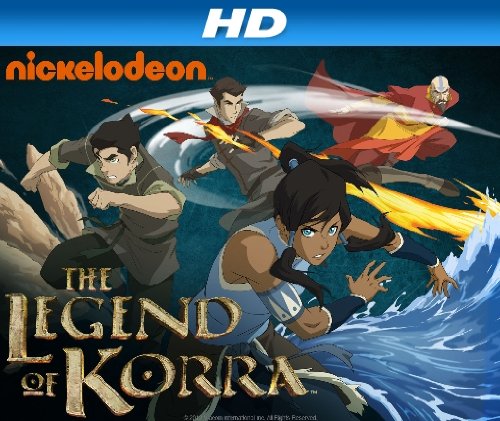
This weekend, during snowstorm Nemo, I took the opportunity to sit and watch all of The Legend of Korra on Amazon Instant Video.

It was excellent.

Super quicky synopsis for those of you who have never seen it: In a world where some people, known as “benders.” have power over one of the four elements, the “Avatar” can manipulate all four. Avatar-in-training, Korra, has mastered all but Air, but when she comes to Republic City to learn the fourth element she find herself caught up in a veritable war.

I never did watch Avatar – The Last Airbender, beyond catching a random episode here or there. It looked good, plenty of people I know liked it, but we just never connected. So when I heard about Korra, I was glad, but not compelled to watch it. It was on my radar, I just needed to make some time for it.

Now I have and I’m pretty pleased at the result. Every character was written incredibly well. I mean that. As a person 100% driven by connection to character, there wasn’t one of the “good guys” that I thought, “oh come on…!” Especially Korra who is that invisible-unknowable to writers in almost every media – a competent adolescent girl. Korra knows from a young age she is the Avatar and has both self-confidence and self-doubt born from that knowledge. She’s not too fragile nor is she too arrogant. She’s welcome over for lunch anytime. ^_^

The story really takes off when she deifies her teacher Tenzen’s order to stay away from sport bending. Korra meets Bolin and his brother Mako…and it’s her illicit professional bending that sets much of the story in motion.

Mako picks up a girlfriend along the way, Asami, who turns out to be a key in the larger plot. Of all the characters, she was the one I was most afraid would be written poorly, but nope. The plot screws her a bit, but the writers never do.

Bei-Fong, the police chief, is a rare middle-aged female character with both bending and secular power. She also gets moment of “waaaah” during the series usually given over to male characters.

Even Tenzen’s family are not afterthoughts. There’s a moment early on when Tenzen and Korra are arguing. Miffed, Tenzen forbids his eldest daughter from being like that, which she wisely refuses to guarantee.

The plot is jam-packed and, as a result moves a teeny bit too fast at the end, but that’s honestly one of only three quibbles I have.

Quibble the first: City Council Members who are clueless sheep. Politicians might follow the money, but darn few of them are clueless sheep. They might be delusional, insane or incompetent, but not too many people are going to make a City Council without *some* presence.  At least make Tarrlok an amazing speaker or something to convince me they were convinced that the worst ideas ever were good. (“Why yes, let’s pass a law that does the very thing the enemy is accusing us of doing! That’s a great idea!”)

Quibble the second: Nothing personal to Mako, and he didn’t have to stay with Asami, but I can think of several ways in which he and Korra did not have to end up together and the story would have ended better. Also, how vexing that Asami, who is a very decent character, is basically brought in just to end up being Korra’s rival. Snooze. I want Asami to be avenged by being a major character next time.

Quibble the third: Aang’s BS about Korra connecting with her spiritual self. Yes, I realize time was running out, but really, 5 more seconds (hey, cut out the Mako scene and you’d have had plenty of time) for the right kind of epiphany and it would have been awesome.

Other than those small things, I genuinely enjoyed the heck out of this series. Korra was definitely my definition of a “strong female lead”. (You can read a discussion of my definition in my review of Bandette.) If I had a girl child, she’d get this series and kung-fu lessons for her birthday. (With a teacher that understands why Aang was wrong!) Highly recommended.

Ratings:

Art – 9
Characters – 9
Story – 8

Overall – 9

Bolin was my fave character, he just said what needed to be said.


Penguindrum Anime Collection 1, Disk 2 (English)

February 6th, 2013

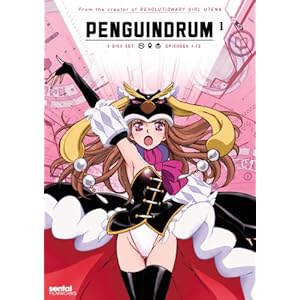
As Disk One of Penguindrum ended, we focus on the not-entirely-overlapping realities currently experienced by Shoma and Kanba, and which to increasingly involve Oginome Ringo and her dead sister’s notebook.

As Disk Two opens Kanba is puzzling out the issue of a number of exes who have suddenly, weirdly lost their memories. We, the viewers can see who is doing it and how but it will be some time yet before we know why.

Shoma is left to deal with an increasingly irrational Ringo, as the reality she believes in slips away from her. She watches as the object of her desire, Tabuki, is dating, engaged to and, evetually, living with “Sunshine-y Troupe” star Yuri. (The scenes of Yuri’s show and retirement party would put a smile on any Takarazuka fan’s face, as they neatly parody a number of fun tropes from the famous female musical revue. Not least of which is Yuri’s partner who looks suspiciously like Oscar from the Rose of Versailles anime.

The bulk of the this disk is caught up in Ringo’s unreality, where her destiny with Tabuki appears ever further from her, even as she strives to achieve it. Shoma, Kanba (and we who watch) learn that the notebook she treasures is the “penguin drum” the Princess of the Crystal commanded them to obtain. What this means is still unknown…and may well remain so.

Ratings:

Overall – 8

There are loads of things that makes one uncomfortable on this disk. Welcome back to Ikuhara world.

And once again, thanks to Okazu Superhero Eric P. for his generous sponsorship of today’s review!


Psycho-Pass Anime (English)

January 27th, 2013

A few months ago, I was wandering around anime/manga goods stores in Tokyo and, I could hardly help noticing the pony-tailed woman in a black suit with the intense gaze in the sections of Psycho-Pass goods. I have excellent gaydar, even for anime and manga, and I instantly got the vibe with her. I looked up the series and found myself confronted with a number of incredibly bad synopses to chose from, none of which explain anything at all about the story. (I understand that the Japanese companies send terrible copy over, but dear ANN and Crunchyroll, get someone who can write a friggin’ coherent synopsis, please. Synopses, at barest minimum should look like this:

In a setting, a protagonist finds him/herself in a situation cause effect. An adjective genre media by director/writer/famous name associated with the series.

Just like a Mad Lib, replace the italics above with the specifics and viola! coherent synopsis.

In a future where a global computer system determines a person’s fate – even so far as their capacity for crime – using their “Psycho-Pass”- new Inspector in the Public Safety Bureau, Tsunemori Akane finds herself  tracking down a serial killer whose “Psycho-Pass” remains unstained with criminal intent. A thrilling new suspense anime written by Urobuchi Gen and novelist Fukami Makoto.

See, it’s not that hard!*

Anyway, so I get home from Japan and Katherine H of Yuri no Boke tells me I really should watch it, Yayoi is awesome. But the synopses I read made the story sound so meh, I resisted. (Sorry, Katherine, I should have listened to you.)

Why the heck didn’t anyone tell me it was also written by Fukami Makoto? Sheesh, people, if you had just told me that, I would have watched it right away. I don’t give a hoot about Urobuchi Gen, but Fukami wrote Vertigo. Anything Fukami is involved in is sure to have lesbians who don’t suck.

Anyway, once I realized Fukami was involved, I started watching Psycho-Pass, which is streaming for free with registration on Funimation’s website. (Region blocking will apply.)

And it was really very good. It is indeed a “suspense” genre with a serial killer, so if you hate that crap (and who could blame you?) avoid it. They never go explicitly gross, like Suicide Club or anything. It’s suspense, not horror, but the implications can get really grim.

Yes, there’s Yuri. In the first half of the series, one of the characters involved in an arc set in a elite girl’s school is not above seducing underclassmen for a little sex and gruesome murder.

But the reason one might watch the series is the aforementioned black-suited “Enforcer,” Yayoi. When we first see her, she has just finished a light snack of Karanomori Shion, an analyst for the PSB. In addition, a full episode is dedicated to Yayoi’s backstory that does not shy from her orientation. If anything it gives a wholly functional look to the slightly ruined  life of a woman who loves women. (Something Fukami is good at.)

Yayoi makes a very decent series excellent. ^_^

There’s one other really excellent thing about the series – the character designs are totally atypical for a Fukami project, so none of the women have absurdly large breasts as they did in Vertigo. And Akane, who clearly would have been moe in any other anime series is shockingly not, here. If anything, her design looks a little droopy-eyed, rather than childish. I really like the character designs, they say “We want to become a live-action movie one day”. ^_^

A good watch, I look forward to the second half. My only complaint is the bad guy. I hate the handwave of the psycho killer who law enforcement canNOT track/find/identify for blah blah reason. Other than that handwave, it’s quite excellent.

Ratings:

Art – YMMV, but I say 8
Character – 9
Story – 9 It’s all shark jumping, all the time
Yuri – 8
Service – 7 Fans of creepy horror violence against women are creepy

Overall – 8

I like the fact that “Psycho-Pass” is a homophone for “psychopath” when said by a Japanese speaker.

*Actually, writing synopses must be hard, Funimation doesn’t even bother on their website for the series.