Archive for the English Anime Category


Ikki Tousen: Dragon Destiny Anime, Volume 1 (English)

March 12th, 2010

Today’s review is an ode to the “obvious.”

In Ikki Tousen: Dragon Destiny, Volume 1, it is “obvious” to us that Kan’u has an unrequited passion for Ryuubi and it is “obvious” to me that Ryomou has focused all her passion on two important women in her life – Hafuku and the (still-so far) departed Ryofu.

Still waters run deep and it’s so “obvious” that these women keep their deep well-spring of passionate feelings buried beneath their outward hardness.

It is “obvious” to those of “us” who are “looking” for it, that is.

And by “looking” I mean we are carefully scrutinizing animated facial expressions as if they are real and making judgements based on them, analyzing ridiculously small details of body posture, tone of voice and yes, going frame by frame to see the exact moment when we see that so-subtle shift between delusion and “obvious.” ^_^

In the fine tradition of turning great war heroes into buxom women whose skirts we look up, Ikki Tousen focuses on the awakening of the malignant spirit of the original Sousou and the subsequent chaos unleashed upon the Fighters of Seito, Nanyou and Kyoushou high schools. (I actually laughed out loud when I saw that the tagline for this series is “Romance of the Three High Schools.”)

Sousou is voiced, btw, by Dan Green of Yu-Gi-Oh TV cartoon fame on the English soundtrack.

In Volume 1, we establish the relative peace of Seito Academy, and how, although Chouhi and Kan’u are ever vigilant, Ryuubi is a total slacker. Albeit with a Dragon living inside her.

Ryomou visits to see the Dragon unleashed and we learn that she also has that same power in her. And Hakufu, too. Sousou, too, presumably, although that’s the least of his problems. Through small, poignant flashbacks, we see that Sousou really does have strong leadership qualities and the ability to inspire loyalty. Unfortunately for him, the evil former warlord isn’t having any of that, choosing to rule by fear instead.

Speaking of ruling by fear, Goei rocks. ^_^

So, yes, this series continues to be a travesty, a veritable feast of the most tedious perversions, but despite that, I like it. I would have liked it much better if the camera angles weren’t so obsessively upskirt and the men’s clothes exploded at least half as often as the women’s but…everyone fights. They fight with everything they have and then some. They fight for loyalty and love and because they *can*. That is pretty much what I fuel *my* delusions about Ikki Tousen with. ^_^

Ratings:

Art – No, seriously, no.
Characters – I kinda like them
Story – Heeheehee
Yuri – .5 unless you watch frame by frame as Kan’u deals with her “obvious” passion for Ryuubi, then 10
Service – 10

Overall – 5, unless you crave the “obvious,” then 8. ^_^

You may have heard that Media Blasters recently laid off a number of their employees, with the hope that these folks could be hired back soon. I have a number of friends working there, and I feel a great deal of fondness for them as a company. If they have ever put out anything that you liked, please support them by buying some of their anime or manga and make it possible for them to weather this storm. Your support can actually make the difference. Thank you in advance and here’s hoping that Media Blasters has a strong, building year.

In the meantime, let me thank Okazu Superhero Amanda M for contributing to MB’s bottom line and to Okazu reader enjoyment. Thank you once more for your support, Amanda.!


Yuri Anime: Rin: Daughters of Mnemosyne, Volume 2 (English)

February 24th, 2010

To fully enjoy Rin: Daughters of Mnemosyne, it might be useful to prepare yourself with a few simple steps:

1) Spend a few moments speaking with someone under the age of 17. Preferably female and preferably Goth and very weary of the world.

2) Read something insanely trashy.

3) Watch a 10-hour marathon of any sitcom that pairs a slobby guy with an attractive wife.

Or, failing that,

Take your brain out of your head for safekeeping.

Once you’ve done this simple – but crucial – bit of preparation, you’re almost ready to watch this series.

Let me give you one warning before you start to watch Volume 2: Do Not Try To Make Sense Of This Story

Sure, you can make sense of it, but the story is *so* much better if you don’t try. Just go with it.

There, now you’re ready to watch Rin: Daughters of Mnemosyne.

Where in Volume 1 time moved slowly, it fairly flies in the second volume. We’re no longer moving a year or a few at a time. Now we are taking decade-long leaps into a futuristic landscape which may seem silly on the face of it (Aquarium floors and ceilings? Really?) but makes a lot of sense if you pay the slightest attention to human nature. (Yes, because we *can*.)

Maeno Kouki has passed out of Rin and Mimi’s timestream, but his descendants are still in their care. Kouki’s son Teruki starts off as an ass, but turns out to be a dependable guy in the end. It’s his daughter, Mishio, who caps off the series and in doing so, changes everything. Rin and Mimi saved Kouki, and saved and protected Teruki, but Mishio is in fact the one who saves and protects Rin and Mimi, repeatedly. When Rin, who has lost her memory as a result of a rather extreme death, is attacked by Laura, it’s Mishio that provides a distraction. Mimi leans on Mishio when she cannot control herself when in the vicinity of Angels.

As the climax approaches (a word that is eminently suitable for this series, don’t you think?) Apos finally reveals all the pieces of the puzzle we were missing and we learn that the puzzle is pretty stupid. ^_^  But that’s okay, because we know this: Rin is the good guy and will win.

And she does, of course.

In the end, we see Rin, Mimi and Mishio as an alternate family of three women bound by thousands of years of fate and who all care deeply for one another.

Yuri in this volume is mostly on Mimi, which annoyed the Rin fans, but I thought it made more sense, really. We’ve known since the first episode that Rin had a man in her life, and we knew that she saw lesbian sex only as a form of payment. Mimi’s relationships with her informers appear a bit more ambiguous. For a moment or two, she even seemed like she may have liked one of them – although since Kugamiya Rie played the role, her reaction was typically passive-aggressive.

Which brings us to the extra on this volume. The four main female voice actors were gathered together to discuss this series and they were surprisingly frank about how working in such an “adult” horror worked for them. This interview took place at the end of Episode 2, I would have dearly loved to see them interviewed again after the final episode. I have a feeling that their opinions might have been a little different. Or not. :-)

I guess the question has to be – was it good?

The story is silly, it panders to a dozen fetishes, it’s violent and gross and sometimes plain old dumb. The art was alright, but was not stellar, even the music was overwrought. But. I think it was entertaining and had characters that exceeded their surroundings. Rin was admirable, Mimi was likeable, Apos was unbearable, Laura was…persistent. Kouki and his descendants didn’t suck.

Ratings:

Art – 7
Story – 4
Characters – 9
Yuri – 8
Service – 23.8

Overall – 8

Yes, it was good.

It is once again my sincere pleasure to thank Okazu Superhero Eric P. for his sponsorship of today’s review (and the review of Volume 1, which I belatedly realize did not credit him. That has been corrected.)

If you would like to be added to the Okazu Hero’s Roll, just pop over to the Yuri Wish List and purchase something for review! The you too will be my Hero. :-)


So Ra No Wo To Anime (English)

February 23rd, 2010

Typically I skip posting on Tuesday and do Guest Reviews on Wednesday, but I hope to have an ounce of energy for you tomorrow, so you’re getting a Guest Review a day early. Welcome back George R!

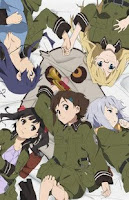
One of the shows airing this winter has quickly risen to being my favorite of the season. So Ra No Wo To (Sound of the Sky) is the debut show of the Anime no Chikara project between TV Tokyo and Aniplex. It’s an original story developed for TV animation.

Sorami Kanata, a lost little girl in a war-torn country, met a blonde lady soldier whose trumpet playing captivated her. Kanata longed to be able to make that “sound of the sky” so much she enlisted in the army when she turned 15 just so she could learn the trumpet. Bugle in hand, Kanata takes trains and motorcycle across the country to her posting in the town of Seize.

She arrives in the town to find a festival in progress, honoring the Fire Maidens of legend who defended the city against a winged fiery demon. After a few adventures, Kanata meets her superior Rio who promises to teach her the bugle, which Kanata now plays poorly, and finally the rest of her platoon.

The platoon is not exactly one off a recruiting poster. It’s composed of five young girls quartered in a poorly supplied fortress which is actually a run-down former school. Their main weapon is a high-tech walking tank, a rare relic from the previous age, which they are trying to restore to working order. Lieutenant Filicia treats the platoon under her more like a family, insisting they use names instead of ranks and having them bathe together rather than in rank order. Sergeant Rio is lax about her uniform, rarely bothering to button her jacket.

And yet, there is more. We’re reminded more than once of a something that most everyone except Kanata and the audience knows (until episode 6 when we finally learn). But that is not the only mystery. I wonder what connects Rio and Kanata: they both seem to have ties to the blonde
trumpeter who started Kanata on her path. Rio even wears the same bell she did. Filicia has her own mysterious mix of “gentle housewife” with “confident commander,” and we find she also has ties to this mysterious trumpeter. (Does everyone?) I also want to find more about the world itself and its history.

So why has So Ra No Wo To become my favorite this winter season? The things that make it for me are the characters, the world and the harmonies.

Some folks have complained that the characters overly resemble the K-On! girls. I see the resemblance in character design, but the five girls of the platoon quickly established themselves as individuals to me. This is not to say they don’t fall into well established types:

Kazumiya Rio is the gruff sergeant with a heart of gold; Filicia Heidman is a gentle young mother, who loves and care for everyone; Kannagi Noël is the taciturn, talented mechanic who likes machines better than people; Suminoya Kureha is the young private who acts tough and holds tight to protocol, as that may be all she has left; and Kanata herself is the young innocent who’s wide-eyed joy at everything we are given to share. But there is enough shown, or hinted at, for each character to seem more than just a stereotype. For example, Rio has issues with her father and the church, Filicia has a keen mind and strong will behind her gentle smile, and Kanata’s perfect pitch is actually worked into the story in places. Their quirks seem to grow naturally from each character’s past, not from a list provided by the marketing department.

Filicia and Rio may be just comrades, but put on your Yuri goggles and they’re a devoted couple who are the two mothers of this family. Just look at the way they interact when alone together and how they care for their “children.” After all, why else would they be depicted holding hands on the front of the official web site. Of course, this is just fandelusion on my part. Kureha and Kanata both adore their Rio, even though she can be severe at times.

In the end, the girls meet my ultimate criterion for “good characterization,” the writers have made me feel and care about them.

I find the world in which this is set fascinating. We’re given a portrait of a country, or a world, trying to recover from a long deadly war. We’re given few specifics about the war, but the destruction from it included the loss of high technology it was originally fought with. There’s a desert of “no man’s land” to the west, described as the end of the inhabited world, presumably left over from some past titanic battle. There is nothing living left in the seas anymore, and there are even rumors that humans are dying out. We find traces of the social and economic chaos following a great war, with a shrunken population, war-orphans, PTSD, loss of high technology, damage to buildings and infrastructure, questions of property ownership and possibly even hyper-inflation. We see both how life goes on after such a war and how people and societies adapt to the vast upheaval.

The society presents us with a mix of a wide variety of cultural elements: the Spanish feel of the town and country (Seize itself is closely modeled on the real town of Cuenca, Spain), the French language used, the German military trappings, the Japanese touches in names, food and religion (including a Shinto/Christian church), the festival which echos southeast Asian ones and the tank’s screens in English. I wonder if this might be the result of survivors from all of these cultures gathering together in one of the few habitable regions left.

The paintings shown behind the OP strongly echo some by Gustav Klimt (mainly the Beethoven Frieze) but including the five girls. In addition to being interesting artistically, they keep the legend of the Fire Maidens fresh in our mind and reminds us of the historical backdrop against which the story is set.

Given the title, it’s not surprising that music is significant in So Ra No Wo To. The opening song grabbed me from my first hearing. Its mix of sadness tempered by hope seems to fit perfectly with this world. The ED is more upbeat and happy, echoing the fun that the girls, especially Kanata, often have. While not every scene has accompanying BGM, the music suits and very much enhances those scenes where it appears. They even use the tune for Amazing Grace to form another link with the blonde trumpeter in the girls’ past.

I wonder if the writers may have put the two main themes of this show in the mounts of two characters in episode 6: “Even if we part with those we love and suffer terribly because of it, we live on. We can live on. That bravery is a very sad, very dear thing.” And, “It’s possible that something which someone did by mere coincidence, may go round and round, and eventually change someone’s life in a big way.” Perhaps it’s just that these resonate particularly powerfully with me and I’m projecting my wishes onto the show. I know some viewers will be disappointed if this platoon never sees battle, but I can be content even if they just show the girls getting on with and enjoying life. I can benefit from Kanata’s example of enjoying life and love as much as the rest of her platoon.

I’m hopeful that the writers will come continue to expand on the hints they’ve dropped so far. Each scene and each episode fills and fleshes out the picture of these girls and their world. We know all the details will never be filled in, but those they give us point the way for our minds to finish the job. I still look forward to what else they may reveal. They’ve been good so far at foreshadowing things we understand later in the episode or subsequent ones, so I’m counting on them to “play fair” over the rest of the series. As the second half of the series starts, they’ve already begun to deliver.

Ratings:
Art – 9 (characters 7, backgrounds 10)
Story – 8
Characters – 9
Yuri – 2
Service – 3
Music – 8

Overall – 9

As much as I like the characters and the world, they are blended together with the story and music to together make a harmony better than any individual component. So, all I’ve mentioned above works together to make something that has already touched me. I look forward to the second half of the series.

Once again, thank you George. I plan on watching this series eventually, thanks for priming me to enjoy the details. ^_^ And thank you for today’s review!


Yawara, A Fashionable Judo Girl Anime, Volumes 5 & 6 (English)

February 9th, 2010

I am vexed.

Very vexed.

Exceedingly vexed.

It’s been a rough day. Technology has been tedious in the extreme. And Yawara, A Fashionable Judo Girl ends in the middle of a total non-arc. I mean, really.

We’ve been talking about it since the beginning. What makes a sports manga work is a rival worthy of our hero/ine. A rival they hate and admire. A rival that pushes them into new heights of achievement. A rival with whom they can be ‘shipped by fans.

Yawara has not one, but four of these. The hapless Sayaka who has everything except satisfaction; Jody Rockwell who was the first one to ever make Yawara really enjoy the art of Judo; the mysterious Belkens of Belgium about which we know little more than her fame; and the masculine, maybe steroided, obviously amoral, Tereshikova of Russia.

So, I’m psyched, we start the final two volumes with the All-Japan Judo Championships. Yawara is distracted, but fighting. We see a glimpse of how clueless she is about Sayaka’s rivalry with her, when she helps Sayaka to beat the annoying Fudou – an act of kindness which is quickly repaid with derision. And then, it all ends, because Sayaka’s injured, so Yawara wins by default.

Which is when the sinking feeling started to hit me.

The next several episodes were clogged with Yawara taking a college exam for a college that will train her to do absolutely nothing useful except husband-hunt, and the trials and tribulations of the people around her who, pathetic as they may be, strive for more.

The best episode by far of the last two volumes was one in which the Judo club formally request a match with Yawara. I was quite teary-eyed at their eagerness to learn from a master of the sport. And I suddenly realized…I didn’t like Yawara at *all.* To have so much skill at a thing, but to want to throw it away at every possible opportunity, feh.

The sinking feeling grew.

Then came one of the worst, most tedious arcs I had ever watched in an anime as Yawara is joined by a fellow first-year in her new school in the hunt for a club to join. I’m surprised I didn’t gouge my eyes out watching this arc, because it was really dumb.

And then…the box set ends.

Seriously, AnimEigo, could you have found a *worse* spot to end the box set? NO ONE will ever want to watch more by the end of Volume 6. If you had ended the box set at the end of Volume 4, we might have sat through 5 and 6 to get to the next arc where she fights but….

Nope.

The sinking feeling of disaster fell into place like a bar of lead.

Yawara is not funny and therefore fails as a comedy, it is not uplifiting and therefore fails as a sports manga; the heroine is a lump and it therefore fails, horribly, as a parody of the above.

I sigh for what was a really wasted opportunity to end this on a great note, so we want more. There were great notes in there, too. But they were buried by the 4 times we had to sit through Grandpa’s retelling of how he met his wife, creepily voiced by Yawara’s VA.

I will remember the good bits, because they are good. But…I am vexed.

Ratings:

Art – 7
Characters – 2, except for Hanazono who is an 8
Story – 1
Yuri – 0
Service – N/A

Overall – Vexing

One last time my sincere thanks to Ana M. for sponsoring today’s review and for doing such a bang-up job on the translation. That, at least, never vexed me once. ^_^

So, my wife asks me at this point – “Would you want the next volume if it came out?” Here’s my response, “Yes, because I’m a hopeless romantic and believe that it has to get better than this. I want to watch Yawara really, truly fight and really, truly win and then I can be done with it.”


Yuri Anime: Rin: Daughters of Mnemosyne, Volume 1 (English)

February 4th, 2010

2010 continues to be a year of wonder for Yuri fans, as we now have an inordinate amount of good and bad Yuri and Yuri-ish anime to watch in English.

Inexplicably among them, Funimation picked up Rin: Daughters of Mnemosyne which has one of my top 2 most favorite opening themes ever right now. “Retsu no Matataki” from Air Master is the eternal winner, but “Alsatia” just cracks me up every time I listen to it.


Let’s get the most important thing out of the way first: Mnemosyne, greek goddess of memory, pronounced: \ni-ˈmä-sə-nē. Thank you, Merriam-Webster.

In Rin: Daughters of Mnemosyne we meet Rin, an investigator of things as small as missing cats and as large as international terrorism and her sidekick Mimi. Rin and Mimi can die, but they can’t stay dead and are, therefore, immortal.

The first episode covers their meeting with Maeno Kouki, a young man with no memory. Their adventure brings them into contact with a corrupt pharmaceutical company, enemies in advanced stages of psychosis and zombie-like test subjects. And a missing cat.

This leads into an episode about a missing stamp and a missing brother who is actually an angel and an episode about a military cover-up and a lethal disease.

Time passes quickly in this series. We jump years from episode to episode. Rin, Mimi and their dog Genta, don’t change, but Maeno ages and technology changes, which are cues for the passing of time that are far more powerful than the opening marquee telling us what year it is.

In every case, the story is deeply strange, full of intensely bloody violence and physical and emotional sadism the likes of which I have never seen before in anime. This is not a series for the light-hearted or light-stomached. It’s not graphically represented. It’s just…obvious.

I know it probably makes me a terrible person, but I love how Rin is tracked over the years by Laura, who single-mindedly kills her over and over and over. I also like how Rin’s deaths become progressively more extreme. You think they can’t beat blowing her up with a bomb but…you’re wrong. Of course, Laura isn’t the real enemy – the real enemy is Apos, voiced perfectly by Ishida Akira.

Apos is a source of much confusion and consternation for viewers….personally, I view almost all the plot complications as handwaves that must be accepted in what is not exactly the most logical or well-constructed plot ever written. Since the story is largely a vehicle for pandering of about 70 kinds, if you’re gonna stress about Apos, then you probably shouldn’t watch this series.

Personally, I loved hearing Noto Mamiko voice Rin. This is probably as close as fans will ever get to hearing her actual speaking voice in a role. And Kagamiya Rie probably broke a few brains as Mimi. She was awesome.

The DVD comes with an extra commentary for episode 2, in which the American director and voice actors are just about as infantile as you’d expect. The word “boobs” is bandied about frequently and references to lesbianism are almost all in the “girls gone wild” sense. Despite that, I laughed once or twice anyway. :-)

There is BDSM and violence and sexual violence, straight sex and lesbian sex and more violence in this series. It’s not for the kiddies and probably not for most normal people. I liked it. :-)

Ratings:

Art – this series is a good reminder that not everything looks better on a large screen – 6
Story – Oh, come *on!* It’s a 4, maybe 5, but if you’re watching it for the story, you have completely missed the point.
Characters – 9
Yuri – 8
Service – 23.8

Overall – 8

Yes, I know my ratings make no sense. Neither did this anime.

Many, many thanks to Okazu Superhero Eric P. for making today’s review possible!