Archive for the English Anime Category


Vampire Princess Miyu, Anime OVA 1 and 2

May 11th, 2008

What better way to start a new week than with a new word! Nioi-kei is a word coined by fujyoshi – the Japanese term for what you probably call Yaoi FanGirl. Fujyoshi are as delusional about Boys Love as you are about Yuri, and as a result come up with all sorts of neat words to describe stuff you didn’t realize needed to be described.

Nioi-kei (pronounced “nee-oy-ke”) means something that “smells of BL.” For instance, Ouran High School which has no actual BL, but because of the preponderance of bishounen and the twin’s playing with an incestuous BL relationship as part of their persona, “smells” like a BL series. In the case of Yuri, it would be something like Kiddy Grade, or Venus Versus Virus. They smell strongly of Yuri, but really, they aren’t.

Today’s review is totally nioi-ke, because although Vampire Princess Miyu OAV Volume 1 and Volume 2 *smell* like Yuri…etc, etc. :-)
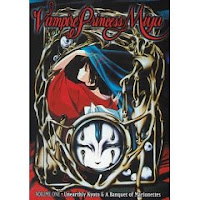
The OAV is outside the framework of the TV series (which I am also rewatching). It begins with a girl possessed, an occultist named Himeko, and rumors of a vampire haunting the town.

Himeko learns of, meets, then begins to obssess about Miyu, sure that Miyu is an evil influence, here to destroy lives – and basically nothing Miyu does convinces her that she’s wrong. For her part, Miyu is determined to remain disinterested in human existence, so while in some ways she’s helping people, in some ways she really isn’t. It’s all comes back to the basic concept of existence as a human equaling dealing with stuff, both good and bad, that life brings. Miyu brings forgetfulness to some, but is she really helping? Himeko unconditionally thinks not.

Himeko continues to track Miyu, as their lives become intertwined in a tragic story of a family betrayed – and true to her inhumanity, Miyu involves Himeko in a way that could very well become deadly.

The end remains as ambiguous as the beginning, with Himeko still convinced that Miyu brings nothing good into the world, even if she doesn’t exactly bring evil.

The thing that stood out the most for me was that, at the very beginning, Himeko arrives at the airport with no money in her purse to get a cab or make a phone call. I just started to grin, thinking that these past 20 years have changed things a lot. Nowadays, you’d hop to an ATM, get some money and call your friend on your cell. But Himeko was basically stranded. Also, Himeko was animated in those days, a generation ago now, when adult women looked like adults, and women. It was very nostalgic.

The Yuri is, as I said, totally nioi-kei. You can just about smell the scent in Himeko’s unreasonable obsession with Miyu, but it’s not developed any more than that, not even as service. The mangaka who created Miyu, Kakinouchi Narumi, has bathed more than a few of her works with that eau de Yuri, and has even added a few actual crystals to the Miyu TV series and to her obscure, one-shot manga Utahime Fight.

For a 20+ year old anime, this OAV holds up pretty darn good, I think. The animation is old-school hand-drawn art and yet, pretty cool, the story is tight, dramatic, full of foxes and other supernatural creatures, action-packed and in some way, all very much about people and what makes a human life.

Ratings:

Art – 8
Story – 8
Characters – 8
Yuri – 1
Service – 1

Overall – 8

Thanks be to Ted the Awesome for his contribution to today’s review and also to my wife who bought me the first OAV of the series a really, really, long time ago. :-)

Also thanks to Bangin-san, for his Japanese Words of Anime Fans blog, where we got today’s shiny new term!




Burst Angel Anime, Volume 6 (English)

May 7th, 2008

My biggest complaint about the previous volume of Burst Angel was that the winning formula – i.e., Jo and Meg being the point people – was sort of dropped and left behind as the plot flailed around in a Jo-focused sort-of-back- and sort-of-present- story.

Thankfully, Volume 6 recaptured what made the early episodes work, so we get to wade about in a pool of satisfyingly standard tropes of action team anime, with a decidely Western flair.

First, having resolved Jo’s personal arc, we must face the inevitable Storm before the Calm, as the team is dissolved for political reasons. As is typical in this particular plot complication, the characters, despite their personal bonds, shoot apart like shrapnel. I don’t know why that is, but it is a requirement that we all go bara-bara. Jo and Meg take to the road, Amy does Amy things and Sei-who-is-not-named-Beth does Sei-who-is-not-named-Beth things.

Jo and Meg face one more crisis, as Maria returns (another standard, which I mentally refer to as “Can’t keep a good bad guy down”) and in a lovely fit of Yuri, she kidnaps Meg, because she wants her for herself. There’s some lovely sexually suggestive stuff in there, before Jo shows up and beats the crap out of Maria in a nicely animated fight. (A trope my wife has just named “Get your hands off my Betty!”)

Meg has a chance to have her own moment of Yuri where she confesses her feelings to a sleeping Jo, kisses her and promises to protect her forever, thus notching up the Yuri without making any committment at all.

Akane returns, as the wildcard cowboy who rides in for the last battle; a nice touch, as it’s a classic tactic for Westerns.

And there’s the standard emotional parting scene where Jo leaves Meg behind before the final showdown. Also a classic Western moment, reflected beautifully by the music.

Last thing I noted was a convention of mecha/sci-fic/cyberpunk anime – the main brain to which all other brains are connected, is inexplicably wired to explode when something something something. Whose idea was that? Imagine if Google did that with their servers…. Seems to me to be a *really* bad idea.

So, the final volume returns to the classic Western roots it sort of vaguely nodded towards in the beginning. It really worked, I think. This wasn’t a deep look at anything particular, it’s not “slice of life,” or “drama,” or despite fans’ insistence “romance,” – Burst Angel is a pretty standard action anime, with strong ties to conventions of good, ole’ American Westerns. For a decent live-action analogy, I recommend Silverado which contained many of the same tropes and was about as satisfying to watch as any Western I’ve ever seen. Plus, the cast kicks. No giant weaponry though, unless you count Danny Glover’s shotgun. :-)

In the end, we get a teeny little brief glimpse of Meg’s future, which I really would have prefered to be her present, but oh well, it’s nice to know that Jo’s scarf bestows +10 competence on the wearer.

Extras as always – the American cast commentary, the Japanese radio dramas and a nifty book full of nifty facts and pictures. Extras aren’t crucial to me, and they won’t save a bad anime, but it feels nice to have such a *chunky* set of extras for this series. It’s the best of both worlds – something for the intellect and something tactile to enjoy.

Ratings:

Art – 8
Story – 8
Characters – 7
Yuri – 4
Sevice – 4

Overall – 8

Overall, a fun series that would make really good background images on a big screen during a party. :-) My thanks to Ted the Awesome for sponsoring today’s review!


Yuri Anime: Kaleido Star, Volume 1 (English)

April 30th, 2008

Today’s review is brought to you by the word “Ganbaru.” Commonly translated in anime or manga as “do your best” or in the form “gambarimasu” usually with an energetic “Let’s go!” it means nothing of the sort. It means to persevere against unreasonable odds, to bear up under unbearable pressure. It means to persist, to hold out – to keep on going no matter what.

And when one watches Kaleido Star, one is treated to a tale about a young woman who isn’t just succeeding, she isn’t just working hard to get stronger, no, in this anime, we watch Naegino Sora overcoming riduculous, demented odds, absurd pressure and insane demands to live her dream. Kaleido Star is the very essence of “ganbaru.” With lots of pretty colors and impossible shinyness.

If you are interested in the evolution of my opinion about this series, feel free to click on the Kaleido Star category on the right sidebar. Originally, I wasn’t wowed, then as the characters (and Yuri) grew, my affection for the series did as well. But, I find myself often torn between tears of outrage and frustration and being moved by joy when I watch Sora and her friends. This series makes me so angry I want to scream, and then a second later, I’m sobbing over a beautiful visual effect. Drives me crazy – and I bloody well can’t watch it when anyone else is around.

In Volume 1, Naegino Sora, a Japanese girl with skills in acrobatics, arrives at Cape Mery to join the Kaleido Stage, a very Cirque de Soleil-type show. Through the most annoying possible set of circumstances, she’s late to the audition, and has to jump through any number of hoops (no pun intended) to get even a modicum of respect.

ADV. I know it’s too late but Cape “Mery,” not “Mary. It’s visible in signs and we can read. “Owner” not “Boss” – they are saying “owner” and we are not deaf. And “Carlos.” Where on earth are you getting “Kalos” from? Every other character has a normal name – Sora, Layla, Sarah, Ken. You couldn’t figure out Carlos? … I’m available for consultation if you need help with this kind of thing.

I tried watching this volume with a different perspective than usual. From Layla’s point of view, it *is* unreasonable to show up late and expect to be given a chance. And it *does* seem suspicious that Sora’s given an opportunity to get on stage when no one else who showed up on time was – so the girls talking behind her back right in front of her makes sense. Sora’s not being bullied, and all people do do that kind of snarking. Nonetheless, when she’s given a week to learn a technique that probably took Layla *months* to master, you can’t help but grit your teeth in annoyance.

But, as I said, this show is about bearing up under unbearable pressure. Sora’s dedication and determination quickly make allies of two of the snarky girls, Anna and Mia.

Which segues nicely into the Yuri. In Volume 1 – Anna and Mia for the win. I had forgotten how boyish Anna is, and how Mia is always looking at her with big heart eyes, and how plain *together* they are. What was I thinking the first time I watched it? Yuri goggles on low, they are still so a couple.

At the moment, Layla barely acknowledges Sora’s existence, but this will change and I will be there to watch it – again. ^_^

But. Truly. What makes this anime worth watching is the utter crazy beauty and brilliance of the tricks on the Kaleido Stage. Sure, most of them are physically impossible – because I don’t care *how* high you jump on a trampoline or swing on a trapeze, people do not hang in midair, suspended, for five seconds.  It doesn’t matter – that’s why this series works so well as an anime, because they can do impossible things and make them seem possible. And that, in a nutshell, is what Kaleido Star is about. Honestly, the person who is designing the tricks is a genius.

Today’s review was made possible by Ted the Awesome. So, while both the picture and the title above are linked to the first DVD volume, I actually received this disk as part of the thinpak box set. As a result, I would like to include Ted’s own words about why to chose the thinpak over individual volumes, because he says it so well.

1. Price! Volume One is listed at $29.98(!) and the following volumes are at the $26.99 range. When I checked out the complete set dubbed “The Amazing Collection”, it was priced at $44.99. That’s cheaper then two volumes of the show!!!!!!

2. Availability! I looked at your list and saw Volume Two was not available. I tried earlier in your list history to get you an item in the same circumstances, but it wouldn’t allow me to send you an item that an individual was selling. So it was either Volume One and Three or the complete series.

3. Space! Thin Packs are my absolute favorite cases for DVDs and I’m shocked and horrified that they haven’t become a standard. Some would say that the side banner is harder to see, but I have no problems with it what so ever. Some will say that they don’t hold inserts, but they can! And since you collect quite a lot of these DVDs, why not take advantage?

4. Complete! Did I mention that it’s complete so you don’t have to wait for every volume to come in?

Of course, for every advantage this set has, there are also a slew of disadvantages. Most of them are all ADV’s fault…

1. Covers – The Cover artwork will certainly be fewer due to packaging spaces and probably a lot less cool looking.

2. Extras – ADV had a good idea (at the time) to have those who collected the volumes of an anime series to keep the extra content while those who wanted the complete series sets just got the series and no extras at all. I still have incredibly mixed feelings about this, because some of the bonus features in Excel Saga are absolutely outstanding and educational that the complete series sets totally lacks! I don’t want to give this series to my friends without those extras!

3. Support – With the savings in price, there also goes a lot of support for the show. It’s probably tough for a studio to charge a lot less for the complete series for the price of less then two volumes combined. I just hope this support is enough, because I want to support the things we like!

That pretty much covers everything I might have had to say about it anyway. lol Thanks Ted, for both the support and the review!

Ratings:

Art – 8, with occasional lapses to 5
Story – 7
Characters – 8
Yuri – 4

Overall – 8

Although it is just a teeny thing, I find it really, I don’t know – charming, I guess – that Mia is Dutch and her emails are in something that looks Dutch enough to me (although I imagine that the folks I know from the Netherlands probably cringe and die when they see them. ^_^) But still, an attempt was made.


Red Garden Anime, Volume 2 (English)

April 16th, 2008

In Volume 1 of Red Garden, Kate, Claire, Rachel and Rose, four high school students on New York City’s Roosevelt Island, learn that their typical teen feeling of being uncomfortable in their bodies can be directly attributed to the fact that they are not, actually, *in* their bodies. They are living in borrowed bodies while their real bodies lay elsewhere, dead.

In Volume 2, the four girls attempt to hold on to what is left of normality for them, while they try to figure out how to integrate their new situation. It doesn’t go well. Rose breaks and runs which, they learn, could put them all in danger. The stress of the violence that fills their lives pushes its way into their previous relationships, threatening to destroy everything that they thought they had.

While Rachel and Rose cling to denial, Kate and Claire find the mansion where they died. And later, all four return to see the brutal truth of their deaths. Having hit bottom, they band together to find some small happiness in the borrowed lives that they are now living. They find themselves sitting in Claire’s apartment, with no phone, no electricity, nothing but food out of a can, and each other. For the moment, it’s enough.

Yuri in this episode is more of Paula’s obvious, but unstated, feelings for Kate – and Jessica’s openly stated jealousy of Kate. It’s slight, but Paula always comes off with class and (no pun intended) grace. She’s a positive role model as lesbian Student Council presidents go ^_^

No extras except trailers and the like, but the riveting drama and excellent characterizations are plenty to make this DVD worth watching. Once again, it is my pleasure to thank Daniel P for giving me the opportunity to review this fabulous anime.

Ratings:

Art – 6 (the noses get really distressing this volume)
Story – 8
Characters- 8
Yuri – 2
Service – 1

Overall – 8

As I watched the scene in the mansion, I couldn’t help but think how much *better* Red Garden would be, if Kate and Claire were an item. ^_^


Kurau Phantom Memory Anime, Volume 3 (English)

April 7th, 2008

Kurau Phantom Memory, Volume 3 is a little like the middle bits of any of the old Doctor Who television series. After the plot had been established, and before the conclusion, there was a lot of running around in corridors and expository discussion, and chasing after companions that had been captured, then freeing them, losing another one, rinse, repeat, etc.

Which is not to say that it’s not enjoyable. I quite like the running around in corridors bits, except I get a little tired of the inevitable screaming the other person’s name 8 million times part that inevitably fills up time and space in an anime.

In the case of Kurau and Christmas, the corridors exist literally – on the Moon, at GPO headquarters. Kurau is there to free Christmas from her captivity. In the middle of all the running around and fighting, we gain a little knowledge – that the GPO knows that the Rynasapiens are, duh, sapient, and that the evil professor who wants to study them really doesn’t care that they are sapient and they feel pain, lonliness, etc. Ayaka helpfully lets us know that in most places Rynax energy isn’t really used or needed anymore, so the reason behind the studies is nothing more than a thin veil over illegal and immoral experiments. Kurau’s Dad gets to meet his “other daughter” and warns Kurau and Christmas not to believe the GPO no matter what they say. And Ayaka starts to, ever so slightly, question her allegiance to The Powers That Be. (Ever since I began rewatching Kurau, I’ve been trying to figure out who Ayaka reminds me of. I just figured it out – she’s this series’ Rimelda, from Madlax.)

Yuri in Kurau remains solely in the eye of the beholder. The relationship between Kurau and Christmas is deep, loving, and can easily be interpretated as sisterly or lover-ly, or even mother-daughter-ly, if you are so inclined. Personally, I believe that the relationship is being handled with the broadest possible strokes on purpose. Ambiguity makes for a bigger audience. If you see them as being “in love,” no doubt you are willing to point out the microscopic details which “prove” that you are correct, if only everyone will listen to you. Likewise, if you insist that they are sisterly, you will also have an arsenal of “proof” for doubters. Frankly, I like the relationship ambiguous. Because this way we can all see what we want to see. As long as we’re willing to admit that we’re making most of it up. :-)

Ayaka’s fixation on Kurau still puzzles me a little. Ayaka is the very typical hardboiled lesbian mystery detective – tragic backstory, hard as nails, impervious to emotion, completely obsessed with the object of the hunt. But in normal lesbian detective stories, the hunted is an actual criminal. Doesn’t Ayaka read lesbian detective stories? She’s after the wrong person…. Ah well. I feel free to make her obsession with Kurau into more than what it is, as well. ^_^

The extras are the same kind of interviews, art and stuff that came with the previous volumes.

Ratings:

Art – 8
Story – 7
Characters – 7
Music – 7
Yuri – 1
Service – 1

Overall – 8

Even with the running through corridors and screaming “Christmas!!!!!” a lot, Volume 3 was still pretty good. Thanks go to Ted for sponsoring this review. ^_^