Archive for the English Manga Category


Ichiroh! Manga, Volume 2 (English)

May 10th, 2010

Ichiroh!, Vol. 2On the cusp of writing this review, I went back to my review of Ichiroh! Volume 1 and find I damned it with faint praise. Volume 2 also was not terrible.

Nanako still spends her days studying for her eventual re-take of the college entrance exams. Akane still spends more of her time and energy on gaming than on studying, Anko is still…annoying. Shino is still in pointless lust after Nanako and Mai is still a studious serious girl with no hang ups at all, who somehow wandered into this 4-koma and got stuck.

In this volume, we start off obsessing about studying, but when that fails to be hysterical, we turn our attention to Nanako’s perpetual shortage of money. This is entirely so the author can find a reason to make Nanako take a job at a Maid Cafe – something that is always treated as if it were vaguely scandalous, the 4-koma equivalent of being a hostess at a hostess bar. (It’s a pretty apt analogy, if you think about it.) In reality, all Maid Cafes have very strict “do not touch” policies and of course every woman is using a fake name and bio.
Nanako is *shocked* to find Mai has a job at that same cafe, but with the same teacher making the referral, maybe it’s not so shocking.

This allows us to be introduced to a new character, Mayura, Nanako’s sempai at that Maid Cafe. Although the job is dropped quickly, Mayura sticks around. And, at the very end of the book, a new teacher is introduced as well. It feels very much as if the author was running out of ideas and had characters in whom he had no confidence, so the only thing he could do was add more characters.

Yuri continues in the person of Shino, who continues to “lust pointlessly” after Nanako. What is slightly more interesting is the moment when Nanako is contemplating buying a cell phone for the first time. Not just Shino, but also Akane and Mai want her to share their phone plan (they all have different plans.) It was a surprisingly harem moment for two characters who, up to this point, didn’t seem to be too interested. After this, there’s a noticeable uptick in the Yuri-ishness of Akane’s relationship with Nanako – even a moment or two when it seems like Akane really is interested in her.

There is, as I said in my review of the first volume, nothing really wrong with Ichiroh!. It’s an amusing enough comic strip if you like comic strips. It has the same bwah~wah~waaah~ humor we’ve come to expect from a 4-koma, the same gamer in-jokes. Like moe, I’m starting to think that 4-koma are really a sub-gamer genre at this point because, outside magazines that target that crowd, I don’t see much of it.

There’s an art to reading 4-koma, as Ed Sizemore mentions in his podcast on the format. A few pages at a time, then stop.Read too many at once, and you’ll find the jokes wearing. Don’t try and read it is as a narrative – it isn’t. It’s a series of gags centered around a thin plot idea.  Remember, these are only published in chapters of a few pages at a time, once a month. Stick to that format when you’re reading and it works.

Read in the appropriate manner, Ichiroh! is not terrible, with a few chuckles.

Ratings:

Art – 7
Story – 6
Characters – 6
Yuri – 3
Service- 4

Overall – 6

Happily, today we welcome a new Okazu Hero, Laurel K, for sponsorship of today’s review. Thank you Laurel for the pleasure of a few chuckles! :-) Email me at anilesbocon01 at hotmail dot com to receive your Okazu Hero badge!


Click Manhwa, Volume 5 (English)

May 5th, 2010

At the end of my review of Volume 4 of this series I wrote:

I can’t *quite* stop reading this series until Heewon gives up Joonha for good and then everyone will be tucked neatly in proper little heterosexual boxes, except for the Jinhoo x Joonha thing, which will be strung along as a fake BL story as long as the author can manage.

I cannot even begin to express to you how vexed I am that Volume 5 of Click! was not when everyone was tucked neatly into proper heterosexual boxes. Joke, joke! It’s pretty apparent that this series *will* have neatly arranged heterosexual pairings at the end, just not yet.

We’ve got all the ingredients we’re going to get now, in this Rice Krispie Treat of a gender switch manhwa. We’re just in the phase where it’s all mixed up and slowly we’ll watch it pour out into the pan to become an enjoyable snack. This is not as random an analogy as you might think, btw. Rice cereal – marshmallow treats are harder to mix together than you’d expect and not all that pliable. And the characters in Click are much the same.

In the not-quite-really Yuri dept, Heewon is still stomping around, pissed because Joonha is a girl. She’s pissed about it, because she’s still obsessed with Joonha and when asked flat out, says she still likes her. For her part Joonha actually shows a moment of humanity when she tells Jinhoo that Heewon can’t be blamed for her erratic and hurtful behavior, because she, Joonha, was the one at fault. And she admits to still liking Heewon. So, two halves make about three-quarters of a whole. I like how Joonha is starting to just accept being female, so while it remains *the* plot complication, it’s being used less for cheap laughs and more as a dramatic point.

Heewon has a heterosexual escape valve, Taehyun’s lackey Jihan, so I’ll be shocked if she doesn’t end up having a satisfyingly contentious relationship with him by the end.

In the fakey-BL love story between Jinhoo and Joonha, there’s a interestingly complicating factor of Taehyun looking less and less like a raging asshole and more and more like a ridiculously appealing, adventurous guy with smarts, money and balls. I’m actually really pulling for a love triangle with Joonha torn between Jinhoo and Taehyun. It could add a fun extra layer of uneeded complexity to the series. I vote for Joonha and Taehyun, because they’d actually work as a couple, where Jinhoo would just disappear into Joonha or vice versa.

The only character I actually feel bad for is Jinhoo’s girlfriend, Hyejin, who is getting trampled on from every direction and really, really doesn’t deserve it.

The amazing thing about all this is, for all that it’s a story with so many layers of relationships, if Joonha ever told Jinhoo the truth, the entire story would come to a screeching halt. The End. Like so many other gender-switch manga and manhwa, this particular plot complication appears to be maintainable over a longish story line in a way that works.

I still don’t *like* any of the characters, but I’m disliking most of them less. And at this point, as long as most of the relationships resolve one way or another, I’m fine with whoever ends up with whoever.

Ratings:

Art – 6
Story – 6
Characters – 6
Yuri – 2
Service- 1

Overall – 6

Thanks very much to the sponsor of today’s review, Okazu Superhero Dan P!


Jormungand Manga, Volume 2 (English)

April 28th, 2010

In Volume 1 of Jormungand, we determined that this series is a fun, sometimes funny, light-hearted look at an occupation with is not at all funny and very definitely full of dark hearts, dealers of arms. In Volume 2, it’s more of the same.

There’s a certain amount of philosophical rambling I’m willing to put up with in stories of people with no ethical underpinnings. It’s interesting to watch authors struggle with the “why” someone would do something so awful and interesting to see that they often have to create a kind of cheerful nihilism to explain it, so that their characters remain likable while slaughtering people. It’s an interesting set of hoops that I have also occasionally jumped through – no less interesting when I have been jumping through them. How does one create damaged goods that are still charming? Well, first, you give them a philosophy that precludes selfishness. They must not just be in it for what they can get, or we won’t give a shit. Then you bond them into a team that not only takes care of one another – they must like and respect one another, so we are assured that they have some humanity left. Then – and this is the most important part – give each of them a moment of honest frailty and a sense of humor about it. Without the sense of humor about their frailty, they become a tragic figure. And the moment that happens, they must die.

Jormungand‘s cast has all these things. They are loyal, they don’t have noble ideals at all, but they are perfectly aware of what they do and why and what it really means – which is nothing at all. They don’t live in the center of their universe. They are a team that respects and likes one another and because Koko doesn’t take herself seriously, they are relived of having to take themselves seriously. Because Koko likes Jonah, they all rally around him as a surrogate family. Koko is the center of their universe and ours. They live or die by her command and we enjoy this story because she enjoys being in it. Without that, our interest would die.

I am pleased that Valmet has a delusion about being in love with Koko, because it allows me to review this manga here. I’m also pleased that she’s not shy about it, because it serves the plot that she is not. I am perfectly content that it is one-sided, because it is amusing without asking me to commit any emotional resources to it.

Like Dogs, Bullets and Carnage and Black Lagoon, the story will sometimes examine a piece of the damage that makes up the past of the one of characters, but is strongest when that’s thrown that aside for an equipment jargon- and obscenity-laced, physics-defying fight. That is why we read it. To have the  fights that we cannot – to be the hard-assed, highly-skilled killers that we can never be (and really don’t want to be, but it feels good to sometimes think about it.)

I like Jormungand and not at all despite myself. I grew up on a steady diet of action flicks and adventure books. This is the kind of stuff I choose to read when I am free from reading horrible ecchi Yuri romances that make me want to sob, because they fail on every level of storytelling. (What I would give for Komari to return to the dorm in Gokujou Drops with one of Koko’s guns and resolve the matter of the ongoing sexual harassment permanently.) This manga is a rollicking adventure story, where the bad guys are the good guys and there are no good guys and no one wins.

Ratings:

Art – 7
Story – 7
Characters – 8
Yuri – 3
Service – 3

Overall – 8

Whether you read it for the amusing attempt at philosophical discourse, the Yuri, the humor, the action or the exercise in trying to make killing people not so bad in your head for a little while, Jormungand is stupid. But it’s fun stupid and that’s all that matters.


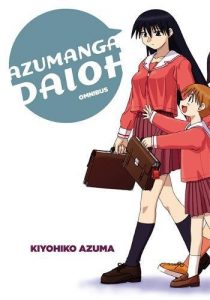
Azumanga Daioh Manga Omnibus (English – ADV Edition)

April 26th, 2010

I swear to you that this is true. Last week I said to myself – y’know, I haven’t read Azumanga Daioh in forever, let’s crack open the old Japanese editions and re-read them. And that afternoon, the English-language Azumanga Daioh Omnibus was delivered.

Do you know, I have never read the English edition of Azumanga Daioh? Well, not entirely true – I scanned the first volume when it first came out, shuddered with distaste, and didn’t buy it. I understood why ADV made the choices it did. And in many ways, I agreed with those choices, as they made the manga more accessible to a wider audience outside the core fandom. By calling Yukari-sensei “Miss Yukari” and when the students called her Yukari-chan, “Yukari baby,” they would make it easier for a non-manga fan to follow the comic. I never disagreed with their choice. I just didn’t enjoy it for myself.

Once again, allow me to clarify – I do not believe that fans want “literal” translations. What we want is an authentic reading experience. This is a subtle, but critical difference.

A literal translation of an idiom won’t kill us (unless it’s a particularly bizarre or obscure idiom. For example,  try thinking of a cute way to translate “pig in a poke” to another language.) It doesn’t really matter if you write “staring off into the middle distance” or “staring off into the day after tomorrow.” Readers will get it, whichever way you chose.

However, Kaorin is a nickname,  and therefore doesn’t really need to be translated. It’s more authentic just to leave it. We have nicknames – we get it.

Why honorifics? Because Yukari-sensei, Yukari,  and Yukari-chan all mean completely different things. It’s perfectly respectable for her mother to call her Yukari-chan and perfectly not respectable (or respectful) at all for her students to do so. As ADV learned, when we all wrote to tell them so. And they listened, as we can see with the lovely translators’ notes, explaining the choices made (and the personal touch they provide) for later volumes.

Azumanga Daioh manga was the first real battlefield where this particular war was fought. The fans have mostly won this now, although there are still pockets of resistance among publishers. Ironically, one of the few instances left that *really* bugs me is in Yotsuba, by the exact same author. “Miss Stake” would only have been good localization if the character’s name was “Chigau.” “Shimau” is a form of the verb “shimasu” and as a result, the choice of translation is irrelevant and annoying. But not to the mythical people who read manga who know nothing about it, might potentially walk in off the street and grab Yotsuba off the shelf because it’s cute. They won’t, because they don’t exist and Yotsuba, which is wonderful and deservedly won all sorts of award nominations, is buried on the far right bottom corner of manga shelves because manga is shelved alphabetically by title, where no one who isn’t looking for it will ever find it.

Ahem.

I digress.

So, anyway, ADV caved and as a result, later volumes of the English adaptation were much less irksome. And, interestingly, as ADV was carving a tighter niche in translation/localization, the artist was doing the same thing with his art.

As a result, reading the omnibus volume of Azumanga Daioh, the manga, is like a little historical retrospective of both ADV’s learning curve and Azuma Kiyohiko’s.

I enjoyed it thoroughly.

Many times I find myself laughing out loud – at 4-koma comics? Is it possible? Yes – possible and probable in this series. I can say just about anything and it’ll make you smile – “Get out of the way, Oji-san!” or mention an iriomote cat named Maya or anything Osaka ever says or, heck, just hold out two evenly broken chopsticks and say, “hehhh.” And you’ll laugh.

Because where most 4-koma comics are amusing, Azumanga Daioh is *funny.*

The absolute best part of this volume is that I cannot *wait* to donate it to my local library. I hope that many people will take it out and enjoy Chiyo-chan in a penguin costume and The Red Raccoon Dogs in gakuran and the Morons.

Oh wait – that’s the second best thing about this volume, The number one best thing is that we have a new Okazu Hero to add to our list. Thanks Kevin R. for your support of Okazu and sponsorship of today’s review! Email me so I can send you your Okazu hero’s badge and my thanks to you personally.^_^

Ratings:

Art – starts 5 evolves to 7
Story – 8
Characters – 9
Yuri – 4
Service – 4

Overall – 9

The manga industry has come a really long way since Azumanga Daioh and so has Azuma’s work. But it’s still hard to top this series for belly laughs.


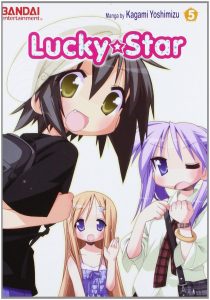
Lucky Star Manga, Volume 3 (English)

March 9th, 2010

I get it, I do.

Lucky Star is a big in-joke for the otaku audience. Look Konata games, she gets moe, she talks about dating sims and anime and ero-games. She’s one of us!

To explain why this does not hit me in the same way it hits you, let me tell you a story. I was sitting at a Druid ritual, when a woman I know came over to me with an expression of love and acceptance and joy and asked me, “Isn’t this wonderful? Don’t you remember the moment when you first felt part of a group that truly accepted you?” I looked at her very seriously and said, “No, because I’ve never looked for acceptance from a group.” This conversation actually went on for some time, her trying to ask me the same question many different ways, and me giving her the same answer – I don’t look for acceptance from other people, so I’ve never needed to feel “part of a group.” As long as I’m happy doing what I’m doing, that’s fine. She walked away after a while, totally puzzled. *Everyone* wants to be part of a group, right?

I have never once in my life referred to non-fandom people (of any kind) as “mundane.” Sports fans don’t refer to non-sports fans as “thinkies,” or anything. Why would I refer to people not in my in-crowd as something silly that they are not? And what should I call you, my non-classical music listening readers? Or my non-archeology loving readers? No, I’m not really much into “us” and “them.”

I am proud to be an otaku, and perfectly happy in my otaku life, with my fujoshi wife. My non-otaku friends are in no way “mundane.” (Understatement of the decade. My non-otaku friends are far stranger than my otaku friends could ever hope to be.)

So I don’t need that thing that Lucky Star provides, that “look there’s a media character that represents us otaku!” If you read Okazu, you’ll know that my blog is largely given over to finding those moments for lesbian readers. The idea that there is a self-referential anime and manga for otaku is great – I just don’t need that particular affirmation of self.

I’m pretty certain that those of you who are deeply engaged with Lucky Star will see this as some kind of slam, but really, I think it’s fine, really! I have no objection to the series. I get what you’re seeing.

In fact, I liked Volume 3, because it explains why 4-koma aren’t all that funny AND why so many fans think Kagami is tsundere – because the creator said so, so even though she really isn’t, and now that it has  been said, you shape your perceptions to see that. Exactly as Konata says. ^_^ What I especially like is that she said that straight to our faces. It’s so rare to see irony in manga.

So, while many of you are resonating to the “she’s one of us!” and all the in-jokes in the anime, the bit that resonates most strongly with me is the ironic (and slightly mean-spirited) meta-commentary by the creator about our otaku habits. I like when he talks about what a waste all our devotion is, and what a pointless thing us spending all that money is. I loved when he had Konata comment that getting the first volume of a manga shows loyalty – even if it’s riddled with errors. That actually made me laugh out loud. (It reminded me of something Dorothy L. Sayers has Lord Peter Wimsey say in Murder Must Advertise – that if you smile as you say incredibly mean things, people will think that you are joking.)

I would also like to blame William Flanagan for being a competent translator, as now he’s sucked the most fun I was having with the series away by replacing the challenging grammar of the previous translator with perfectly sensible English. Thanks, Bill. (-_-);

Yuri? Yes…um there’s two minor characters whose names completely escape me right now and who are always together. Perhaps they are a couple. And the girl who draws doujinshi…I’ve randomly decided that I think she’s gay. Other than that? I still think that Konata x Kagami is entirely in your head, so why shouldn’t I create other Yuri that isn’t there, too?

Ratings:

Art – 5 I can’t really respect the art. At some point you’d think it’d get better.
Story – 7 There isn’t one, really. But it is a 4-koma, so one has low expectations
Characters – 7
Yuri – 1
Service – 10 Not in the salacious way this usually represents. This series was created precisely to appeal to the Fanboy in all of us and is in that way completely an expression of the meaning of otaku.

Overall – 7

I’m still not charmed, but I did laugh out loud several times at in-jokes. I also find the notes really interesting because despite the fact that the series is for the hardcore otaku, the notes were for “mundanes.”

Thanks ever so much to Okazu superhero Dan P. for allowing me this foray into this representative medium of an important part of my life. ^_^