Archive for the Guest Review Category


Yuriten 2019 in Fukuoka Guest Report by Jenn O.

June 5th, 2019

Hello everyone and welcome to Guest Report Wednesday on Okazu. Today we’d like to welcome translator Jenn O with this terrific report of the Yuriten final location in Fukuoka. You can find her on j-entranslations.com or Twitter.  As always I hope you’ll give her a warm welcome and positive comments. Take it away Jenn!

I’m Jennifer, a game localizer and nerd who loves exciting adventure as well as cute LGBT romances. Currently residing in Japan and buying more manga and books than my apartment can hold. I had no idea the Yuri fair Yuriten was even a thing until it popped up as a retweet on Fukuoka city’s Twitter. But I was pleasantly surprised when it did! A ten-day long pop-up shop and exhibition dedicated to all things Yuri? Sign me up!

Fukuoka is a reasonably small city (compared to Tokyo and Osaka at least), so Yuriten was not hard to find. It was on the second floor of the Tenjin Core building. The moment I went in, there were posters and a small display directing people to the second floor. So that even people who had no idea it was there would have their curiosity sparked.

I honestly didn’t know what to expect when I went but was taken aback by three things in particular; the size, the content, and the people.

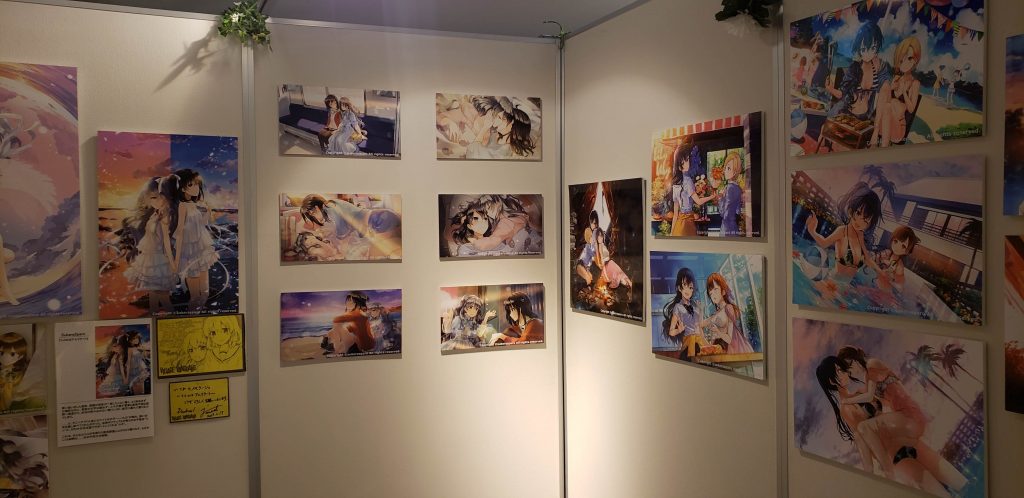
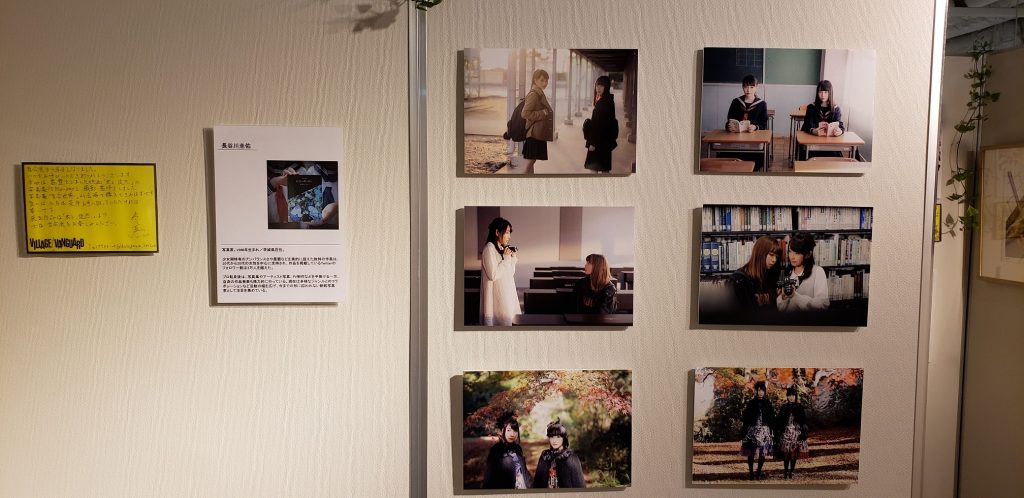
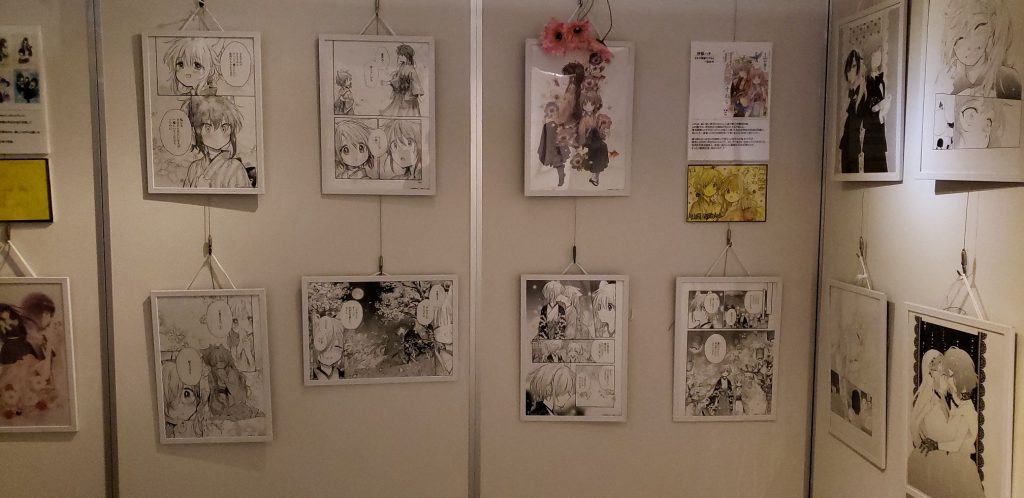
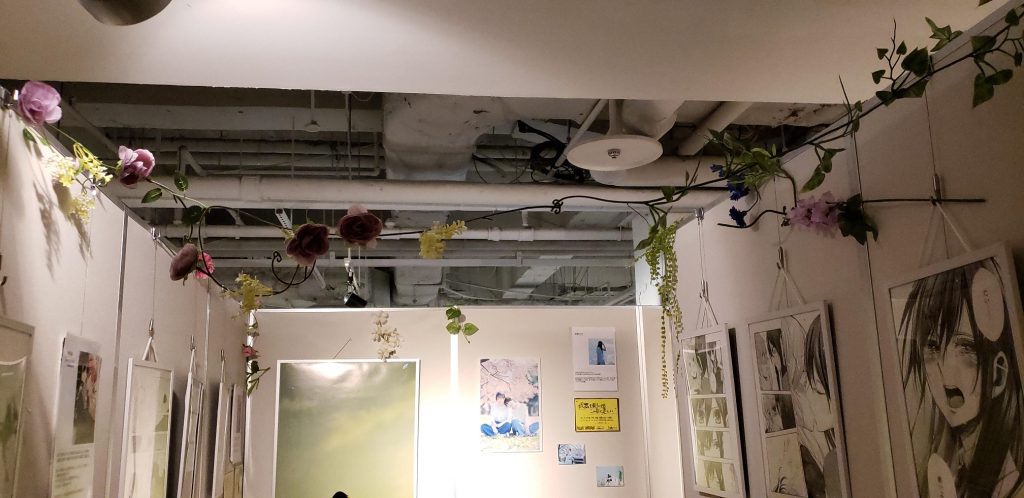
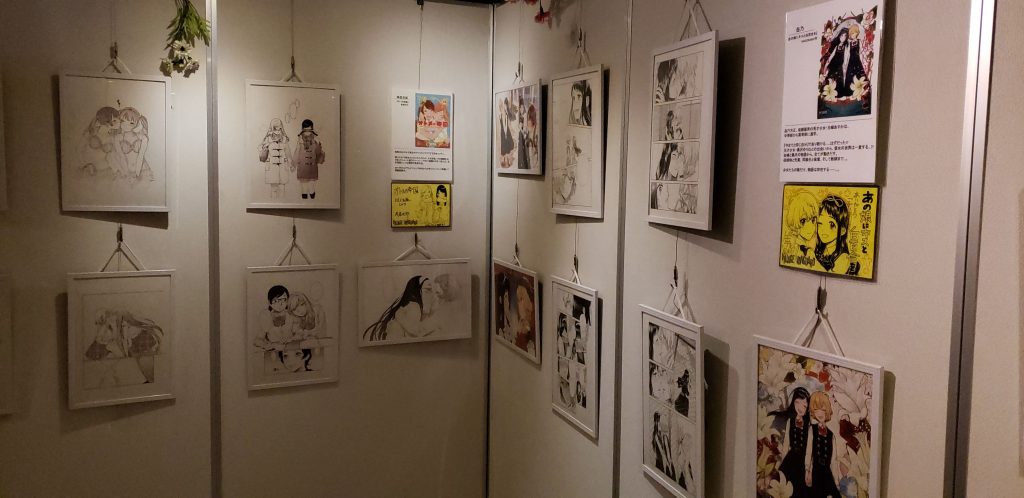
Yuriten Fukuoka was surprisingly small, certainly smaller in comparison to past Yuriten reviewed on Okazu, tucked away in the corner of this mall. Half of it was an exhibition of art and photography from Yuri manga, games, and photo books. Because the space was so small the exhibition consisted of a small corridor that winded in on itself, with the pictures lining the white walls.

It was interesting to see the variety of approaches to Yuri narratives. Some were clearly aimed more for male audiences while others were more vanilla. Most were titles I’d read or heard of, but it was a nice surprise to see a few I hadn’t. Seeing the large prints of the various art styles also made it easier to pick out some new titles.

There were a few artistic photographs that I didn’t feel comfortable with. Or perhaps didn’t know how to feel about? There a few that were photos of schoolgirls thighs, and one that was borderline sexual between two girls in sexy costumes. It felt like there were a few that were aimed at men, rather than celebrating Yuri-ness. These mostly consisted of photos or manga that had young attractive girls who were constantly kissing. Whereas I was drawn more to the cute daily life style images between women.

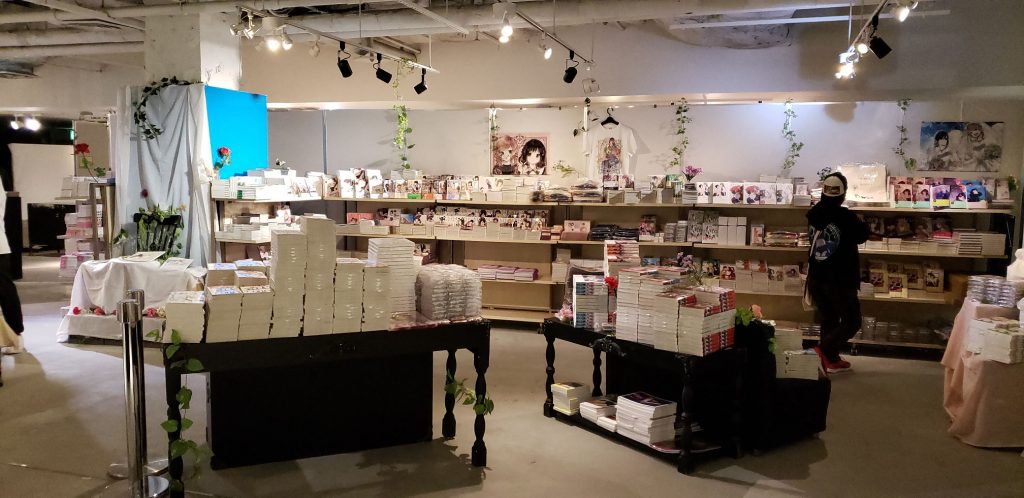
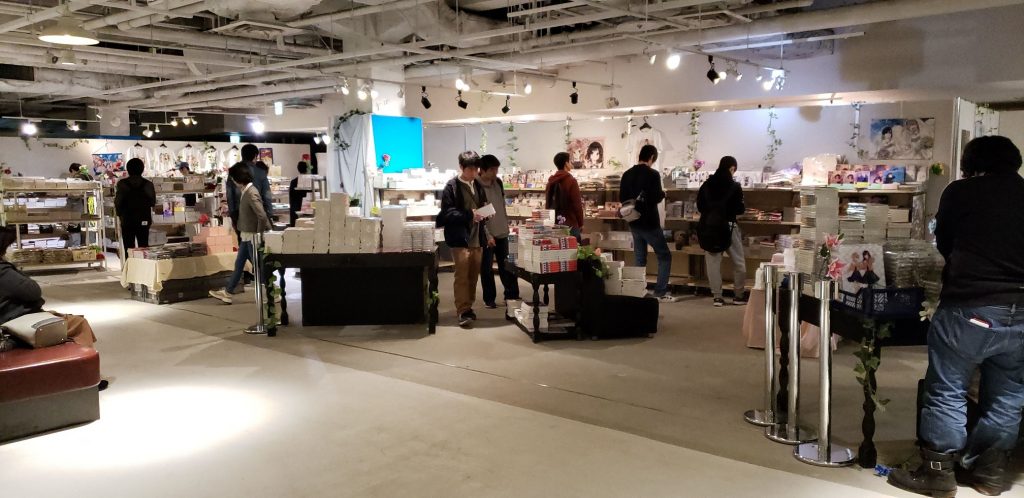
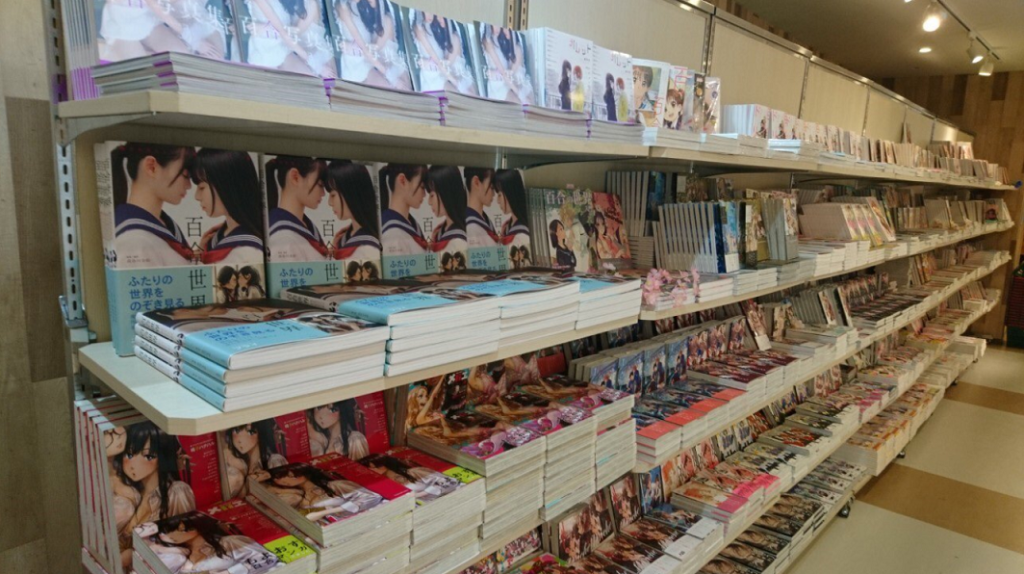
The corridor ended back out into the second half of Yuriten, which was a shop with mostly manga as well as some other goods. All the manga and games featured in the art exhibition were waiting at the end, ready for you to buy! Including some more unexpected surprised. Such as Stjepan Sejic’s lesbian BDSM comic Sunstone!
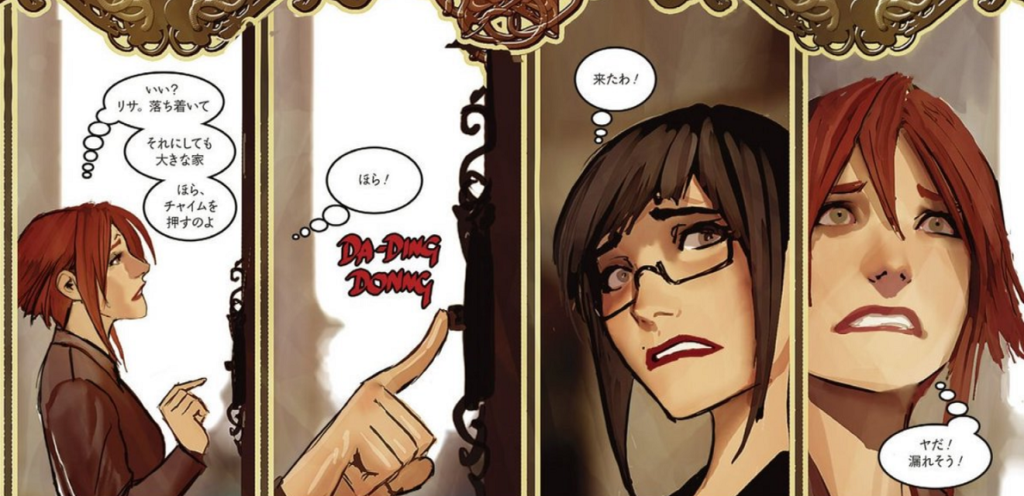
Sunstone is a particular favorite of mine and if you’re a fan of fun, witty, sexy stories with amazing art, then I highly recommend it! I knew the first volume at least had been translated into Japanese (because I picked it up at Village Vanguard) but was thrilled to see they had volumes 1-6 available at Yuriten in Japanese!

Anyway, there was a lot of Yuri. But more than that, you could actually get signed copies! Specifically you had to go at the start of the day of the last Saturday or Sunday and get a lottery ticket due to limited signed copies. Yuriten listed on their Twitter which days had which manga, and the details for entering. I decided not to go get something signed in the end but I kind of wish I had.

Which brings me onto my third surprise: the people. I think I was expecting to see a lot of men but was pleasantly surprised to see a number of women too! I would say about half were men, and half were women. They were by themselves or in pairs.

I overheard a few of the girls talking about their preferences for stories and images. (Wish I had eavesdropped a little more.) It was also great to see people’s excitement and the massive wall of manga.
Around the corner between the manga and the entrance to the exhibition was a little display of artwork made specially for Yuriten, and a massive wall of post-it-notes. People wrote out little messages, or art, or just expressed their joy for Yuri. And it was massive. Yuriten tweeted the wall at the end of the 10 days and it was completely full.
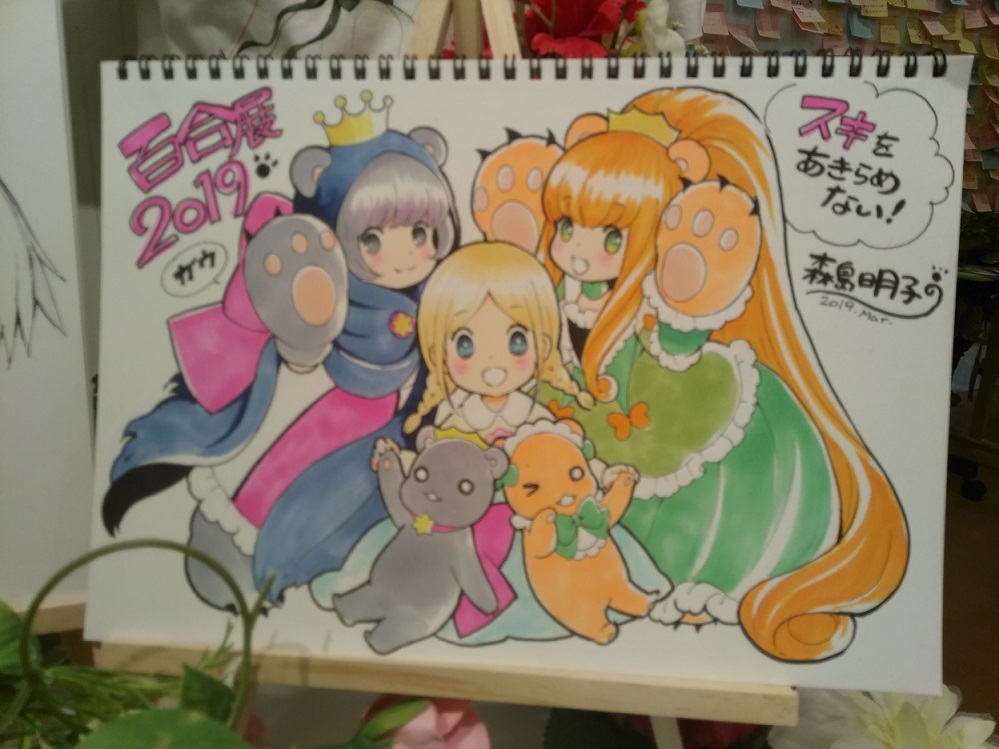
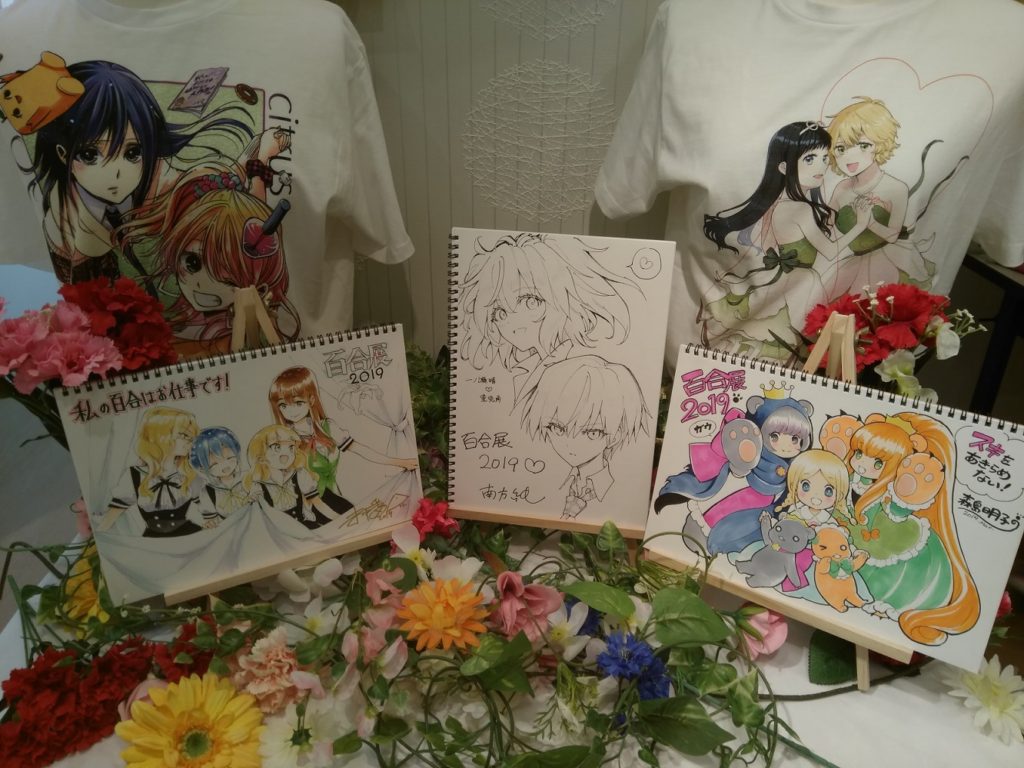
People clearly enjoyed themselves.
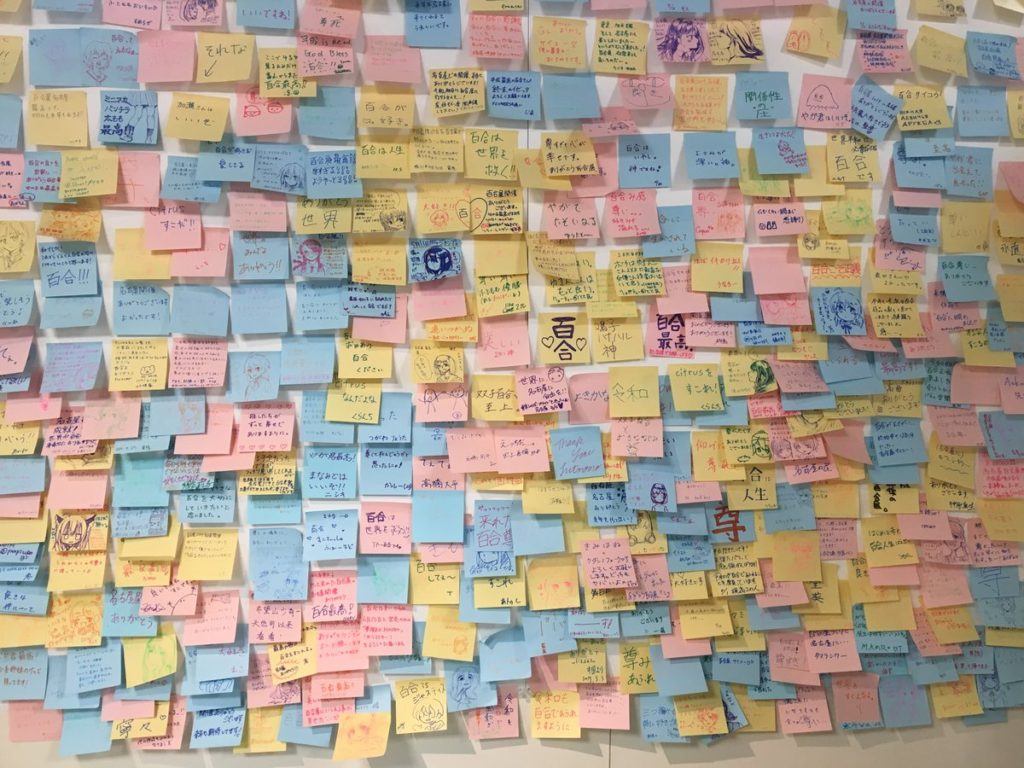
Yuriten is nothing big or fancy, but I do think it was special. It was the highlight of my day at least. It’s a celebration of Yuri for all genders. Even if you don’t know Japanese, if you love Yuri it’s worth tracking down what city they’re going to next and checking it out if you’re in the area.

Erica here: Thank you so much Jenn for this report! We had three of 5 events covered this year, and each time it just seems that people were really loving it. I love the idea of a traveling Yuri exhibit and pop-up shop. And I’m pretty stoked to see Sunstone in the mix. Thanks again for letting us walk around with you.




Yuri Manga: Kiss & White Lily For My Dearest Girl, Volume 9 (English) Guest Review by Christian LeBlanc

May 29th, 2019

Hello and welcome to Guest Review….Thursday. Yeah, I dropped the ball yesterday and simply forgot to post this. But I didn’t want you to miss this terrific review by Senior Kiss & White Lily Correspondent, Christian LeBlanc of 3DComics! So please welcome Chris back and give him your kind attention as he breaks it all down once again for us.

Let’s cut right to the chase: this penultimate Volume 9 of Canno’s high school “Yuritopia” Kiss & White Lily For My Dearest Girl (translation by Leighann Harvey, lettering by Alexis Eckerman) is a better end to the series than Volume 10, and if you enjoy these books well enough but happen to only own a few volumes, you owe it to yourself to add this one to your collection, because s*** gets real.

How real? Well, one girl forgets her toothbrush after sleeping over at her girlfriend’s house, someone else gets so angry at the world that they turn to cosplay to cope with it all, and in the climax of the series, another girl tells off their mom and then makes out with the girl she likes! (Suggested listening for this scene: your favourite pump-up music, be it something from Sailor Moon, Kill La Kill, or, if you want to get real campy, the opening 27 seconds of “Everything Louder Than Everything Else” by Meat Loaf.)<

With that out of the way, let’s back up a little and talk about our final new pair of characters. Asuka Sakurada finds herself repeating her final year of high school due to a basketball injury that made her miss too many days (it must have been a concussion or something, because she’s only shown with a broken leg in flashbacks, and I assume the poor girl would have had access to crutches). As a senpai forced to join her kōhai, she gets a *huge* chip on her shoulder about it, attending only the bare minimum of classes, refusing to integrate or socialize with anyone, etc. Her self-destructive attitude becomes extreme enough that she turns to that most delinquent form of rebellion, cosplay, which is how she meets Mikaze Hagimoto. Asuka cosplays a character who has a lot in common with Mikaze and vice-versa, the two hit it off, and we quickly see them making out on school benches, fashion wigs and all.

All of this is framed as a tragic romance, by the way – the first two words in the book are “It’s over.” If you’re like me and have a predilection for the melancholy, it means good times all around: put on your favourite gloomy Cure record and enjoy the tearful scenes that are to come. (I joke slightly, but it does get dark for poor Mikaze, who takes the break-up very hard indeed: the color has gone out of her world, she can’t concentrate in school, she starts skipping classes…we see later on in flashbacks that she spent at least one night alone with Asuka, which perhaps sheds light on why she’s having such a tough time, if things had gotten that intense between them.)

I think a much stronger ending would have seen these two making peace with each other as friends, but, you’ve already seen the cover, and you’ve probably read at least a few volumes of this series before, so you’ll just have to put on a different Cure record, I guess (one of their happy ones, that make you want to live). This is why Volume 2 will always be my favorite, by the way – Chiharu is rejected, but we get to see her *move on*, and she gets the entire volume in which to do so. Here, it feels like Canno wanted to explore a good break-up story, but had to wrap things up in order to get her characters posed happily for the cover shot; Asuka’s sudden change of heart even feels more like a plot requirement than anything sincere.

As for flagship characters Ayaka and Yurine, both characters get the plot resolution that the entire series has been building towards. Both of their chapters start with the same event (viewing exam results, the only thing that makes Ayaka feel alive…I worry about how she’s going to cope after high school, actually), and then follows either Ayaka or Yurine for the rest of their respective chapters as they resolve their plots in a neat bit of parallel story-telling. Yurine even gets a call-back to the very first chapter of the series, which makes it feel like a better ending than Vol.10, even without things “officially” wrapping up.

For analysis, let’s back things up again a bit. Ok, a lot: having lived and died centuries before Yuri began 100 years ago, René Descartes likely did not anticipate getting the opening quotation, “Conquer yourself rather than the world!” In this book, this means bringing about change through internal, rather than external, factors. Ayaka can’t change how her mom feels, but she can change how she accepts and internalizes the support she gets from others. Yurine doesn’t stop feeling alienated because of how she performed on any external exams, but by realizing she’s been gradually becoming a “normal girl” with her own community of friends all along. Mikaze tries to become someone “special” enough to win back her ex-girlfriend, but realizes it’s much healthier to try and accept the break-up, who she is, and that neither partner should have to change to suit the other. And Asuka stops cutting herself off from everything, after realizing she’s gone too far in cutting Mikaze out of her life. To drive the point home, Asuka’s pocket mirror keeps getting passed back and forth between her and Mikaze, further reflecting (sorry) this focus on the self and internal change.

In all, it’s a wonderful volume of Kiss & White Lily – we get closure for plots that have been in motion since the very first chapter (along with some related tender scenes), Ai Uehara and Kaoru Machida each get some good scenes to help lighten the mood (Ai could be one of Yuri’s best supporting characters ever, if we only got to see her more often), Asuka and Mikaze bring some enjoyably melancholy drama, characters in Kiss Theater flit in and out of cameos as always, and anyone who’s ever been on a cover of K&WL appears in at least one panel.

Canno’s Continuity Corner: there’s an incidental panel of Ayaka and Yurine starting Year 2 from Volume 3 (this time drawn as background characters); Lyrical Seira, which Asuka and Mikaze are cosplaying as, is the anime from their childhood that Sawa and Itsuki went on a movie date to see in Volume 5; there’s some bonus Valentine’s Day vignettes at the end featuring our cover-stars from Volumes 5, 6 and 7; we briefly see Yurine’s little sister again (poor Sumire – this marks her last appearance in the series, and she only gets the one panel, just like in Vol.7). In one of my favourite tiny details, the exam results show Nagisa and Hikari from last volume placing in the top 10, consistent with their characterization as high achievers – not only that, but Nagisa is even 4 places higher, which fits with how she had complained “Why does everyone always put Hikari and me on the same level? I have better grades!” while a visual of their test results shows her getting 98 vs Hikari’s 97.

Ratings:

Art – 9 The thicker blacks compared to the Japanese edition aren’t as destructive this time around; I looked, but couldn’t find any tell-tale moiré patterns. A point is still taken away for how much art gets trimmed off the edges, though. Canno’s art is gorgeous, expressions are delightful, and backgrounds really contribute to the atmosphere in a few key scenes.
Story – 9 Plot resolution, dramatic tension, sweetness, cosplay…this one has a lot going for it.
Characters – 10 Ayaka and Yurine have grown a lot as characters, and their relationship has evolved over time to reflect that. Asuka and Mikaze with their cosplay were a fun change of pace as well.
Yuri – 8
Service – 3 As Erica said in her review of the Japanese edition: “I’m not gonna lie, that kiss was pretty hot”

Overall – 10

I still remember back in April 2018, how excited I was when the 2-page colour illustration from the opening was teased on Twitter, showing Ayaka and Yurine holding hands while they emerge from a cold, snowy winter and walk off into the warm spring-like foreground together; I immediately retweeted it stating “THEY ARE HOLDINGS HANDS THIS IS HUGE THIS IS NOT A TEST” in all caps. It’s still one of my favorite illustrations from the series.

And, you don’t have to be a genius like Yurine to know how things will end up, but you’ll still want to see how it all happens in the final Volume 10, which is set to come out on October 29, 2019 from Yen Press.

Erica here: “anyone who’s ever been on a a cover of K&WL appears in at least one panel.” Foreshadowing the entirety of Volume 10, frankly.
Christian, you deserve an award for this review. It was absolutely brilliant and got both laughs and thumbs up from both members of the household here at Okazu Central. Well done.


Maiden Railways Manga (English)

April 21st, 2019

It’s always a pleasure to welcome a new publisher to the stage and today we have that pleasure. At AnimeNYC 2018, Denpa Books announced a series of very interesting licenses, including panpanya’s Invitation from a Crab (which I included on my Best Manga of 2018 list for The Comics Beat and The Comics Journal)  and Nakamura Asumiko’s Maiden Railways, both collected from comics serialized in Rakuen le Paradis magazine. Each story is connected by the theme of trains – specifically the Odakyu-Odawara Line – and young women. (The original title for this is Testsudou Shojo, i.e., Train Girls.)

I very much enjoyed the individual chapters that made up this volume when they ran in the magazine and am now equally as pleased to review Maiden Railways, as a collected work. That is to say, this is a review that I am both very pleased to be able to write and deeply unhappy that I must write. I should not be reviewing this book for Okazu. That honor ought to have gone to our late friend Bruce P, train enthusiast, Yuri enthusiast and guest reviewer of the original volume in Japanese.

Every story in this volume is…intense. There’s a lot of heightened emotions, often not spoken of. There’s suspicion and tension, and betrayal, but all told from a slightly aloof perspective, as the protagonist is sucked into someone else’s problems and can’t quite extricate themselves without being changed by it. If there is a single overarching emotion that describes the characters in these stories it would have to be nonplussed. As a result, it frequently appears that the characters are creepy, or strange, until you realize they were simply stunned. ^_^ This is very common for Nakamura-sensei’s work and it helps to remember that as you read anything she’s done.  Once you stop waiting for the boot to drop, some of these stories are surprisingly touching.

In Yuri story “Overpass Crossing” our nonplussed character encounters and has her life changed by another woman. And we’re given two color pages to show that it is a change for the better for both of them.

I am also inordinately fond of “Savarin Thursdays” in which a married man has his life changed for the better, as well. I also very much liked “Night After Night”. All the stories do something unexpected, they all involve a young woman, the obvious love Nakamura-sensei has for the Odakyu Line…and then they turn out to be tied up in a neat bow after all.

Denpa Books did a lovely job on this lovely manga. I recommend it for some unusual and fun reading.

Ratings

Art – 8 YMMV, but I like her art
Story – 9 All of them are enjoyable
Characters – Same
Service – 0
Yuri – 8

Overall – 9

“The Odakyu Odawara Line (小田急小田原線 Odakyū-Odawara-sen) is the main line of Japanese private railway operator Odakyu Electric Railway. It extends 82.5 km from Shinjuku in central Tokyo through the southwest suburbs to the city of Odawara, the gateway to Hakone in Kanagawa Prefecture. It is a busy commuter line and is also known for its “Romancecar” limited express services. From Yoyogi-Uehara Station some trains continue onto the Tokyo Metro Chiyoda Line and beyond to the East Japan Railway Company Joban Line.”


Yuriten 2019 in Sendai Guest Report by Meru C

April 19th, 2019

This is an unprecedented event in Okazu history. Not only do we have a second Yuriten Report, this time on the Sendai exhibition, this is a second week with two guest posts and we welcome a new guest writer! I am exceedingly pleased to welcome Meru C to the Okazu family and I hope you will offer the warm welcome (and kind responses in comments) that I’ve come to expect from you all. ^_^ Meru, take it away!
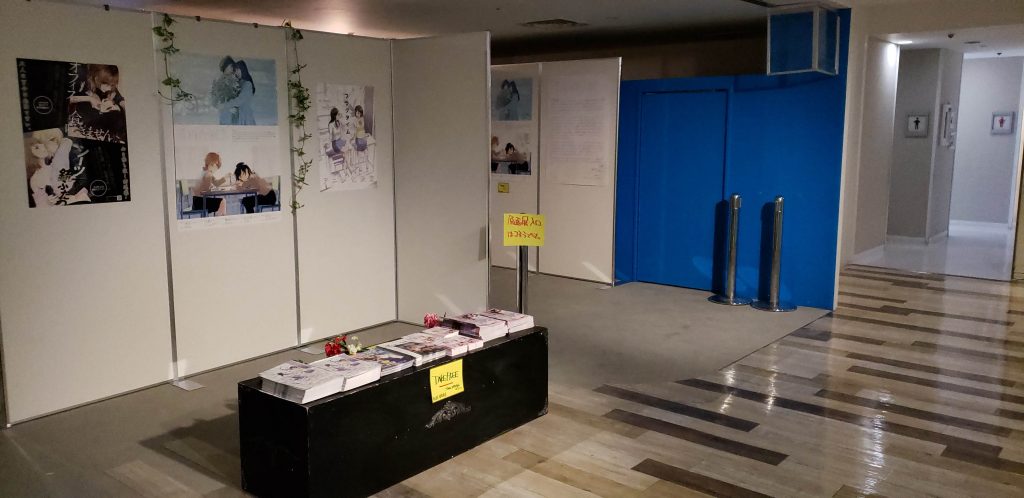
Let me start off by saying that this was Sendai’s first Yuriten event: they were added to the expanded, five-city roster this year, and hopefully, will get a return show next year.

For me, this was a great boon: it often feels like Tohoku gets left out of events like this unless they’re linked to Animate directly, or they’re larger campaigns. I’m glad to say that via Village Vanguard, more Yuri fans in Tohoku will be able to experience this wonderful event from April 13 to April 21. I attended on Day 1, April 13, to see the first opening.

The event was held on the top floor of Sendai Forus, a multi-story shopping mall that can easily be accessed using the Tozai Subway line at Sendai Station, which has elevators and escalators, or by walking for about 15-minutes from Sendai Station through the Ichibancho Shopping Arcade area. It was easily accessible and had ample seating outside the event area for weary fans to rest before or after their Yuriten experience. Additionally, the exhibition offered ample space for different abled individuals to move through, which I appreciated as a person of size. However, it should also be noted that there’s no seating within the actual exhibition area.


I was actually the first to queue up before the shopping mall opened, and one of the first to enter specifically for the event, which was a bit shocking: I had expected a bit of line, to be honest. Inside the actual shopping mall, there wasn’t any signage or direction to the top floor but I knew where to go due to the listing on the Yuriten site, which was easy enough to use without without Japanese language skills.

Village Vanguard staff was present in the exhibition area, there wasn’t anyone specifically designated to monitor how many people were in the actual exhibition space, or to limit entry. In fact, I was able to explore at my own pace, first eyeing all of the goods I wanted (note: I had a list, and the Yuriten website shows all the items potentially available) and then entering the exhibition itself. I found this open format was good for people who wanted to shop first, then look, or vice versa.

The lighting was decidedly moody once inside the exhibition itself, which made it feel like I was entering a really special place and lent to a kind of magical, soft feeling. Though perhaps unintentional, it made the exhibition a bit more special, accenting the cute rose garland strung over the exhibition and about the space there were plenty of spotlights. I found glare minimal, and was largely able to take clear pictures: the simple white walls -which doubled to form the path- made everything easy to see.


Each artist showcased in this exhibition had their own wall space, with their work grouped together by series: the same went for photography work, which there was ample amounts of. It was lovely to see manga panels from some of my favorite series blown up to A3 size: better, being able to take as many pictures as I wanted meant I could really take my time and geek out about all of the new titles I found to read. I also found some new photographers to keep up with: sadly, there were no business cards visibly displayed, so I had to make sure to write down their names or find them online right then and there. Thankfully, because there wasn’t a crowd, I could also take my time. I think I probably spent about 40 minutes in the exhibition, and was able to really take in all of the images.


Additionally, each artist had an A4 sized panel with their name and a prominent work, and below, a small Village Vanguard panel with art and their personal signatures. Though I won’t be present for any additional book signings, it still felt really cool to see their messages and their handwriting up close. Next year -and I do plan on going next year, should Sendai be on the roster again- I’ll be sure to check which days signings are available so I can offer a bit of insight into those too.


After winding through the space, I exited into shop again, and actually wandered around with the intent to make a few purchases. I’m glad to say that there was lots of merchandise, ranging from acrylic stands to button packs to clear files and a sizable assortment of t-shirts. Every series on display in the exhibition had something you could buy, whether a button pack, a manga, or a tapestry, all of which were lovely and of solid quality.


Naturally, the shirts have a smaller range, so I unfortunately couldn’t indulge: however, that didn’t stop me from spending a good amount of money. I largely picked up clear files and event specific merch, such as the Yuriten Tote Bag at ¥500, bearing the event logo on the bottom right corner. It’s admittedly not a sturdy bag: I wouldn’t put anything heavier than a thick paperback in it, or maybe a tablet. However, I got it with the intent to embroidery lilies and roses on and use it for lighter purposes, so it suited me well.

I’ll admit I had trouble finding some of the items I wanted: they either weren’t displayed or just weren’t available at all, which meant I left without the super cute Kase-san Series glass cup. But on the other hand, I also found other items I didn’t expect to see, the best being merchandise for the manga After Hours by Yuhta Nishio. I picked up a two-button set for ¥600 and a large black and white tote bag for about ¥2400. As a note, prices are not listed with tax included, so plan ahead to save on any cash register woes should you be a big shopper like me.


Check-out was easy: though there was only one register at Sendai’s event, I didn’t have to wait but a few seconds to pay for my goods. I ended up spending a hearty amount of money, largely because the quality of the items felt on part with Animate and other big-name shops, and because the environment encouraged you to get at least one thing. I will say that there’s a noticeable mark-up: clear files that would normally run about ¥250 or ¥300  at an Animate were ¥500, but honestly, I felt it was worth it as these may be limited items, or at least, hard to get, post-Yuriten. I also didn’t buy any manga though there was full stock for all the series featured in the exhibition: I prefer to buy older titles second-hand, and new, current titles Animate so I can collect points.

I’d also like to mention the crowds: I saw a good mix of genders, with the largest groups being young women and non-binary presenting folks. There were a few groups of college aged male folks, and a lot of couples shopping together. Most surprising were the few mothers and high school aged child (primarily female presenting) pairs I saw, which absolutely warmed my heart: as a queer high school teacher, I regularly interface with students who aren’t in a place to engage with their identities alongside their parents, and so it was nice to see multiple mothers enthusiastically supporting their children regardless. This exhibition definitely was family friendly, though some of the photography could be considered sensual, though I found little that parents would have genuine concern over. It felt, overall, incredibly welcoming and accessible regardless of knowledge or identity.

Overall, I have to say that this really was a lovely event to go to. Its simplicity really reminded me just how much I love Yuri. Though I went alone, I would easily suggest taking any curious friends or partners to this exhibition, especially since it’s free. There’s a lot of really good gateway titles with concurrent publishing in English, and a lot of new titles for older fans too. The photography was really my favorite part: it gave me a good bit of nostalgia about being a young, queer person falling in love with a woman for the first time, and how tender it can be.

I’m really glad I came upon this event both on Twitter and through previous reviews and I’m even more glad that I had time to go and really engage with the lovely pieces. This is definitely on schedule for next year: I can’t wait to see the creators they’ll feature in 2020!


Erica here: Thank you Meru! It is so delightful to have been able to walk through the Yuriten with you! I, too, will hope that Sendai is included in more events. There is a Sendai Comiket, but I take your meaning – Tohoku is not often thought of as comics stronghold, as Nagoya and Sapporo are.

Speaking of Nagoya…do we have any fans in the Nagoya area willing to report back on the Nagoya Yuriten event? ^_^


Yuri Manga: Kiss & White Lily for My Dearest Girl Volume 8 (English) Guest Review by Christian Le Blanc

April 17th, 2019

Welcome back to Guest Review Wednesday here on Okazu! Today we have a special Guest Review by Christian Le Blanc of 3DComics! His love for Kiss & White Lily is infectious. Let’s all be whisked away by his enthusiasm!

“Love is not gazing at each other, but looking in the same direction together.”

So opens Volume 8 of Canno’s Kiss & White Lily for My Dearest Girl from Yen Press (translation by Leighann Harvey, lettering by Alexis Eckerman), and it’s as romantic a spin as can possibly be put on this volume’s tsundere vs. tsundere cover stars. Hikari Torayama (reddish-brown hair, Tiger type, Ayaka analogue with her long hair and headband) and Nagisa Tatsumi (silver hair, Dragon type, Yurine analogue with her cool personality) are rivals for the position of Student Council President. Who can’t stand each other. And who also, as luck would have it, live together – a twist of fate has landed Hikari as a guest in Nagisa’s house. We need this plot device to force them to spend time together, because otherwise they’d avoid each other like the plague and we’d have a different pair of girls on the cover. Which would be a shame, because once I got over the fact that these two are not going to be acting lovey-dovey and give me anything to swoon over, I started to enjoy their relationship, which exists as a mirror for Ayaka and Yurine. Ayaka and Yurine are rivals who want to be more than just that, while Hikari and Nagisa can’t think of anything they’d rather be than rivals with each other. “Even if we stop being rivals someday…we might eventually see eye-to-eye,” Ayaka tells Hikari…”But just as classmates, of course!” she adds, still in denial.

The Tao of Canno

It’s easy to suppose how Canno came up with Hikari and Nagisa – start with the idea of tsundere vs tsundere, and then inform their personalities and rivalry with Tiger vs. Dragon, the eternally-opposed yin and yang of Taoist mythology (the kanji in Hikari’s last name means “tiger” and “mountain,” while Nagisa’s means “dragon” and “sea”). Both are symbols of strength, of course, and both girls dominate over the rest of Seiran High School: they excel in academics, they’re in competition for Student Council President, and they feel ‘larger than life’ compared to everyone else; they’re the boss characters, if Kiss & White Lily were a video game brawler (now there’s a thought!). Of Tiger traits, Hikari demonstrates protection: “She’s good at taking care of people.” She’s concerned about the smaller, more vulnerable clubs, and picks up after Nagisa at home. Of the Dragon traits, Nagisa demonstrates prosperity: she favors the larger clubs, and acknowledges that “My family is relatively well off.” They hang out on the forbidden school roof a lot (the heavens); naturally, the little white cat they’re looking after together adores Hikari and hates Nagisa. Maybe they complement each other, maybe they even need each other, but it’s no accident that we don’t see them exchanging chocolates in next volume’s Valentine’s Day back-up story. All the same, through their three chapters together, it’s fun not only watching them bicker, but also seeing how they react whenever something threatens to send them in different directions.

Our Returning Champions, Ayaka and Yurine

The book opens with Ayaka considering her own run at the presidency, which organically introduces our cover stars who go on to enjoy the spotlight in the next three chapters. Yurine has started to act goofy and awkward around Ayaka, a result of her growing and changing feelings towards her, especially after Ayaka helped her out of her depressive episode last volume. She’s torn between wanting to support her friend, knowing she could help the school as much as she helped her, but also knowing she won’t get to see as much of her if she wins. When Ayaka tells her her decision concerning the elections, it helps Yurine realize her true feelings for her, and grow out of her selfish and simplistic ‘deredere’ (constantly, clingingly affectionate) archetype. She can finally be honest with herself, something Ayaka is still struggling with when we see them again in the fifth and final chapter.

Speaking of this last chapter, Ayaka’s cousin and roommate Mizuki has had just about enough of Ayaka’s blitheness. She’s graduating soon, and, having been her emotional support for the past several years, wants to make sure Ayaka will have someone she can talk to after she’s gone. When she realizes that Ayaka still doesn’t even have so much as Yurine’s phone number, she demands that she asks her for it first thing in the morning, later hinting that she needs to be way more honest with herself.

It isn’t until the walk home from school that day that Ayaka finally does clumsily take the next step, managing to ask Yurine for her number. She tells her “Sorry. I kept you waiting too long” when she makes her miss her crosswalk light, but I think it’s meant to apply to more than just that.

This entire chapter, Yurine has been the model example of supportive. She knows Ayaka’s been trying to tell her something, and gently gives her the opportunity. Instead of making a huge embarassing deal out of getting her number, she just lets her know that she can call her anytime. Which is good, because Ayaka’s mom phones her that very night, triggering one of those depressive episodes that Mizuki was so worried about. Yurine handles it like a frigging champ, though. She didn’t really know what she was doing when she helped her out of a similar episode in vol.5 (we see an allusion to this episode on this chapter’s title page), but between that experience, and the help she got from Ayaka last volume, she’s become the epitome of everything you’d want in a friend helping you out when you’re at your lowest.

Lastly, we’re treated to two bonus stories at the end of the book. I didn’t really need an origin story for how Nagisa was recruited into the student council, but it did at least give Canno an excuse to bring back the eternally beleagured treasurer from vol.3 (who Yukina kept butting heads with…she even gets a name in this volume!). The other story brings back Amane, Ryou and Nina, the cover stars from vol.6, to show where the little white cat came from.

In fact, there’s a ton of returning characters this volume, obscure and otherwise: Rika “not good with her hands” Kouno is in one panel, who was only ever in two pages in vol.4. Tsubasa and Karin appear in one panel at the dorm, who likewise were only ever on two pages from vol.2 (Tsubasa was the one who accidentally locked Chiharu and Maya in the dorm’s storeroom together). We see members of the public relations committee again from vol.5, and, charmingly, their club sign that’s still only taped up over the more permanent “science” placard underneath. Characters who had leading roles in previous volumes play supporting roles here as well (we only get the back of Izumi’s head in one panel, but she’s there!). Not only does this provide more of an ensemble feel for the book, but it’s a good bit of world-building that makes Seiran High School feel more ‘real’ and lived-in. Further realism is established via small details like how Nagisa has a ‘lazy’ version of her hairstyle when she’s lounging at home, and how she and Hikari are on a first-name basis, sans honorifics, when noone else is around. This all makes re-reads a lot more interesting for me, because it always feels like I’m catching some small detail or other that I hadn’t noticed before. We’ll be seeing more adherence to continuity, as well as progress on Ayaka and Yurine’s relationship, in the penultimate Volume 9, due out very soon on May 21st, 2019 from Yen Press.

Ratings

Art – 7 I feel so petty bringing this up, but the English edition again uses significantly thicker blacks than the Japanese version, which causes tones and shading to suffer on occasion. Worse, however, are the jpeg compression artifacts visible on the front and back covers. As for the art itself, it is as detailed and charming as ever. Hair in particular has a great deal of definition and shading, rendering it with a great deal of volume and depth, and the snow and moon in the last chapter are rendered beautifully. (I’ll admit that maybe…in the right light…Canno isn’t all that great at drawing cats, but that just adds to the charm for me)

Story – 9 I average an 8 for Hikari and Nagisa, and a 10 for Ayaka and Yurine. We’re nearing their endgame, and watching Yurine be there for Ayaka was one of my favorite chapters in the series. Leighann Harvey has done a wonderful job translating every word, barring a weird side note concerning the quotation at the start of the book: my wife recognized the quotation, which is from Antoine de Saint-Exupéry’s Le Petit Prince (uncredited here). The quotation at the start of the Japanese edition is already in English, and is closer to the more proper quotation “Love does not consist in gazing at each other but in looking outward together in the same direction.” I think Leighann Harvey must have translated the Japanese version of the quote into English, ignoring the English version that was already there, all of which says nothing of the original French version of the quotation (!). Not a big deal, just a neat peek behind the curtains of translation.

Characters – 9 There’s a ton of character development going on in this volume.

Yuri – 7 That might seem like a high number considering three out of four main characters are tsundere, but you have to keep in mind that nearly everyone at Seiran is in some form of Yuri relationship.

Service – 1, by default. (I thought it was a cute touch when Nagisa’s mom told her to stop laying around in her underwear, but Canno withheld such salaciousness from the visuals)

Overall – 9