Archive for the Guest Review Category


Lesbian Space Princess

January 14th, 2026

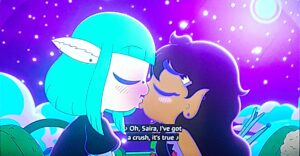
Screencap from Lesbian Space Pirate, with humanoid and alien girls kissing under the light of an alien star in a purple sky. The alien girl has white skin, and aquamarine hair, the human girl has medium-brown skin and dark long hair. by Burkely Hermann, Guest Reviewer

In this 87-minute mature sci-fi fantasy film, with space opera, comedic, and romantic elements, an introverted princess, Saira (voiced by Shabana Azeez), goes out of her comfort zone of safety and shelter. She leaves her home planet of Clitopolis and travels outside the confines of protected Gay Space so she can save a woman that means everything to her.

This Australian film, Lesbian Space Princess, is more than a fun ride, that can be comedic and heartfelt at times, involving Saira confronting her anxieties. At first, I was drawn toward this film through the media that influenced it. On social media, it was noted that the film was directly inspired by six animated films and three live-action films. This includes Steven Universe: The Movie and Revolutionary Girl Utena: The Movie(otherwise known as Adolescence of Utena). The film’s directors, Emma Hough Hobbs and Leela Varghese, praised the first film for its emotional truths and space lesbians (Garnet and Pearl for one). They said that the second is a “great reference” for queer anime that hits hard emotionally, while “not taking itself too seriously, and…[is] really clever with its budget.”

They further listed the film Blue is the Warmest Colour, which is briefly referenced in the film, and an adaption of a comic by Jul Maroh, as an inspiration. In their view, although that film does not have the best lesbian representation, it has remained influential to many queer people. They note that Lesbian Space Princess is, in contrast, “a more authentic and positive take on queer culture.” Although the Steven Universe film is only a few years away from being eligible for the National Film Registry (it will be eligible starting in 2029), it remains a cultural touchstone in many ways, not just for fans, but for queer representation as a whole.

In a Q&A with Hobbs and Varghese, they further described the film’s world, and character design, as influenced by Sailor Moon, Utena, Invader Zim, and Adventure Time, adding that “LGBTQIA+ flag colour schemes” are shown throughout the film. Both directors stated that they were inspired by French lesbian filmmaker Céline Sciamma, Canadian screenwriter Emma Seligman, and gay Korean-American screenwriter Andrew Ahn. Sciamma is known for, among other works, her acclaimed and majestic historical drama film, in 2019, entitled Portrait of a Lady on Fire (Portrait de la jeune fille en feu). Seligman is a queer filmmaker known most recently for the satirical black comedy, Bottoms. Ahn, on the other hand, had his directorial feature debut with a crowdfunded film, Spa Night, set in Los Angeles’s Koreatown, about a closeted, gay, and Korean-American teenager named David.

The queer themes start from the get-go. The film begins with Saira’s scrapbook for her girlfriend, Kiki (voiced by Bernie Van Tiel), who have only been together for two weeks. She notes her struggle with getting attention since people are obsessed with her two moms, Queens Leanne and Anne, voiced by Jordan Raskopoulos and Madeleine Sami respectfully. These queens are the rulers of the lesbian planet of Clitopolis. The on-the-nose name makes me think of C.L.I.T. (Center for Lesbian Information & Technology), a collective lesbian archive in the 1996 classic queer film, The Watermelon Woman. Saira is determined to not be single, even though she is scared to go anywhere, or do anything, while Kiki is an adventuring bounty hunter. Her girlfriend cannot take this anymore, not liking how clingy she is and for openly expressing her emotions (mainly through crying and apologizing), while admitting that Saira is “good with her hands” in bed.

Kiki leaves despite Saira’s pleas. It turns out that this is happening on an open stage that anyone can observe. It’s part of her parents’ birthday celebration for her, parents who forget how old she is. Saira is the lesbian space princess in the film’s title. The crowd and her parents pressure her to summon her labrys, a lesbian feminist symbol referring to self-sufficiency and strength, the same symbol which Marceline’s ax bass likely resembled in Adventure Time. However, when Saira is unable to summon the labrys, everyone declares that she is useless and worthless, including her own parents.

Following this disastrous celebration, the film’s main conflict begins. While Saira is feeling sorry for herself, falling into despair, her now-ex-girlfriend, Kiki, is kidnapped by a group of three beings, Known as the Straight White Malians, and voiced by Mark Bonanno, Zachary Ruane, and Broden Kelly respectfully, they kill the three women she is having sex with. These beings have been ostracized in the galaxy. They have one goal: to have her as bait so they can use Saira’s royal labrys to draw in women to their “chick magnet.” These characters are not only the film’s villains but are supposed to resemble boring and awful straight White men, particularly male podcasters. Although the film could have been written differently without them, their presence drives forward the story.

Due to their threat, Saira is forced to rescue Kiki. She leaves her protected surroundings and rolls into a “problematic ship” (rather than a perfect one) that is male-centered, sexist, and racist, and voiced by Richard Roxburgh. Her galactic adventure begins. After she exits the Safety Bubble (voiced by Reuben Kaye) surrounding of Gay Space, she crash-lands on a planet. Soon thereafter, she meets Willow (voiced by Gemma Chua-Tran), a bisexual free-spirited goth girl, songwriter, and musician, who uses they/them pronouns.

Willow’s entrance makes the film more exciting, rather than a sad adventure, especially when Willow and Saira begin flirting with one another and enjoying one another’s company. Willow sometimes sings her heart out, often playing her guitar, almost akin to Marceline the Vampire Queen in some ways, but different in many other ways. Willow and Saira bond in a deep way, especially after Willow explains that she escaped the horrifying prison of gay pop and went indie instead. This part of the film’s exploration of allosexuality. 

Willow serves as a positive influence on Saira, who falsely believes that she is nothing without Kiki. She even begins a makeover montage, which pales in comparison to the montage involving Adora, Glimmer, Catra, and Scorpia in the “Princess Prom” episode of She-Ra and the Princesses of Power. Afterward, Saira and Willow enter S Club, that is run by a drag queen named Blade (voiced by Kween Kong). At first, Saira is terrified, especially after Willow leaves her side when they enter the club.

I liked how the film depicts her as confronting her inner demons, manifested as a dark version of herself, continue to haunt her, telling her she isn’t good enough. This includes her moms, who hate single people. This first comes to a head when she helps DNM Girl (voiced by Demi Lardner), with her words about loving someone ringing true to how she feels about Kiki. Blade, a drag queen whose real passion is weapons, declares that you have to empower yourself. She tells her that she is not broken, encouraging her to begin mediation.

Thus begins one of the film’s best sequences, when she enters her mindspace, overcoming her strong mental barriers that are holding her back, with trauma from bad friends, abandonment, and parents which are neglectful and arguably emotionally abusive. She is able to unlock her labrys, that is chained and locked inside this mental space. A ball of light comes from between her legs and in Utena-like fashion, the labrys comes out of her lower body as she leans back, moaning in ecstasy. At that moment, when she feels that she won, Blade reveals her true goal. She yanks away this special weapon, almost equivalent to a heart-sword in Utena, from her hands.

After a battle, in which Willow saves her with a pineapple, she ends up beheading Blade, who had tried to kill her. Later on, back on the ship, Willow sings the obvious in a song about her having a crush on Saira. They end up kissing, a scene shown at the beginning of this review, and have sex with one another, after clicking the incognito button, so the ship can’t judge them. This relationship does not last. The lesbophobic Malians, in their man cave, continue to hold Kiki hostage, dangling above an acidic, toxic brew, with terrible jokes and accidentally killing a thespian, with one Malian falsely thinks is a lesbian, followed by a discussion of The L Word. They plan to killing Kiki sooner, since she keeps arguing them and calling them out, as she begins to slowly lose it, with many failed attempts to escape. In a heartbreaking scene, Saira dumps Willow, friend-zoning her, believing that she can get back with Kiki.

In the film’s final part, Saira saves Kiki at the last second, with the ship inspiring her to go forward. In the process, she destroys a phallic ship which resembles male genitalia. She gives up a personal part of herself, her labrys, in order to save Kiki. Despite this, and the fact she has changed on this journey, Kiki falsely declares nothing has changed. She leaves the man cave like a jerk, remaining emotionally unavailable. She is barely even thankful she was saved nor does she recognize the journey Saira had ensure in order to get there. As a result, her labrys fades away. Doubts and mental blocks cause it disappear. While Saira’s inner insecurities take over at first, she soon defeats them, realizing that her parents are bad and that Kiki is a “narcissistic asshole.”

Using her inner power, she transforms, in a somewhat magical girlesque way. Her crown moves to another part of her head and she summons her labrys once more. She leaves the suffering Malians on their own, especially after their “chick magnet” ends up killing a woman. She proposes they date one another and they take up her suggestion, beginning a polyamorous throuple. What follows is one of the best scenes of the film: she leaves behind Kiki, despite her ex-girlfriend’s continued claims that she is still in love with her, declaring that she can’t be with her anymore. The film ends happily: there’s family therapy, Willow writing a hit album about her, and Saira beginning new adventures with Ship, which is now an ally. She has no partner but is confident in herself instead.

Even before the film released in the U.S., the queer themes were evident. The film’s directors described their film as a queer love story, championing queer voices and people of color, seeing it as a step forward for “queer voices in adult animation,” and describing the film’s characters as epitomizing queer fashion trends, with a focus on self-love and self-acceptance. They hoped that the film would become an example for queer art to be seen “as more commercial and valuable” than in the past, particularly in animation. The film’s directors were committed to continue telling funny queer animated stories which provide a “safe space for the community,” including a possible sequel, perhaps in a game format. More than that, the film’s message is unique.

Many films like Lesbian Space Princess would have Saira begin a romantic relationship with someone, either involving, in this film’s world, Saira resuming a relationship with her controlling ex-girlfriend (Kiki) or with her free-spirited rebound (Willow). Whether reviewers picked it up or not, the film has the message that you can be confident by yourself, with self-love, rather than having to be with someone. Similar themes of self-empowerment are a key part of Steven Universe, while anime series, particularly A Place Further than the Universe, Wandering Son, and Skip & Loafer, focus on self-discovery.

Furthermore, the film’s diversity is reflected in the voice cast, which is primarily composed of Australian actors, and a few New Zealanders like Madeleine Sami. Specifically, drag queen Kween Kong, lesbian actress Madeleine Sami, trans lesbian comedian Jordan Raskopoulos, bisexual comedian Demi Lardner, and drag artist Reuben Kaye voice characters. This film was the first film voice role for Raskopoulos and Sami. Both had voiced characters in animated series before. Sami voiced characters in multiple episodes of Bro’Town, which featured a faʻafāfine school principal. Raskopoulos provided voices in the animated series The Team. For Lardner and Kaye, this film serves as their first-ever voice roles. This was also the case for Shabana Azeez, who is of Fujian and Indian heritage.

– Ratings

Art: 8

Story: 7

Characters: 8

Service: 4 or 5 (some occasional nudity at certain points in the film)

Yuri: 7 (there’s at least two sex scenes shown off screen, plus multiple kisses, blushing, etc.)

Music: 8

Overall: 8

Postings on social media have indicated that this film may be continued in some form. If it is continued, I’m not sure what storyline will be followed, since all the conflicts were already resolved in this film. I wouldn’t say that Lesbian Space Princess could ever become a “cult classic” as some have claimed. Nor would I say it is a “serious arthouse drama,’ is “peak queer comfort cinema,” or simply delightful, splendid, and unapologetically queer. Some might say it “behind the curve” by echoing Adventure Time, Steven Universe, Twilight, BoJack HorsemanFuturama, and Rick and Morty, or that it is designed for those once involved fan discussions on AO3 or Tumblr. Those discourses are not to be simply sneered at and pushed away as some would like to do. Lesbian Space Princess is worthwhile queer film in its own right, with its own charm and overt queerness, even if it is irreverent at times, or clunky at others.

Lesbian Space Princess is presently available, for purchase or rent, on PrimeVideo, AppleTV, Google Play, and Fandango at Home, and streaming on Fandor. The film’s Blu-ray can be pre-ordered from Umbrella Entertainment, with a collectors edition also available for pre-order.

Burkely Hermann is a writer, researcher, and former metadata librarian. His reviews can be read on Pop Culture Maniacs or his personal WordPress blog. He can be followed on Instagram, Bluesky, or on Mastadon communities such as library.love, glammr.us, genealysis.social, and historians.social.



Adachi and Shimamura, Volume 12

October 29th, 2025

Two young women stand under a colorful sunset sky on the beach, wearing flowery and flowy bathing suits. by KatGrrrl, Guest Reviewer

Adachi and Shimamura, Volume 12 is the twelfth numbered entry and fourteenth overall in this now long running light novel series by Iruma Hitoma, available in English from Seven Seas. This volume features three ‘what if…?’ alternative universe chapters followed by a return to the main timeline as our titular couple take a trip to the beach.

Despite the way this volume is numbered, it actually continues on from themes established in 99.9, one of two short story collections that were released after Volume 11. In particular, Yashiro’s newfound role as a cosmic matchmaker, making sure every Adachi finds her Shimamura in every timeline and alternate reality. Yashiro, as decently a fun comic relief character as she is, was always a bit too omnipresent in previous volumes for my liking, so giving her constant presence a greater purpose, as well as finally playing into her status as an extraterrestrial, really boosted my overall enjoyment of her character, as well as nicely tying in the AU chapters into the main timeline.

Unfortunately, the first AU story of this volume somewhat sullies this idea. “What If Adachi Was a Teacher?” is the title of this chapter, an innocent enough idea… except that one of her students is a six year old Shimamura. And if the alarm bells aren’t already ringing for you, this story sees child Shimamura propose to teacher Adachi, who promises on the condition that Shimamura wait until she’s eighteen. Twelve years later, Shimamura keeps the promise, proposing once more, a happy ending all round and another job well done for Yashiro… Look, I don’t really have to explain how completely irresponsible and predatory Adachi comes off as here, or how the thoroughly positive, ‘destined lovers’ framing is inappropriate for such a story. If this was a one-shot, I wouldn’t have much more to add, but as an AU, I still found some value in it when reading things a little less literally. Younger Shimamura here really stood out to me with how open and upfront she was to Adachi about how she felt, compared to the emotionally withdrawn teenage Shimamura of the main timeline who needed Adachi to help and push her to open up to her feelings. The way she keeps her proposal promise to Adachi throughout her withdrawn teenage years really shows the strength of her love for Adachi, particularly in comparison to her doomed childhood friendship with Tarumi. The Japanese blurb of this volume (if I’m reading it correctly,) seems to imply these AUs are daydreams of Shimamura’s, and for this chapter I feel the framing of a dream or daydream would be such a simple yet effective improvement that would greatly reduce the grossness and further highlight the insight into Shimamura’s character, and I’m annoyed this framing isn’t text.

Thankfully the next chapter, “What If Adachi Was an Author?,” is not only the standout of this volume, but the best AU chapter in the series so far. In the main timeline, Adachi’s thoughts are so pre-occupied by Shimamura, more Shimamura, and oh, did I mention Shimamura? that we rarely get any insight into other interests and hobbies, if they exist at all. I wouldn’t go as far as to call it a flaw of the series, in fact I’d say Adachi’s single-track mind for Shimamura is one of its strengths. But after thirteen books, I felt some areas of characterisation were still a bit too lacking for the fully-realised characters that the series needs if it’s going to continue throwing them into random slices of life with no overarching plotlines to rely on. So to see author Adachi here giving an interview about her thought process behind becoming an author, what she thinks about the writings of others and her own, and her lack of interest in the film adaptation of her novel, was exactly the kind of fresh look into those lacking aspects that her character needed and I want to see more of it. Not just a continuation of this AU—novelist x actor Yuri is an excellent concept—but more of seeing Adachi and Shimamura interacting with the real world as people with rich, inner lives.

The third AU chapter, “What If Shimamura Fixed the Timeline?,” is fine. It’s mainly a retelling of the events of volume one chapter one where Yashiro shows up too early and breaks the timeline. From the title, I expected Shimamura to take a bit more of an initiative in fixing things, but in the end she’s handheld by Yashiro for most of it. It was fun to see her befriend Adachi for the first time in a different setting, but overall I felt this chapter stuck to the original events to a point where it felt like it was playing it too safe. I still enjoyed reading it, but it left little to no lasting impression. “What If Everything Was Back to Normal?” is the fourth and final chapter and brings us back to the present part of the main timeline, although it actually seems to take place before Summer18 from Volume 11—any sense of linear storytelling in this series is well and truly gone. I’m impressed it managed to take this long to get a proper beach chapter. We’ve had swimming pools, bikinis and even Nagafuji and Hino at the beach already, so it was about time. With this being their last summer of high school, there’s a definite ‘end of an era, start of a new’ atmosphere here, with Shimamura in particular starting to think towards adulthood and a newfound desire for independence fueled by her desire to be with Adachi, whilst also looking back on her past beach trips with family and whether they would ever happen again, which contrasts with Adachi, who has never been to the beach before. I really like this contrast and subsequent balance between the two, Adachi has independence but no childhood, Shimamura has a childhood but no independence, and this beach trip represents the merging and sharing of both experiences, creating new memories and a new life together. I get the impression Shimamura’s mother has also noticed Adachi and her daughter are now an item, she makes some interesting choice of words for sure. I can’t wait to find out the climax of this plot thread in volume twenty-two in ten years time! Overall this was a solid chapter and my analysis above aside, their beach date was exactly the kind of wholesome cute I can’t help but smile at when reading.

There’s a couple of short shorts here, one involving Nagafuji and Hino, the other with Yoshika and Akka (yes, that’s the correct reading of her name.) There’s not much to say about these other than Nagafuji has large breasts (just in case you forgot, you know? Can’t have the reader forgetting something important like that, can we now? No way…) Molly Lee gives us another excellent translation as always and raemz is really making a habit of giving us beautiful cover illustrations.

Ratings:

Art – 9
Story – 7
Characters – 9
Service – 1 (bikinis, Nagafuji)
Yuri – 7

Overall – 7

KatGrrrl finds herself getting more addicted to Yuri by the day. Socials at linktr.ee/katgrrrl.


Girlfriend Manual

October 22nd, 2025

A dark-haired woman lays sleeping in the lap of a woman with long, orange-pink hair, who holds a book as she looks down at the woman in her lap.By Burkely Hermann, Guest Reviewer

In this heartwarming, and ongoing, young adult romance, readers are introduced to Alice Elena Tan, otherwise known as Athena, a young woman who struggles to date women. She has tried everything, whether workouts, specific skincare, an array of various outfits with a distinct style, or attending a certain university for her journalism degree. Nothing seems to work. With her confidence at rock bottom, she meets a barista named Levinne “Levi” Cruz-Santos. She doesn’t want this to go wrong. So, her friends help her by putting together a girlfriend manual, hence the comic’s title.

Girlfriend Manual was originally on Webtoons Canvas, with over 17 issues posted from late July 2023 to late January 2024. The current version supersedes that version of the webcomic. Saefira is the comic’s artist and author. She works as a full-time artist and part-time student. She is Filipino and known for a fantasy drama, Merlin. That comic is also on Webtoons Canvas and on hiatus. For Girlfriend Manual, Sonia Tagari serves as editor and Kole Hunsinger as assistant editor.

The Webtoons Originals version of Girlfriend Manual, which is reviewed in this posting, officially launched on February 14 on the Webtoons website. Saefira described it as including rewrites, hard work, and a “labor of love,” hoping that it would bring joy to fans. Apart from the official Webtoons site promoting the series on social media, the series has been a hit elsewhere.

People have posted about Girlfriend Manual on YouTube and TikTok, often praising the series. Others have posted about it on the usually chatty yuri subreddits, which at times focus only subtext rather than textual yuri. Some there described it as a girl’s love manhwa. There were further posts about it on Twitter, Threads, and other social media sites. Dedicated fans even created fanart.

Yuri themes are at the heart of Girlfriend Manual, which nicely mixes slice-of-life, comedy, and romantic elements. Athena brings magnetism to every panel she is in. She can be dramatic and exciting at the same time. She is jealous of what other people have and their romances, saying they are “lucky,” and wondering why she is single. She turns down an interested man, in episode 1, telling him she is gay. Her friend Melissa “Mel” suggests dating her, as she’s also gay, in episode 2. But Athena turns her down. With dating apps giving her trouble and her friend Nicolas “Nico” telling her that she should be okay being single, she agrees it is a risk.

She pushes that aside. She wants to be with someone and wonders what it is like to be in a relationship. She goes a date at a local cafe, Cafe Dream, but the person never shows up and ghosts her. At the same cafe, her friends Nico and Mel console her. She happens to meet Levi there and instantly falls in love with her. Mel comes up with a “girlfriend manual,” in an effort to give Athena confidence, rather than directly beginning a romantic relationship. It is likely that what’s inside the manual is what Mel wanted to do with her, but was unable to do. The plan is to approach dating carefully, so that she can go out with Levi without any misunderstandings.

This involves trying to determine if Levi, who manages her parent’s cafe, Cafe Dream, is romantically interested in women through some unsavory means by secretly watching her, then asking someone close to her. The latter is Tojiro Sato, a local artist, who works at the same cafe. Nico asks out Tojiro, but spills the entire plan, seemingly ruining their second attempt to glean information. Nico ultimately succeeds as Toji agreeing to be a “middleman” as long as Levi isn’t hurt. He wrongly thinks that Athena is a “fangirl,” when she is actually more than that. In the process, Toji ends up casually revealing that Levi is gay and has been for years.

As the comic goes on, Levi admits she is open to love, after much heartbreak in the past and failed dating. She surreptitiously meets Athena in a local park. They hit it off. Athena wonders why she should even follow the girlfriend manual. Mel tells her to not disregard it, saying that queer dating has complicated rules, and she has to avoid “potential landmines.” This doesn’t stop her from having a major misunderstanding: she thinks that Levi has a girlfriend. Athena, at Mel’s urging, aims to learn if Levi is single. They later learn that the “mystery woman,” who held hands with Levi, was actually her sister, a superstar named Annika “Annie” Starr. At one point, she teases Athena, saying she should ask her out instead. It turns out this is actually just a test, which Athena easily passes.

Athena attempts to ask out Levi but fails. She struggles with creative writing for a contest, which could lead to her being published. One of the characters in her essay is partially based on Levi. While Athena’s crush on Levi develops more as the series continues, she tries to get close to Levi. The latter gets a crush on Athena as well. Even so, her insecurities come to the surface. She sees Athena’s school ID with a different name, thinks that Athena might be a reporter, and is reminded of her terrible ex-girlfriend. Despite teasing from her sister, Annika, she aims to “expose” Athena, even secretly following her to learn “the truth.” Toji suggests she date her to learn what is going on, saying she is projecting her insecurities. Later, Athena’s friend, Mel, composes a list of dating spots. It is implied she planned to use this for dating someone, specifically Athena herself, before Athena turned her down in episode 2.

They end up meeting each other in the library, where Athena gives her a copy of The Seven Husbands of Hugo, likely a reference to The Seven Husbands of Evelyn Hugo, which is about Hugo’s life during the seven marriages, and affairs, she experiences. If so, that book somewhat refers to the insecurities both Athena and Levi have about dating. Soon thereafter, Athena musters her courage and asks Levi out on a date. A few days later, they travel to an amusement park, including going into a haunted house, on a rollercoaster, and other rides. Athena brushes away her thoughts that it will go horribly. Everything seems to be going well until Levi hears from Josh that someone was assigned to write about her sister Annika. 

Levi incorrectly assumes that the person Josh is referring to is Athena even though no photograph is available to prove her suspicion. When Athena comes back with soft serve ice cream, unaware of the conversation that Levi had with Josh, it all begins to fall apart. Levi wrongly believes that Athena is leading her on, dressing her down. This causes Athena to lash out, telling her that she doesn’t get to decide which parts of her are real and says she really did like her, and that the date was a mistake. Levi is clearly shaken.

The would-be couple breaks apart. This is even indicated in the ending message for each episode, which has nothing written in the section that Athena writes (presumably), unlike in previous episodes. Athena ends up dismissing the idea of romance. She decides to jog, do mediation, drink water, study, and write instead. She aims to focus on herself, rather than anything else, even though this seems wholly unhealthy. This is also reflected in the ending message for each episode. Toji and Annika end up talking about what happened, with Levi falling deeper into herself. Athena feels that what she did was a waste of time and that she should have asked Levi directly instead. She tries to not think about what happened the day of the failed date, at all.

Annika calls out Levi on her error. Levi says that Athena reminded her of the producers who treated her sister terribly and feels pressured by everything. She admits that if she did apologize, and was wrong (which she was), it wouldn’t fix “anything.” However, she feels too far gone to do anything and is unsure she can accept her sister’s advice. At the same time, Athena reflects on what happened and impugns Mel’s manual, with Mel even agreeing with her. She claims that the manual was made from “observation.” It is abundantly obvious she made it because it included things she wanted to do with Athena.

Ratings:

Art: 8 out of 10
Story: 9 out of 10
Characters: 9 out of 10
Service: 3 or 4 out of 10 (This comic is pretty mild, but Levi and Athena sometimes wear partially revealing outfits)
Yuri: 7 out of 10

Overall: 9 out of 10

I look forward to seeing how the series resolves the severe misunderstanding between Levi and Athena. You can enjoy Girlfriend Manual, which is still going strong after almost 70 issues, on Webtoons Originals, with various issues available for purchase on the app. Saefira can be supported through Patreon.

Burkely Hermann is a writer, researcher, and former metadata librarian. His reviews can be read on Pop Culture Maniacs or his personal WordPress blog. He can be followed on Instagram, Bluesky, or on Mastadon communities such as library.love, glammr.us, genealysis.social, and historians.social.


Literary Link

September 24th, 2025

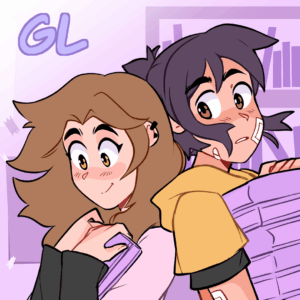
Two girls stand back to back in a library. One with multiple bandages, holds a stack of books, looking back at the other who smiles gently as she clutches a book to her chest.by Burkely Hermann, Guest Reviewer

Burkely Hermann is a writer, researcher, and former metadata librarian. His reviews can be read on Pop Culture Maniacs or his personal WordPress blog. He can be followed on Instagram, Bluesky, or on Mastadon communities such as library.love, glammr.us, genealysis.social, and historians.social.

After a street fight, Faye Scott has to do community service in a local library’s literary club, for a six-month-period. This annoys her because she detests reading. That all changes when she meets another twenty-something young woman named Atlas Valentine, and wants to give reading a try. Atlas tries to get to know her better, aware she is not there willingly, and hopes that Faye will find a “sense of community” while working there. Faye reveals she got her fighting skills from her late father and that she has no friends apart from her black cat Dani.

Literary Link, a slice-of-life comic, with romantic themes and rated for teens and up, follows the growing relationship between these two young women, involving shelving and preparing for the book club at the local library. At one point, Atlas worries she scared Faye away, as she is overthinking, based on how people have treated her in the past, but Faye returns! Previously, a short video feature for the comic was shown on a visual art site named Glow Art, as were various other yuri webcomics on Webtoon including Unleashed, Susuhara is a Demon, Diamond Dive, and Pick Me prior to Glow Art shutting down in late July of this year for unknown reasons. The latter could be related to Google cutting off web traffic. Following the site’s closure, Glow Art fired all existing staff and ended agreed-upon contracts. Luckily, creators could keep their intellectual property so it isn’t trapped on the site.

The yuri themes are central to this webcomic, whether with Atlas and Faye blushing at each other, Atlas treating Faye’s wounds, or working together on tasks. As they continue working in the library, side-by-side, they learn more about one another. Faye even beats up guys who take the book that Atlas gave her, while Atlas embarrasses Faye by showing up at the bakery, BakedKitty, where she works. It is made worse, for Faye, when the shop owner, Ethan, strikes up a conversation with Atlas. She also begins occasionally hanging out at the bakery, rather than just at the library, surprising Faye.

Their friendship, with romantic undertones, is strained when the other person doing community service, Vega Blutfield, shows up. It turns out that he is the person that Faye beat up before. Even so, they end up getting along, despite their denials, and later act competitive. In fact, in one of the Glow Art episodes, Vega teases Faye about her crush on Atlas, even proposing she write a love letter to her, after a love letter was discovered (which wasn’t even to Atlas, but someone else). Despite all of that, Atlas and Faye enjoy each other’s company, even dressing up for Halloween, Faye acting sweet toward Atlas (like giving her a new cupcake flavor made at the bakery), and Faye having a romantic dream about Atlas, thinking it is a “nightmare.”

The background Yenzu provides for Faye, about her grandmother, who hasn’t come to the library for a while because she got sick, gives the story more depth, as do the presence of the other characters hanging out in the library, or Faye’s grandmother appearing in the library. The series is no longer just centered around Faye and Atlas. At another point, Faye helps Atlas write a romantic story for a writing contest, when Atlas gets writer’s block. 

Later on, Ethan teases Faye about making Atlas her girlfriend (or “more than a friend” as he suggests), which she pushes off. However, she undoubtedly has feelings for her, and vice versa. She soon realizes he was right, letting her guard down, but remembering people on “the street” dislike her. Some time after, she even reads the completed romantic story Faye submits for a contest, and saves her from Vega’s ex-friends, who are bullies.

Yenzu often features fanart by fans, or herself, including one of Faye as Adora and Atlas as Catra in an adaptation from a new-”classic” She-Ra and the Princesses of Power scene from Season 5, sketches at the end of each comic, and highlights comments by readers, plus occasional shorter comics to keep the story going. Other short comics are more holiday-themed like Atlas giving Faye a cheek kiss under the mistletoe. Merenge does a great job with coloring this webcomic and helps make the characters come to life in this cute, fluffy comic. Literary Link is also available in Spanish language under the name “Vínculo Literario.”

There are currently plans by Yenzu to move Literary Link to Webtoons Originals as various other webcomics on the site have done. She said the new version of the comic will be improved and that the story will “bloom.” Recently, she said she is working hard on the originals version. Hopefully, the version on Webtoons Canvas stays intact and is not overridden. I say this because sometimes when comics move from Webtoons Canvas to Webtoons Originals, the original version disappears into the ether and can’t be re-read. This can be good for the author, as they can start over the story, and change it, but not necessarily the reader, as you can’t re-read the story ever again. In any case, I look forward to the improved Literary Link and plan on reading it whenever it comes out, seeing what Yenzu has changed, or kept the same.

Ratings:

Art: 7
Story: 8
Characters: 
Service: 1 (or maybe even zero as this is pretty mild)
Yuri: 3 or 4, as not much has happened yet
Hanging out in libraries: 10, as this series is centered around hanging out in a library, although not all of it occurs there.
Cuteness: 8

Overall: 9 (it’s a nice, enjoyable comic apart from the fights Faye has with others, which are not a major focus of the story)

You can enjoy Literary Link on Webtoons Canvas. It can be supported on Patreon, Ko-fi, or Red Bubble (has pins and stickers for characters from The Owl House).


Toi et Moi (トワ・エ・モア )

August 6th, 2025

In sepia tones, two girls sit at a garden table, One with long hair, wearing a long skirted dress -style school uniform. holds her chin in her hands as she leans forward. The other girl, short-haired, wears a suit and slacks for her uniform, oxford shoes and no socks, as she sits with her legs crossed. Both gaze relaxedly at us.by Akatsukinoluna, Guest Reviewer

I first came across Toi et Moi (トワ・エ・モア ) in Yurihime’s February 2024 magazine, and was instantly struck by the uniquely beautiful artwork and characters, and mature tone. It was only five months later that I excitedly discovered it wasn’t a oneshot, but has a tankōbon, and is serialized on Palcy (Kodansha’s shoujo & josei manga app). The catch copy for the series reads “More than love with the one she admires. More than friendship with her best friend. A ‘girl meets girl’ story of 4 girls at an all-girls school.” (憧れの人、恋以上。親友と、友情以上。女子校に通う4人のガール・ミーツ・ガール)

Set in all-girls high school, the story is split into four chapters (Silence, Boheme, Ombrage, and Portrait), and focuses on two couples: Okawa Seiran & Nose Chigusa (prince and princess) of Class B, and I-eshima Yae & Arisugawa Yukiyo (writer and actor) of Class A. Seiran is seemingly your typical aloof girl prince, but under the surface is merely a socially awkward and misunderstood lone-wolf. Chigusa, the shy and misunderstood, solitary doll-like princess, stands out for her elegant, lolita-esque fashion, and always walking under an umbrella outdoors.Both are misunderstood by their classmates, who assume they are being looked down upon. Seiran, initially afraid to approach Chigusa, wonders “are flowers merely meant to be gazed at?”, and maintains her distance. But when a group project gives them a chance to connect, they waste no time in growing closer to each other. 

In “Boheme” we are introduced to two childhood friends, Yae & Yukiyo, as the narration asks “What is the point of stories (monogatari)?”. Yae is an aspiring writer whose manuscripts are never quite good enough, and boyish Yukiyo is an actress who is constantly sidelined and mistreated in the school drama club. More than friends, less than lovers, and quietly harboring affections, these two are each others’ reason for their craft, and each helps the other overcome their flaws and hardships. While their relationship can be a bit tricky, as long as they have each other, they’ll be alright.

“Ombrage” & “Portrait” set the stage for our 2 couples to befriend each other, and the story and relationships unfold from there. From a school picnic, to rooftop conversations, with various casual and intimate moments, we get to see everyone grow from within and outside of their respective relationship. Yukiyo’s carefree nature forces Seiran to confront her own jealousy of Yukiyo & Yae’s friendship with Chigusa, while Chigusa reassures her (without cutting off her new friendships). Yukiyo learns that the emotional intimacy she so strongly yearns for is closer to home than she thinks — a realization she has through her conversations with Seiran. Confiding in Yukiyo, she finally understands what’s held her back all this time — and what she truly wants to depict — while Yukiyo can finally voice (quite passionately) what she truly wants to act.

The artwork in this series is gorgeous. It’s very finely detailed, soft but firm, and the eyes particularly are quite captivating (though some might find them a bit uncanny). There is simultaneously a very elegant and warm feeling, and a sense of definition. Having four visually distinct, well-developed characters with unique relationships is really refreshing — as is the lack of cheap tropes and fan service (though there’s plenty of doki doki moments). The characters all learn something unique from each other, in their interactions. And the contrast between Seiran & Chigusa’s very fast, emotionally intimate and communicative bonding vs Yukiyo and Yae’s very drawn out yearning, pining and unspoken affections is delightful. Despite being set in a school, the story is not at all focused on the usual school rhythms (culture & sports festivals, elections, valentine’s, career plans, etc), but on the characters’ personal growth. Finally, a quick shout-out to the beautiful eye-catches, and the author’s beautifully legible afterword.

Ratings:

Art – 10, elegant and distinct — especially the eyes
Story – 9, the volume ends before it gets to the really good parts
Characters – 10, unique and well developed
Service  – 0, but lots of shoujo-style doki-doki moments
Yuri – 10, very touching, well-developed, and sometimes steamy 

Overall   10