Archive for the Guest Review Category


Reverse 4 You, streaming on Netflix

March 25th, 2026

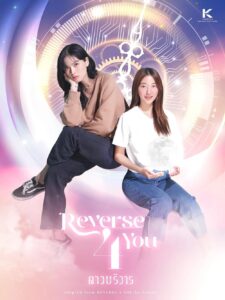
On a pink and blue background with a gold clockface design, two women in casual clothes sit not quite back to back. by Eric Potter, Guest Reviewer

In Reverse 4 You, 19-year-old Jattawa, or Wa for short, is studying to be a lawyer and working odd delivery jobs while living alone with her 15-year-old sister, Vivi. Rather than just being normal sisters supporting and looking out for each other, they also happen to have special powers. Wa can freeze time or even reverse it by as much as 10 minutes, which she often utilizes whenever an accident occurs or she made a mistake—but only once per day, and cannot use it to fix something major right after using it for something that was comparably minor. Vivi can see out-of-the-blue visions at out-of-the-blue times of the future, albeit mostly of Wa’s future—but has no personal control over the visions, with some being more vague than others. And she can never see her own future. This still comes in handy in its own way when it comes to knowing exactly when Wa will be home at the front door and what food she is bringing over.

Then one fateful day, Vivi declares to Wa that the Wa was going to meet her soulmate at the university. While Vivi only made out a silhouette of the mystery person, she otherwise relays a precise scenario that will take place so Wa could identify him. Both naturally assume they are talking about a guy at the start. Meanwhile, Wa misses a food delivery deadline by a couple minutes, and the receiving client—a delinquent-seeming, tough-talking no-nonsense type girl—rubs in her failure with zero empathy. Wa later finds out that this same girl, named Four, is known across campus for having an attitude and engaging in fights. And just when it started seeming to Wa that Vivi may have been wrong (despite it being established that she historically never is), all the pieces of her vision come together to the point where Wa finally realizes the only person it could be is, you’ve guessed it, Four.

Once revealed that the soulmate in question is another woman, both sisters interestingly skip past the usual routine of denial before coming around to the idea, and instead readily accept it and adjust their thinking accordingly. Vivi was driven to pair her sister with her destined boyfriend, but just as easily shifts her drive to pairing her with her destined girlfriend instead. And for Wa’s part, she is more awkward with Four being her soulmate given the non-best first impressions the two started with. But after Wa reverses time to save Four from an accident, they begin growing closer from that point forward. Four softens up, and Wa finds out how misunderstood Four is and that she is someone who just does not take crap from anyone, for herself as well as the people she cares about.

Much of the series just centers around Wa and Four’s relationship, with all the traditional high points, conflicts and your standard soapiness. Because Wa uses her power more sparingly by this point, it was almost easy to forget the story’s sci-fi angle, at least until it comes into major play in the third act. One of the real highlights of this series is Vivi herself, in which it simply cannot be denied what an adorable delight she is, which actress Natnicha Polsombat plays with such genuine naturalness. It succeeds in making viewers feel what they should once the story takes a dark turn toward the end, and Wa is forced to make a choice that will unearth eye-opening revelations that shed a whole new light on everything, and answer the riddle of whether or not love is a strong enough force to conquer fate.

There are really just two issues I have with this series, one far more major than the other. Starting with the bigger one, midway through Four drinks herself stupid due to a misunderstanding with Wa (of course), and Wa tries guiding her safely inside, and then Four engages getting intimate with Wa on the spot. To which Wa ultimately goes along with. All the way. I swear I remember a similar scene like this having happened in The Loyal Pin, and it makes me wonder a little—does Thailand have different standards on what constitutes a consensual state of mind, or is this considered “passable” due to it being a same-sex relationship and the assumption that viewers would give no thought to it? Either way, there was nothing “comfortable” about watching what was trying to pass off as a sweet moment, and it took me a while afterwards to get behind this series again as the story got back on track.

The more minor issue was the ending—not before the credits, where we receive a genuine payoff of a conclusion, but midway through said credits when we get a scene of an extra bit of character interaction (not between Wa and Four) that cemented bitterness. If that was supposed to be the final ending, it felt like capping the series off with an odd note from nowhere, which made me wonder if this was supposed to leave open for a season 2 that I find no information on.

Those problems aside, the eight-episode Reverse 4 You really turned out to be a pleasant surprise that made clever use of its sci-fi gimmicks in an otherwise traditional GL story that turned out more elaborate than one would have predicted. This was my first Thai live-action Yuri that did not star Freenbecky, and it really felt like a lucky find by chance on Netflix.

Ratings: 

Story—8 (would have been a 9 if not for that problematic middle, and your mileage may vary with the usual soapy drama)
Characters—9 (all the characters have their charm, but the score’s mostly for Vivi!
Service—2
Yuri—10

Overall—8 (same reason as the story grade)


Threads of Me and You

March 18th, 2026

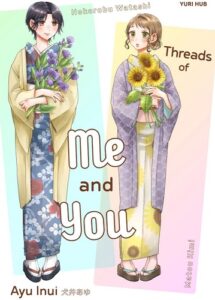
Two women wearing kimonos and holding flowers that complement the other's outer coat look at each other.One with short black hair wears a blue and white kimono an golden outer jacket, holds a purple flower. The other women with longer light brown hair pulled u into a bun at the neck wears a sunflower pattern kimono, and purple outer coat while holding sunflowers.by Patricia Baxter,  Guest Reviewer

Threads of Me and You is the newest yuri manga series from Ayu Inui, the author of If We Leave on the Dot. Like her previous series, this is a manga focused on the lives of two women who are already well established in their respective careers, meeting, growing closer, learning more about themselves, and falling in love along the way. One of the major differences between the two series is that Threads of Me and You focuses on women meeting and connecting through fashion and self-expression, centered around wearing kimonos.

Yui Nanjou is a twenty-eight year old office worker who dislikes being seen as “cute” by others, and wishes that she could look more mature. At a local restaurant she meets Mizuho Shiiba, a woman her own age who is typically seen wearing a kimono while working, with a mature and refined air about her that Yui can’t help but admire. After an impromptu conversation, Mizuho agrees to teach Yui how to wear a kimono, which marks the beginning of their friendship.

One of this series’ greatest strengths is how it showcases Yui’s character arc, as she slowly but surely begins to undergo a journey of self-reflection, which helps her learn about herself and how she wants to be perceived. This also includes unlearning heteronormative assumptions about romance and relationships that she had internalized. Her journey of learning to love herself, Mizuho, and kimonos, are all entwined together and feel natural, and seeing everything come together in the end was a joy to read.

Unfortunately, Mizuho does not get the same amount of depth and character development as Yui, which is a shame because she was clearly shown throughout the series as having her own struggles and insecurities. Unlike Yui, who is undermined because she looks cute, Mizuho finds people have high expectations of her since she appears “mature”, when in reality she has trouble with directions, even to familiar places, and gets easily distracted by her interests. This could have been an interesting setup for a sapphic romance with an implied neurodivergent love interest, but the series, and Mizuho’s struggles, are wrapped up very quickly for the sake of a satisfying conclusion.

Despite these snags, the positives of the series, such as Yui’s character growth and seeing various women pursuing their passions, make it a worthwhile read.

Ratings: 

Art – 7.5
Story – 8
Characters – 8
Service – 0
Yuri – 4

Overall – 8 

Threads of Me and You is available to buy or rent as twelve individual chapters exclusively on Renta! and each chapter costs $1 USD each.


Cosmic Princess Kaguya!, Streaming on Netflix

March 4th, 2026

A girl in purple, wearing a keyboard guitar and a girl in pinks dance on a stage in a vaguely classical Japanese virtual world.Guest Review by Ambi Reine

If you found out that your life was based on a fairy tale, would you fight for a happily ever after?

From Studio Colorido and Studio Chromato comes Cosmic Princess Kaguya!, a retelling of the classic Japanese story The Tale of the Bamboo Cutter but with a near-future sci-fi twist.

The tale focuses on three main girls. The first, Iroha Sakayori, is an overworked high school student who is trying her best to make her own way in life, but doesn’t necessarily want more than she has. Second is Kaguya, an energetic girl who appeared as a baby inside a utility pole and claims to have run away from the moon. Ultimately she turns to being a content creator in the hopes of performing with Iroha alongside the virtual livestreamer Yachiyo. Third is Yachiyo Runami, who Iroha is a big fan of. At seemingly every opportunity, Iroha is either watching a Yachiyo video or listening to one of her songs. She even has a shrine to Yachiyo by her desk and is brought to tears by her songs. But it is made fairly apparent that Yachiyo seems to know more than she is letting on.

While Iroha initially names her Kaguya after the fairytale, it turns out that life really does imitate art in their case. From accidentally causing a myriad of people to want her hand in marriage, to the Lunarians wanting to retrieve Kaguya, the story’s events begin to play out in real time. But Kaguya wants only one thing: a new, happy ending and to spend more time with Iroha. And as Iroha grows closer to Kaguya, she begins to want to change the ending of the story as well.

Though she is annoyed with Kaguya’s antics initially, Iroha still finds herself doing things she thought would be out of character. And yet she still tries to convince herself that she would be fine with things going back to normal. It is only when it is seemingly too late that Iroha is able to fully step out of her comfort zone and confront the things that were holding her back.

Although some might find their relationship offputting since Kaguya is initially found as a baby, she grows up to be a similar age to Iroha within just a few days and we later discover that her infant state was just a physical body created by her ship. She’s even revealed to have held a job on the moon that she had ditched to come to Earth.

Visually the film is stunning. It uses a good mix of 2D and 3D visual effects to make the virtual world, Tsukuyomi, feel different to the real world. From the water made out of cubes to the flickering low polygon fire on the torches, the virtual world is full of charm. The game they play within Tsukuyomi called Kassan is a prime example of this, taking advantage of the game setting to craft expansive 3D environments. When it comes to the concerts, they go all out with visually impressive light shows and choreography. That isn’t to say that the real world in the film is uninteresting to watch. I especially enjoyed the use of exaggerated smear frames when Kaguya was doing pretty much anything.

The soundtrack is a mix of new songs and remixes by various vocaloid artists. The film’s main song, Ex-Otogibanashi, has been stuck in my head since I watched it the first time. As an added treat, the English dub track has English covers of all of the featured songs save for the ending credits. I always find it a bit jarring when English dubs of music shows suddenly switch back to Japanese for the songs, so it is quite nice to not have that immersion broken in this film.

The film is available as a Netflix exclusive worldwide. And as of the time of writing this, you still have a chance to see a “live” performance by Kaguya in VRChat as part of the 2026 Sanrio Festival. As well, there is a music video for the song Ray on the movie’s official Youtube channel, that also functions as a bit of an epilogue for the story. Unfortunately at the time of writing it is currently only available in Japanese with no option for English Subtitles.

I recommend watching the film as spoiler-free as possible for your first watch through, and as such have kept the spoilers to a minimum in this review. Later revelations help to recontextualize the dynamic between Kaguya, Iroha, and Sachiyo that make rewatching the film a delight.

The only real complaint I have is that the montages rush through a lot of character development. There is probably comfortably enough story here to fill out a full cour of episodes just by extending those montages. Still, the film knows the tale that it wants to tell, so those parts inevitably fell by the wayside. It also took me a few watches to fully understand how Kassan is played, but I think that someone more familiar with that type of game may have an easier time understanding it.

The film serves as an inspirational tale about overcoming destiny to be together with the one you love. It is also a love letter to Vocaloid and VTuber fans and communities who will have a lot to like with the film. It’s even inspired me to dust off my VR Headset to explore those virtual worlds once again.

Ratings:

Art – 9
Story – 9
Characters – 6 A lot of Iroha’s development is unfortunately only told through the montages, and characters other than her, Kaguya, and Yachiyo do not get much focus.
Music – 9
Service – 3 While there are Beach and Onsen scenes, the outfits are not too revealing.
Yuri – 8

Overall – 9


My Beloved Zako Streamer

February 18th, 2026
Two young women wearing different Japanese school uniforms, look into a cell phoneby Burkely Hermann, Guest Reviewer
Is the internet “forever”? A recent indie anime plays with that concept, following the story of a livestreamer and her best friend, who get romantically close to one another, and kiss twice on the livestream channel. The Japanese title for the series is Itoshi no Zako Haishinsha-chan愛しのザコ配信者ちゃん」streaming on YouTube. That title has many different translations into English, including My Beloved Underdog Streamer Girl, My Beloved Weak Streamer, My Beloved Low-Tier Streamer Girl (from the site of voice actor Mochimiyu), My Beloved Zako Deliverer (Melon Books and Niconi Commons), My Beloved Zako Streamer (Suruga-ya), My Beloved Zako Streamer-chan, or My beloved girlfriend is an unpopular youtuber (used in official subtitles).
This series director, Naoya Ishikawa, is well-known for his short series, Kuttsukiboshi. Five episodes and four promotional videos for Zako are available to watch on the company’s YouTube channel and there have been screenings in Tokyo. Firstly, this series shows the strength of indie anime, for which there are very few examples.  The series has official English subtitles, so users do not need to use the “auto-translate” feature. 
The reality of COVID-19, and importance of stopping viruses, is clear from the get-go. I liked that it showed, in a respectful way, characters wearing masks. In the first episode, some characters even compliment each other on their masks. This is something I have not seen in any animated clips or series, even though the COVID-19 pandemic began in December 2019. Many people sadly act like the pandemic is “over,” thinking they can go back to their “normal” behaviors. Others won’t even depict it at all. Beloved Zako Streamer reminds people that the virus is here to stay and that you can, and should, take precautions
The series contains some commentary on YouTubers / livestreamers. Mamiko (voiced by Koyori Nohana) is a very unsuccessful streamer. However, the person who inspired her to become a streamer is Mikittan (voiced by Popura Sawano), a young woman who lives in a messy, dirty, and disorganized apartment. She might be a hoarder. She claims she knows where everything is and gets lots of comments on her stream. In the fourth episode, Shii (voiced by Yui Otogura) is completely overwhelmed by the deluge of comments that Mamiko gets on her channel and wants them to stop. It reminds me of a recent episode of Oshi no Ko, where an adult-oriented cosplayer criticizes a series online, almost bringing it down.
The first episode begins with Shii dreaming that she is in a compromising position with her childhood friend Mamiko, then kissing her. As she wakes up for school, she realizes she had a wet dream. Later that day, she thinks that Mamiko doesn’t realize she is in love with her. She is caught off guard when Mamiko declares that she wants to do a livestream with her, making her believe that her dream will come true after all. This somewhat implies that Mamiko has feelings for her as well. It takes until the second episode of this ongoing series for things to heat up. Mamiko and Shii sit naked in the same bathroom, and then the same bathtub. Somehow, Shii still believes that she could never have a sexual relationship with Mamiko.

Using a camera she borrowed from Ita, their school friend, Shii and Mamiko begin their livestream. Ita (voiced by Nadeshiko Komae) and Miseri (voiced by mochimiyu), are hinted as having feelings for each other. In one episode, one of them tickles the other with her feet. They are among the stream’s six viewers. In the third episode, everything goes off the rails. Shii pulls Mamiko to the floor. They lie together before Shii pulls Mamiko into the exact position she had dreamed about. She asks Mamiko if she would save her from a train, or five of her favorite YouTubers, in a classic description of the trolley problem. Consent should have been emphasized better. The consent should not have been dubious. Even so, when compared to other anime, including some yuri works, perhaps Beloved Zako Streamer is better.

Only seconds later, she kisses Shii. Mamiko encourages Shii to take the next step. As the calm music plays, they kiss one another again. Their kisses gain them lots of viewers. They are unaware their stream is ongoing. In the following episode, Miseri and Ita continue watching. One of them snaps a photo of Mamiko and Shii’s kiss. Eventually they get in contact with Mamiko and Shii, before they do anything racy and get banned. Both finally learn they were livestreaming this entire time!
In the last-available episode of Beloved Zako Streamer, Shii desperately tries to reverse everything by going back in time thirty minutes. She thinks that the fairy of time, Tokkie, will help her go back to when she pushed down Mamiko. Tokkie warns her that if she does so, her special relationship with Mamiko will be reset. She promises to confess to Mamiko in a better way. She soon awakens and realizes that meeting Tokkie was her imagination.
Apart from secondary coupling-of-sorts, Ita and Miseri, who spend time close to one another, in the last-available episode, Shii’s false assumptions are blasted apart. She truly thinks that no one really watched the stream. When she returns home, her aunt reveals to her what she feared: she has become a celebrity-of-sorts. Someone snapped a photo of her kissing Mamiko, effectively publicly outing her. As she scrolls through the social media feed, she is horrified. She is worried that her “normal” high school life is over, meaning that she can’t be with Mamiko in the way she originally envisioned.

Ratings: 

Art – 8
Story – 8
Characters – 8
Service – 3 or 4 (there’s some nudity but it is covered up by lens flares)
Yuri – 6 or 7
Music – 8

Overall – 8

Hopefully more episodes air this year, continuing my list of series that are yuriish. A preview at the end of the most recent episode hints that Shii and Miseri will begin their relationship for real. It seems that Beloved Zako Streamer will depict a growing, healthy relationship by two people under a lot of pressure as sort-of online celebrities.

Burkely Hermann is a writer, researcher, and former metadata librarian. His reviews can be read on Pop Culture Maniacs or his personal WordPress blog. He can be followed on Instagram, Bluesky, or on Mastadon communities such as library.love, glammr.us, genealysis.social, and historians.social.



Out of The Cocoon

February 11th, 2026

by Patricia Baxter, Guest Reviewer

Content warning: Several of the stories in this anthology feature intense subject matter as their primary focus, which will be discussed in this review. This includes queerphobia, ostracism, body horror, impending apocalypse, ero guro, and cannibalism. Reader discretion is strongly advised

Two years ago, when I reviewed the final volume of Yuriko Hara’s Cocoon Entwined, I expressed a wish for her manga anthologies to be licensed in English next. I had no idea that my wish would be fulfilled just a year later. Released last December, Out of the Cocoon is an anthology featuring four of Hara’s most recent one-shots, along with a new epilogue chapter for Cocoon Entwined. Half of the stories are girls’ love and half of them are boys’ love, and several of them address queer themes in overt and unambiguous ways. Much like Cocoon Entwined, this book has some of the most captivating imagery I’ve seen in a manga, and the characters are written with an impressive amount of depth for such a short number of pages. I would call this a near-perfect manga, if not for one of the stories sadly missing the mark.

The first story, “Sweet-Dreams Zombie”, is the story that is alluded to on the anthology’s cover. Taking place during an ongoing zombie outbreak throughout Japan, Nishikawa encounters two of his classmates, Noumi and Momoe, kissing in an abandoned shed. However, one of the two girls, Momoe, is now a zombie. One of the most overt stories in the book addressing queerphobia, “Sweet-Dreams Zombie” is one of the angriest one-shots I have read, and its rage is completely justified. On top of its, sadly, evergreen message about misinformation and how it negatively impacts marginalized groups, the book is extremely impressive in terms of its foreshadowing and layouts, with seemingly inconsequential panels becoming clever calls forward upon a second reading. A wonderful, if melancholic, manga.

The second story, “If the World Was Ending Tomorrow”, is a boys’ love story about two men reuniting on the eve before the end of the world. Back when they were in high school, Takada asked Katou what he would do if the world was ending tomorrow. Now, reunited a decade later and the end actually looming above them, the two try to make the most of their final moments. On top of its excellent storytelling, “If the World Was Ending Tomorrow” really shines in terms of its panel work, which is some of the best that I’ve seen, particularly during the final pitch scene. One of my favourite one-shots, both in this anthology and in general.

The third story, “Dog-Eat-Dog”, is hands down the most polarizing story in the whole anthology. A boys’ love ero guro story about a cannibal, where sex and violence coincide, this is a one-shot that requires a strong stomach before diving in. This, in my opinion, is the worst one-shot in the anthology collection, as the characters are flat, the subject matter feels like it exists just for the shock value, and the attempts at giving the protagonist depth near the end feel too little too late. The church scene is genuinely good, but it can’t save this story.

The fourth story, “52-Hertz Whale”, is a girls’ love story that was originally published in the Éclair Orange yuri anthology. The story is about a woman who compares herself to the 52-Hertz whale, a solitary animal who calls out in an unusual frequency, unable to find a response. This one-shot has some exceptional panel work and visual metaphors on display, particularly in its use of water. Reading this one-shot in Éclair Orange years ago convinced me that we needed to see more of Yuriko Hara’s manga, alongside Cocoon Entwined, in English and this feeling still resonates with me upon reading it again.

Speaking of Cocoon Entwined, the fifth story, the titular “Out of the Cocoon”, is the second epilogue chapter focusing on the lives of Youko and Hana after the events of the series. (Oddly enough, the first epilogue chapter, which was included in the final volume of the series, was also named “Out of the Cocoon”). This chapter is pure fanservice, both in terms of seeing these beloved characters live their lives freely, and in terms of them moving forward, emotionally and physically, in their relationship. While readers can theoretically enjoy the story without reading Cocoon Entwined, it is still best enjoyed if you have read the series beforehand.

At the end of the anthology, Yuriko Hara alludes that this is a book about change, and being changed. I agree with this statement, and would add that this is also a book about connection, and how those connections allow us to change. 

Ratings:

Art: 10
Story: 9 for the majority of the book. 3 for “Dog-Eat-Dog”
Characters: 9 for the majority of the book. 1.5 for “Dog-Eat-Dog”
Service: 3 for “Out of the Cocoon” due to the multiple levels of fanservice for Cocoon Entwined readers. YMMV for “Dog-Eat-Dog” depending on if you like ero guro.
Yuri: 8 (when the story is girls’ love
LGBTQ+: Yes (queerness, in both senses of the word, is one of the underlying themes throughout this anthology)

Overall: 9

While this is, admittedly, a heavy book to read through, it is not one that wallows in despair, but instead offers a message of hope, resilience, and love throughout. It is one of the best, if not the best, manga anthologies I have had the pleasure of reading, even with its one sour spot. I highly recommend giving this anthology a read if you love comics, especially those that are unabashedly queer.