Archive for the LGBTQ Category


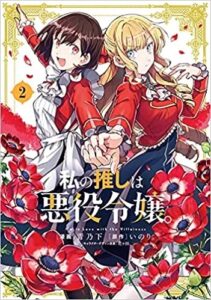
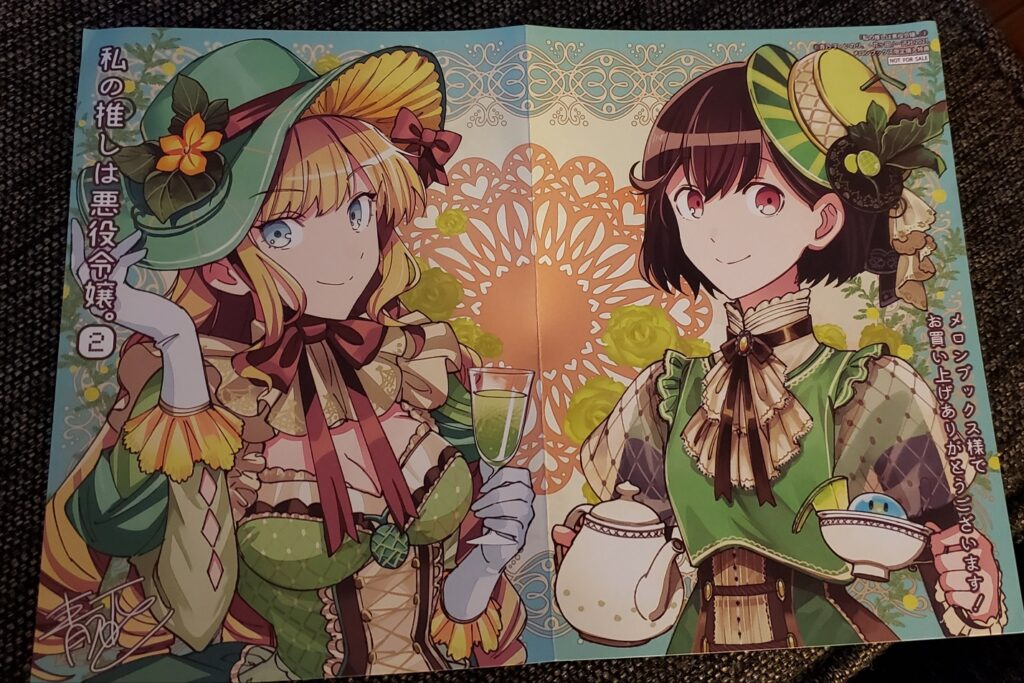
I’m in Love With the Villainess, Volume 3

June 8th, 2021

As I said of the Japanese edition of  I’m in Love With the Villainess, Volume 3, “We’ve already established that all norms are off the table in this series, so the plot here is a little bit of everything – school drama, romance, socio-political drama, and some other things and then the demons arrive. From this point on the book is spinning plates and juggling balls and then an axe or two on a high-wire.”

And indeed, we are handwaved into an idyll that will be shattered, trod upon, and sliced and diced and none of it – not one word – hit me as hard as the final scene in a throwaway side story. (T_T)

Former daughter of the nobility and school villainess, Claire Francois and her wife, the supernaturally powerful and gifted protagonist of the game Revolution, Rae Taylor, are living a reasonably comfortable life. Given that this life was built in the ruins of a revolution to take down a monarchy, it’s a very sweet life. Their adopted daughters are energetic and precocious. They have jobs. Why would anyone give up all that they have carved out for themselves?

The answer is of course that Claire believes in her upbringing – that, as a (former) noble, she has standards  and serving her country is the core of her beliefs. That her country is, maybe less worthy than she hoped, is a given. Instead of rethinking society into a more equal structure, all the government wants to do is create a new kind of second-class citizen of women and queer folks. That’s only just about 100% likely.

But instead of wrestling with rich men’s refusal to share power, we head off to the Nur Kingdom. At which point, I would like to digress and discuss my personal interpretation of the country names. As I see it, they are as follows: Bauer is kind of Germany; Alpes is Austria; Sousse is Switzerland. That’s kind of straightforward.

Okay let’s do Nur. In Japanese its written as ナー, so more like “Naa”

What country might that be? Hm, I wonder what aggressive militaristic country is threatening to Japan right now. It’s not hard to see that Nur is China, and Rusha (Russia) is “north” of that.

I want to note that Frieda, who affects a fake French accent here is from Melica, or, as I think of it, ‘Merika. Because ‘Xico and Nacada (or something like that) will get a mention next book and there will be reasons. So, while this is my interpretation and not at ALL a criticism of the translation, I think of Frieda as a really annoying American. For reasons.

As I thought of all this, I realized that, in the smallest and most tedious way possible, I’m kind of in Rae’s position. I know what’s coming, but I don’t know how it might turn out, only how it has turned out, when it’s over.  So gosh, how irritating for Rae. ^_^;

In any case, as with Volume 1, Volume 3 is mostly introduction and set up and I will also say that not every question posed here will be answered in V4. Which is why I stare with longing at GL Bunko’s listings waiting for a V5 to be listed.  inori-sensei has also posted all the final chapters of this arc and her story from Claire’s perspective on pixiv fanbox and I hope that will bring up the page count enough for the next volume soon.

Now I will return to reading the manga for my fix. And waiting for V5 in Japanese or V4 in English, neither of which have a date as of yet. In the meantime, we may enjoy the sweet scenes of domestic bliss, holidays and celebrations and what will pass (for now, eff you new government) as their wedding. And that’s still not the queerest part of the book.

I mentioned that the emotional impact here for me was, rather than the childrens’ trials, the final chapter where Claire experiences a Rae who does not love her and how bereft her life becomes. That one got me in the gut.

Ratings:

Art – 8
Story – 9
Characters – 10
Service – Kind of, but I’m alright with any and all of it.
Yuri – 10
Queer – 10

Overall – 10

There are STILL questions I have even after Volume 4. In the meantime, I have one question for you – what did you think of Dorothea? I adored her, as you might imagine and need a lot of fanart of her. ^_^ Sadly she’s too cool and competent (and adult /eyeroll/) for most fan artists, who seem to prefer Lily or Philene. Sigh. Poor me.


Boys Run the Riot

April 18th, 2021

Ryo has a secret and it is becoming increasingly difficult to keep it under wraps. Ryo is a boy, and yet, here he is forced to wear the girl’s school uniform and suffer from both the indignities of being perceived as a girl and having a female body. Ryo’s escape is to buy boy’s clothes and be the person he is.

When Ryo is discovered by Jin, a classmate who has a reputation as a tough, he assumes the jig is up. Instead, Jin turns out to be someone with a dream of his own, as vaguely formed as it it. Together Jin and Ryo will “create a brand” of clothing together! Ryo struggles with the idea, but eventually adopts it as his own. As Volume 1 of Keito Gaku’s Boys Run the Riot progresses, it becomes apparent that this story will be the story of Jin and Ryo gathering people who are struggling to be who they are, to be part of their brand.

I had a lot of feelings as I read this volume. I’m not unfamiliar with gender dysphoria – about clothes, particularly, and Ryo’s struggle with the girl’s uniform brought back a lot of unhappy memories for me. As a result, I found him sympathetic, but also found him very annoying and immature which…well, yes. For a long while here, Ryo is not likeable, lashing out at everyone and everything. His fear is wholly understandable, and when at last he lets Jin in, the change is remarkable.

But here, in one panel, is what 100% sold me on this series. During a photoshoot for their brand, Jin is hamming it up for  the camera. Ryo asks, “Don’t you have any shame?” and Jin responds, “Why would I?”


BOOM. That is your lesson, right there.

We’re not stupid, of course – shame can absolutely be something other people create for us. In these first pages, however, shame is what we make for ourselves, by fearing to be ourselves. And that, my friends is the lesson I have spent a lifetime teaching people. Why should you be ashamed? If someone tries to shame you, they are the problem.

Again, we’re not children, we can understand that at least part of Jin’s answer here is cis privilege. But before we get angry at Jin, assuming he’s never been shamed, let’s think about him a little more clearly. He’s a big guy, not good in school, a tough – the kind of kid that school systems are designed to spit out into a life of petty crime and little hope. He’s probably never had a single teacher that even wondered if there was a spark of creativity and intelligence there. He’s probably been shamed. He simply doesn’t care. Why should he? Why should we?

And then Boys Run the Riot finds it’s own legs, as Ryo and Jin shamelessly embrace their creativity and newfound partnership. How Ryo will deal with the rest of his life is, as of yet, a mystery to me. As long as “no shame” is the mantra embraced here, I’m willing to see it through.

The art is both extremely good and extremely ugly in places, which seems like a specific stylistic choice. Ryo’s breakdowns are painful to watch, but as he starts to feel like there is a goal, he grows in strength and clarity. Jin’s long-limbed easy-going enthusiasm is infectious and goofy, but there’s an intensity to him that I expect we’ll explore in later chapters.

An interview at the end of this volume confirms what I assumed – that Gaku-sensei created this story because he wasn’t finding work about, by or for trans men. The notes at the end also say that the entire localization team on this series is trans, which pleased me no end on several points. One, how awesome for us and the team that there are enough trans folks in the industry to have a whole team; how wonderful for the creator and the readership that this book will be treated with the care and sensitivity it deserves – and how awesome that Kodansha put all of that into practice.

Ratings:

Art: 7 Hard for me to like, but it soars in places
Characters: 7 Same, but that, I think, is the story
Story – 7 as a place to begin. If it develops as I hope it might, it has room to grow
Service – Sort of? I’m going to reserve this score until next volume
LGBTQ – 10 but also not. We all know that coming out is a long process

Overall – 8

Thank you very much to Kodansha Manga for the review copy.  You can read the first chapter of Boys Run the Riot for free on Kodansha. Do give it a try. It’s long past time we have a fresh, hopeful look at life as a trans man.

Boys Run the Riot, Volume 1 by Keito Gaku will be available at the end of May on Amazon, RightStuf, and bookstores near you. There does not seem to be an ebook edition of this available at the moment. Volume 2 is slated for a late July release (you can pre-order on Amazon, RightStuf).

Two openly queer media in 3 days here on Okazu. It’s a good week. ^_^ Read this and let me know what you think in the comments!


Queer Japan Movie

March 28th, 2021

Tokyo Pride 2016. It was my extraordinary pleasure to be able to speak at the Tokyo Comics Showcase, where I presented my Brief History of Yuri. One of the folks there was the lovely Graham Kolbiens, who talked to me about a movie he was working on about queer life in Japan. When the Queer Japan Kickstarter launched, I was thrilled to be able to back it. As a result I have just been able to see the full Queer Japan movie and it’s absolutely fantastic.

The movie takes a look at queer life in Japan through the eyes of a number of folks – activists, club and bar owners, a politician, a plethora of artists. Life in Japan as sexual and gender minorities is presented from their perspective. Each perspective is unique. Each perspective is beautiful.

The cinematography here is pure arthouse, which suits the locations and the circumstances. And yet, these people let you into their homes, and their work and their lives. The movie provides a range of experiences from full on spectacle balanced with the every day; dressup party photoshoots with sitting in a comfy bar in Okinawa; from butoh dancer to business owners. Queer Japan is a priceless archive of these queer stories told by people whose voices aren’t heard much in the west. And it gives us any number of places to visit and art to see next time we’re in Japan. ^_^

According to the Queer Japan website, the movie is on video on demand and DVD in the US and Canada. If you or anyone you know wonder, what queer life in Japan is like for real, outside of Yuri and BL entertainment, I strongly recommend watching this movie.  I’ll now have something I can suggest to watch when someone asks me what queer life in Japan is like!

Ratings:

Overall -10

Queer Japan is an intimate look at Japanese queer lives told in their own voices.


Watashi no Oshi ha Akuyaku Reijou. Volume 4 (私の推しは悪役令嬢。)

March 15th, 2021

Watashi no Oshi ha Akuyaku Reijou., Volume 4 (私の推しは悪役令嬢。) is a wild ride of a novel that has more twists and turns than the newest roller coaster at your local amusement park. It was awesome.

At the end of Volume 3, we left Rae and Claire in the Nur Kindgom, having made a heck of an impression on the despotic rule of Nur, Queen Dorothea, in a battle against the Demon Rulers. They also made an impression on the Demons.  Both of these are understood to be ambiguous in nature and will surely come to a head. But first, we have some much more important stuff to deal with….

…including an Iron Chef-like cooking contest between the greatest chefs of Nur, and Rae and Claire’s 6-year old daughter Aleah. And a formal ball. Also a act of incredible magical skill handled by their other 6-year old daughter, Mei. Rae and Claire help foment rebellion, change the diet of the entire army, solve a murder mystery and three other mysteries, only one of which was in the least predictable. Then a kidnapping. And then, about 2/3 of the way through this book, the story slams down on us with a vengeance.

Inori carefully weaves their way through the various plotlines and pulls out exactly the right ending for the book. It could not have been handled better without making concessions to what we knew of everyone.

This felt like a long book, and we had a number of new characters, several of which are undoubtedly going to be key in Volume 5. It was no surprise that I like Hilde, the hyper-competent bureaucrat with a monocle, but almost despite myself, I also like Frida, the Princess’s “Merikan” friend.  This story still remains wholly queer and deeply rooted in social and political activism. This volume takes some time to get there, but when it does, it does.

Every single one of my questions from Volume 3 were answered, save one, and that clearly is going to be a plot in Volume 5. There are a lot of loose ends yet to be tied up. I’m constantly fighting with myself whether to read the chapters on inori’s Pixiv Fanbox or not but I have chosen to not do so, and hope you will respect that by not spoiling anything for me, as I have tried to not overly spoil this for others. Thank you. ^_^ I still have hope that two of the things left undone will be done by the end of the series and one other new thing also gets followed through with, but I admit that this last is simply because I really like Dorothea and want to see more of her.

The art was the best so far of the series. I’ll never adore moe-fication of characters like Dorothea, but I felt that everything in this book was way more finished and solid than in previous books and a few of these were extra lovely. (I did mention the formal ball, yes?) ^_^

Volume 3 is slated for a July release in English, which feels so far away, and Volume 5 is not yet listed in Japan, but I remind you that Volume 3 and Volume 4 are available in Japanese on US Kindle. They are so worth it.

Ratings:

Art – 9
Story – 9
Characters – 10
Service – Yes. Still perfectly okay.
Yuri – 10
Queer – 10

Overall – 10

Oh, the boot I kept waiting to drop in V3? It dropped in V4. And it wasn’t a main plot point, just one more crazy arc that lead somewhere else entirely and was even worse and better than I imagined.

If you’d like spoilers or have read it and want to shout with me about it, please join me on the Okazu Discord. ^_^


Journey Through the First 100 Years of Yuri Manga with Erica Friedman By Your Side

February 18th, 2021

It’s official! I and Journey Press are pleased to announce By Your Side: The First 100 Years of Yuri Manga & Anime.

The term “Yuri” began life as a coded reference to lesbianism within manga and anime genres, but in the last two decades has been shaped by creators, publishers and fans into a genre of its own. Though Yuri as a genre is a modern development, it has a century of artistic and literary history behind it. In “By Your Side: The First 100 Year of Yuri,” we take a stroll through that history, from Yoshiya Nobuko’s pioneering works for young women in 1920s Japan, to current 21st century trends in webcomics, light novels, visual novels, events, manga and more.

Factual, funny and highly entertaining, By Your Side is a series of interlocking essays, articles and lectures from Friedman’s work on Yuri anime and manga. Meant to be approached as informal discussion in the manner of convivial conversation over multiple dinners, or panels at an anime convention, through these essays, readers will become familiar with the key creators, tropes, concepts, symbols and titles of the first 100 years of the Yuri genre. Walk by our side as we journey through the past, present and future of Yuri!

By Your Side is scheduled for a June 2022 release, in time for both Pride Month and the 20th anniversary of Okazu, the oldest and  most comprehensive site on Yuri in any language.


About Erica Friedman

Erica holds a Masters Degree in Library Science and a B.A. in Comparative Literature, and is a full-time researcher for a Fortune 100 company. She has lectured at dozens of conventions and presented at film festivals, notably the San Francisco Lesbian and Gay Film Festival and the London Lesbian and Gay Film Festival. She has participated in an academic lecture series at MIT, University of Illinois, University of Michigan, Michigan State University, Harvard University, Kanagawa University, and others.

She has edited manga for JManga, Seven Seas and Udon Entertainent, most recently Riyoko Ikeda’s epic historical classic, The Rose of Versailles.

Erica has written about Yuri for Japanese literary journal EurekaAnimerica magazine, the Comic Book Legal Defense Fund,  Dark Horse, and contributed to Forbes, Slate, Huffington Post, Hooded Utilitarian, and The Mary Sue online. The founder of Yuricon, she has written news and event reports, interviews Yuri creators and reviews Yuri anime, manga and related media on her blog Okazu since 2002.


About Journey Press

Journey Press was born in 2019 with the goal of bringing unusual and diverse science fiction to the forefront of the publishing landscape. They are dedicated to supporting the women and queer people who have been erased from the history books and reprinting novels that fell by the wayside, in addition to publishing new novels by creators of all types.

For interviews, signings or appearances please contact Erica Friedman

https://www.yuricon.com/contact-yuricon/

For all other publicity, please contact Christine Sandquist at [email protected]

Contact Us