Archive for the LGBTQ Category


LGBTQ Manga: Our Dreams at Dusk: Shimanami Tasogare, Volume 2 (English)

August 9th, 2019

Every once in a while in any media, something comes along that is so radical, so once-in-a-lifetime, so game changing that even if the buzz around it is hyperbolic, it cannot be enough. (Except for television, which talks about every show as if it is a masterpiece, no matter how banal.) When it comes to queer manga, we’ve had a relative glut the past few years with manga like My Brother’s Husband, My Lesbian Experience With Loneliness and now this extraordinary story.

In Volume 1, we met Tasuku, a young man being bullied for his sexuality, something he wasn’t sure about at all. At the Drop-In Center, he meets a group of LGBTQ individuals, who change his life, Haruko and her wife Saki, Chaico, an elderly gay man, Nanami-kun older than Tasuku, but young and attractive to him, and Misora, a young trans girl.

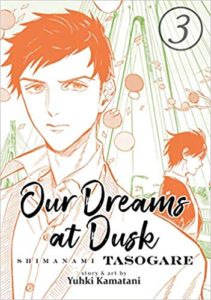
In Our Dreams at Dusk: Shimanami Tasogare, Volume 2, Tasuku tries to understand Misora a little better. She’s struggling with mutually exclusive gender identity and puberty. She’s so alone that Tasuku’s attempts to get closer are seen as insults. And Tasuku only has so much time and attention for the youngest member of the Drop-In Center, as he’s finally starting to admit to himself what the people around him have known…that he is gay. He is learning to accept that he has a crush on a classmate, to figure out what he’s going to do with the house he’s been given to rehabilitate and, in the few empty spaces, he’s trying to be there for Misora, who isn’t making it easy. Misora’s struggles are equal or greater to Tasuku’s, but he only has so much of himself to spread around. A friendly date to a local festival ends in disaster.

Haruko takes several opportunities to make important points about LGBTQ people and life, and is, as she has been from the beginning, the strong backbone of this circle.

Beyond the drama that is stirring at the Center, and unbeknownst to Tasuku, his crush may have learned his secret.  Volume 3 will be explosive.

The art is excellent, at times breathtaking. The representation of queer people living their lives, dealing with both society and individuals who seek to harm them, or make them invisible, and the internal struggle with acceptance and understanding that every individual must work through, is handled in very real, very nuanced strokes.

Creator Yuhki Kamatani and the series deserve all the praise they received. I also want to take a moment to note the folks who have worked on the English adaptation: translator Jocylene Allen; adapter Ysabet MacFarlane, both of whom I consider masters at their craft; Kaitlin Wiley, who did lettering and retouch – one of the most difficult jobs in manga; KC Fabellon whose cover design is true to the original and legible and striking; original designer Hiroshi Nigami, a credit I am very pleased to see here; proofreaders Kurestin Armada and Danielle King, editor Jenn Grunigen, and Production Manager Lissa Patillo the unsung heroes of great works. Amazing job, every one of you. Please note that Seven Seas credits every single person who brought this amazing manga to you. Not every manga company does and I want to say that this is definitely one of two things that has set Seven Seas apart from every other company since the beginning.  I’m also going to shout out to Lianne Sentar who is Marketing Manager for Seven Seas, and Jason and Adam at the top who make the choices. This was a really good one.

I hope to see this book break records, like Nagata-sensei’s work has, because if there is a manga series that I consider more important to LGBTQ folks than Lesbian Experience….it’s this one.

Our Dreams at Dusk: Shimanami Tasogare is a masterpiece of LGBTQ life in Japan and a masterwork of a manga.

Ratings:

Art – 8
Story – 9
Characters- 8
LGBTQ – 10
Service – 0

Overall – 9

It has been just shy of a year since I reviewed the Japanese edition of this book. Even knowing what will happen in Volume 3 (slated for a September release, whoo!) and Volume 4 (which hits shelves in December!), I cannot wait to read them all over again!

When I reviewed the Japanese edition, so many of you said you couldn’t wait for it in English. Well…here it is! This series will make a great  holiday gift for your young queer friends and relatives. ^_^


Summer Reading: Mrs. Martin’s Incomparable Adventure

August 4th, 2019

It’s summer and the time is perfect for reading stuff you might not otherwise find yourself reading. As you know, if you are an Okazu Reader, I read just about anything. I’m fond of action and science fiction, and a few summers ago, I read a bunch of classics I had missed as a kid. And of course I read massive amounts of Yuri, which means I am frequently reading romance stories. But here’s my ugly secret  – I really don’t like romance stories! (Not so much of a secret, really, since I’ve been saying I want sports Yuri / action Yuri / science fiction Yuri for about 20 years… But here I am reading mass quantities of the one genre I like least. ^_^; )

As you probably also know, I am very active on Twitter. Despite the many flaws of the platform, both theoretical and practical, I find Twitter to be a breathtakingly fun way to learn from people in all kinds of circles I might never otherwise encounter. Which is how I ended up following romance writer Courtney Milan. She and a number of other non-white romance writers were writing about the (sadly predictable) gatekeeping and racism of white women in the romance publishing industry. I found myself following Milan and a bunch of other PoC romance writers, despite my disinterest in Romance as a reading material for myself, and because of my interest in publishing and in learning about a genre I am largely unfamiliar with.

When Milan posted that she had written a senior lesbian period romance and it was only $2.99 on Kindle I pounced at it so fast I surprised myself. Which is how I found myself reading Mrs. Martin’s Incomparable Adventure. It was delightful.

69 year-old Miss Violetta Beauchamps finds herself in a terrifying position of not only being a superfluous woman, but an unemployed, unemployable, poor, elderly, superfluous woman. She doesn’t like the way that looks. Having been summarily (and fraudulently) fired by the man she’s worked for for decades, Miss Beauchamps concocts a swindle. It’s not a great swindle, but as she’s attempting to swindle an even more elderly lady than herself – a fabulously wealthy woman, a woman who won’t miss a few dozen pounds, which is all she needs to survive – Miss Beauchamps heads off to swindle Mrs. Martin. Only Mrs. Martin, at 73, has a mind like a steel trap. She’s rich, she hates the way Terrible Men (including and especially her Terrible Nephew,) treat women.

What happens is a lovely, ridiculous, absurdly delightful story of class, and sexuality, body image issues and sexism…and sweet, sweet revenge. As Milan states:

Author’s Note: Sometimes I write villains who are subtle and nuanced. This is not one of those times. The Terrible Nephew is terrible, and terrible things happen to him. Sometime villains really are bad and wrong, and sometimes, we want them to suffer a lot of consequences.

The climax of the book was gratifying, to say the least. Exceedingly gratifying.


Ratings:

Overall – 9

You may, like me, not be interested per se in Romance genre novels. But for a fun summer read, one that was satisfying on several levels, and in which Terrible Men get what’s coming to them and the elderly spinster gets the elderly widow and they live happily ever fucking after, it was an absolute delight.


Yuri Manga: I Married My Best Friend to Shut My Parents Up (English)

June 17th, 2019

Let’s start this week off with a manga that veered closeish to addressing LGBTQ life. That’s right, we’re talking Kodama Naoko’s I Married My Best Friend to Shut My Parents Up.

Machi’s parents are pressuring her to get married – because that is what should be done. And she’s just not interested. Her friend Hana needs a place to live while her apartment is renovated and she thinks she’s got a good idea – she and Machi will pretend to be a married couple. Surely that will get Machi’s parents off her back, one way or the other. Machi agrees, with significant reservations, while Hana gleefully starts playing house with the woman she clearly loves.

As I said in my review of the Japanese edition,(the title of which I read as I Fake Married my (Female) Friend Because of My Annoying Parents,)  “But if the idea of a fake same-sex marriage of convenience isn’t going to bother us, then the idea that the actual relationship between Hana and Machi is horribly unfair, is just fine. (-_-) ”  Hana is happy enough, but Machi, a character uncomfortable with herself her whole life, has no idea how to be a good friend to Hana, much less a good partner.

Machi’s character has a lot of developing to do, and we’re happy for her that she does it. Hana is there not just as a catalyst, although to call Machi’s development an “awakening” might be going a step too far. The end result is that Machi and Hana build a relationship that works for them and the Japanese readership learn (presuming they didn’t already know) about the Shibuya same-sex relationship certificates. As I say, this story veered cloeseish to addressing some real issues as Machi faces down derision and homophobia from her parents.

The last part of the book is a separate short about two girls on track team, their emotions around their own abilities…and each other. I think this story would have benefited from being longer and more nuanced, but “nuanced” is not Kodama-sensei’s strong point.

Ratings:

Art – 8
Story – 7
Characters – 9 for Hana
Service – 2 Some light romance/sexual discomfort
Yuri – 7
LGBTQ – 4 Mention of the real-world same-sex partnership certificates, but no discussion around it

Overall – 7

One could consider this a LGBTQ manga, but I’m still disposed to thinking of it as Yuri. I’m not sure why exactly – perhaps because it doesn’t feel like a sincere attempt to address those issues or that the issues were exposed only as a byproduct of a gag plot complication or maybe my discomfort with the artist’s take on relationships has colored my opinion. I cannot put my finger on it, and I’ve been thinking about it since I read this in Japanese the first time, last year.


LGBTQ Comic: Kiss Number 8 (English)

June 14th, 2019

Kiss Number 8 by Colleen AF Venable and Ellen T. Crenshaw is the last of the books I brought home from TCAF, in this case thanks to Johanna Draper Carlson of Comics Worth Reading. Johanna and I agree on almost nothing, but I love conversing with her is terrific and I  almost always learn something I did not know when I do. ^_^

I know I talk about TCAF a lot, but one of the things about that I particularly like about it is the proximity to so many reviewers who recommend excellent books to me that I might not otherwise know about. And this year, as the Ladies in a Hotel Room occupied the corner table at the lobby bar, we had a great number of amazingly talented, passionate and interesting people join us. So I actually met Colleen and Ellen before having had a chance to read this book.

Kiss Number 8 follows Mads, a high school girl from a family in a community that is strongly, even strictly, Christian. Church and age-appropriate dances and the like fill her life. Her friend’s brother is into her though she’s not into him, although she tries to be, for a while. And in the meantime, she’s dealing with a pile of normalish growing up things, and a family secret that she’s just kinda pissed about. She’ not pissed that they have a family secret, or, when she learns what it is, but she is seriously pissed at her Dad, who is her best friend, being a dick about it.

Speaking of best friends, Mads has some friend issues of her own. Her one best friend is in love with her, which was kinda obvious to me, but not to Mads and Mads is in love with a different friend, which is obvious to everyone, except Mads.  Mads is trying to be the good (straight) girl her community and family want her to be. So when she has kiss number 8, drama ensues, but not for the reason you might expect.The story isn’t a “coming out” narrative, although that does happen. When Mads and we finally learn her family secret, it’s not at all what we -or she – think it is.

Everything about Mads’ life as it is presented, is alien to me.  But the mass amounts of drama around friendship and dating…that was all as I remember it. So it was both entirely realistic and also oddly foreign, the way going over to dinner at a friend’s house was when you were 12 and finding that all the things you had on the table and thought were normal are nowhere to be seen on your friend’s table and if you ask for Worcestershire sauce they just stared uncomrehendingly…it was like that.

Although the art isn’t photorealistic, it conveys a very realistic feel to the story, with a single-camera perspective. It’s an easy read, even though it can be emotionally heavy.  The story, the characters, the art all combine to tell a poignant tale of learning about life, about one’s self and the people around one.

Ratings:

Art – 8
Story – 8
Characters – 6 I only really liked Laura
Service – Not really
LGBTQ – 9

Overall – 8

Like Laura Dean Keeps Breaking Up With Me, this is a solid YA book that would make a great pride gift for your family member who needs help understanding themselves or others, or the local library. ^_^


LGBTQ Live-Action: Gentleman Jack

June 9th, 2019

In a world where every generation of people seem to need all of history explained to them, personally, or they don’t “get” why we need a Pride month, it’s sometimes easy to feel a sense of disconnection from history.

The Stonewall Uprising happened 50 years ago – I recommend the American Experience episode on Stonewall for first-person recounting of what happened and why. If you haven’t read Lillian Faderman’s The Gay Revolution: The Story of the Struggle, consider it assigned reading for this Pride Month, as well. ^_^

The protests we’re seeing this year tend to be about pushing back against rainbow capitalism and corporate overrun of Pride events – and these are legitimate issues, but there is also a welcome renewed “in your face”-ism about Pride, as a whole generation of hate groups show up to the party, enabled by the downfall of empathy in our governing bodies; so we’re back to having fun as loudly and publicly as possible to remind people that we won’t be forced back into the closet.

Most folks are probably not all that clear on the who and whats of even recent LGBTQ history, literature or art, much less events in the distant past. As I’m starting to see a whole generation of young people who are new to the ongoing struggle, I find I do want to re-establish those connections. Especially as we’re once again finding ourselves facing increasing violence and bias. It’s good to remind ourselves that we are not alone now…and we have never been alone.

As I get older, I’m also really finding myself less tolerant of people who believe that because the word “lesbian” didn’t exist, people could not be presumed to be lesbian. (Much as if Indigenous people needed colonizers to name their country before they had an identity. Which, yes, I know colonizers and white supremacists believe.) There have always been words to describe women who, when they look for romantic or sexual partnership, look to their own sex. There have always been words that queer people used for themselves, as well as those that have been used about us. The premise that because the word “lesbian” did not exist means that no lesbian relationships existed before the word is…well, it deserves to be ridiculed. Regardless of the words used, I guarantee that women fell in love and lust with other women before the 20th century.

And so we come to Gentleman Jack.

Gentleman Jack is a fictionalized story based upon the real diaries of a real 19th century English lesbian, Anne Lister. Actual passages from her diary are used in this show, in which the characters are won’t to break the 4th wall and address us in their actual, historically accurate words.

This HBO/BBC production is lovely, and painful and honest and often rather funny. Written and directed by Sally Wainwright, my wife and I are finding it to be compelling watching right now. Wonderfully acted by Suranne Jones, Anne is not all that likable, until she is…and she often is. Funny, snarky and scheming, hyperactive and overachieving, Anne Lister is someone who would be exhausting to be around, but amazing to watching from a distance. Anne’s relationship with the emotionally fragile Ann Walker can be tiresome, but I’m all in for watching this story take us into a second season.

The setting, the clothes, the facts of life in 19th century West Yorkshire are all impeccably researched and presented. Shibden Hall itself is a fantastic member of the cast. Anne’s relationship to the people around is presented as accurately as possible, with interpretation coming in the form of tone of voice, body language, expression, all of which feel real. The music is another cast member, “almost like her companion” as my wife describes it.

As an insight to one lesbian’s life, Gentleman Jack is a terrific story, but since our job today is to understand history and the context of the day we find ourselves in, it’s worth remembering that Anne Lister was not the only well-known 18th century lesbian in the UK. The Ladies of Llangollen were contemporary, preceding Anne in society as lesbians. They apparently knew each other and Anne visited Plas Newyd at least once (as have I, for what it is worth.)

I actually like that the sex scenes are not explicit or extended, but are not coy or childish either. The strongest bits of the narrative, in my opinion, are Anne talking about her gender presentation and sexuality with honesty, a little pain and a lot of self-awareness. These scenes are largely taken from her own words, which give them power and resonance.

Ratings:

Acting – 10
Cinematography – 8, but there have been some controversies.
Story – 9
Lesbian – 10

Overall – 9

Much of Anne’s voluminous diaries remains untranslated, but there are number of abridged editions available, including Gentleman Jack: The Real Anne Lister, by Anne Choma, the historical advisor for the series and a woman who is still transcribing the diaries. Also worth looking into is The Secret Diaries of Anne Lister, a 2010 BBC movie.