Helena Walker is a renowned paleontologist in the 21st century. She suddenly finds herself in the ocean, escapes monsters which try to devour her, and washes ashore on a strange, and vibrant, island, filled with prehistoric plants and animals, going far beyond the dramatic dinosaur breeding theme park in
Jurassic Park. Helena has to survive, make new allies, and avoid being killed. This mature sci-fi series is bloody and brutal in some ways, with trauma forced upon on her through death, violence, and spilled blood. At the same time,
Ark: The Animated Series is inspiring, with Helena choosing science rather than cruelty. People from a variety of cultures, whether Inuit, Lakota, Chinese, or African-American, fight alongside her for what is right and against the forces of oppression. The latter is primarily led by two White men: power-hungry General Gaius Marcellus Nerva, originally from Ancient Rome, and his right-hand man, a former disgraced and egocentric scientist from the Royal Academy, Edmund Rockwell. The latter dubs the island “the Ark,” hence the series name. This series is the first animated adaptation of the 2017 video game
Ark: Survival Evolved.
Ark: The Animated Series, which originally began streaming on Paramount Plus in March 2024, has
more going for it than its star-studded voice cast. The series serves as a bit of an antidote for the current, and terrible, political environment in the U.S. where anything and anyone claimed to promote diversity, inclusion, or equity is under attack. Gareth Coker’s music score is a driving force, seamlessly connecting with the superb animation, voice acting, and writing, which helps the compelling character dynamics and visual storytelling come alive. The voice cast is headed by Aboriginal Australian actress Madeleine Madden as Helena Walker. It also includes Malaysian actress
Michelle Yeoh as Chinese warrior-leader Meiyin Li (or Mei Yin Li), part-Lakota actor Zahn McClarnon as Lakota warrior Thunder Comes Charging (or John), Devery Jacobs as Inuit teen Alasie (also John’s adopted daughter), and Jeffrey Wright as Henry Townsend, a Black Revolutionary-War-era spy for the Patriots. Apart from other well-known actors in the voice cast, Aboriginal Australian and Maori actress Deborah Mailman voiced Helena’s mother and Chinese actor Ron Yuan voiced Meiyin’s brother, Han Li.
The voice cast is not the only place there is diversity: showrunner Jay Oliva is of Filipino descent. Actor Devery Jacobs is part Mohawk and queer. Canadian actor Elliot Page is a trans man.
Ark: The Animated Series serves as
the first voice role (as Victoria) for him since his gender transition, in 2020, and his first-ever major voice role in an animated series. Voice actor Cissy Jones previously voiced Theoda, one of the two moms of Akila Theoris in
Cleopatra in Space, and Lilith Clawthorne in
The Owl House. One series writer, Kendall Deacon Davis, is a Black man. The other, Marguerite Bennett, is a queer woman known for her depiction of female relationships. She
previously said she wants to write queer relationships which are honest, sincere, and real, with “tenderness, loss, joy, motherhood, [and] partnership.” In another interview, she expressed her
enjoyment of writing stories about complicated heroines, “body horror, historical fiction[,] and queer romance,” some of which are present in
Ark: The Animated Series.
This series is queer from the very beginning. In the first episode, Helena, after she has been isekai’d to the Ark, has flashbacks of her with her wife Victoria. For instance, she centers herself by looking at her at least twice when she is under pressure while making a presentation. Both women are a lovely couple who support one another, with the implication they are about to have sex with one another, as they walk into their bedroom together. Victoria is a humanitarian aid worker who travels to war zones and Helena is an acclaimed paleontologist. Helena wants Victoria to stay with her, rather than putting her life on the line to help others, saying other people can do the work instead. This mentality becomes part of Helena’s arc through the series, as she goes from being a thinker, an intellectual to be precise, to a fighter putting her life on the line to fight oppression.
In a heart-wrenching flashback during the 47-minute first episode, Helena is informed that Victoria is presumed dead. She sees her die and disappear. Due to their deep emotional connection, she becomes depressed, drinking wine to an excess. She ends up overdosing on prescription pills and dies. Perhaps the latter is a trope, but you cannot blame Helena. Her actions go far beyond Rei or Kaoru taking painkillers
in Dear Brother. There’s the implication Victoria somehow brings Helena
back to life in the Ark. In a social media post about
Ark: The Animated Series some years ago, Bennett highlighted the music score for the relationship between Helena and Victoria,
saying she was heartened by “queer stories of love, conviction, and survival that persist beyond space and time.” While the latter doesn’t apply to Helena and Victoria directly, it is still a story of survival, justice, conviction, and love.
Helena has no chance to stay depressed, nor does she struggle through her trauma as Korra did
in The Legend of Korra. Instead, she is thrown into yet another life-threatening situation, after she flees a camp where she is held captive by Nerva, Rockwell, and their soldiers, barely escaping with her life, after they injure her with a spear. This is when Meiyin comes into the picture. She
saves Helena from soldiers out to get her and from a sabertooth tiger. They are both drawn to each other. Their connection goes beyond any
intimate friendship. It is clearly romantic and sexual. While they fight together as comrades, arachnophobic Meiyin blushes when Helena saves her from a spider, inside its lair. In what echoes scenes from the newest yuri-ish Lara Croft animated series, they uncover secrets about the Ark and find a new fancy weapon, a gun with tremendous power, and blast their away out of the cave. Once outside, they are soon surrounded by warriors led by the aforementioned John, setting the stage for the third episode.
Later episodes bring them even closer. Helena and Meiyin join John in the nearby Indigenous village. Helena quickly becomes friends with the spunky Alasie, a teen
who would be at home in the interlinked words of
Avatar: The Last Airbender or
Korra. She takes a liking to the moniker for Meiyin (Beast Queen) even though she isn’t sure why people name her this (she learns
why in the fourth episode when Meiyin rides a dinosaur). Seeing Meiyin’s amazing skills, she can’t help but compare herself, even though Alasie cautions her to not do so. In one scene which hints at their growing feelings, Helena begins sketching in her journal. One page has a dinosaur and another has a portrait of Meiyin. Soon thereafter, Helena and Meiyin fight side-by-side, to liberate a mining camp, even after Helena’s movie-inspired plan fails. Meiyin becomes disappointed when Helena does not kill a messenger who escapes. This is a constant theme
Ark: The Animated Series: whether to kill oppressors or let them live. Meiyin favors the former, but Helena supports the latter, as someone who cares about
life.
The fifth episode is a bit of a turning point. Meiyin and Helena come from different time periods, the first from the 3rd century and the second from the 21st century. So, it is no surprise they have different ideas for how to fight oppression. Putting aside their back-and-forth banter on this, Meiyin’s command of forces gathering against Nerva and Rockwell is put under question. A man named Henry (noted earlier) says that she is a great warrior, but not a good leader. Despite Henry’s sexist undertone, Helena continues to support her. She reminds her that it is okay to ask for help and treats Meiyin’s wounds.
This is a key moment: Meiyin shows that even though she is a skilled warrior, she has her own weaknesses and vulnerabilities. Before this, she is a bit closed off, with her red-colored armor serving as barrier-of-sorts. Acting as a healer, Helena allows these weaknesses and vulnerabilities to melt away, while she still has her own. She respects Meiyin as a fighter and asks Meiyin to teach her, which surprises her. Meiyin takes her up on it, putting her through tough training. Helena continues to treat Meiyin and they have good times together. They get so close that Helena sleeps on Meiyin’s shoulder. This does not last. Meiyin and Helena realize the village is under attack from enemy forces. Despite a valiant effort, during which General Nerva is injured, Meiyin is captured after she’s shot with a tranquilizer dart by Rockwell. While Helena wants to follow, she takes John’s advice, and decides to fight another day.
The final episode brings Meiyin and Helena closer. Meiyin refuses to answer questions about where Helena is hiding and she is roughed up in the process (i.e. tortured), showing the pain she is willing to endure, even though she incorrectly believes she has nothing. Perhaps she thinks that no one will come to save her. This can’t be further from the truth. Back at their makeshift camp, Helena sings Meiyin’s praises, remains scared for Meiyin and everyone else, and helps put together a plan to save Meiyin. Later on, once Helena gets inside the enemy palace. She discovers something horrifying which shows the sadistic nature of the series villains: Meiyin is tied up on a crucifix,
a common Roman punishment aiming to publicly humiliate victims. Meiyin is glad Helena came for her.
As it turns out, it is
all a trap set by Nerva. He
likely believed, as other Romans did, that lesbianism was a “degenerate Greek perversion…an absurd impossibility” rather than something that should be “accepted as normal.” In contrast, Meiyin is from the time of the Yellow Turban Rebellion, a 21-year peasant revolt during the reign of the Han Dynasty in Ancient Time. During that era, the dynasty’s ten emperors
were “openly bisexual.” As such, she likely knew
what a lesbian was, even if she had never had romantic feelings for another woman before Helena, or had never heard the term “lesbian” in her life (the term isn’t used by any character in the series). In the video game that
Ark: The Animated Series is based on, Meiyin later has girlfriend named Diana Altreas.
His plan soon falls apart: John saves the day, setting off explosions, allowing them to escape with help of Henry and others. John’s sacrifice, in a violent death, after he kills the favorite T-Rex of General Nerva, is in vain. Rockwell’s hand is chopped off and the palace is ablaze. While the series villains
had hoped to exploit Helena’s love for Meiyin, instead their actions allowed the love between them to blossom. While riding a parasaurolophus, named Scary, Helena and Meiyin realize their feelings for one another. They look each other in the eyes and kiss, while tears stream down Helena’s face, reciprocating their love.
Ratings:
Art: 9
Story: 9
Characters: 8
Service: 3 or 4, the main outfit Helena wears on the Ark can be a bit revealing and the same can be said for some outfits Victoria wears, or when Helena is treating Meiyin
Yuri: 7 or 8, since there are kisses, sexual innuendos, and implied sex between Helena and Victoria in a flashback
Traumatic situations: 10, as this series can be very bloody at times, with people dying, getting stabbed, shot with arrows, or trampled, plus substance abuse, torture, discrimination, and the like
Music: 7
Overall: 9
The next part of Ark: The Animated Series, set to come later this year, promises to be even more queer. If the preview at the end of sixth episode, is any indication, viewers will see Helena’s first meeting with Victoria, Meiyin getting new armor, Meiyin praising Helena for saving her, Meiyin and Helena training and having good times together, and Helena having short hair. The latter is common across queer media, whether Sage in High Guardian Spice, Korra in Legend of Korra, Vi in Arcane, Amaya in The Dragon Prince, Rei Asaka in Dear Brother, Kase in Kase-san and the Morning Glories, Lynn Lambretta in Bodacious Space Pirates, Haruka Tenoh in Sailor Moon, Catra in She-Ra and the Princesses of Power, Ruby in Steven Universe, or Rei Hasekura in Marimite, to give some examples. I am curious to see what else will happen in the second part of Ark: The Animated Series, and hope it continues in the future.
Burkely Hermann is a writer, researcher, and former metadata librarian. His reviews can be read on Pop Culture Maniacs or his personal WordPress blog. He can be followed on Instagram, Bluesky, or on Mastadon communities such as library.love, glammr.us, genealysis.social, and historians.social.

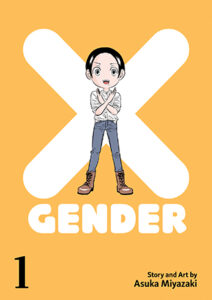 by Eleanor Walker, Staff Writer
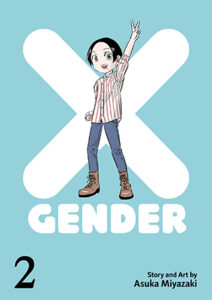 Overall, I’m happy this series exists and was released in English. It’s a good introduction to non binary identities for those who have absolutely no idea what they are. (I am a cis lesbian with many non-binary friends, and I acknowledge this is not a substitute for actual lived experience.)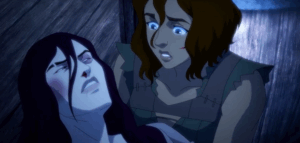
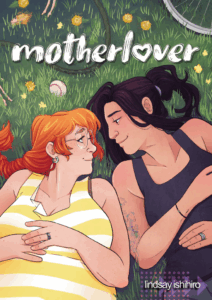
 Matt Marcus is a cohost of various projects on the