Archive for the LGBTQ Category


Lesbian Comic: Honey & Honey

February 24th, 2008

One of the questions I get quite often is “Are the terms seme and uke used in Yuri (or do lesbians in Japan use them) the way they are used in BL?”

Like just about every question I get, the answer is yes – and no. (I’m starting to sound positively Elvish these days, with my inability to provide straight answers to deceptively simple questions.) ^_^

Since educating people on lesbian relationships and gender roles is part of what Takeuchi Sachiko’s Honey & Honey is about, this seemed like a good time to address that question here.

First, let’s talk about the terms, seme and uke. Seme (pronounced “seh-meh”) refers to the pursuer, the person who initiates a sexual relationship. Uke (pronounced “oo-keh”) is the receiver, the person who receives those advances. These positions in the relationship are based on power, and preference. They date from early Japanese male homosexual relationships, where the uke was traditionally younger and had less power than the seme, who was an adult male with some social status. These terms are similar to what we mean today when we say someone is a “top” (seme) or “bottom”(uke.) In BL stories, the seme is the more masculine in terms of gender role, while the uke tends to be more feminine. These are of course generalizations and yes, I know, there are exceptions to the rule. In general, the positions of seme and uke represent who has the power in the relationship. Why do I say “power?” Because this is modeled after a heterosexual model where the man  (or manlier man or woman) is presumed to hold the power and status.

In contrast, the commonly used lesbian terms tachi (pronounced “tah-chee”) and neko (pronounced “neh-koh”) are more aligned to our English terms “butch” and “femme,” rather that a direct match to seme and uke. As I discovered for the last Now This is Only My Opinion, tachi comes from tachiyaku, the kabuki term for an actor of a male role. Neko, in the only etymology I could find, was supposed to be from the combination of nemu and ko – e.g., the girl you sleep with. In Honey & Honey, Takeuchi says that tachi tend to play the male role, and neko the female, in a lesbian couple. (Women who switch back and forth are called reba, because they “reverse” roles.) As with butch and femme, there’s a certain natural tendency in some women towards one or the other.

When tachi are, in fact, playing the “man’s role,” they, well, they treat their women kinda crappy. Because that’s what men do, you know. In the US, butches tend to be way more solicitous of their femmes, because they are the Queen, and we live to serve, as I once found myself explaining in a lesbian bar in Japan. I was assured at the time that American butches are way nicer than Japanese tachi. If Masako in Honey & Honey is indicative, I’d say that I was told right. But I’ll get there in a sec.

Here’s where it gets weird. ^_^ The reason that I find the terms seme and uke awkward when it comes to lesbian relationships is because when it comes to female couples, it’s the femme that tends to be the seme. They make the rules, they call the shots. So, while yes, seme and uke are used, if you look at, say, Haruka and Michiru from Sailor Moon, there is no doubt whatsoever that it’s Michiru who is seme there, despite Haruka’s role as tachi. Seems counterintuitive, but that’s how it looks from this side of the mirror. ^_^

Now that we’ve cleared all that up, let’s talk about Honey & Honey. Like the sequel, Honey & Honey Deluxe, this book was designed to explain lesbian and sexual minority life to straight women, with gentle humor. Everything from “how did you know you were lesbian?” to breaking up, from debunking “all lesbians were abused by men” to dating basics. Sachiko (neko) and her girlfriend Masako (tachi) go out together to buy underwear and have dinner and face confusion, derision and misunderstandings from friends and family, as well as find support, love and community.

I can’t say I really *like* Honey & Honey, in part because Masako, as both tachi and a bisexual, tends to behave very callously, and stereotypically. Instead of representing bisexuality as simply finding both sexes equally appealing, Masako acts like an omnisexual pervert, acting like she’ll stray at any second. And as a tachi she tends to treat Sachiko unsympathetically. I realize that this is probably meant to be played for humor, but it sort of wore on me.

However, as with the sequel, the story does what it is supposed to do – it educates the nonke (straight/heterosexual) audience, explaining what lesbian life is about; the good, the bad, the annoying, the funny, with a cheerful attitude of “you’re a woman – you’ll understand what I mean.” In the beginning note Takuechi makes it plain that lesbian life is not painful or sad or lonely at *all* – in fact, she’s having a blast. For that alone, it’s worth reading the book. ^_^

Ratings:

Art – 6
Story – 6
Characters – 6
Lesbian – 10
Service – 0

Overall – 6

If you’re a young person, trying to swim upstream against all the “but…” questions from friends and relatives, grab a copy of the this book and hand it over to the questioner – that’s *exactly* what it’s for.



Event Report: Book Signing at Jim Hanley’s Universe and Comic: Dolltopia

January 20th, 2008

Here’s a quick report on the book signing I did the other night, and a little review, too!

Jim Hanley’s Universe, seen on the left, is immediately across the street from the Empire State Building. I took a picture looking up at it from below, but it didn’t really come out. Oh well. I like the ESB – so deco, so excessive, so phallic, so shiny.

I arrived early. I always arrive early. It’s my nature. And not only were we expected, with a table set out and all, it even had good placement right up near the front of the shop. The staff at Jim Hanley’s Universe were *fabulous*. Every last person we dealt with was as nice as can be and they really did a great job of making us feel welcome. Thanks Vito and Harry and everyone at JHU!

I sold a book or two before Abby or J.D. even arrived, which set my whole evening off on a good footing. :-) Then Abby came and got herself all set up. We chatted a bit until at about 6:30 when people started to arrive – except JD, who was stuck in traffic. :-) Patty and David from Prism Comics came and made sure we were all good to go.

I was so pleased that some friendly faces showed to provide support. Mari, John, Chet and Yuri Monogatari 5 artist Jess B. who made a stealth appearance! I made her sign books, but she sneaked out when I wasn’t looking. lol

J.D. finally made it and before she even got her coat off, I made us take pictures together, because I would have completely forgotten to, otherwise. :-) From the left, it’s J. D, me, and Abby.

We really had a terrific time. All three of us sold each other’s books, which was pretty funny. “Now that you’ve bought this book,” we’d say, you should buy one from these two.” And for the most part, people did! Since people came for each of us specifically, it was a very cool way to get our books in front of people who might not otherwise have learned about us. After it was all over, we decided that it was so much fun, we’d definitely try to do this again in the summer as a Pride event. Prism continues to be the least sucky GLBT group I’ve ever dealt with.

Abby quite generously gave me a copy of her Dolltopia comic and I absolutely wanted to tell you all about it immediately. You’ll love it. Run right out and get a few copies for yourself and friends – it would make a great “thinking about you” gift for someone. In fact, next time I see Abby, I’m buying a handful and giving it to friends. It’s like 2 bucks, so there’s really no excuse when you figure it’s cheaper than a cup of coffee at Starbucks.

Dolltopia is a mini comic series about doll interior lives and what they do when they break free from the constraints of their molded characteristics. Dolltopia is the world that dolls have constructed for themselves. Inhabiting this world are many dolls that have taken freedom into their own hands, including two modified “Darling Candy” dolls, Candy-O and her partner Candy-X. And yes, that’s parter, as in “life partner.” Abby says of the “Darling Candy” dolls, that they are based on a popular doll model that everyone would recognize. She told me that as a kid, she always used to hack their hair off, make her own clothes for them and drawn makeup and tattoos on them. This was, in part, the inspiration for Dolltopia.

The themes that permeate this comic, “who am I?” “what is my role?” “how can I be free?” are the same as in many an anime and manga relating to artificial intelligences. And they resonate with people because despite our apparent freedom, many of us find ourselves trapped in our bodies, our roles, the perceptions of what we can and cannot do – just like the dolls in Dolltopia. This is a mini-comic that packs a pretty solid punch. And it has non-creepy lesbian dolls, what more can you ask for? lol

Thanks to Abby for turning me on to this series, I now await the next volume impatiently. ;-) And thanks to everyone who came to the event, (I was told that we drew a bigger crowd than a well-known DC artist with the explanation, “But he’s an asshole and you guys aren’t.” LOL) Thanks again to the staff at JHU, and J.D. for setting this all up and Prism Comics for being in existence. It was a fantastic evening all around.


Lesbian Novel: American Goth (and Event News)

January 16th, 2008

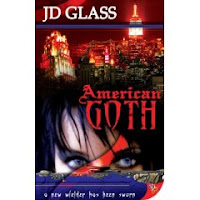
In honor of the fact I will be joined *tonight at 6:30* for a book signing at Jim Hanley’s Universe, by author J.D. Glass, today’s review is something I wrote for her brand-new shiny novel, American Goth.

C.S. Lewis once said that myths “are lies…breathed through silver.” Perhaps, then, we can see fiction as a golden filigree of words forged by a smith into an ornament that decorates our lives with tales that are not real, but are not really lies.

American Goth is such a book – an alchemical reaction of ink, paper and intent, forged in the mind of a writer to tell a tale of a quest, of a destiny, of the life of a woman.

In American Goth Glass combines and balances many tensions, as a young woman grasps at her chance to make a life after tragedy; rebuilding herself and her emotional stability with unfamiliar (to her) surroundings, people and rites. Glass’s blend of music, ritual and sex forms a bond of its own, as we find ourselves drawn into Samantha’s life, her quest and her growth.

Less hard-edged than Glass’s previous novel, Red Light, this novel is no less edgy. Like a piece of Celtic knotwork, the reader will be following multiple threads through many connections, until the whole resolves itself into a powerful and exquisitely detailed pattern.

This was the book that I was waiting for when I was 20, when a large part of my time was spent combing through literature searching for some reflection of myself in the universe. I imagine that there are quite a few young, pagan, lesbians out there who will be delighted to train with Samantha, to find themselves part of a destiny greater than themselves and most of all, to find love.

**

Join us tonight to get your own copy of American Goth signed by JD, Shoujoai ni Bouken or Yuri Monogatari signed by me and Tough Love signed by Abby Denson, for a faboulous triple play of fun! I hope to see you there!


Lesbian Novel: Another Kind of Love

January 9th, 2008

Last summer, I picked up a copy of Lesbian Pulp Fiction: The Sexually Intrepid World of Lesbian Paperback Novels 1950-1965, edited by Katherine V. Forrest, who herself is the author of many lesbian novels, notably the Kate Delafield detective series. (Looking back at a list of her works, I got a glimpse of my own youth during the years I read lesbian novels voraciously. It’s a bit cringe-making, really. Blessedly I have forgotten much of what I read. lol)

The book was a lot of fun, with excerpts from dozens of lesbian pulp fiction books. Forrest did a brilliant job of editing, so we could enjoy the “good bits” without the rest of the dreck.

BTW, “pulp” novels were so-called because of the cheap paper they were printed on. They were the mid 20th-century equivalent of turn of the century “penny dreadfuls” and anything printed by Ace in the late 60’s-70’s. ^_^ Because I don’t feel like going on at length about the history, here’s the wikipedia reference on Lesbian Pulp Fiction. I strongly recommend you read this entry. It says anything I might say better than I could say it.

After reading the above book of excerpts, I decided to buy a whole pile of pulp to take with me to Mexico. The trashier, the better. I wanted to be sitting on the beach drinking colorful drinks and reading mid-20th century smut, much of which has been reprinted by Kensington. These books were the voracious reading of the previous generation of lesbians. Reading these books allowed me to experience the fascinating feeling of reaching back in time to touch not only the lives of the women in the books, but also the women you know furtively bought and read these when they were young and trying to figure out who they were.

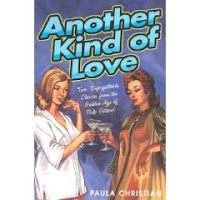
Another Kind of Love, is a collection of two novels by Paula Christian, Another Kind of Love and Love is Where You Find It.

There’s a fair amount of self-loathing and homosexuality bashing in pulp novels because of course being gay is unnatural and a disease. But despite the supposedly “moral” endings of pulp novels, there seemed to be a whole lot of hope for these women. At least one book ended with the girl getting another girl that did not suck at all. Oh, sure, they smile bitterly at one another and guess that they’ll be together for a while, then probably want to kill each other, or worse, share their unnatural lives together forever, but it’s all a matter of perspective. I can see Laura and Madeline growing old, watching the world change around them, until these days when they’re stepping out of their midtown apartment to walk down to a LGBTQ rights rally, holding hands, their gray-haired heads held high.

Paula Christian’s characters are often working women, in a world where it was still a little strange for women have a career. (These two novels were originally published in 1961.) Dee is a photographer, Laura a journalist. They work with men, and sometimes for them, but are not wrapped up in the world of men. Sure, both Dee and Laura have crappy taste in women, at least at first but, duh, who doesn’t? Girlfriends are like tattoos – you almost never like your first one. ^_^ (That doesn’t apply to you, honey.)

The one thing that really, truly impressed me about all of the novels by Christian was her use of “voice.” None of the protagonists sounded like one another from novel to novel, and the characters within any given novel all had unique voices. It’s my single favorite quality in a writer. Her characters have depth; they are not perfect – often they are really annoying, but they are always human and real. Laura is wishy-washy and becomes an alcoholic (but gets herself together before the end.) Dee starts off in an abusive situation, then hurts a nice kid out of self-protection and heads into the next relationship with a sense of futility. All the experiences Christian describes are entirely truthful, even if they are fiction. This is the kind of fiction that authors get letters about that read, “You must have lived through this, because no one who hasn’t could know how it feels.” Even when they haven’t.

Paula Christian is a good writer, and this is a fascinating piece of American lesbian history. If you’re looking for brainless reading that’s actually quite intelligent, this collection is a good choice.

Ratings – Another Kind of Love:

Story – 6
Characters – 7
Yuri – 10
Service (because pulp novels were ostensibly for the underground, the creeps and the like) – 8

Overall – 7

Ratings – Love is Where You Find It:

Story – 6
Characters – 6
Yuri – 10
Service – 7

Overall – 6

“Laura” was the “Natsuki” or “Yuriko” of its time. It seems that every third lesbian pulp protagonist was named Laura or Beth. (Or both, if you’ve read Ann Bannon’s stuff.)


Lesbian Novel: The Spanish Pearl

December 15th, 2007

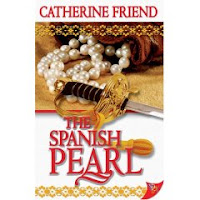
In preparing for my trip to Mexico, I stockpiled a bunch of trashy lesbian novels to take with me. One of the first was The Spanish Pearl by Catherine Friend.

The premise was simple – modern lesbian is transported back in time to 11th century Spain where she falls in love with a man who has a secret. The “secret” was not only obvious – it was stated plainly on the back of the book and in the description on Amazon. The “man” Kate falls in love with is really…gasp! shock!…a woman.

Okay, so I bought the book knowing this and thinking, cool, that would be the first few chapters and then there’d be a story. It was apparent about fifteen seconds after they met that “he” was a she, so I kept waiting for the rest of the story. Only, no, that WAS the story. The whole story. That was it. There was some violence (not enough) and some rape (plenty, thanks) and some internal and external medieval politics (about the right amount) but the main point was Kate figuring out slowly, painfully and awkwardly what any reader knew going into the book.

But you know, that wasn’t really that bad – just sort of “buh?” What was bad was Kate’s insistence on relating to the people around her in 21st century American terms. For instance, in one scene, she berates Louis for killing two men – two men who would have raped Kate, mind you. I would have been kissing Louis and kicking the corpses, but not Kate. She was furious that Louis stooped to violence instead of what – talking their way out of it? If this was day one in the story, I might have accepted it, but it was well into the story. And the reason they were in that situation was also Kate’s fault in the first place after several really bad decisions.

What was also sort of strange was Kate’s obsession about a child she met for less than an hour and her use of that child as an excuse to return to the future. And last, what tanked the book utterly for me was that there’s a sequel. The miserable girlfriend from the future comes back to the past to “rescue” Kate. Thanks. I’ll pass.

For fun, I often read Amazon reviews after I finish a book. To my shock everyone loved this book – they thought it funny and lyrical and a love letter to Spain. No one wrote, “I thought Kate was an ass.” Perhaps I should write a review there, because I totally did think that. ^_^;

On the positive side, Catherine Friend writes well. I don’t think I flinched at any portion of the book (as I did several times during my attempt to read another lesbian novel recently – whole sentences had me cringing. I gave up after the first chapter.) So for that alone, The Spanish Pearl is above average.

Ratings:

Story – 5
Characters – 5
Yuri – 9
Service – not on a bet, but the rape would suffice I imagine – 2

Overall – 5

If you aren’t looking for plot so much as a series of crises set around a relationship, it’s not really that bad a book. And with a blue ocean eating white sand, while you drink a brightly colored drink, you could definitely do worse. But you can also do better.