Archive for the Live Action Category


She Makes My Heart Flutter

August 7th, 2024

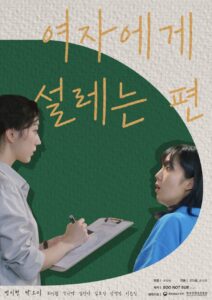
Promotional poster for the South Korean live-action yuri series She Makes My Heart Flutter, showing Jung One (left) holding a clipboard and her niece Kang Seol (right), looking surprised.

By Frank Hecker, Staff Writer

I like to highlight yuri series from different countries (why should Thailand get all the attention?) and from new directors and studios. In that spirit, today’s pick is She Makes My Heart Flutter, a short web series (just over an hour in total running time) from South Korea’s SOO NOT SUE Studio. It’s not exactly new, having been released almost two years ago, but I wasn’t around these parts to review it then; please allow me to rectify that omission.

She Makes My Heart Flutter wastes no time in kicking off its plot, as “optimistic” 20-year-old Seol Kang (or Gang Seol—the subtitles have inconsistent romanization as well as name order) awakens to her girlfriend breaking up with her via text message. Meanwhile her aunt, “considerate” 33-year-old One Jung, posts a “help wanted” poster for Dickinson’s Room, her café and bar, which is frequented by Seol’s friends. (The series also doesn’t waste time introducing its characters: they each get an introductory graphic with name, age, and personal traits.) As she joins her friends for drinks, Seol is surprised to learn that her aunt is the cafe’s owner, and schemes her way into getting a part-time job.

This sets up the first of the show’s two plot threads: unlike Seol, who is proudly out, One is both closeted and very reserved, and wants herself and her café to have as low a profile as possible—the café has no exterior signage and its social media account is private. As Seol brashly points out to her, this strategy is not conducive to running a successful business, and Dickinson’s Room is often empty of patrons. Well, not completely empty: Re Lee, the woman who designed the café’s interior, now comes in every evening at 8 pm sharp to have a drink and talk with One. Seol’s friends think Re is straight, but it’s impossible to miss the sparks flying between the two. The two parallel subplots briskly play themselves out, with conflict between generations on the one hand and mature reticence on the other, but all is well in the end.

She Makes My Heart Flutter is a romantic comedy that separates the two aspects: Seol and her friends provide the comedy (along with Bin Yu, the café’s manager) and One and Re supply the romance. This works quite well from both a story and character perspective. Ji-Hyun Byun as Seol Kang is the very model of an extroverted young lesbian who’s come out at a time when that’s increasingly a normal thing to do, while So-Mi Park as One Jung gives a subtle and touching performance as a mature thirty-something who still fears the disapproval of her parents and society at large.

The director of She Makes My Heart Flutter, the pseudonymous Soo Not Sue, has released two other web series on YouTube, the 15-minute short Chalna: Enough Time to Fall in Love and the 3-episode series Out of Breath. In an interview, she’s expressed her desire to make more shows reflecting the reality of lesbian life in what is still a relatively conservative and hostile South Korean society. I hope she gets that chance.

Story — 8
Characters — 8
Production — 7 (director Soo makes maximum use of limited resources and locations)
Service — 2
LGBTQ — 10 (the series reflects the lesbian scene in Seoul’s Hongdae neighborhood)
Overall — 8

She Makes My Heart Flutter is a can’t miss combination of young adult lesbian comedy and mature adult lesbian romance, both wrapped up in an easy-to-watch one-hour package. If you missed it back then, consider checking it out now.

Erica here: This year there was finally some good news for same-sex couples in Korea, as a high court ruled that discrimination by national insurance is illegal, but Korea is generally far behind on rights for queer folks.


Omai Series

July 22nd, 2024

Promotional image for the TikTok version of Omai Series, showing Omai (left) and Mina (right) hugging her.Thailand’s next-door neighbor Vietnam is poorer and more socially conservative, and has a government more resistant to addressing its LGBTQ population’s concerns. Thus it’s understandable that Vietnamese bách hợp (“lily”) films and series are still few and far-between. One of the most recent and most interesting ones is Omai Series (no “the”) from Fimbé, filmmakers associated with Brave Films & Entertainment, a Ho Chi Minh City production house. Omai Series was originally released in the form of very short TikTok videos, in Vietnamese only. These were then combined and released as longer YouTube videos with English subtitles for international fans, and then combined again into a movie-length season 1 (with a season 2 compilation perhaps to follow in future).

Born on the internet and unconstrained by the strictures of broadcast TV, Omai Series (literally) shows its colors in the first scene: First-year university student Mai (nicknamed Omai after the Hanoi dried fruit snack) arrives at her new apartment in Ho Chi Minh City to find a strange flag on the door. “Is my roommate a foreigner?” she wonders. No, that’s the lesbian flag, and her roommate is the sultry and sophisticated Mina, a third-year student. Mina directs Omai to sit with her on the only bed (“no chairs in this room”) and teases Omai about her nickname (“Sour? Sweet? Or spicy?!”) while reassuring her, “Don’t worry, I won’t eat you.”

Indeed she doesn’t, at least not literally, but as time goes on Omai gradually finds herself succumbing to Mina’s charms. She’s cheered on by her two classmates and friends Watermelon and the gay-coded Loa Phường, and opposed by her rebellious twin sister Lili, who’s resentful of Omai’s status as the “good child.” Lili’s machinations, Omai’s relationship with her parents, and Mina’s relationship with her mother (who’s trying to match her up with a handsome doctor) drive most of the plot.

Live-action romances live and die based on the sparks that fly between the main couple, and Omai Series does not disappoint in that regard. The actor Omai is especially good at portraying both Omai and her polar opposite Lili — on my first watch I didn’t realize they were played by the same person — although she doesn’t make a truly convincing drunk. The actor Mina is a worthy foil to her. (In a promotional livestream the actors expressed a preference to be identified by their nicknames – which are the same as their character names — rather than by their full real names, and the show credits reflect that.) The acting for Omai’s best friends is broader and less professional — not surprising since Watermelon and Loa Phường are portrayed by the director/screenwriter and Brave’s PR manager respectively.

Omai Series is a relatively low budget show, but it’s a reasonably professional production with adequate English subtitles. However the vertical format sometimes forces odd choices in the cinematography, and for a good part of the show the subtitles are in small yellow text that can be difficult to read at times, especially on a smartphone. To my knowledge it’s the first yuri entry from Fimbé and Brave. I hope it won’t be the last.

Story – 7 (the addition of Lili livens the action)
Characters – 7
Production – 6
Service – 3 (a chaste first kiss leads to something more intense later)
Yuri – 10
LGBTQ — 7
Overall – 7

Omai Series is a sweet and savory Vietnamese treat, whether you snack on individual episodes during the day or make a full meal of it binge-watching in the evening.


Love Bully

July 10th, 2024

The promotional poster for the Thai yuri series Love Bully, showing Charlotte Austin (left) and Engfa Waraha leaning in for a kiss.By Frank Hecker, Staff Writer

Two of the most impactful scenes of season 2 of Blank: The Series featured a fictional version of the real-life Thai show Club Friday, in which people call in to tell the hosts and audience their relationship problems. Club Friday is so popular that it spawned a long-running live-action spinoff Club Friday The Series, with plots based on those calls. Its current season (titled Hot Love Issue) includes the four-episode yuri series Love Bully, now streaming on YouTube.

CW for this series: homophobia, transphobia, and sexual assault.

Love Bully stars Engfa Waraha and Charlotte Austin, both former beauty pageant contestants turned actors, who previously starred in the beauty pageant yuri series Show Me Love. The first thing to say about Love Bully is that it is literally a soap opera: one of its sponsors is a maker of detergent (featured in one of the most hilariously out-of-nowhere instances of product placement I’ve ever seen). Love Bully lives up to that description, its plot featuring family secrets and corporate intrigues, with characters dressed to the nines.

Charlotte plays rich party girl and lipstick lesbian Irene, who befriends Night (played by Engfa), the bartender at Club Joanne, a bar owned by “Auntie Jo” (Uan Return), a trans woman who has a hidden connection to Night. Irene is being groomed to assume the CEO role at the real estate firm headed by her imperious mother CJ (Meenay Jutai), who is most displeased at the possibility of her daughter having a lesbian relationship, especially with someone of Night’s class and family background.

Complicating matters further are Fey (Gift Sirinart Sugandharat), Irene’s conniving corporate rival, and her lover Thul (Namo Thanapat Phiukham), who also happens to be Irene’s executive assistant and Night’s ex-boyfriend. Fey is a delightful example of an evil mastermind whose plans for world (or at least corporate) domination are continually ruined by an incompetent minion. As played by Gift she’s the best thing about this series — I found myself counting the minutes impatiently waiting for Fey to have another scene.

But, wait, you say, wasn’t there supposed to be a hot lesbian romance? And what about the quest to make “Englot” a top-tier “love team” to rival “Milklove” of 23.5, “Fayeyoko” of Blank, or perhaps even “Freenbecky” of GAP? Well, about that . . . Charlotte and Engfa’s characters’ interactions in Show Me Love were brought down by Charlotte’s relatively flat acting opposite Engfa. She’s improved a great deal since then, and to her credit gives an expressive performance in Love Bully. However, I still found the central love story to be unconvincing.

That may be because the four-episode runtime leaves little space for Irene and Night’s relationship to develop naturally: from Irene’s point of view the first scene in episode 1 is almost literally “Hi, I just got off the plane from LA, I need a drink! I love the drink! I love you! Please be my girlfriend!” Or it may simply be that the actors lack that most elusive and hard-to-describe factor, on-screen chemistry. Charlotte and Engfa will no doubt get another chance to star in a Thai yuri series, and perhaps third time’s the charm. But at this point I’m not that motivated to find out.

Story – 6
Characters – 7 (Fey ups the score)
Production – 7
Service – 5 (short skirts, bunny suits, and for BL fans a shirtless Thul)
Yuri – 10
LGBTQ — 7
Overall – 5

Love Bully is a competently produced and acted high-gloss soap opera with some fun moments (especially those featuring Fey). However, it’s not a “must see” for anyone but diehard Englot fans.


Ayaka-chan ha Hiroko-sempai ni Koishiteru Live-Action (彩香ちゃんは弘子先輩に恋してる)

July 5th, 2024

A cute woman with dyed hair and a pink crop top leans on a shocked looking woman with dark hair in  dark colored blouse, both surrounded by colorful draped cloths.Ayaka works in a fairly typical Japanese office where the star of the company is Hiroko, a very competent, caring career woman. After a gaffe early in her career,  Ayaka is helped by Hiroko, and as a result, Ayaka has fallen in love with her sempai.  To try and gain Hiroko’s attention, the mousy Ayaka had undergone a remake and is now fashionable and cute. And she is all over Hiroko.

Only, Hiroko is actually a lesbian. On the one hand, this is a part of her life she has not shared at the office, and as the cool sempai, she is beloved by both male and female colleagues, so she keeps her professional relationships professional. On the other hand, she is absolutely sure that Ayaka is straight and clueless, so she’s not touching that with a ten-meter stick. On the third hand, Ayaka is so hot, it’s killing Hiroko.

Ayaka-chan ha Hiroko-sempai ni Koishiteru Live-Action (彩香ちゃんは弘子先輩に恋してる) is based on the manga written by Sal Jiang of the same name, of which I have reviewed Volume 1 and Volume 2 here on Okazu, but have not yet had a chance to read Volume 3.

Japanese comedy is often quite broad with zany facial expressions and wacky sound effects, even slapstick action. This series is meant to be understood as a comedy. As a result, I went it into the first episode unsure if it would work for me, although the trailer gave me hope. Because Hiroko’s reactions are 98% of the comedy, it is very much on Mori Kanna’s shoulders to carry the series. I am pleased to report that the comedy does work. In part because of the way Mori plays Hiroko, and also in former Nogizaka46 member Satou Shiho’s Ayaka, who does not overplay her role. So Ayaka comes off as sincere and maybe a little much, while Hiroko is played sympathetically as a lesbian who would totally be in to this girl who keeps throwing herself at her, except she’s probably super straight, argh!

My favorite scenes in the first episode (titled Nonke ni Otosrenai, ノンケに落とされない, don’t fall for a straight girl) takes place in Hiroko’s local lesbian bar, where her endless ranting about Ayaka is both hilarious and annoying to the other patrons. I laughed out loud at Hiroko spinning in her barstool complaining about how this straight girl is going to kill her. ^_^

Which brings me to a pretty major point here. This series is another live-action Josei series by and about queer women in Japan, thus once again allowing me to be smug about Josei making good live-action drama (^_^) and rejoicing that we have another live-action series by and about queer women in Japanese media! I am very pleased by that.

Ratings:

Acting – 9
Characters – 9
Story – A very silly 8
Service – It’s not above showing a little skin
LGBTQ+ – 10

Overall – 9

As noted in last week’s YNN Report, this series is available with subtitles in English and other languages on Asian LGBTQ+ media streaming service GagaOOLala. Episode 1 also aired in Japanese, with no subtitles on TVer.jp. I watched it on the latter because I wasn’t in the mood to sign up for another streaming service and I have a VPN, but do whatever works best for you. That said, do watch Ayaka-chan ha Hiroko-sempai ni Koishiteru live-action, because it is openly queer and actually amusing.  And I’d love for this to get the kind of reception Tsukuritai Onna to Tabetai Onna live-action got, sending a clear message to Japanese media companies that queer rep by queer creators will do well.


Blank: The Series, Season 2

July 3rd, 2024

Official poster for season 2 of Blank: The Series, showing Neung (Faye Peraya Malisorn, left) and Aneung (Yoko Apasra Lertprasert) gazing into one another’s eyes.In my review of season 1 of Blank: The Series I noted three negatives of the series: the 16-year age gap between the older Neung and the younger Aneung struck many fans as problematic, the behavior of Aneung was childish and annoying (and her portrayal by Yoko Apasra Lertprasert somewhat one-note), and the subpar English subtitles made understanding the dialogue difficult at times.

Still, I liked season 1 and I’m happy to report that season 2 of Blank: The Series is even better. The subtitles, while not perfect, feature understandable and idiomatic English. Now that Aneung is in university her maturity level has increased, and Yoko’s portrayal of her has correspondingly improved to the point where she’s often upstaging Faye Peraya Malisorn’s Neung. As the plot unfolds Aneung is alternately happy, angry, loving, despondent, or delightfully mischievous, as she goads an oft-reluctant Neung into various displays of affection.

As for the age gap, the story wouldn’t work without it. Its central theme is how Neung is caught between two different generations and must determine how to negotiate their differing demands and perspectives in her own life. Aneung is young but now fully an adult, has made new friends in university, and is confident and secure in who she is (an out lesbian) and what she wants (a relationship with Neung). On the other side of the divide are Aneung’s absentee mother Phiangfa (formerly Neung’s best friend), Neung’s ex-fiancé Chet (who we learned in season 1 has a previously-hidden connection to both Phiangfa and Aneung), and Aneung’s grandmother. All of them have their own reasons for continuing to treat Aneung as a child and (like many Asian parents and grandparents) seeking to control her life as an adult.

Meanwhile Neung, although the same age as Phiagfa and Chet, in many ways reads as closer in age to Aneung: she’s skated through life thus far, rejecting both her privileges and responsibilities as a member of the Thai aristocracy, her slacker lifestyle subsidized by ongoing “loans” from her younger sister Sam. Following the events of season 1 she moves back to her family’s “palace” and begins to assume the position to which she was born. However, at the same time she finds herself being drawn more and more to Aneung. Between Aneung’s entreaties and the older generations’ demands, Neung gradually finds herself entangled in a Gordian knot of irreconcilable expectations, a knot that’s cut by a final melodramatic plot twist and Neung’s and others’ reactions to it.

New production company NineStar Studios has done a stellar job of sanding off the rough edges of Chao Planoy’s source novel and turning out a great adaptation of it on a relatively limited budget (further strained by doing reshoots for parts of season 2). Faye continues to shine as Neung, and as noted above Yoko more than holds her own opposite Faye. The writing and cinematography are generally sharp, with occasional dips in quality (including an odd and confusing flashforward in the final episode) that are more than compensated for by some excellent scenes, most notably those involving a radio call-in show.

NineStar CEO Wanwand (“P’Wan” to Blank fans) is a self-described social media influencer and (judging by her X timeline) a major Becky Armstrong fan. A year and a half ago she was making GAP reaction videos, a year ago she first read Blank, by August she had formed NineStar Studios (with Ice Papichaya Pattaralikitsakul, who portrays Sam in the series, as COO) and was starting casting for the series, and five months later (assisted by veteran production house Moongdoo Production) NineStar debuted episode 1. After a slow start Blank: The Series is now a solid success, with individual episode segments racking up millions of views and sold-out fan meets in Thailand, the Philippines, and elsewhere. I’m looking forward to what P’Wan and NineStar come up with next, whether it features Faye and Yoko or not.

Rating:

Story — 7
Characters — 8
Production — 7
Service — 3
Yuri — 10
LGBTQ — 5 (Aneung to Chet re her friend Yui: “She’s not a tom[boy], she’s queer!”)
Overall — 8

This may be blasphemy to write, but in some ways season 2 of Blank: The Series is a more interesting and emotionally satisfying watch than was GAP: The Series (the previous gold standard for Thai live-action yuri), ditching superfluous side plots and “comic” relief in favor of a sustained focus on the central couple. If you’re interested in Blank but have limited time, you may wish to start with episode 6 of season 1—just go on the internet first to acquaint yourself with the basic facts about the characters.