Archive for the Thai Drama Category


The Loyal Pin

September 18th, 2024

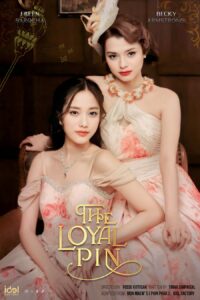
Promotional poster for the series The Loyal Pin, showing Freen as Pin and Becky as Anin.It’s been less than two years since Rebecca Patricia Armstrong and Freen Sarocha Chankimha put Thai live-action yuri on the map with their appearances in GAP: The Series. GAP racked up hundreds of millions of views and inspired a host of other Thai yuri series seeking to match its success. Becky and Freen have now returned to put to flight the pretenders to their throne, in their new series The Loyal Pin, based on the novel of the same name by Mon Maw. (The Loyal Pin is currently streaming on YouTube; this review covers the show through episode 7 of 16.)

The “throne” is almost literal in this case, as The Loyal Pin, a period piece set in the 1950s on, tells the story of Princess Anin (Becky), a member of the Thai royal family, and Lady Pin (Freen), her childhood friend and (as the series progresses) lover. Unlike GAP (for which its production company Idol Factory famously had no sponsor), The Loyal Pin is lavishly funded (by the Thai Ministry of Commerce, among others). Every baht of that shows up on the screen, from the beautiful sets to the top-notch cinematography to the lovingly-photographed Thai cuisine. As befits what is in many respects an advertisement for Thailand (part of the Thai government’s “soft power” strategy), The Loyal Pin also presents an idealized view of a (fictional) Thai royal family, depicted (at least thus far) as uniformly nice people.

To put it simply, The Loyal Pin is a romantic fantasy of a princess finding true love — except that in this case the princess is a lesbian. Princess Anin and Lady Pin have been extremely close since they were children, when Pin was adopted by her aunt (another princess) after the death of her parents. While Pin is attending university, Anin returns from studying abroad in England to express her “burning desire” for Pin. Pin, an introverted young woman (and outranked by Anin to boot) is initially reluctant to respond in kind, but eventually gives in to her own desires. But trouble is on the horizon: now that their studies are over, Anin and Pin will no doubt be expected to marry eligible suitors arranged for them. Anin has rejected a multitude of hopefuls thus far, and may escape that fate (there is real-life precedent for this), but it’s likely that Pin cannot. The remaining episodes of the series will presumably see this drama play out.

Freen and Becky’s previous appearances in GAP and other works and their history as an Idol Factory-promoted khu jin or “imagined couple” have given them a level of trust and comfort with each other that makes their characters’ on-screen romance completely convincing. Becky has improved her acting since GAP, and effectively portrays a princess who can be imperious with servants and would-be suitors, and dominant in her love scenes with Pin, but who is ultimately subject to the constraints of her position as a young woman in a patriarchal family.

Freen has less dialogue and the character of Pin is shy and retiring, but she compensates for it using her eyes, facial expressions, and gestures to convey Pin’s emotions. The camera focuses on her when Pin finally confesses to Anin, and rightly so — it’s an achingly romantic scene. Finally, I would be remiss if I didn’t mention Nam Orntara Poolsak, who plays Anin’s maid and confidante Prik. Nam, who played Sam’s friend Jim in GAP, is truly hilarious as the wingman for Anin and Pin’s relationship; she deserves to have a lead role someday in her own show.

Ever since GAP, fans have been waiting for “FreenBecky” to appear on screen again. Another production company featured them in the science fiction film Uranus 2324, but that movie has not yet been widely released outside Thailand. Now with The Loyal Pin Idol Factory has created a more than worthy successor to GAP, one that further cements Freen and Becky’s position as Thai yuri royalty.

Story — 8
Characters — 9
Production — 9
Service — 5 (sensual without being explicit)
Yuri — 10
LGBTQ — ? (a final score must wait until the full plot plays out)
Overall — 9

Incredible production values, an affecting story, and solid performances by Freen and Becky make The Loyal Pin the best Thai live-action yuri series to date, a sapphic storybook romance that should delight their current fans and attract new ones.


The Secret of Us

August 14th, 2024
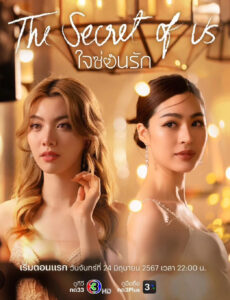
Promotional poster for the Thai live-action TV series The Secret of Us, showing Orm as Earn (left) and Lingling as Fahlada (right).Another day, another Thai yuri “love team.” Today it’s Lingling Sirilak Kwong and Orm Kornnaphat Sethratanapong, better known to fans as “Lingorm.” They star in The Secret of Us, an 8-episode series that aired on Channel 3, Thailand’s oldest commercial broadcast channel, and is streaming with English subtitles on YouTube, the 3Plus Premium service, or Netflix, depending on the country.

Based on the novel of the same name by Mee Nam, The Secret of Us features the lovers-to-enemies-to-lovers story of Fahlada (Lingling) and Earn (Orm), who meet and fall in love as university students. After a particularly cruel parental intervention, Earn is forced to break off the relationship. Stung by Earn’s rejection, and not knowing the cause of it, Fahlada is unpleasantly surprised years later to find that Earn, now a successful actor, has been engaged to film a commercial for the private hospital owned by Fahlada’s family, in which Fahlada now works as a doctor and of which she’s the presumptive future director.

While Fahlada wants absolutely nothing to do with Earn, and is slated to be engaged to a handsome fellow doctor, Earn regrets the break-up and tries to persuade Fahlada to open her heart to her once again. And here lies the major problem with this series: although Earn wants to reconcile with Fahlada, who was severely traumatized by Earn leaving her, Earn never bothers to explain to Fahlada exactly why she left her in the first place, and we as viewers aren’t provided any clue as to why Earn doesn’t provide that explanation. It’s a particularly egregious example of a story that wouldn’t exist if the people involved bothered to talk to each other.

The Secret of Us has other plot problems: The end of the series features a clichéd plot twist (one that’s already been employed by at least two other recent Thai yuri series) that serves to force a family reconciliation that comes off as more than a bit unearned. (It’s apparently a standard theme in Thai dramas that happy endings require that initially-recalcitrant elders be appeased.) There’s also a cringeworthy BL subplot that is not in the source novel and was clumsily shoehorned in, presumably as a sop to BL fans.

Fortunately, things look better when we turn from plot to characters: Orm (who resembles a young Scarlett Johannson from certain angles) is quite winning and winsome as the brown-haired extroverted member of the standard yuri pair, while Lingling cuts an elegant figure as the scorned and sensitive black-haired beauty. They play well against each other, both when angry and upset and when being cutely affectionate with each other—although those looking for the raw eroticism of GAP and Blank will be disappointed. Three other characters stand out from the crowd: Russamee (Um Apasiri Nitibhon) is an ice-cold villain and formidable final boss who won a “most hated” award on Reddit. Engfa (Ying Anada Prakobkit), one of Earn’s fellow actors, is consistently interesting as she alternately pines for Earn and helps her reconcile with Fahlada. And Earn’s manager Suzie (Eclair Chatsak Mahata) is so unabashedly herself, in her colorful outfits and ever-changing hairstyles, that she transcends the comic relief role that the script has assigned to her.

Unfortunately, the relatively weak scriptwriting in The Secret of Us often puts otherwise compelling characters into situations that don’t make sense given the context, as with some of Earn’s more forward attempts to win Fahlada back. Lingling and Orm deserve a better vehicle for their considerable talents.

Story – 5
Characters – 8
Production – 8
Service – 4 (not just one but two shirtless guys for the BL fans)
Yuri – 10
LGBTQ — 3
Overall – 7 (I was this close to giving it a 6, but Lingling and—especially—Orm persuaded me not to)

The Secret of Us is a fun watch as long as it focuses on the main characters, but you’ll need to turn off the part of your brain that’s sensitive to plot holes and clichés.


Love Bully

July 10th, 2024

The promotional poster for the Thai yuri series Love Bully, showing Charlotte Austin (left) and Engfa Waraha leaning in for a kiss.By Frank Hecker, Staff Writer

Two of the most impactful scenes of season 2 of Blank: The Series featured a fictional version of the real-life Thai show Club Friday, in which people call in to tell the hosts and audience their relationship problems. Club Friday is so popular that it spawned a long-running live-action spinoff Club Friday The Series, with plots based on those calls. Its current season (titled Hot Love Issue) includes the four-episode yuri series Love Bully, now streaming on YouTube.

CW for this series: homophobia, transphobia, and sexual assault.

Love Bully stars Engfa Waraha and Charlotte Austin, both former beauty pageant contestants turned actors, who previously starred in the beauty pageant yuri series Show Me Love. The first thing to say about Love Bully is that it is literally a soap opera: one of its sponsors is a maker of detergent (featured in one of the most hilariously out-of-nowhere instances of product placement I’ve ever seen). Love Bully lives up to that description, its plot featuring family secrets and corporate intrigues, with characters dressed to the nines.

Charlotte plays rich party girl and lipstick lesbian Irene, who befriends Night (played by Engfa), the bartender at Club Joanne, a bar owned by “Auntie Jo” (Uan Return), a trans woman who has a hidden connection to Night. Irene is being groomed to assume the CEO role at the real estate firm headed by her imperious mother CJ (Meenay Jutai), who is most displeased at the possibility of her daughter having a lesbian relationship, especially with someone of Night’s class and family background.

Complicating matters further are Fey (Gift Sirinart Sugandharat), Irene’s conniving corporate rival, and her lover Thul (Namo Thanapat Phiukham), who also happens to be Irene’s executive assistant and Night’s ex-boyfriend. Fey is a delightful example of an evil mastermind whose plans for world (or at least corporate) domination are continually ruined by an incompetent minion. As played by Gift she’s the best thing about this series — I found myself counting the minutes impatiently waiting for Fey to have another scene.

But, wait, you say, wasn’t there supposed to be a hot lesbian romance? And what about the quest to make “Englot” a top-tier “love team” to rival “Milklove” of 23.5, “Fayeyoko” of Blank, or perhaps even “Freenbecky” of GAP? Well, about that . . . Charlotte and Engfa’s characters’ interactions in Show Me Love were brought down by Charlotte’s relatively flat acting opposite Engfa. She’s improved a great deal since then, and to her credit gives an expressive performance in Love Bully. However, I still found the central love story to be unconvincing.

That may be because the four-episode runtime leaves little space for Irene and Night’s relationship to develop naturally: from Irene’s point of view the first scene in episode 1 is almost literally “Hi, I just got off the plane from LA, I need a drink! I love the drink! I love you! Please be my girlfriend!” Or it may simply be that the actors lack that most elusive and hard-to-describe factor, on-screen chemistry. Charlotte and Engfa will no doubt get another chance to star in a Thai yuri series, and perhaps third time’s the charm. But at this point I’m not that motivated to find out.

Story – 6
Characters – 7 (Fey ups the score)
Production – 7
Service – 5 (short skirts, bunny suits, and for BL fans a shirtless Thul)
Yuri – 10
LGBTQ — 7
Overall – 5

Love Bully is a competently produced and acted high-gloss soap opera with some fun moments (especially those featuring Fey). However, it’s not a “must see” for anyone but diehard Englot fans.


Blank: The Series, Season 2

July 3rd, 2024

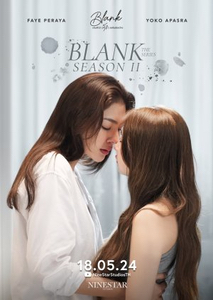
Official poster for season 2 of Blank: The Series, showing Neung (Faye Peraya Malisorn, left) and Aneung (Yoko Apasra Lertprasert) gazing into one another’s eyes.In my review of season 1 of Blank: The Series I noted three negatives of the series: the 16-year age gap between the older Neung and the younger Aneung struck many fans as problematic, the behavior of Aneung was childish and annoying (and her portrayal by Yoko Apasra Lertprasert somewhat one-note), and the subpar English subtitles made understanding the dialogue difficult at times.

Still, I liked season 1 and I’m happy to report that season 2 of Blank: The Series is even better. The subtitles, while not perfect, feature understandable and idiomatic English. Now that Aneung is in university her maturity level has increased, and Yoko’s portrayal of her has correspondingly improved to the point where she’s often upstaging Faye Peraya Malisorn’s Neung. As the plot unfolds Aneung is alternately happy, angry, loving, despondent, or delightfully mischievous, as she goads an oft-reluctant Neung into various displays of affection.

As for the age gap, the story wouldn’t work without it. Its central theme is how Neung is caught between two different generations and must determine how to negotiate their differing demands and perspectives in her own life. Aneung is young but now fully an adult, has made new friends in university, and is confident and secure in who she is (an out lesbian) and what she wants (a relationship with Neung). On the other side of the divide are Aneung’s absentee mother Phiangfa (formerly Neung’s best friend), Neung’s ex-fiancé Chet (who we learned in season 1 has a previously-hidden connection to both Phiangfa and Aneung), and Aneung’s grandmother. All of them have their own reasons for continuing to treat Aneung as a child and (like many Asian parents and grandparents) seeking to control her life as an adult.

Meanwhile Neung, although the same age as Phiagfa and Chet, in many ways reads as closer in age to Aneung: she’s skated through life thus far, rejecting both her privileges and responsibilities as a member of the Thai aristocracy, her slacker lifestyle subsidized by ongoing “loans” from her younger sister Sam. Following the events of season 1 she moves back to her family’s “palace” and begins to assume the position to which she was born. However, at the same time she finds herself being drawn more and more to Aneung. Between Aneung’s entreaties and the older generations’ demands, Neung gradually finds herself entangled in a Gordian knot of irreconcilable expectations, a knot that’s cut by a final melodramatic plot twist and Neung’s and others’ reactions to it.

New production company NineStar Studios has done a stellar job of sanding off the rough edges of Chao Planoy’s source novel and turning out a great adaptation of it on a relatively limited budget (further strained by doing reshoots for parts of season 2). Faye continues to shine as Neung, and as noted above Yoko more than holds her own opposite Faye. The writing and cinematography are generally sharp, with occasional dips in quality (including an odd and confusing flashforward in the final episode) that are more than compensated for by some excellent scenes, most notably those involving a radio call-in show.

NineStar CEO Wanwand (“P’Wan” to Blank fans) is a self-described social media influencer and (judging by her X timeline) a major Becky Armstrong fan. A year and a half ago she was making GAP reaction videos, a year ago she first read Blank, by August she had formed NineStar Studios (with Ice Papichaya Pattaralikitsakul, who portrays Sam in the series, as COO) and was starting casting for the series, and five months later (assisted by veteran production house Moongdoo Production) NineStar debuted episode 1. After a slow start Blank: The Series is now a solid success, with individual episode segments racking up millions of views and sold-out fan meets in Thailand, the Philippines, and elsewhere. I’m looking forward to what P’Wan and NineStar come up with next, whether it features Faye and Yoko or not.

Rating:

Story — 7
Characters — 8
Production — 7
Service — 3
Yuri — 10
LGBTQ — 5 (Aneung to Chet re her friend Yui: “She’s not a tom[boy], she’s queer!”)
Overall — 8

This may be blasphemy to write, but in some ways season 2 of Blank: The Series is a more interesting and emotionally satisfying watch than was GAP: The Series (the previous gold standard for Thai live-action yuri), ditching superfluous side plots and “comic” relief in favor of a sustained focus on the central couple. If you’re interested in Blank but have limited time, you may wish to start with episode 6 of season 1—just go on the internet first to acquaint yourself with the basic facts about the characters.


23.5: The Series

June 5th, 2024

by Frank Hecker, Staff Writer

The Thai company GMMTV is a BL powerhouse, with eight live-action BL series aired in 2023 and a staggering fifteen BL productions scheduled for 2024. Thus it was major news when GMMTV took note of the success of GAP: The Series and created their first yuri series, 23.5 (airing on either Youtube or Netflix depending on the region).

In creating 23.5 GMMTV generally played it safe, with a high school setting, a plot element (mistaken identity) that was centuries old when Shakespeare used it, the classic pairing of a short brown-haired extrovert with a tall black-haired introvert, and two actors (Milk Pansa Vosbein and Love Pattranite Limpatiyakorn) who had displayed good chemistry as a side couple in GMMTV BL series. However, GMMTV did show some confidence in the appeal of a yuri work: A popular pair of BL actors was rumored to be included as a side or even second primary couple, but GMMTV apparently decided that “MilkLove” would be able to carry the show without such help. GMMTV also chose an out lesbian (Fon Kanittha Kwunyoo) to direct. These both proved to be wise choices.

The astronomically-themed 23.5 (after the tilt in the Earth’s axis) is set at S-TAR Academy (“S-TAR” = “star,” get it?), which the shy and gawky Ongsa joins as a transfer student. She finds herself attracted to Sun, one of the most popular girls in the school, and reaches out to her over social media using the pseudonym “Earth.” Their online relationship quickly blossoms, but not without complications: Sun wonders when Earth (whom she assumes is a boy) will ever meet her in person, while Ongsa tortures herself over whether and how to end the charade and tell Sun her feelings face to face. Those familiar with mistaken identity romances know how this will end, but the journey on the way is quite enjoyable, thanks in large part to the central couple. As portrayed by Love, Sun is one of the most adorable and charming love interests ever to grace this solar system, while Milk’s Ongsa is completely endearing as she veers from giddy infatuation to agonized embarrassment.

23.5 is worth watching just for them alone, but as usual there are some side couples as well. The most prominent other yuri pairing features View Benyapa Jeenprasom as Ongsa’s introverted and UFO-obsessed cousin Aylin (“Aylin” = “alien,” get it?) with Luna (portrayed by June Wanwimol Jaenasavamethee) as a “manut” (human) intrigued enough to want to get to know her better. View’s portrayal of Aylin, who’s clearly intended to be read as neurodivergent, may be a questionable aspect of the show for some. I’ll leave it to others to assess how realistic her character is, but for much of the series the only direction given to View seems to have been “look straight ahead and talk like a robot.” However, later in the series Aylin opens up a bit in response to Luna’s offer of friendship and View can portray a wider range of emotions.

There are other positive aspects to 23.5: there’s a quasi-BL side plot involving a character who wouldn’t normally be featured in a conventional BL series, and another side plot involving the students’ teachers that’s notable among Thai series for featuring trans women in roles not limited to comic relief. As befits an experienced production company, other aspects of the series are generally competent, including the English subtitles. However, the writing can occasionally get overly saccharine or stray into “special episode” territory (as in the Aylin subplot, which at times treats her as a problem to be solved rather than a person to be respected).

Despite my quibbles, I can recommend 23.5 as a solid and satisfying first entry by GMMTV into the yuri genre, with Milk and Love (along with Faye and Yoko of Blank: The Series) poised to rival Freen and Becky as the next hot yuri pairing. I hope GMMTV will see fit to give them starring roles in another yuri series, and in particular will let Milk and Love be the adults they are; as anyone who’s seen her modeling photos can attest, Milk in particular would be stunning as a glamorous and sophisticated older character.

Rating:

Story – 6
Characters – 8
Production – 7
Service – 3 (Ongsa in a traditional Thai outfit)
Yuri – 8
Overall – 8