Archive for the Magazines Category


Yuri Manga: Comic Yuri Hime,(コミック百合姫) March 2011

March 21st, 2011

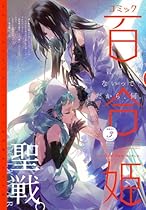
Comic Yuri Hime (コミック百合姫),Volume 2 gets off to a smart start with cover art from “Rapunzel,” this issue’s short story written by Fukami Makoto, illustrated by Kazuaki. The story is quite literally a tale about a girl trapped in a tower while an evil “witch” does experiments using her as a guinea pig – as a form of torture in order to get information on the whereabouts of the girl’s sister. Ultimately, the fifth artificial human caretaker she’s had, Chanel (number 5, yes, yes) helps her escape. This can only be described as a “really creepy story.”

This volume’s wacky column from the editors trains you in how to be a “Yuri Sommelier” and make suggestions of series based on people’s tastes. As you may know, I have avoided doing this for many reasons, but here is the primary one: When people recommend things to me, 95% of the time I don’t find them as wonderful as they did, and therefore assume that it will be the same for you if I recommend something for you. In fact, there are only two people I know who can recommend manga to me and only one who can recommend books.

“Wakka Hane-Hane” introduces us to aggressively clueless Yuka who shows up and moves in with Saka-chan and then is aggressively clueless until they both decide they like it that way. I never did come around to that way of thinking.

Hayase’s employment is the topic of discussion in “Fu~Fu” and so is the dynamic between her and Komugi. This leads into a little furry play on Kina’s part, and then a morning after hasty explanation in the hallway. A goofy interlude, with some serious implications about relationship dynamics, but again, presented in a way that slides the important stuff under otaku radar.

A woman falls for a married woman in “Suwako-san to Uchyuu Ryokou.”

Arisu and Saki contemplate marriage and “playing house” together in “Renai Joshikka.” This chapter was stellar. There’s a bit of awkwardness and miscommunication, as there is in real-life, but these are the first steps toward *after* happily ever after and I’m beyond thrilled that Morishima-sensei is the one leading the way! Everyone – follow her!!

Skipping “Kokoro Renjou” because I’ve kind of had it with the Black Cat Mansion stories. Fans of twincest will like this chapter.

“Hime Cafe” this issue is a somewhat informal chat about…stuff…with Namori-sensei, creator of Yuru Yuri. This is followed by editor’s recommendations and picks and comments, including the same kind of “everything old is new again” phenomenon we’re experiencing here. No surprise, you gotta figure every generation needs to rediscover the classics for themselves. (And what sells well never dies, so they’ll reissue things as long as people shell out for them!)

Rokuichi’s “Kimi-Watashi” is a slightly melancholic story about two women who can’t seem to let go of one another. This is followed by a sneak peek at the artist’s collection, Kuchibiru ni Sakete Orange, which I have previously reviewed.

“Yuru Yuri” was short. But don’t worry – it’ll be back.

Otsu Hiyori plumbs the depths of the moment between confession and answer, from the perspective of the one confessed to. Of course we all know the feelings of the confessor and the many tortures we/they go through, but what does the confessee feel? I’m not sure this story really convinced me – it was a little too close to “sympathy love” for my taste.

“Utsutsu no Itoshii Hito” by Takemiya Jin continues the saga of two sisters with radically different approaches to love.

When I saw that Uso Kurata was going to be doing something called “Yuri Danshi” I was not filled with joy, but neither was I running off panicking. I trusted Kurata-sensei to not turn in something that sucked. And so, I read the first pages with reserve. We meet Hanadera Keisuke, a secret Yuri Fanboy, with a stash of Comic Yuri Hime magazines under his bed and an overactive imagination. And a grin-making name. Even my wife laughed at that. Keisuke has a little crush on the Yamato Nadesico of the class, Fujigatani Saori. But when new student Miyajima Akane transfers in and immediately glomps her childhood friend Saori, a new obsession is born. Keisuke is *absolutely positive* that they must be a Yuri couple! All excited to see a real one, Keisuke begins to follow them when he comes to the sudden, sobering conclusion that, if they are really a couple – they would not want him around. There it is folks. The THREAT. If they are lesbian couple he is unneeded, unwanted – an annoyance. What mental hoops will Keisuke create for himself and jump through next time? Tune in to find out!

The short story by Miyamoto Ayako wasn’t all that good, IMHO.

“Juliet and Juliet” by Oimoro Jiroh was exactly what it sounds like.

Kurokiri Misao’s “Kokoro no Pendant” was a misunderstanding wrapped around a pendant, but everything works out in the end.

“Reversal” by Imura Ei was unique for several reasons. The art was all scratchy and sketchy, which sort of fit the tone of the story, which followed a girl involved with, let’s face it, it was prostitution. When she is hired by another girl for a little humiliation, she ends up turning the tables on just which of them is in control of the relationship.

Skipping a couple of stories which didn’t make a mark on me, the volume wraps up with a sneak peek of Rikachi’s Ibara no Namida. The sneak peek follows three female college students and the love triangle that has them orbiting around each other. It instantly caught my attention for the clean art and realistic behaviors. I’ve got the volume sitting here and I’ve bumped it up on the too-read pile.

So, overall, still loads to like for just about anyone, and maybe even getting better, bit by bit. I love the new wacky column in the beginning of the volume. Starting off with some goofball humor coming off the stress-y Fukami stories is a good way to get us all to relax and have a little fun while we read.

Ratings:

Overall – 8

Before I wrap up, I want to answer one more question that was asked at the UBC lecture the other day that I didn’t have time to answer. The questions was, in short – whether men who like Yuri identify more with the seme or the uke (which only applies in *some* stories, but we’ll use it for the moment, because neither is the answer anyway) in a Yuri couple. Of course I cannot answer for every man who is a Yuri fan (or every woman who is, for that matter) but here’s what I’ve seen in the majority of the Yuri fans – we identify with the couple. In my many, many discussions with Yuri fans over the years the issue is not that we want to be Haruka, or date Haruka…we want Haruka to be with Michiru. Remember my interview with Fujieda Miyabi-sensei when he said that when he creates a couple together, that’s when he’s happiest. I have had so many people tell me that this goes for them, too. I also feel this way. When the couple is happy, so am I. Therefore, I will generalize and say that Yuri fans do not identify with either pursuer or pursued, but with an established, hopefully functional, couple. ^_^




Yuri Manga: Kyoumei Suru Echo

March 1st, 2011

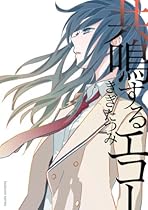
Kyoumei Suru Echo (共鳴するエコー), by Kigi Tatsumi, is a collection of shorts from Tsubomi magazine,  that are intertwined by mutual acquaintance but otherwise don’t intersect. In this case, the connections have very little impact on the story and serve only as a thread that links them.

In “Runner’s High,” a horrible trauma turns out to be less of an issue than we might have expected, and once Yuki faces the truth, she’s able to move on.

Yuki’s coach Ayami deals with life and love when she was in high school in the second story. Nothing new, but cute nonetheless.

The third story covers a day in the life of the Yuki and her twin sister Hibiki, their older sister and the drama that makes a family a family.

It is the final, multi-part story that sets this collect a little apart from others of its kind. In “Lonesome Echo” Yuki and Hibiki’s older sister, Ritsuko joins the staff of a school as a new teacher. Ritsuko encounters a strange slacker student Yohko, who lounges around the music room and asks embarrassing questions of the new teacher.

As time passes, Yohko learns that some thing is not at all right with Ritsuko. She is being abused by her lover. A lover who, Yohko finds out, is female, older and Ritsuko’s former music teacher. Yohko stands up for Ritsuko, only to be brushed off by the arrogant, abusive lover. But Yohko is not a shrinking violet – she is the granddaughter of the school chancellor and has strings she can pull and the clout to protect Ritsuko. The end of the story is a handwave, but a perfectly acceptable one.

I thought this last story was interesting – if pat – because it illustrates a trend I notice in any maturing genre. Once every possible iteration of “Story A” is told, writers start to branch out. Depending on the genre, they may reach into more and more extreme perspectives, which why “suspense” novels are now filled with serial kidnappers/torturers/killers. In the case of Yuri, it means that along with some silly fantasy scenarios, we’re getting some looks at “lesbian life” outside the romance part. In the case of “Lonesome Echo” we got a glimpse of a real issue, abusive relationships. Yes, it’s true that the ending was not realistic, but the expression on Ritsuko’s face and the words she spoke about how her lover is really a good person, it’s her fault…those were real.

Ratings:

Art – 7 (I wish, in collections like these, that authors would include a cast of characters page, so I don’t have to guess at names and relationships)
Story – 7 overall, but 8 for Lonesome Echo
Characters – 7
Yuri – quite low, until Lonesome Echo, in which we see an actual couple in crisis – 6
Service  – 1

Overall – 7, Lonesome Echo – 8

If we want Yuri to mature as a genre, we must be willing to take a look at the bad along with the good.  This was a reasonably gentle entrée’ to a topic that would be distasteful to some and inexplicable to other readers of Yuri. The audience of Tsubomi magazine are used to their Yuri being dished up in palatably sweet flavors of schoolgirl crushes. A story like this would have a sour taste for many. And for that, I applaud it.


Yuri Manga: Wildrose Re:Mix disk a and disk b

February 26th, 2011

Yuri Hime Wildrose was a 6-volume anthology of Yuri manga by Ichijinsha, the publishers of Comic Yuri Hime. Those six volumes were extremely variable, and tended to focus more on “Plot, What Plot?”-type stories than those being serialized in the Yuri Hime magazines. Wildrose has been re-launched as Girls Love (and the missing apostrophe has been the subject of many a Japanese Yuri blog post, something I admit I find amusing.) I have reviewed all 6 of the Wildrose volumes:

Volume 1 – Volume 2 – Volume 3 – Volume 4 – Volume 5 – Volume 6

You’ll note that I did not much like them, precisely because they focused on stories where the extremely thin plots were meant only to barely cover the sex scene. It’s not that that kind of story can’t be done well, it was just that mostly, these weren’t. In the end, I gave away the entire set.


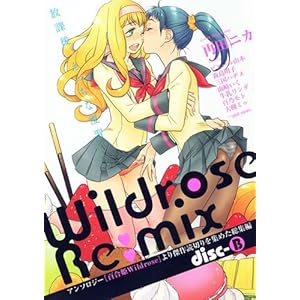
The two Wildrose Re:mix disc-a and disc-b volumes are exactly what they sound like – some of the (presumably most popular) stories from the earlier collections, focusing on artists that are working within the pages of Comic Yuri Hime. As with all collections, there is good, bad and ugly, and your opinion might differ strongly from mine, depending on what you like. I did not like most of these stories the first time, and was no more thrilled the second time. However, there were a few from each volume that I found enjoyable enough, even though I’ll admit to finding explicit, bodily fluid-filled sex not all that appealing, really. I guess I’m just a romantic at heart. (I wrote that in hopes of getting you to spit-take. Did it work? ^_^)

If you’re one of the crowd that prefers your Yuri manga to be short, uncomplicated and full of sex, this would be an excellent two-volume collection to purchase. There’s even a few cute stories in it.

Ratings:

Overall – Everything varies widely, let’s be generous and say…6

Probably the most interesting thing about these two volumes was the mystery of who bought them. Some anonymous Okazu Hero sent them to me and did not include a message, or a name. (Anonymous Porn would be the best band name, wouldn’t it?)

26 Feb Note: Mystery solved! Today’s review was sponsored by Okazu Superhero Dan P. Thank you very much Dan, for letting me relive some of the better Wildrose stories.


Yuri Artbook: Yuri Hime Color Artworks Chronicle

February 4th, 2011

Yuri Hime Color Artworks Chronicle (百合姫カラーアートワークス CHRONICLE) is exactly what the title says it is. This is a collection of color illustrations from Comic Yuri Hime and Yuri Hime S magazines and several of the collections published under the Yuri Hime imprint, from 2005-2010. And it is therefore a chronicle of the magazine from its birth through its cytokinesis into two magazines.

The book is split into a number of sections – Cover Works, Pin-Up Works, Color Comic Works, Other Works and Comic Cover Works. Overall, they provide a really wide variety of styles, tone and Yuri. Noticeably absent are the covers and art created by Hibiki Reine from the first five issues of Yuri Hime. The collection begins with the cover of the sixth volume, by Eiki Eiki and Zaoh Taishi. From there, the covers are arranged chronologically.

As a historical artifact for Yuri history, this book is pretty remarkable. As an artbook, it’s fantastic.  While I might not like every picture, there’s still plenty to enjoy, with such a variety of talented artists. Nearly every page reminds me how many people have contributed to the making of this magazine.

A side effect of flipping through the pages of this book is to remind me how much I really didn’t much enjoy a great deal of the color art for Yuri Hime S.  Kind of a no-brainer, I suppose. But it also reminded me in a very visceral fashion, just how relaxing I find Fujieda Miyabi’s art. I’d be flipping past a series of moe-servicey things and get to a picture of Sarasa and Seriho and just…relax. ^_^

If you never did get a chance to read the early issues of Yuri Hime, or you just relish the idea of collecting all the color pictures, Yuri Hime Artworks Chronicle makes a great addition to your Yuri collection.

Ratings:

Art – Variable, obviously

It is my very, very genuine pleasure to thank Okazu Superhero George R for his sponsorship of this review and for the contribution of this piece of Yuri manga history to the world’s largest collection of Yuri!


Yuri Manga: Pure Yuri Anthology Hirari, Volume 3 (ピュア百合アンソロジー ひらり)

January 24th, 2011

Pure Yuri Anthology Hirari (ピュア百合アンソロジー ひらり) is making a valiant effort to stay relevant in the Yuri magazine game. At Volume 3, it has yet to really build character, but it’s trying, I think. Both older sister magazines, Comic Yuri Hime and Tsubomi have some big hitters on their team, but little sister Hirari is not backing down from the challenge.

And so Volume 3 begins with Hakamada Mera as leadoff batter. Certainly Mera is a big(gish) name in Yuri, but her stories are more bunt than single. In “Salomelic” a dark, potentially gloomy girl with the word “black” in her name, whose interest is witchcraft is befriended by a shiny, happy “light” girl. They become friends and somehow, we’re to understand that it’s more.

And that, in a nutshell is the single biggest problem I have with Hirari. The stories are mostly sweet and frequently end with two girls as friends or two friends renewing their bonds of friendship. So rarely is there more than hand-holding, that I’m often hard pressed to see this as “Yuri,” as opposed to nice story about girls who are friends. And when they go past friendship, it’s mostly an uptick in heartbeat and “what is this feeling?” I’m not looking for hot lesbo sex, but there’s so much more variety and depth than this in a relationship, it seems such a waste to keep pitching the same one pitch over and over.

Probably the best story in the book for me was “Pulchrima” by Fuji Koyomi. Her style is quite reminiscent of Hakamada’s, but the characters were not. Of all the stories, this was the one I am absolutely able to say is “Yuri.”

The other story that stood out of the pack in a good way was “Under One Roof” by Fujio. (There were a few that stood out for not particularly good art or confused story telling, but I don’t feel like being a drag and either you’re buying this or you’re not. It’s not likely that you’re waffling on Volume 3 of an anthology.) This story, which is well down the batting rotation, sets up a situation with a young woman getting a roomshare with another woman who – gasp! – likes women. I’m hoping future chapters remain peppy.

I’m torn between wanting to kick Hirari in the ass and root for it like the underdog it is, but right now, it’s just not really ready for the big league.

Ratings –

Variable – 6