
Archive for the Magazines Category


Yuri Manga: Tsubomi, Volume 9 (つぼみ)

January 20th, 2011

Reading Tsubomi, volumes 7, 8 and 9 in such a relatively short period of time has reminded me once again about what a linchpin continuity is for a serialized story.

The difference between that 5-month wait between volumes of a series here in the West and in Japan is HUGE for one incredibly important reason. In Japan, the readers are often being fed a monthly installment of story, while here in the west, there is just a silent space of time in which we amuse ourselves with something else. By the time we return to a story 5 months later, no one can really be blamed for having forgotten where we left off. Manga for younger readers often have a “The Story So Far” insert, but that’s not true for most adult-oriented works…nor is it true for quarterly anthologies such as Tsubomi.

So, perhaps more than three months have gone by when I finally get around to the next volume and I have a very hard time remembering who these people are and why I should care. This is, at least in part, because I found a number of the Tsubomi anthology stories not overwhelmingly interesting initially. It made it harder to remember them in the torrent of similar stories I read. But having read three volumes in a matter of three months, I find that I can remember far more of the stories than I previously did. I’ll chalk at least a little of this up to my failing memory, which cares about fewer things every day, and is far more relaxed about forgetting inconsequentials than it used to be. ^_^

Which brings us to Tsubomi (つぼみ), Volume 9.

“Hoshikawa Ginza Yon-choume” continues as Otome and Minato try to find balance in their domestic situation, and what, if anything, they expect out of each other.

Which is not entirely dissimilar from the situation in Morinaga Milk’s “Himitsu no Recipe” as Watanabe now has to reconcile herself to being in cooking club because she likes cooking, as opposed to being in cooking club because she likes the cooking club president. Her expectations have to shift if she is going to find any happiness at all.

In “Green” Youko and Megu show us how their relationship developed.

I like “Hana to Hoshi.” The simple addition of a backstory between the two protagonists gives this particular girl meets girl (again) tale some depth. In addition, the opening scene of this chapter, in which Hanai is practicing different ways to say hello to try to be cool and casual, gave the story a new level of verisimilitude.

Unlike “Prism” in which the rather tired trope of girl meets girl (who she thought was boy when they were young) is handled pretty unexcitingly. IF this story continues, I’ll hope it sets that trope aside and moves into new, somewhat less overused story lines.

Yay for “Lonely Wolf Lonely Sheep”! Here’s a Story A told with some genuine effort at making all the pieces feel new and fresh. Imari-chan and Imari-san begin to date, but long after Imari-san has healed up, something is still wrong with Imari-chan’s hand. The story of what exactly is wrong and the fantastic way Imari-san handles it, reminds me again there are no truly “original” stories, but that there are still plenty of ways to tell a well-told story originally.

“Tandem Lover” seems to have lost a lot of the obnoxious service that plagued its opening chapters. In this chapter two Tandem teams go full on to beat the crap out of each other. The lower pilot on each team is a little surprised to find that the upper pilots are motivated by a lovers’ quarrel.

We learn some of Kuroi-sensei’s backstory in “Renai Manga,” and really, it’s kind of predictable. Crisis and a love triangle means that this will probably hang on for a few more chapters, until a tearful happy “Story A” end.

“Endless Room” has officially become creepy. I don’t mind stories about the people who stay in the suite in a hotel, but the same androgynous waitress kind of watching over/seducing them is rather uncomfortable-making.

“In “Girls Ride” motorcycling and love triangles are the order of the day.

As always, there are stories that I have skipped, but I notice that I am following more and more of the stories in this collection. So, we’ll take this anthology off “critical” bypass “serious” and move it right to “stable.”

Ratings:

Overall – 8

If only for “Hana to Hoshi” and “Lonely Wolf Lonely Sheep,” I find myself actually looking forward to Volume 10, which comes out next month.

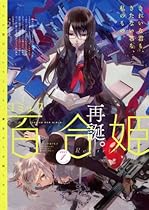


Yuri Hime Rebirth – Online

January 20th, 2011

For a limited time, the first issue of the newly rebooted Comic Yuri Hime is available online. Ichijinsha has also mentioned, on their editorial blog, a few series will be continuing only online.

The second volume of Comic Yuri Hime is now available wherever fine Yuri Manga anthologies are sold.


Girls Jump Magazine

January 16th, 2011

/singing/ You know Shounen and Business and Super and Weekly, and V and Young and Monthly and Ultra….but do you recall, the newest Jump magazine of alllllll……..?

Announced at the end of 2010, Shueisha added the seasonal Girls Jump ( ガールズジャンプ) to the lineup. The premise was to approach popular and off-beat female manga artists to draw manga for a young adult male audience. The inaugural issue is a combination of talent, creativity, flavored with a dash of wtf that makes for a truly compelling read.

Anyone who is reading current popular manga will recognize at least a few of the names in this collection. For our purposes here at Okazu, the three names that will draw our attention are Suekane Kumiko (Afterschool Charisma,) Nakamura Ching (GUNJO) and Torino Shino (Ohana Holoholo,) but there are any number of excellent storytellers in this volume.

The manga I liked best was a Furuya-esque piece called “Uki Mieru” by Tomii Masako, in which everything – by which I mean every random thought that could be expressed as an individual image – that a girl thinks, is visible to those around her. Because the story is set at Christmas, there’s a lot of happy shinyness going on there, and a lot of other stuff too.

Suekane Kumiko had a story that I found snortingly amusing called “Christmas Koroshiya” in which a young man who had wanted to become an assassin when he was young, imagines killing all the happy, shiny couples around him.

I can’t not discuss Nakamura-sensei’s “Vespa.” If you’ve ever wondered what life in a beehive is like from the perspectives of the bees, then you really need to read this. In a sense, it’s kind of a hopeless love story between a nameless drone and the Queen.

While these three stories were my favorites, they hardly give you a taste of the variety in art and story encapsulated in the volume. I wouldn’t hesitate for a second to pin my newly coined “fifth genre” label on this – it is not precisely josei, nor truly seinen, but something new and interesting, for people who want to read it.

Ratings:

Variable , Overall – 8

Should there indeed be a next issue, it already has a guaranteed place on my must-read list.


Yuri Manga: Comic Yuri Hime , (コミック百合姫) January 2011

January 12th, 2011

And thus, the fourth era of Yuri has begun.
Ichijinsha has re-launched Comic Yuri Hime (コミック百合姫), with an entirely new look, a slightly new feel and a new bimonthly publishing schedule.

Gone is the sweet snuggliness of Fujieda Miyabi or Hibiki Reine, gone is the stoic Eiki/Taishi look, gone is the moe-moe of Tsubaki Asu. Comic Yuri Hime Rebirth is heralded with violence and darkness…

…there is something so very, very wrong about this that I immediately loved it. ^_^

The whole experience begins immediately on the cover where, buried in the art, begins a short story by Fukami Makoto (writer of Vertigo, which I reviewed a few months ago), illustrated with slightly more blood than, maybe, strictly necessary, by Kazuaki – a tale of girls shooting each other with guns in sexy and pointless ways. It was great, but then, you know I love stories about homicidally violent women.

I laughed like a loon at the first page after the color art page, in which we are trained in the proper application of “Yuri Brain,” similar to our “Yuri Goggles.” Here we are taught how Yuri Brain shifts things to being Yuri, even when they are not, really. The example given is hilariously funny: In the real world, Junsui Adolescence *is* Yuri, and K-ON! and Grappler Baki are *not* Yuri. With Yuri brain, only Grappler Baki remains on the “not Yuri” side of the equation. With that kind of sense of humor upfront on this magazine – and the girls with gun fetishes wtf-ness in the cover story – I was primed and ready to read the new Comic Yuri Hime and hopeful that we can leave some, if not all, of the moe blob blandness behind us.

The volume gets off to a good start with Takemiya Jin’s story of two sisters who have a radically different approach to love. Takemiya does great short series, and has really leveled up in the past year or two of working professionally.

Techno Samata’s story of cool girl/uncool girl left me feeling lukewarm, but only because I’ve seen it done a lot recently and I clearly need a few chapters to warm up to any story.

Way back in the 90s, Mist magazine used to label all their stories – “Coming Out,” “Second Love,” etc, so you kind of knew what categories a story might fall into. Sakamoto Mano’s “Pie wo Agemasho, anata ni pie o ne” is handily labeled “90% Bitter and about the same Sweet, Love.” Even more interestingly, this label is in a creole of Japanese and English that totally works in either language. For the label alone I would have liked this story, but in addition, the story fascinated me right away as it took two typical characters, subverted the way they were handled, then threw them into the Yuri blender to see what happens. What happens is a very unlikely love.

Also new for the Rebirth, btw, there is contact info for all the creators – snail mail only, which I thought was kind of cute and old-school. Of course so many of them are on Twitter, it’s easy enough to reach them. (Start by following my Yuri Artists and Writers list to get a head start on it.)

“Fu~Fu” takes Kina-chan and Su-chan on a whirlwind tour of their own feelings about their relationship when another female couple moves in next door. When Komugi and Hayase are so upfront about their relationship, it inspires Kina to level up the love-love talk as well. This series is a like a refreshing drink of water, even as it wallows in its own silliness. We need about a dozen more series like this.

Tanaka Minoru takes a few well-covered tropes – two women meeting at a group date, cell phone madness and emotional awkwardness and sews them together for “Mettesarete Kya-”

Uso Kurata takes a look at a different story in the RPG world of “Sore demo Yappari Koi o Suru.” A young girl befriends a good looking guy in virtual reality, but is able to see right past superficial appearances to the jaded woman behind the character.

Takahashi Mako returns with a less drippy, and slightly less dark story in “Kobako no Tegami.” This is followed by only about 30 pages of “Yuru Yuri” which contained one amusing gag relating to the use of color in some of the pages. At 30 pages, it was totally tolerable. Perhaps the cancer is at last in remission.

I have not had a chance to read the short story by Morita Kisetsu that follows, but the illustrations do not give me much hope. This is followed up with a chapter of “Para Yuri Hime,” and an essay by Miura Shion on the volleyball manga Shoujo Fight, which I also have not had time to do more than just scan. I hope to have some time in the near future to actually read these….

“Yuki no Yosei” was another cool girl/uncool girl story. I feel like I’ve read too many of this in the recent past to really like them, but this one was sweet enough.

I’m sorry, I can’t even remember “Lost Girl,” the story that follows. Looking at it now, I don’t remember a single thing about it.

Yeah, I’m still skipping “Mugen no Minami” and I don’t expect that to change, ever.

Love on the school rooftop in “Twinkle Little Secret” was cute, but also kind of retread. “Onna no Karada” by Konno Kita was almost Mist-like in content, but much gentler in art style. This was a nice exploration of the mental hurdles of getting to “couplehood” for two women.

I would like to apologize sincerely to Zaou Taishi and Eiki Eiki for my presumption. They are doing *exactly* what I thought they were going to do, but they are totally not doing it the way I expected and, as a result, “Love DNA Double XX” is not nearly as excruciating as I had feared. Carry on ladies. I’ll trust you to know what you’re doing.

Morishima Akiko-sensei and her editor Poin have a chance to meander through a number of topics – some sillier than others – in a short column called “himecafe.” This is followed by messages from the contributors to the magazine and some suggestions for good reads and watches from the editors of the magazine.

Another thrilling chapter of “Black Cat Mansion” brings two girls together and gives us a hint that the mistress of the mansion has a story of her own.

You know what? Hiyori Otsu could draw a story about absolutely nothing and I’d love it. Thank god she draws Yuri.

“Musou Honey” basically is much like everything Mikuni Hachime writes, with lots of flailing and hurty faces. This chapter has slightly less depantsing than usual, so I guess that’s a win.

“Renai Joshika” turns back to the very first couple, Arisu and Saki, as they take their first steps together as a couple. Immediately an ex pops up to plague them, but it’s not really a crisis at all. Ow, ow, my cheeks hurt from smiling. Ow.

Are we ready? I know I am. I know I am VERY, VERY ready for this chapter of “Ame-iro Kouchakan Kandan,” in which Seriho makes it VERY, VERY plain what the ring she gave to Sarasa means and what it means for Sarasa to accept it. Squeee! Ow, ow, my heart. Ow!

Which just about wraps up this exceedingly chock-filled to the brim with a bunch of different kinds of Yuri issue…but, wait, there’s more! Just before we close the final pages, there’s “Kimono Nadesico,” a little 4-panel strip full of lovely classic cosplay, in the sense of kimono and archery uniforms and the like.

So – overall, there is something here for just about everybody. Action, romance, guns, girls, women, realism and fantasy. If you can’t find something you like in the new Comic Yuri Hime – seriously, it’s you.

Ratings –

Overall – 9

Great start to the new era. Let’s go Yuri!


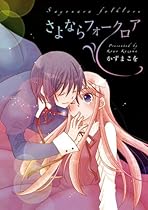
Yuri Manga: Sayonara Folklore

January 6th, 2011

You know how it is – you join a club, start a new hobby or take lessons in something, and find that there’s a whole freaking mythology attached to it. Rituals, jargon of course, and all these unwritten rules that no one tells you, but you gotta know.


In Sayonara Folklore, (さよならフォークロア) Hayase has gone to this school for years, so she knows that you do *not* touch anyone on Monday, and if you do, there’s a little incantation that must be recited. But Mashiro has just transferred in, and does not know these things. Hayase explains –  we do not touch on Monday, because not too long ago two girls did – and they fell in love, became lovers and tried to die together. Therefore, if you don’t recite the charm, you might fall in love with whomever touched you…and that would be bad. Of course Hayase explains this after Mashiro has touched her…on a Monday.

At first Mashiro is amused, then annoyed and finally, frightened by this stupid ritual that forces Hayase to continually reject her touch.

By the time the rumors have traveled through the school and the teachers find out, it’s too late for Hayase and Mashiro – they have indeed fallen in love. The “Monday curse” has come to pass. When Hayase refuses to deny the relationship, they are separated. Hayase is left in an attic room to reflect on her behavior. In that room, she find letters from one girl to another…  Mashiro, never one to play by the rules, climbs to the dormer room to be reunited with Hayase, who has now learned the truth about the two girls who originated the Monday curse.

This story and a short omake about a woman and her animal-eared maid, are by Kowo Kazuma, one of my current favorite artists. Kowo-sensei just manages to reach into my chest and squeeze my heart. I never really understand why, but her work always touches  me. Something about the art makes me *care* about the characters in a way that few other artist’s work does, and this feeling extends to her non-Yuri work, as well. I love Kowo-sensei’s story in Rakuen le Paradis, “Dear Tear”.

More objectively, this is a nice little Story A with a silly setup that manages to remain sustainable through the volume (unlike, say, Zettai Shoujo Astoria, in which the zOMG thing just gets left behind, then picked up again later and explained away badly.) This is not a major work of literature, but it is a good solid read, especially if you like stories of schoolgirls in love, with a teeny “human tribes create ritual and taboo” driver.

Ratings:

Art – 7, but I like it 9
Story – 7
Characters – 7, but I like them 9
Yuri – 8
Service – 1

Overall – 9 for me, but your mileage may vary, depending on how you feel about Kowo’s work.