Archive for the Magazines Category


Yuri Manga: Yuri Hime Wildrose, Volume 5 (百合姫 Wildrose)

February 28th, 2010

Girl A – /meets/is in love with/argues with/falls in love with/is going out with/drugs/ – Girl B.

They have sex.

The End.

That’s it. I’m totally done with this series. I don’t get why anyone likes this crap, it’s irredeemably dull and utterly unsexy.

I think I’ve been more than patient with this series, waiting for it to develop some character, some depth, some strength of conviction, and all it’s done is move further and further backwards into the most banal of “Story A” territory.

Yuri Hime Wildrose, Volume 5 (百合姫 Wildrose) is an entire collection of “Plot, What Plot?” stories that are well beyond uninspired, a veritable fanfiction.net of a Yuri anthology.

I have five volumes (1-5) of Yuri Hime Wildrose here and I’d like to get rid of them, because they stink. In the comments field, write me a Story A romance in two sentences, in Mad LibsTM form:

Girl A (verb) Girl B. They (verb). The End

Don’t be gross, vulgar or pornographic. I won’t approve comments like that. Be creative and funny (unlike the stories in this collection) and you win all 5 books.

Ratings:

UGH

“Body and Heart entwined Bathtime” reads the obi copy.

UGH

Headslap Update: If you plan on posting as “Anonymous” could you sign off with a nickname or initials or *something* so I can tell you that you won and not some other Anonymous? Duh…!

Second Headslap Update: I should probably point out the obvious and say that you need to be over 18 to be part of this. If you are under 18 and entered, wtf were you thinking?


Yuri Manga: Yuri Hime Wildrose, Volume 4 (百合姫 Wildrose)

February 12th, 2010

It’s pretty evident that I’m not the average Yuri fan. I don’t read Yuri looking for titillation, I don’t particularly care if a story has sex in it or not. What I’m looking for is a good story.

Short stories are harder than long ones. You have less time to make a reader care about the characters, and less time to develop the situation. A lot of short stories that include sex scenes read like “Plot, What Plot?” stories – even if they aspire to be more than that.

Yuri Hime Wildrose, Volume 4 (百合姫 Wildrose) is a collection of PWP stories and frankly, it doesn’t aspire to much more. This is a collection for the Lowest Common Denominator who want sex in their Yuri and don’t really care much about story, character or plot.

The only stories that stood out to me were Nanzaki Iku’s attempt to *not* do another ShizNat-style story, Morishima Akiko’s story for being something I actually disliked from beginning to end and Takahashi Yostsu’s gang parody.

Nanzaki’s story shows us the relationship between a woman who works at a pet store and one of her customers. It’s sweet, a little dopey and has obligatory sex. It was a refreshing change from his usual. In balance I find myself starting to recognize patterns in the sex scenes he draws and that disturbs me a bit.

Morishima Akiko’s story is set in France, a girl who has to leave takes advantage of the girl she loves in a story that really put me off. It’s classic Cream Lemon, with a super whiny, yet willing to rape to get her way, protagonist. And it’s fake rape, you know, because the other girl wanted it, really. UGH

Takahashi Yotsu’s story was silly. Arisa is the leader of the Wildrose gang, but she falls in love with Serika, they hypercompetent employee at Ichinjinsha bookstore. When Arisa decides to leave gang life for Serika, she finds that her love is actually the Yuri Hime gang leader. Bwah wah wah~~

Other that these, the stories are a mix of unpopular/popular girls, and other blandly typical stories, with sex.

Ratings:

Art – Variable, but I don’t think it got better than a 7.
Stories – 4-6
Characters – 4-6
Yuri – 9
Service – 10

Overall – 5 for me, but more if you think Yuri equals girls having sex.

If having sex is your number one criteria for a Yuri anthology, then this is probably a book you will like. If you’re looking for something with a little character in the characters and oomph in the plot, give this one a miss. I was going to stop getting this series with this book, but Volume 5 is already looking intriguing, so I’ll give it one more try.


Yuri Manga: Yuri Hime S Volume 11

February 3rd, 2010

Yuri Hime S, Volume 11 comes with a calendar for 2010, each month with an illustration by one of the artists from the magazine. Whether you think it’s great or mediocre will entirely depend on whether you like the artists in this magazine. The front illustration is hitting Dengeki Daioh levels of icky and then it heads right into that paean to passive-aggressiveness, “Flower Flower.” Nina sees Shuu through the eyes of the common people who adore her and at the end she’s still passive-aggressive


The second story of the collection was so surprising, so breathtakingly stellar, that the bulk of my review today will be centered around it. Minamoto Hisanari’s “Fu-Fu” is a story that I have already read three times and cannot stop boggling at how it managed to be included in this magazine and thanking the deities that it has.

Today is the first day that Su-chan and Kina are living together. They are already a couple, and clearly have taken the next step forward in their relationship. Kina asks if she can be Su-chan’s hanayome. That is, her bride. Su-chan wants to know why the word “lovers” (koibito) isn’t sufficient. Kina answers that their relationship is more than just lovers, now that they are living together, and she’d like a word that recognizes that fact. She suggests the traditional word for a married couple, fufu. This word is written 夫婦 in Japanese, the first character symbolizes the husband and the second, the wife. Kina likens it to sushi. Tuna is maguro, but there are specific words for the parts of the tuna that are special, toro, chuutoro and ohtoro. Likewise, when a person takes a special place in your life, there ought to be a word for it.

Before I deliver the punchline here, let’s stake a step back and look at the magazine once more.

This is Yuri Hime S which, since it’s inception, has targeted the male, moe Yuri audience. This is an audience that is not particularly LBGT friendly in any country, preferring to see Yuri as entertainment and titillation for them, and nothing to do with real, probably ugly lesbians who don’t really want them to watch, so screw off.

This story is quite sweetly making a case for what is arguably one of the two main issues involved in the question of same-sex marriage. One is, obviously, an issue of unequal rights and benefits. The other, more pernicious issue, is that of wording. The word “marriage” is powerful, precisely because it gives a name to a very specific joining of two people that is recognized by their community, potentially their deity, and their government at *all* levels. Likewise, the words “husband” and “wife” are equally powerful because they provide an instant way to establish the relationship between two people that combines their emotional and legal existence in one word.

Significant other, girlfriend/boyfriend, lover, just do not do that. They don’t and all of us who have to correct, reply, cajole, point out and casually mention what we call the other person in our lives who happens to be of the same sex, know that.

And here is this quiet little Yuri manga addressing what is a traditionally ultra-conservative group of people. (I was at a lecture at the Japan Society in which a Japanese art professor excoriated otaku for clinging to outmoded gender roles and national identity (I.e., focusing on fantasies of male/Japanese supremacy) to the exclusion of all else, but I sincerely doubt that the American otaku in the audience realized that he was talking to them, as well. Updated: I just read a chapter of Genshiken which made the same point, in which a male otaku insisted it wouldn’t be right for him to sit on a subway when there was a woman with him. She said, “how typical of an otaku.”)

I read this story open mouthed, agape, amazed and exultant. No, still not the “L” word, but I will gladly bypass that conversation to resolve this one. I will give up the word Lesbian, to be able to call the woman I love, “my wife.”

That is exactly what Kina and Su-chan do. While they can never be fufu, 夫婦 , they decide that they will be fufu, 婦婦. A word I whole-heartedly approve of.

This is meant to be a continuing series, so I now have a grain of hope that Su-chan and Kina will cutely and sweetly train the male Yuri fans of Japan to have a clue. In fact, between this and Poor Poor Lips I have more than a grain of hope. (Day 33, 2010 is *still* the best year ever!)

“Konohana Teikitan” has fox girls in kimonos doing things cutely for people who like that kind of thing.

“Osanajimi to Yobanaide” is a drippy looking story about a love polygon at school, by an artist who draws drippy looking stories about love polygons at school.

“Zettai Shoujo Astoria” combines EVERYTHING. For pity’s sake, even the title is a combo of everything ever. Rito comes to a new school, with a mysterious “unicorn horn”pendant around her neck and finds herself in love, then enmity, with her roommate and there’s school mysteries and stuff, and fighting, too. This series is a total ice cream sundae of a series and all it needs is a transformation scene to have one of each and some sprinkles on top.

I’ve stopped reading “Honey Crush.” Not because it offended or disgusted. I just got tired of it. It failed to hold my attention.

“Hatsujou Jijou” by the same artist who drew “Love Cubic” so I skipped in on principal.

Twice as much blood than ever before in “Shinigami Alice” which is desperately flailing for a plot. Dead people everywhere this time, including the protagonist. I guess that means something will actually happen now.

I can’t believe I’m saying this. I was so happy to see “Kaichou and Fukukaichou” in this volume. I guess I just wore down from the constant onslaught of carnival-head Yuri. Fine, fine, I like Hakamada Mera – are you *happy*?!?

In “Casseopeia Dolce” Anna gets lots of kisses and is surprised when her doll talks. I can’t imagine why…the one doll has been talking since the beginning of the series. Oh, and for some reason, not a single bath was taken this chapter. Takagi is falling down on the job.

“Yuru Yuri” follows that. Again, I have no particular reason to not read it except that it doesn’t interest me.

Yoshitomi Akihito’s “Futari to Futari” looks like every one of his last fifteen stories. I think he’s played out, overstretched, something. There hasn’t been a single story in any of his stories in three magazines for over a year.

More fox girls, more “Konohana Teiktan” followed by the resurrected, but no more interesting than it ever was “Nanami to Misuzu.”

Another skipped story and this time, I can’t even be bothered to translate the title it’s so unappealing. lol

“Ko-no-hana-link” finally hits the big day of the school festival and an old relationship drops by to cause a scene in front of Chieri. I find the title ironic, because it’s honestly quite difficult for me to remember who is who and what their relationships are from chapter to chapter. I expect a collected volume will help with that. I don’t blame the story – in fact, that single fact makes me believe that there’s an actual *story* in here, something more complex than “Story A.” One day I will read all of it in a row and find out what’s actually going on. :-)

I’m sorry, I’m just not as resilient as I used to be, so I skipped “Hime-chan ha yappari tereya-san” purely on account of the art.

Uso Kurata’s “Apocalypse” went somewhere I didn’t expect. When Matsuhara accidentally breaks Natsu’s game system, she asks Natsu and their friends to go on without her and lends Natsu her system. They do, and meet up with a guy wandering alone. He’s a nice guy, so they team up for that adventure. He sees Natsu’s marriage ring – that oh-so-rare item – and is kind of flipped out when he hears that she’s exchanged it with another woman. He writes it off as being just a game thing, and her friends don’t help by calling Matsuhara her “friend.” Although it’s just a game, Natsu wants to make sure she doesn’t leave Matsuhara behind, and asks Shibachi to lend her system this time, to let Matsuhara catch up. Clearly, Natsu has some reconciling her real feelings and their game relationship to do. I’m totally interested to see where this goes. Plus I really like Kurata’s art.

And finally, there’s a two-page short of drippy art that once again I skipped.

I’m sorry I skipped so much, but I’ve gotten to the point that I’m not wasting my time reading stuff that doesn’t interest me anymore. If you mostly disagree with me and my opinions, if you just read the stuff I skipped, you should probably be satisfied. ;-)

Ratings:

Overall – 7

Overall, the magazine was just as variable as ever, but the entire thing was made worth it by “Fufu.” That was such a significant, amazing story that I’d recommend the magazine just for it alone.


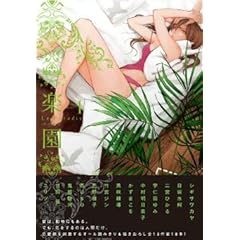
Yuri, Yaoi Manga and More: Rakuen Le Paradis Magazine

January 31st, 2010

In an industry that primarily determines genre by target audience, the rarest of publications is one for “anyone who wants to read this publication.”

There are a few of these kinds of magazines. Kodansha’s Morning 2 can fall into that category, as can F Comics’ Manga Erotics F magazine. Not surprisingly, I really like both of these magazines. The stories are really meant for adult readers, but the content is varied, kind of odd and offbeat. In Morning 2 you have a sincere, cleanly drawn story about a young man who is a rising star as a magician, right next to some really strange, supernatural, violent, non-linear crazyness. Neither Gunjo nor Peepoo Choo were at all out of place in what is an overall experimental magazine. Erotics F runs stories of adult relationships or gang warfare right next to something like Aoi Hana.

To me, what these magazine say is that there is a different manga reading audience. A niche audience. This audience is composed of adults who admire manga for more than just the heroic fighting or the romance aspects, adults who are looking for good stories, drawn interestingly.

I count Rakuen Le Paradis as one more of these rare magazines. This one particularly seems to be for whoever wants to read it, rather than a particular demographic niche. And it is the very first magazine that I have ever seen that carries stories with straight, lesbian and gay pairings under one cover. I can’t say I liked everything in the magazine, but damn if I wasn’t impressed with it as a whole.

The first story is by Kowo Kazuma, the creator of Junsui Adolescence. It’s a straight romance that I quite liked, with a decent bit of character building in a short space. Following that is what was possibly my least favorite story, also straight, about a guy and woman who were a terrible match and not at all likable, separately or together, by Kiko Urino.

This was followed by a story of an established lesbian couple by Nishi UKO. They are established, but not without conflict. One can’t stop buying books and the other spends all her money on clothes. They can’t stop fighting about it, but it doesn’t stop them from loving each other. I loved this one, I admit it. Their befuddled friends were a great touch. :-)

Mika Hisaka’s story left me a tad cold, but it wasn’t bad. After sleeping with the guy, she leaves him her key. I’m not really sure what the moral was there. :-)

The life of a salaryman is charted by Takeda Chu in a story that combines trains and koto playing. This was charming, but difficult for me to follow.

“Overpass Junction” by Asumiko Nakamura is a rather unique look at Yuri. A girl sees a woman having a screaming match with her phone on the train platform, and finds herself drawn into the other woman’s life…and into love with the woman herself. This was a totally different approach to girl meets girl than I’ve ever seen and I liked it quite a bit.

Unita Yumi’s “Know me now” was a lovely little ditty about a boy and the girl next door. He’s in like but cluesless. Lucky for them, she’s not clueless at all. I like this artist and I really liked this story.

Then came “On,” by Rendou Kurosaki, which was probably the ugliest art in the magazine, but somehow it fit the story. The entire thing is basically a guy having sex with someone, who you think is female until the end, when he turns out to be a guy. I was glad to see BL in the book, but didn’t really like this story.

Takemiya Jin’s “Omoi no Kakera kata” had something I don’t think I’ve ever *seen* before. A girl who knows she’s gay and is totally cool with it, a priori. She likes going to this woman’s cafe, because she gets to read, thinks the owner is attractive and basically likes being around women who are probably gay. When she sees a group of loud woman making another of their group miserable, she walks over and pours a glass over the head of the loudest. Ultimately she meets with the woman she saved, who is having issues about maybe preferring women. Our heroine offers to sleep with her to see what happens. Years later we see our protagonist working at the cafe and the woman she slept with walking by pushing a baby carriage happily. I didn’t love the story so much, but I hope we see more of the protagonist. I loved how straightforward and no-nonsense she was.

“Otome Loop” is some high school wackiness by Suruga Kiryuu that totally missed me.

“…Gokko” was a story that honestly flipped me right out. Hikaru Ninomiya’s story appears to be a brother/sister incest story. But. I really should have read the title. That’s all I’m saying.

Nishi UKO has a second story, “Mio Post” about a woman who sees another woman on the train every day and wonders who she is and where she comes from or goes to. The end has the feeling of a “fateful meeting.”

Kaya Shigisawa’s “Anata sae Inakereba” was, IMHO, a lot of nothing. Very typical relationship drama. The art was nice, though.

Rendou Korosaki weighs in with another supremely ugly piece about a woman sexually harrassing a man. It looks totally consensual, but messy and blecch.

And finally another Kiko Urino “Nichiyoubi ni Jissatsu,” which starts with a guy getting ready to hang himself and his meeting with a young woman who had just killed herself in the afterlife. It was all right. The art was good, the ending a bit typical.

So, let’s see, finally tally was 6 out 15 stories I liked. Not bad for an anthology, really.

In general, it wasn’t that simple to know who this book was for, which I liked a lot. I’m a big fan of ambiguity in target audience. After all, why shouldn’t books be “for whoever might want to read it?”

Ratings:

Everything is variable, of course.

Art – 2-8
Stories 2-8

Overall – 7

My gut sense is that most of these artists have established followings individually, and the goal of the anthology was to utilize the collective buying power of these fans. I hope it worked! There is an ad in the back that mentions a second volume available in February. I will be very interested to see where this collection goes.


Yuri Network News – January 23, 2010

January 23rd, 2010

Of course, since I took a week off big news hit. Isn’t that always the way? Here we go!

Yuri Anime

Top story of the week is something that I alluded to some time ago – ANN reports that Yuri Hime series Yuri Yuri has been greenlighted for an anime series. I’m happy that we’re finally getting a Yuri anime from one of the Yuri Hime magazines, I personally wish it were a series I liked. Yuru Yuri will appeal to the Lucky Star-type fandom and, so, it’s a wise choice in that way. I suppose I should feel lucky that they didn’t choose Love Cubic, but I admit to being a tad disappointed in the choice when there are other, so much better IMHO, series to have chosen from.

Clarification: Japanese YNN correspondent Y_Y points out that the ANN article is not entirely correct – the obi says that it would be nice *if* Yuru Yuri has an anime – and the Yuri Hime editorial staff blog also said they think it would make a nice anime…but there is no anime greenlit as of yet.

***

Yuri Manga

Top story here is still Gunjo, which will be re-serialized in Ikki magazine in Japan – starting in the April issue which, for reasons known only to some publisher in the depths of time, will go on sale February 25.

The first 13 chapters (the ones that ran in Morning 2 magazine) will be re-serialized and the first volume will come out this spring. Once the series is caught up, it will continue in Ikki with, Nakamura-sensei tells me, volumes 2 and 3 slated for 2011 and 2012.

Now, before you you go running around screaming, wondering when you might see it in Viz’s SigIkki online magazine, and start a letter campaign to Viz to ask them to license it…let me ask you to take a deep breath – and wait. Just wait. I’ll let you know what’s going on as soon as I can but, for the moment, just hold off on blasting Viz with emails. I promise to let you know if that’s going to be necessary. ^_^ If you do want the latest on the situation, and don’t mind getting it in Japanese, I strongly recommend reading Nakamura-sensei’s blog directly. She’s very open and upfront with her information.

Today, as a special manga feature we have a mini-review from YNN correspondent Mara on another Viz title, Jormungand:

I grabbed the first volume of Jormungand off the shelf because it stood out from the others as it was published by the Viz subsidiary Sig, the same publisher Dogs, Bullets and Carnage has. I quickly read the back and discovered that it was about Koko Hekmatyar: a highly active weapons dealer who is into making a lot of money off appropriately vague wars over the world. She shares the spotlight in this with Jonah, a child soldier, who is recruited by Koko to join the other mercenaries she has as part of her entourage.

So upon reading that blurb I immediately bought it, read it and found it to be most entertaining. Koko for one is a fun, kooky yet incredibly sharp protagonist who makes the sale and then gets out of doge before anyone can aim a gun at her.

Should anyone manage to get Koko in trouble aside from Jonah there is Valmet to help as well and here is where the possible Yuri comes in. Valmet is shown to find Koko cute to the point of ‘comical’ nosebleeds and an extra at the end of the volume shows that Valmet is indeed very focused on Koko and even likes her bad points, like how she complains a lot.

I feel the Yuri is set more to what we connote from what we are shown rather than stated at the moment. There needs to be more character development for Valmet before I can say anything for certain and considering this genre of manga it is highly likely the kinds of scenes that I read in the manga could never happen again or it could be explained in a different manner.

While there is very little to go on in the first volume I wished to highlight this series to you as even if the Yuri does turn out to be false this is still a fine series in the style of Black Lagoon or Dogs. Great fun and has a female protagonist who is for once given the appropriate ‘rights of the protagonist’ for this kind of series.

Thanks, Mara! Sound really interesting – I’ll be sure to add it to my cart. :-)

***

Other News

I don’t know if you all saw this a few weeks back, but Brazilian artist, Mauricio de Sousa had planned a joint venture with Osamu Tezuka, but Tezuka died before their dream could be realized. Now, de Sousa’s work, which will include character-of-interest Safire from Ribon no Kishi is going forward. There’s been a lot of renewed interest in this series, from the not-great remake recently in Nakayosi magazine to the constant requests directed (by me and others) at Vertical. It will be a great day when this first Princess-Prince series finally manages to make it over here.

***

That’s a wrap for this week.

Become a Yuri Network Correspondent by sending me any Yuri-related news you find. Emails go to anilesbocon01 at hotmail dot com. Not to the comments here, please, or they might be forgotten or missed. There’s a reason for this madness. This way I know you are a real human, not Anonymous (which I do not encourage – stand by your words with your name!) and I can send you a YNN correspondent’s badge.

Thanks to all of you – you make this a great Yuri Network!