I was about to sit down this morning, at an obscenely early hour, while the sun rose into my living room (bringing light and heat, but not joy) when something important happened.
I picked up my copy of Tsubomi, Volume 2, (つぼみ) all ready to damn it with faint praise – how the stories were like eating Spicy Thai potato chips – pretty good, sort of painful and, after a while, you can’t really taste them, because you’ve gone numb. I opened the magazine to realize that if I did so, I’d be lying.
Because the stories weren’t like eating Spicy Thai potato chips (recommended by the way) they were like that hard candy your grandmother had in a dish on the living room table. They were candy, it’s true, and they were different flavors, but somehow they just never satisfied your craving for sweets.
I was going to rag that Volume 2 was just like Volume 1, sort of bland and the same. I was going to hold up one solitary story, “Hotei and Ebisu” as an example of the only different story in the book. But when I started to flip through it, I saw any number of not-schoolgirl stories. Easily a half dozen or so. Why didn’t any of them stick in my head?
Perhaps I was so charmed by the name of the above story (named for two of the 7 Lucky Gods, patrons of mine) or perhaps I wiped the rest away with my usual disdain for Story A. Or, perhaps, I read them when I was dead tired and simply forgot they existed.
While Tsubomi, Volume 2 is not a pinnacle of the art form, I don’t want to do it a disservice by painting it as bland, either. There are, in fact, stories of adults and young women and sisters, yes, and a step-mother and her step-daughter. There are friends and lovers and more than friends, less than lovers and “S” and others.
As I pondered this today (while I wrestled with a complex periodic safety update for the health authorities,) it came to me what the real problem is here. It’s obvious that the stories are not the same and, really, they aren’t even all that similar. The problem lies not in the execution, but in the intent. Most, if not all the stories in Tsubomi live in that ambiguous, tense space before anything is said, through just after something is said, or at least admitted to self. So few of these stories go on to portray a “couple” in any way that resolves itself in my head as life as a “couple,” that all of these vaguely-not-quite-together non-couples all begin to blur.
Nonetheless, after a second read through, I note some stories that begin to stand out. I also notice that many of them include a relationship which would be considered um, illegal, here in the US. I don’t mind May-December relationships, but I prefer the spring chickens to be out of the egg. If you will.
Anyway, upon sober reflection (hey, who knows, maybe my first time through this volume was accompanied by one girly drink in a bottle too many….) Tsubomi Volume 2 is tilling different ground than Yuri Hime. It remains to be see if I genuinely like the garden being planted, or not.
Ratings:
Overall – 7
I’m not throwing it out in disgust, I’m not giving it a place of honor. Let’s see where we are in three months, shall we?
 Butterfly 69 is everything that is good and right about Yuri manga. It makes me happy to be a manga reader.
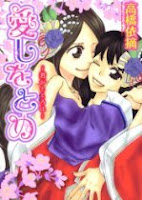 Set in the Heian period, Itoshi wo Tome ~ Kimi ga Kokoro ha ~ (愛しをとめ~君がこころは~) is a story about noblewomen Tachibana and Sakura, whose older sister had been a lady of the Emperor’s palace, but had died. Sakura is living with Tachibana’s family as a courtesy.
 The second half of Comic Yuri Hime, Volume 16 (コミック百合姫) starts off with what I consider to be an interesting turn of events. In “Honey Mustard” Morishima Akiko details a silly little story of two careerwomen, Kaori and Mitsuki. Some years ago they were lovers, but are now good friends – then rivals, as they fall for the ubercute server at the window of what we used to call in college a “grease truck.” Mai finds both women attractive in their own way, but her coworker, Chiho is less enthusiastic because she is, quite clearly jealous. The story itself is cute. It’s nice to see more adult characters, but that is not particularly what interested me.