Archive for the Miscellaneous Category


Taisho Yakyuu Musume Manga, Volume 1 (大正野球娘) Guest Review by George R.

November 4th, 2009

TYMM1Once again it is my great pleasure to welcome back George R., with another timely review, so I can get a few chores done. :-) As it happens, thanks to another Okazu Superhero, Bruce P., I am currently reading this very volume, so I may have some comments at the bottom. In the meantime, George, the room is all yours….

Seeing Taisho Yakyuu Musume from this summer’s anime lineup prompted me to look at its appearance in other media. This show followed the now-common path of starting as a light novel series, then branching out to both manga and anime adaptations. I’ll talk about Volume 1 of the manga here, as I still need to get the novels. In this case, the manga adaptation is done by Shimpei Itoh, a well-established mangaka, though not one known for Yuri.

I think the manga works well on its own, though it is interesting to see how it differs from the anime. For instance, several girls end up playing different positions, which makes me wonder where the novels originally assigned them.

The art is unquestionably Shimpei Itoh’s style. This differs from the anime, but is just fine in its own right. In fact, the art and humor remind me of his 1999 manga, Shoujo Tantei (Girl Detective), which was also set in the Taisho era, but has no Yuri. I think Itoh-sensei’s girls are a bit less moe than those of the anime, or at least Koume and Noe are.

It also follows Itoh-sensei’s story-telling style including a healthy dose of physical comedy and over-the-top humor. Somehow I doubt the novels include Noe experimenting with small rockets for military use (unsuccessfully) or suggesting they make bats from aluminum (accompanied by an illustration of an aluminum-armored tank from the ’70s). Those just seem his style. A couple bath scenes give us a little humor and also a chance to see the characters modelling their birthday suits. I wonder why the Japanese seem to have a fascination with spring-based resistance training harnesses. I’ve seen these in multiple shows. These appear a couple times here, though only played for humor.

The first volume of the manga covers introducing the characters and assembling the team. Baseball doesn’t even come up until the second chapter where we get Akiko’s motivation and her request to form the team.

Koume is still the sweet girl who happily follows and supports her friends through their adventures. Her mother seems to have no problem with her and baseball, wishing her a fun time and even letting her wear a western school uniform.

Akiko is the same rich daughter who is chauffeured to school, so naturally she is called Ojou. Noe is more of a ringleader here, taking Akiko’s baseball idea and running with it. She is the only one, other than Anna-sensei, who starts knowing anything about baseball.

We are given a closer look at some of the supporting characters. Shizuka is possessive of her twin sister Tomoe, and they both seem equally athletically competent. Their dad is a well-known doll-maker, and some call the twins living dolls he made. Tomoe likes Koume’s friendliness and warmth and hopes that becoming friends will warm the heart under her (and maybe Shizuka’s) cool porcelain skin.

Tamaki and Yuki are childhood friends. Tama-chan takes care of all the cooking at home as her mother is busy being a newspaper reporter. This may be a bit anachronistic for Japan of this era, but I find it hard to argue with women having independent careers like she and Anna-sensei do. However, Tama-chan certainly wishes her mother was a bit more responsible at home, which may be the source of Tama-chan’s attitude. Yuki is her same responsible, caring self, supplying her
friends with advice and equipment among other things.

Saburo comes off well as Koume’s fiancee, even taking her out for a date to watch a practice baseball game. When he finds she knows little of the game, he happily explains it to her.

What Yuri is here requires goggles to see. Mine needed a higher setting for the manga than the anime. We are treated to displays of both akogare and shinyuu in the different relationships among the girls. Kome and Akiko vary between the two. Tama-chan and Yuki have the comfortable ease of shinyuu, whereas Tomoe’s feelings for Koume are definitely akogare, as are those of Tomoe’s fanclub.

Ratings:

Art – 7
Story – 6
Characters – 8
Yuri – 1
Service – 4

Overall – 6

In all, I found this an amusing manga. Though it never made me fall off the couch laughing, it did bring many a grin to my face. I will admit to preferring the anime. Perhaps because it seemed better at keeping the feel of the Taisho era: some of Itoh-sensei’s humor jars my mind out of the era. Or perhaps seeing the anime first left me naturally biased in its favor.

Erica here. The art style is distinctively Itoh’s and, as a result, everyone is a bit over the top. Akiko’s fiancée’s rant about women in the home was three pages long and done at high volume, as opposed to his quiet, old-fashioned confusion as to why on earth women would want more from the anime.

I disagree that baseball is not mentioned until the second chapter – and, oddly, it seems that you’re not alone in thinking this, George. In the first chapter, the baseball team is *already* formed, Koume’s mother asks her if it’s fun to play baseball, and she waxes rhapsodic about how much fun practice and games are. The rest of the story is a flashback to how the team was formed. I’m guessing that, since Itoh’s specialty is not sports manga, they skipped trying to show any of that. ^_^ So we can understand that Koume and the others are, in fact, *already* playing ball, even if we don’t see it. Which we don’t. ^_^;

The other thing I wanted to add was that the anime, surprisingly, added a great deal of dignity to the story. By pulling back from over-the-top antics and rants, the issue of feminism was handled really, shockingly, well. Considering the dehumanization of women into object d’fetish so often in anime, it was just that much better handled than I could have possibly expected. Where the anime was a comedy-drama, with an emphasis on “sports drama,” this manga is definitely “comedy.” Fun, at times funny, but firmly in the “wackiness ensues” side of comedy. It is Itoh, after all. ^_^

Well thank you, as always, George for a great review!


Shitsurakuen Manga, Volume 1

October 15th, 2009

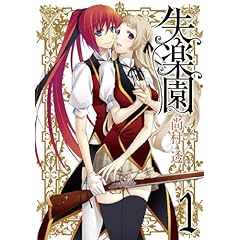
If you really, really like Shitsurakuen (失楽園) Volume 1, let me caution you about reading this review. I did not like it at all. I will be critical and, if you’re a typical fan, you’ll take that as me criticizing you, your tastes and your family – despite the fact that there is no intent to do any such thing. My intent is only to explain why *I* do not like it. So if you do like it and you are that kind of remarkably fragile that fans so often are when it comes to other people not loving what they love, then maybe you’d better skip the rest of this review. Your other option is to lecture me in the comments about how I *clearly* don’t understand what I read. Feel free to do that, of course, but be aware that my friends and I are laughing at your need to “educate” me. I did understand what I read – I simply understand it differently than you.

Shitsurakuen takes place at the oxymoronically named Utopia academy. We join the school along with transfer student Sora, and once again find that she has somehow – like so *many* heroines – managed to be accepted and transfer in without an inkling of what the school is actually like. Her expository friend Tsuki helpfully explains that she’s pretty much just transferred into hell.

Male students battle for supremacy, while female students are forced into subservient, near-slave positions, where they are dominated and abused by the males students and used to produce weapons with which the boys fight.

Fans of Revolutionary Girl Utena will immediately recognize many of the qualities of the duels, and will understand that every girl has been turned into Anthy. It comes down to our not-even-remotely androgynous, but nonetheless determined-to-protect-a-princess Sora. Sora’s name made me smile, btw. Utena’s family name was “Tenjou” – ceiling. “Sora” has broken free of the confines of that limitation and is the entire sky.

As far as the duels go, despite the guys’ screaming, Sora mostly keeps winning, except when she’s sucker-punched or ganged up on, thus accumulating a harem of 2.5 girls by the end of the volume. (.5, because one girl is currently questionable, for various reasons. No doubt she will join our our team – wink, wink, nudge, nudge – by the end of Volume 2.) Plus Tsuki, whose job it is to provide exposition.

As I said initially, I did not like this manga at all.

For one thing, the humiliation and abuse of the girls at the school made me ill. The near gang rape of a middle school student was pretty much the icing on that shitcake. And the premise that, if left unchecked, all men become abusive, rapist animals makes me angry on behalf of the men I know. I really didn’t enjoy spending time at Utopia. I want all the women to pick up cast-iron frying pans and swing. Knees break easily, as I always say.

I’m sure that Sora will continue to save the day and will eventually save all the women at Utopia.

Ratings:

Art – 7
Story – 8 if you can make it work in your head, 2 for me
Characters – same
Yuri – 1
Service – 6

Violence against women as entertainment for women deeply disturbs and puzzles me. Violence against women as entertainment for men enrages me. And that is why I did not like Shitsurakuen – because being enraged does not make me feel happy. Give me a manga where equals kick the crap out of each other and I’m there. Something like this? Pass.


Needless, Anime and Manga

September 15th, 2009
needless

A little over a year ago, I began getting Ultra Jump magazine, when Hayate Cross Blade moved to there from its former home. One of the other series in the magazine was the manga Needless and, being the manga omnivore I am, I gave it a try.

I picked it up in the middle of a fight between a bunch of girls, whose underwear the reader was shown repeatedly and a buxom woman with evil eyebrows, whose cleavage the reader spent a lot of time looking down. There were two older guys with silly facial hair, a bunch of people in the background and a lot of screaming.

Now, about 14 months later, Needless is still in the middle of the very same battle, with the very same characters in the same locations and lots of screaming.

So, when the anime was announced, you can bet I had no expectations. And so far, I’ve been right on with that. ^_^

In a post-apocalyptic setting, Needless is the name given to people with special powers who spend most of the series yelling and fighting. The story is surprisingly Shounen Jump-ish (well, not *that* surprisingly, after all UJ is the older creepy brother magazine of SJ.) The fights include standard shounen screaming of creative attack names, and Yu-Gi-Oh-esque character designs, endless fights in which power-ups make the bad guys able to come back from death blows and good guys miraculously rise from the ashes over and over. The crux of each battle is figuring out the *one* crucial clue that will unlock the other person’s ability. I have no doubt that there is an actual overall plot, but have yet to see sign of one in either anime or manga. Arc by arc is as good as you get, it seems.

There is no visible Yuri in the manga, but I counseled you to look for Yuri in the anime. Why? Because I just knew they were going to add it in where it was not really. The manga is full of Yuri-service, I had no doubt the anime would be as well. Naked women rubbing together and a ending sequence with the aforementioned schoolgirls kissing is exactly the kind of thing I expected. That’ll be good enough for most. The fact that the series is actually about a boy is beside the point.

Too old to buy Shounen Jump without thinking that you’d like to see Sakura naked once in a while? Needless is for you.

Ratings:

Art – I mean it when I say SJ. This is Saturday morning cartoon art.
Story – I suppose one will eventually show up.
Characters – Eve’s habit of renaming people is the most likeable thing anyone does.
Yuri – The ending sequence of the anime.
Service- All of it.

Overall – 6, if you take it for what it is

If Melody of Oblivion and Yu-Gi-Oh had a slightly impaired child, it would look like Needless. ^_^


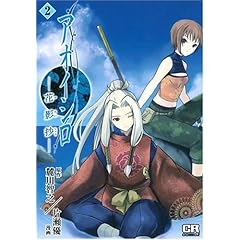
Aoi Shiro Manga, Volume 2

September 3rd, 2009

In the Jive edition of Aoi Shiro, the focus is squarely on the game characters, as opposed to Ichinjisha’s Yuri Hime edition of the story, in which the focus was on two almost irrelevant characters and was so tepidly Yuri that it failed to capture my interest.

In Volume 2 of the Jive version of Aoi Shiro, Yuri takes a back seat to Action and Mystery and other capitalized selling points.

Shouko, captain of the kendo club, is drawn into an ever-deepening mystery regarding Nami, the child she found on the beach. Her own childhood memories, Nami’s unusual dress, and a giant Bull-Demon all collide in what probably makes a pretty good game and makes a reasonably good manga. This is all made even more interesting by a suit-wearing Onee-san type from Shouko’s past and a guardian with one good eye-type from I have no idea whose past. And Nami transforms into someone older and less whiny.

It’s all full of shiny action and stuff. I’d go so far as to say it wouldn’t make a bad anime, probably. Better than most games that go to manga or anime, for sure.

I have never played the game, of course. Have you ever wondered about my disinterest in games? It’s not just RPGs or computer games I feel that way about – I don’t play card games or board games or games of chance. They simply bore me and always have. After I learn the rules, I have no interest in doing the same things over and over and over. It’s really nothing personal…except that I note that I have lost some very talented writers and artists to gaming, so in that sense it is personal. But for myself, I’d just rather spend my time translating a book, or publishing, or reading, or just about anything. The only game I ever enjoyed playing with another person was Knock-hockey, because none of the kids my age understood the concept of angles and I usually won. ;-)

Anyway, if you liked the Aoi Shiro game for itself, there is a very good chance that you’ll like the manga. If you liked it for the Yuri, the manga will disappoint, as there is so little that even Yuri Goggles fail to make it obvious.

Shouko and Nami have some kind of bond…it could be anything at this point.

There’s a bonus Akai Ito story in this volume, which positively reeks of the smell of Yuri, without actually having any. But it’s not bad in and of itself. It’s creepyish and horror-y, without being a horror story.

The biggest selling point is definitely featureless moe girls with weapons.

Ratings:

Art – Other than the character designs 8, the characters are so simplistic 6 is being generous
Story – 7
Characters – 6 but I feel like we’re not being given a chance to really know or like them
Yuri – .5
Service – 1 on principle, but really hardly anything

Overall – 6

And once again, I give my sincere thanks to Okazu Hero and good friend Komatsu-san. Thank you so much for the opportunity to read and review this. ^_^


Lucky Star Manga, Volume 1 (English)

August 28th, 2009

Very Important Disclaimer: Because of the popularity of this anime series and the level of Fandelusion engaged in by Fans of the series, I want to make this very clear up front. I do not hate Lucky Star. I have watched a total of about 30 seconds of one episode. I have nothing to compare this manga to – I may in fact be the only person to review this manga who has never seen the anime. Today’s review is *only* about the manga, with no bias at all in relation to the anime. Please do not accuse me of anything other than what I am doing – reading this manga and taking it at face value as itself. Thank you for your understanding. ;-)

Lucky Star, Volume 1 is a 4-koma comic about a bunch of simplistically rendered high school girls. There is, approximately, one joke for every two characters, none of which get that much funnier as the book goes on.

The main character, Konata, is a hardcore otaku. And…that’s about it. She lives with her Dad, who is also otaku and the two of them live a bachelor life together. Konata is smart, but slacks on her studies in favor of playing games all night long.

Tsukasa is her classmate and is in nearly every way, normal and a little dull. A typical comedy “straight man.”

Kagami is Tsukasa’s twin sister – she is a good, somewhat driven student, and her sole raison d’etre appears to be to rag on Konata.

And finally, there is Miyuki, who is the class president, smart, cute, glasses-wearing and occasionally clumsy, because powerless women appeal to otaku who are not me.

The chapters in this first volume are pretty much the same few gags repeated over and over. We get a teeny bit more background about the characters, but as this manga focuses on their interactions with each other, these snippets are more often than not used as cheap laugh generators.

Of course, I cannot pretend to be unaware of the raging case of Konata x Kagami-itis among fans of the Lucky Star anime series. And to them I say – seriously, there is NO KxK Yuri here in the manga – not even if we read the panels REALLY slowly. In fact, taken on its own, it’s pretty clear that Konata finds Kagami to be a huge pain in the ass and Kagami thinks of Konata as a thorn in her side.

If I needed to manufacture Yuri in the manga, I’d turn the goggles up to high and look at Konata’s fetishizing of Miyuki, which is pretty much meant to reflect the way otaku view most anime characters as a sum of the fetishes that make them up.

But, in all of this, I have not yet mentioned the one quality of this manga that, more than any other, really tanks it. The translation, which was undertaken by Bandai, is *so* spectacularly awkward and awful that it is almost funny in and of itself.

For example, “If you cause some case in the future, ‘I had thought that she would do something like this someday.’ would be exactly what I would say.”

Clearly Bandai felt that adaptation was a step they could skip entirely, since “everyone knows” that otaku prefer literal translation. And this is as raw as they come.

(As an aside, I believe that that particular “everyone knows” is a relic of the days when anime and manga companies over-localized everything for us, and left us with a desire to know what had really been said. It’s not that American fans want “raw” translations, or literal translations – they wanted things like “onigiri” to remain onigiri and not be turned into “pastries” or “snacks” or some other thing that is not rice balls.)

In fact, this is truly a “literal” translation and is nearly unreadable as a result. It’s not a good literal translation, either – it’s so raw that I can only assume that the translator (who is not credited, nor is anyone else who worked on the English language edition of the book,) really is not a fluent English speaker.

“There are so many ideas as to what that unspeakable element is…!!”

I am not making fun of the translation, I want you to understand. I need Japanese companies to understand that what they think is Good English is really nothing even close. Just like school-taught Japanese spoken by an American sounds mangled and weird to any Japanese person.

Dear Japanese companies – you *need* fluent English speakers and writers on your staff. You cannot do it yourself.

So, in conclusion, if you are a fan of the anime series, I would actually recommend you avoid the manga. And, if you are not, there is nothing here with which to entice you.

As I said, I do not hate this series, I simply found it to be puzzling. Aside from the bad TL, I think the anime must have been funnier by having more anime/game in-jokes and references that the audience found amusing and appealing. As a manga, this is one joke over and over and over until any entertainment value it originally had is long gone.

Ratings:

Art – 3
Story – 3
Characters – 5 Perhaps they are funnier in the anime, but they still aren’t that interesting. I’ll give them the benefit of the doubt and add two points.
Yuri – .5
Otaku – 7 Gaming in-jokes and CompAce in-jokes, the latter of which will mostly be lost on American fans

Overall – 3

Many many thanks to brand new Okazu Hero Yurri H. for the opportunity to see first hand this really interesting example of manga localization at its worst. Yurri – email me for your very own Okazu Hero badge of honor!