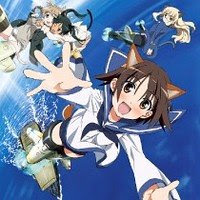
 Once more, my sincere thanks to a guest reviewer, this time a guy I only know as Bob. (Sounds like I buy reviews on the street, doesn’t it? “Hey, ya wanna buy a review, I got some in the trunk, right here…” lol) Bob is filling in for an Erica who is halfway out the door to go teach martial arts again for the first time in eight years. Can’t wait. Take it away, Bob!
(I would like to preface this by saying that this would normally be a loser fanboy review, but I’m not a fan of the material covered and so it’s just a loser boy review.)
Sex and violence, as the old saying has it, are reliable sellers. Without that expression, the lasting popularity of Strike Witches would be one of life’s great mysteries, up there with Fermat’s last theorem, Fermi’s paradox and why people can’t believe it’s not butter. I don’t clearly remember why I picked this series up, but it must have seemed like a good idea at the time – maybe I was just desperate for something that seemed likely to be high-yuri in content and wasn’t another season of Ikki Tousen.
The year is 1944 and Strike Witches is all about an international crew of magical mecha-shoujo moe cat-lolis with guns fighting Borg-Angels week after week in a world where Manchukuo, Katyn and Auschwitz-Birkenau never happened. You see, in the world of Strike Witches – hereafter shortened to SW – 1939 saw, not the invasion of Poland and the beginning of World War II, but an invasion of the entire planet by mysterious beings called Neuroi, whose way of life is to hit things with death rays and make more Neuroi out of the charred remains. Having discovered that fighter aircraft et cetera are useless, humanity falls back on Plan B: the magical girl.
Enter our young hero Yoshika Miyafuji, yanked out of her happy pants-free school life by a woman with a disturbing laugh and a patch-covered demonic eye who wants her to join an elite squad of underage witches on the frontline of the war against the Neuroi. Witches, that is, who confront the enemy not with wands and broomsticks but with machine guns and Striker Units – the latter being a miraculous invention of Yoshika’s MIA father, whose stroke of brilliance was to combine the essentials of a piston-engine monoplane with a magical boot. Yoshika, who of course wants to find said father, is badgered into accepting. When the baddies attack en route to England, still holding out against Neuroi-occupied mainland Europe, she establishes herself as the heroine of the series by hijacking a spare set of Strikers and growing furry ears and a tail before taking to the sky. Once in the UK proper, she finds herself inducted into the 501st Joint Fighter Wing, which suffers from a chronic shortage of actual fighters and whose other members hail from thinly-veiled analogues of Japan, Canada, France, Russia, Finland, Italy, Germany and the United States. The rest of this mercifully short series follows a generic monster-of-the-week format with comic interludes as Yoshika uses the power of naïve affection to win over her comrades one by one.
Some, if not all, of the above will sound familiar to those who have consumed a fair volume of entertainment material, because there isn’t a shred of originality in SW from start to end. Yoshika is textbook love-and-peace magical girl material. The other characters are equally stock – which is particularly disappointing because I’d heard over and over that they were based on actual historical figures – though not so much that they can’t be endearing now and then. And of the plot itself? If you’ve seen Star Trek‘s Borg episodes and the first half of Evangelion, you’ll know what the Neuroi are. If you’ve seen the last few episodes of Blue Drop or Ghost in the Shell: Stand Alone Complex, you’ll see the backstabbing conspiracy coming from kilometers away. If you’ve seen Sakura Taisen: The Movie, you’ll not only know how SW ends but even what the final boss looks like. Like Evangelion, the series implies that the Neuroi are more than relentless, mysterious foes, but runs out of episodes before actually making anything of this development. I have no doubt that a second season is in the works somewhere out there.
To its credit, SW doesn’t waste much time pretending to be anything other than what it is: a light fanservice show that crams in enough tropes to make Kaishaku jealous, albeit in a more coherent fashion. Its particular forte, like Agent Aika and Najica Blitz Tactics, is panties. The viewer who makes it through all twelve episodes will be well and truly inundated with them, because the League of Nations apparently banned women’s pants in order to divert cloth supplies to frontline hospitals. There’s also fanservice of the swimsuit and breast-groping varieties, along with an episode of panty-swapping.
Where’s the Yuri, you ask? Also under the purview of the fanservice bureau, for the most part: the French teamster is blatantly intent on keeping the demon-eyed officer to herself, the Finn and Russian regularly sleep together – in an innocent fashion, of course – and Yoshika herself is heavily implied to have erotic dreams about her well-endowed Canadian partner. It rarely gets further than heavy subtext, but it’s more than some ‘Yuri’ series have offered.
On the technical side of things, the animation quality is decent: while there are occasional bouts of very obvious CGI and some pretty blatant corner-cuts, it didn’t make my eyes bleed. The sound likewise is generally unremarkable and unoffensive.
I started SW with rock-bottom expectations, which is good because it didn’t surpass them by any great measure. If you, unlike me, have a taste for magical girls, moe lolis, gratuitous panties or any of the other items mentioned above, there’s no harm in checking out this series. If you can tolerate said fetishes and are merely looking to watch something inconsequential and get a few laughs, there are probably worse choices – ditto if you just want the Yuri. Don’t watch it for the faux-WWII setting, which is pure gimmick, and fans of girls-with-guns can find far better material elsewhere. If Gonzo et al intend to add to this franchise without it becoming more stale than the bread I ate today, my hearty recommendation is to swap the airscrews for sea screws, bump the timeline forward to 1962 or thereabouts and give us a series called Strike Fishes.
Ratings:
Art – 6
Story – 2
Characters – 7
Yuri – 8 if you have a good imagination, 6 if you don’t
Service – 12
Overall – 7
Thanks Bob! No one told me there was a woman with an eyepatch. Now I guess I’ll *have* to watch it. Bleah.

 Volume 6 of Vampire Princess Miyu answers a lot of questions. But it answers those questions in the bizarrest and least logical way, for which I give it a lot of credit.