
Archive for the Miscellaneous Category


Lesbian Graphic Novels: Fun Home and 12 Days

March 8th, 2007

I read both of these graphic novels this week and, as soon as I put down the second of the two, I knew that I absolutely had to review them together as a compare/contrast. So, I’m shaking out my old Comparative Literature Major for today’s review. It’s a bit dusty, let’s see how I do.

Both Fun Home, by Alison Bechdel and 12 Days, by June Kim are stories written by lesbians about lesbians that are not lesbian narratives, really, at all. Both stories are more properly seen as narratives of grief, of relationships and of missed opportunities for communication and closeness.

Alison Bechdel subtitled Fun Home a “Family Tragicomic” which suits it very well. It is indeed a graphic rendering of a family locked in tragedy, caught in moments from her life – and more importantly, from the life and death of her father. Alison tells her story through snatches of literature, photography, art, even her own diary from her childhood, in a series of repeated, but not repetitive looks at the relationships in her family and the relationship she had with her father, in particular.

12 Days is a story of a woman’s attempt to get over her grief for an ex-lover who has died. This process is complicated – and assisted – by the presence of her lover’s cousin, who brings her some of her her ex’s ashes, and stays around to escape his own issues with his family. Through Jackie and Nick’s reflections, we come to know a little bit, but not too much, about Noah, her life and her death.

Both books are executed exceptionally well. In Alison’s case, the limited use of color allows us to see the world almost as told through faded photos, while June’s black and white setting broken up only by the occasional use of gray, sets the whole thing off sharply, to good effect. In both cases, the art compliments the story exceedingly well. I’m almost tempted to say something tedious like, “one can’t imagine it being done any different” but you know really, one really can’t. ;-) Like Alison’s detailed art, her dialogue is rich, textured and flavored with quotes from many sources. June’s dialogue, like her art, is stark and limited.

Both of these stories center around a death. In both cases, the death itself is seen from several different angles through the course of non-linear narratives, and in both cases there is a surprising lack of anything like passion in the telling. Alison discusses *why* this is, the curious lack of affection and emotional connection in her family. In fact, the why of the lack of passion takes up a whole section within the book. In June’s case, I could *see* the emotion Jackie was feeling, but I found it hard to feel it myself. At the end of the book, I learned (because I really do read *everything* in a book, like the credits, the forewords, the introductions and, in this case, the dedications) that this was not June’s own story, but a story told to her by someone else. In her rendering of this story, it *feels* like it is someone else’s, someone over there. Not us. Them. Where Alison engaged me in her lack of passion, June failed to do so.

Fun Home is a book that is, from beginning to end, unremittingly intelligent. It is cloaked and festooned with references to literature and art and makes no allowances for those who have not read and/or seen – or at least heard of – these things. She compares her father to Oscar Wilde, to Proust, to Leopold Bloom and herself to Collette and Sylvia Beach and Stephen Daedalus. I cannot express how much this kind of intellectual burden makes me love a story. The hooks into myth, into early 20th century homosexual history and the art and literature it spawned practically gives me bookgasm. If Alison had asked, she couldn’t have found a better way to engage me in her story. I wonder how many people it put right off. ^_^

For 12 Days the hook is more heuristic, with the background told later, as an afterword. Jackie, deprived of her lover by miscommunication, by family pressure, by fate, perhaps, has decided to drink Noah’s ashes and thus “become a living urn” in order to put this behind her. We learn a lot about the circumstances of Noah and Jackie getting together, some of their life together, and much about Noah’s leaving to get married and her subsequent death – but we never really get to know either Noah, or Jackie, all that well. The only one we really manage to touch (and, I’m betting, the one character really created out of whole cloth by June) is Nick, the odd man out, the psychopomp for Jackie’s journey. Because I have not had an experience of my own to tie into Jackie’s feelings and give them depth, they simply lacked depth for me.

I didn’t not *enjoy* either book. But that is totally beside the point. They are both excellent and well worth reading. I feel enriched by having read them, an important benchmark for me and any literature.

To sum up:

June’s 12 Days was incredibly good, but I did not like it.

Alison’s Fun Home was incredibly good, and it simply doesn’t matter whether I liked it, or not.

Overall Ratings:

Fun Home – 10

12 Days – 9

I guess I can admit it now, I really don’t like Dykes to Watch Out For. Every single character failed my “would I have them over for lunch?” test, but Alison Bechdel and June Kim are welcome anytime.




Shocking Loss for the Yuri Community

February 28th, 2007

I was going to start “fanservice week” tonight on Okazu, with reviews of three lowest common denominator series OVAs that have just come out, but I learned something tonight that has made it impossible for me to do so.

Philip Mak, owner of shoujoai.com and the server that houses the Yuricon website has died of a sudden cerebral hemorrhage. The loss to the Yuri community is staggering. Philip was an important supporter of Yuri and his server housed many popular websites with Yuri content.

Philip was 26, was a huge Lina inverse fan, and always pleasant to deal with. And, sadly, I was thinking of him just this weekend – I have a notation on my “to do” list to email him.

I’m shocked and saddened by his loss. He will be sorely missed by many people.


Brains and Brawn

February 1st, 2007

Reviews are going to thin out for a little while, but not because I’m slacking. And not because of bad stuff. In fact, it’s all good. I just have one of theose weeks that are a confluence of *things*: a Yuri Monogatari Project deadline, getting ready for New York Comic Con, and a lecture in NYC by a friend of mine. Which is what I want to mention today, as it involves…a book.

Just a little less than a year ago, I was in Illinois and I had the pleasure of reading Black Bodies and Quantum Cats written by my friend Jennifer Ouellete.

Jen has a new book out, one that will surely appeal to geeks of all kinds. Her new book, The Physics of the Buffyverse, combines three of Jen’s favorite things in one – physics, fighting and Buffy, the Vampire Slayer.

Tonight, she’s going to be doing a combination book-promotion/signing/lecture/martial arts demo, “The Physics of the Fight: Isaac Newton in the Buffyverse,” in New York City. I plan on being there – you all know how I feel about women who kick ass. LOL Nuthin’ I like better than to watch a real women beat people down…for fun. Just for a laugh, I contacted some old Martial Arts friends and we’re going to have a little reunion at the lecture. (If you’re interested in attending the lecture, you’ll want to get the details from Jen’s own faboo blog, Cocktail Party Physics.) So, tonight I’ll be setting aside my “Doyen of Yuri” life for an earlier incarnation. (Which means that, for the fourth time this week, my old MA will come up in conversation…I’m starting to think the universe is trying to make a point….)

Anyway, when I’ve read Jen’s book, I’ll be sure to let you know how it is. I have no doubt that it’ll be fun. And I’ll start doing reviews again next week. Promise.


Three Non-Yuri Reviews: Onegai Friends, Venus Versus Virus and Ode to Kirihito

January 30th, 2007

All three of these things I am reviewing today – one a drama CD, one an anime, and one a manga – were things I wanted to talk about. But none of them are Yuri, so I thought I’d lump them together in one mashup post, going from the worst to the best, in quick succession.

Starting with the bottom of the pile.

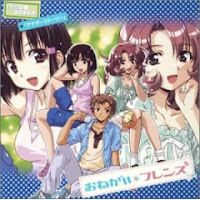
Onegai Friends is a Drama CD-only side story in the Onegai Teacher/Onegai Twins world. As you may or may not know, the Onegai Teacher manga was drawn, although not written, by popular Yuri manga artist Hayashiya Shizuru. That was the best thing about the series. It’s otherwise tripe. It’s one of those things I can benchmark people on. Anyone who loves this series will never be invited over for lunch. ^_^

There was some rumor on both Japanese and American forums that Onegai Friends was going to be a story with lesbian characters – that the friends are, in fact, in love with one another. Well…no. They aren’t. They are both in love with the same guy. THAT is the ENTIRE story. Just, they are both in love with the same guy. Guy shows up, one falls in love with him, the other, her friend, pretends to not be in love with him, so her friend can have him, only he’s in love with the friend who is giving him up. Until the friend who loves him, but loves her as a friend more, gives him up so her friend can have him. They are very good friends, and this story is so dull I wanted to cry. I’m only glad that “PLEASE!”, the production company that writes the “Onegai” series, stopped. They suck at writing. Did we mention that they are friends? Because they do about 145,798 times in the CD.

Ratings:

Art – N/A
Story – N/A
Characters – 4
Yuri – 0
Service – 5 (how many baths do people have to take a day to make it a fetish?)

Overall – 2

Second up: Venus Versus Virus is a new anime that has one of the worst titles in the world, ever. ^_^; I know that some Yuri is reported to exist in the manga, although I have not yet read it – I expect it to be thin to non-existent, and there are so many better things to spend my time on. The anime has fake-y yuri in the opening and ending sequences – you know the drill, the two female leads curled up near, maybe slightly touching one another, one sitting in front of the other…. I know this may come as a surprise, nay shock, to some of my less socially developed readers, but women touch each other all the time without it meaning that they are lovers. In short…this is a kiddy-version of Kiddy Grade (Two female leads, lots of action, tears, possible death-like sequences, some belabored grieving over the fact that the other didn’t understand how much she meant to me, but no real deaths – and no Yuri. ). This is a classic case of the “Newtype Effect” in which two otherwise straight women are deployed draped over one another to play the Yuri-service card, when there is no Yuri and neither character is remotely lesbian. Not that this will stop fans from insisting.

…Yesterday, I answered a questionnaire about the genre of “Yuri” and one thing I pointed out was that, when I first began pioneering calling all of this Yuri, it was hard to get people to recognize that two characters were a couple at all, even when they were explicitly shown to be so. Now it’s all I can do to keep some fans from calling every two girls who stand next to one another, a “couple.” Sheesh…!

Ratings:

Art – 5
Story – 5
Characters – 5
Yuri – 1
Service – (OMG! They are so a couple!) 4

Overall – 5

Lastly, a manga that is so good, that I really felt kind of uncomfortable about covering it in this post – it so richly deserves a post of its own. But it’s not Yuri, and many, many, many people are writing paeans to Ode to Kirihito. So I’ll keep this short.

Ode to Kirihito was incredible. I honestly felt a bit intimidated by the 800-page book. But it was at my library and I thought, “If not now, when?” So I grabbed it, went home and read. And oh, my god. I actually feel *honored* to have been able to read such an incredible book. It is big, but it’s a page-turner of a story. I read it through in one sitting, and could not have put it down if I had wanted to.

I went into Ode with no expectations, or any knowledge of the story – I strongly recommend doing that, therefore I won’t say a word about the story. I think it’s safe to warn that there is violence, some sexual violence, and nudity. This is not a book for kids – and really, not too many kids will be interested in this tale of human nature.

But oh my god, what a tale.

Quick technical thing: the book reads left to right and has been flipped in that old-fashioned way that make people shake hands left-handed. Despite that, and because the story *is* all that, I barely noticed.

Ratings:

Art – 7
Story – 9
Characters – 9
Yuri – 0
Service – 2

Overall – 8


Life Manga, Volume 1

January 22nd, 2007

This is the first review brought to you through the generosity and kindness of the folks who purchased something for me from or through my Amazon Wish List. In this case, the review has been sponsored by pachy_boy and many thanks to him for it. He thought this manga would interest me and it does – but not for the reasons he thought. (Sorry…)

The story is, at least for the first volume, mostly realistic. Ayumu, a girl with low self esteem and poor study skills, relies on her smarter friend for assistance to pass the exams into high school. When, through a bizarre turn of fate, her friend Shii does not pass the exam, she begins to resent Ayumu, then outright hate her.

Personally, I question the fact that her friend could have possibly lost skills through helping Ayumu study. That simply makes no sense. If they were studying at a level high enough for Ayumu to pass, then they were studying at a level high enough for the friend to pass too, but be that as it may. Full of self-loathing, Aymu becomes a “cutter.” That is to say, Ayumu begins to cut herself in order to inflict punishment on herself for her self-perceived unworthiness and to feel alive at all. This part, at least, is written incredibly well – Ayumu’s feelings match those of many teenagers who cut themselves.

Ayumu goes on to the new high school, determined to be antisocial, but a shiny happy, incredibly superficial and immediately loathsome girl, Manami, pops into Ayumu’s life and takes it over. And this is where I had to check out of the story. Manami is, as I say, entirely loathsome. So much so that I cannot for the life of me conjur up the least little sympathy for Ayumu after she decides to be friends with such an obvious skank. I felt for her about the cutting, I really did. It’s nothing I ever did, or would ever do – I much prefer to take my bile out on others rather than direct it towards myself – but still, I understand the thing that drives a person towards cutting well enough. But if she didn’t take one look at Manami and think, “what a tick”, well, she’s going to get into miserable situations.

And she does, of course. I did a quick overview of the next several volumes, and it looks like the story goes from one misery to another, with no hope for redemption or resolution in sight. Yeah – I’d want my teenaged girl to read this…not. I imagine it will resonate well with girls facing similar situations, but if there are that many girls facing that many similar situations, then our country has WAY more to worry about than kids cutting. And maybe it does, I don’t know. I despair to think that that many girls might well be in that many horrific situations. I have to believe that it’s a soap-opera mentality; wanting to see people marginally like you in crisis situations that are like yours blown well out of proportion to increase the dramatic potential. I fervently pray that it is so.

What *did* interest me about Ayumu was that, although she is in no way lesbian, she is an exceptional example of a woman-identitfied woman. Most of the examples I can come up with are lesbian characters, so I found Ayumu’s behavior very interesting.

It’s not uncommon to see women, of any orientation, notice what other women are wearing, or comment on their looks. What is less usual is to see women represented as noticing and caring what other women think of them. This is hardly uncommon behavior in real life, but I only tend to see it portrayed in “chick lit” and/or dismissed as an example of the superficiality of women. But Ayumu is more than that. She watches the girls around her almost exclusively, measuring herself against them, not for the sake of a boy, but for the sake of herself. It’s hard to miss that she comments on the looks of the other girls in the class, but completely ignores the appearance of the boys. And yet, I believe she is straight. Ayumu notices the girls for their beauty or popularity, not because she desires them, but desires to be measured against them. She identifies herself in relationship to them, not in relationship to the guy(s) in her life, as Manami does.

So, I don’t see any yuri at all, but I do see a reasonably woman-identified-woman. A rare thing in manga.

Unfortunately for Ayumu, her desire to be carried away in the company of women is going to be getting her in mounds of horrible trouble. I won’t be reading the next volumes of Life, but I might skip to the end to see what happens, when the series finishes.

And, if I did have a daughter who was reading this series, I’d definitely take the opportunity to discuss some of the many issues in here with her.

Unfortunately, Tokyopop blows a HUGE opportunity to engage the reading audience in a dialogue about cutting. The final page is a pedantic, dry and overwhelmingly dull discussion of cutting by a women who has a bunch of letters next to her name. Way to disengage a teen audience there, guys. A small box with the Cutting Hotline number and short, simple and unpretentious message would have served everyone far better. No young person in emotional distress wants some psychologist going “blah, blah, blah, blah, blah” at them. Hell, I don’t want it now, and I’m no longer a teen, nor in emotional distress.

And btw: Hotline for Teens who Cut: 1-800-366-8288

Talk to someone about it. Seriously.

Ratings:

Art – The Usual Teen Manga – 6
Story – The Usual Melodramatic Teen Manga – 5
Characters – The Usual Melodramatic Self-loathing Teens – 5
Yuri – 0
Service – 3

Overall – 5

It wasn’t awful. it wasn’t good. It wasn’t my cup of tea. The biggest problem with the story? I didn’t like a single person in it.