Archive for the Novel Category


Novel: Moribito Volume 2, Guardian of the Darkness (English)

April 25th, 2012

In Moribito, Guardian of the Spirit, we learn Balsa’s tragic backstory, and why she cannot return to her country, Kanbal. In Moribito 2, Guardian of the Darkness, she returns to Kanbal to face her past.
Still in New Yogo, Balsa learns that the King who had had her father killed unjustly and caused her foster father Jiguro to take her out of the country as a child, has died. She decides to return to her country – and to her tribe – to face the wounds she still bears.

Of course, on the way, an adventure breaks out. As with the first book, it is two young people that help her figure out what has gone wrong where. And indeed, several things have gone terribly wrong. The land is suffering because a ritual has gone undone for too many years, the wrong person is in charge of her tribe and there is a conspiracy against her life.

Because it is Balsa, and not someone else, we can be content to watch her work out the pieces until she knows what must be done – and what must be done, right away, is the long neglected ritual in which a future tribe leader faces down the darkness.

Accompanying the true heir to the title of leader,  Balsa faces the spirits of the darkness and the joys and horrors until, at last, she comes face to face with her own ghosts.

The scene where she fights for not only her own life, but for her tribe’s future and her own mental well-being had me in tears. I was, and am, so glad that this was translated into English!

Once again, I recommend this book for a young person with an interest in myth and action. But more than the first book, this novel was all about Balsa – her childhood, her adulthood, her life. And for that, it was absolutely, fabulously awesome.

Ratings:

Overall – 9

At the end, she turns her sight on home…New Yogo…and Tanda. Awww. ^_^


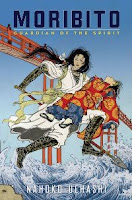
Novel: Moribito, Guardian of the Spirit (English)

April 24th, 2012

Over on the Yuricon & ALC Publishing group on Facebook, I’ve started posting pictures of a few bad-ass female characters just for fun. Last week, I posted a picture of Balsa from Serei no Moribito. I’ve never really talked about the anime series here, because it’s not Yuri, but I’m reading the Light Novels and find that, despite the fact that they are not Yuri, I think they are worth talking about. So, here we are talking about them. ^_^

The first two volumes of the novel series were translated into English by Scholastic books. Much like the anime series, they didn’t get much play in critical or blogger circles and basically just slipped under the radar, which was a damn shame

The Moribito anime, to be brief, is stellar. I consider it, without question, to be the very best anime I’ve ever watched. Everything about it was excellent – characters, story, animation, music. The fact that the story is family-friendly and that there is someone for everyone in the family to identify with, just makes it that much better. Young, old, male, female, there’s someone to like. The strongest indicator that this was something special was when about 5 episodes in, both my wife and I realized we liked the kid. That never happens. And, not only did we like the kid, but by the end of the series, we loved him. Prince Chagum is an extraordinary character. All of them are.

The story, for those of you not familiar with it, is an episode in the life of a spear-wielding female bodyguard, Balsa. She has a tragic backstory of her own, but in the anime – and the first volume – she is drawn into an adventure of a lifetime. The second Prince of New Yogo is the target of an assassination attempt by his own father. His mother, the Second Queen, hires Balsa to save the Prince’s life. Why Chagum is being targeted and what happens, makes some of the most compelling anime ever made. The entire series is available and Media Blasters did a great job of it.

But today, we come to discuss the first novel of the series, Moribito, Guardian of the Spirit. Physically speaking, this book is gorgeous. The paper is a soft cream color and trim and text are a dark blue that gives the pages a slightly other-worldly feel.

The story follows the same outline as the anime, but is not nearly as detailed nor does it have as much character development as the anime. The long days while Balsa and Chagum build trust and a relationship are nowhere to be found in the book. The plot remains the same, but in a minimalist way, The action scenes remain intact and anyone who has watched the anime will recognize the story. For one of the few times in my life, I recommend the anime over the novel.

However, if you know of a budding young otaku and want to really encourage reading, hand them this book. It’s a good story, with likable protagonists, fantasy/myth elements and a lot of cool spear-wielding by Balsa.

Ratings:

Overall – 7

If you’ve read the first book and want to know whether the rest of the series is worth it, tune back in tomorrow, when we take on the next in the series. ^_^


Novel: Wasurenagusa (わすれなぐさ) Guest Review by Hafl

May 25th, 2011

It’s Guest Review Wednesday, thank heavens. Today, returning Guest Reviewer Hafl is going to talk about another of Yoshiya Nobuko’s novels. As you may remember, I consider Yoshiya to be the Grandmother of Yuri and certainly one of the driving forces in the creation of Japanese popular literature for girls, what we think of as the shoujo genre. Any chance to talk about her work – which is relatively unknown in the west – is a good thing. Take it away, Hafl!

On the first glance, Yoshiya Nobuko’s Wasurenagusa (わすれなぐさ) is a tale of three schoolgirls, who become friends and learn to deal with their family situations. On second glance, it is entirely possible to read it as a story of a love triangle, and it does not even require that much effort on part of the reader.

The three main characters are Makiko, who is the ordinary girl, Kazue, who is the quiet and responsible girl, and Youko, who is the spoiled rich girl. Each of them also has family issues they must resolve before the book ends. Youko does not see the value of having a full family. Kazue is the eldest child in a fatherless household and is overly self-sacrificing. Makiko has a terminally ill mother and an authoritarian father, who wants her to completely sacrifice herself for family’s sake and wants her brother to become a scientist like him, despite the boy’s apparent distaste.

In the beginning, Makiko borrows school notes from Kazue, an act which is witnessed by Youko, who immediately starts suffering from jealousy and decides to get Makiko as her special friend. To that end, she employs such various methods as forcing Makiko to crossdress, gift swapping, summer camps, tailor-made dresses and distracting her with many different amusements. However, in the end, her spell over Makiko is broken and Makiko becomes friends with Kazue, who also helps Makiko’s father see that he cannot rule his children with an iron hand.

These are only the bare bones of the plot, which can be read in several different ways. It can be read as a simple tale of three girls becoming friends. It can be read as a veiled attack against Western decadence (It must be significant that Youko, always associated with Western clothing, wears kimono in the last scene of the book). And finally, it can be also read as a story of girl used to always getting her way, who decided to claim one girl for herself – that is the way I chose to read the book, since for me, it is the most fun way.

Wasurenagusa was written in the thirties, some ten years after Hana Monogatari and Yaneura no Nishojo and it shows. The prose style is much easier to read and there are mentions of things that would be simply unacceptable before, like Kazue ‘s father being a soldier who died in China. Even though the book is mostly told from the point of view of the main characters, there is an interruption from Makiko’s brother’s point of view and it shows that if one were to read the book “properly,” the main theme is not the relationship between the girls, but in relationships in family…and that the book’s more or less explicitly told stance on those relationships is that children must be allowed to find their own way in the world without their parents’ interference.

I tried to not spoil much of the plot, since Wasurenagusa is definitely worth reading. Personally, I would rate it to be about as difficult to read as the Maria-sama ga Miteru novels, so it is not as hard as Yaneura no Nishojo or Hana Monogatari. Or, perhaps, I have just became used to Yoshiya’s style, so I can read it more easily.

Story – 7, It is simple and without many surprise, but nicely told.
Characters – 7, Nothing special, but likable.
Yuri – Between 0 and 6, depending on how you decide to read the book.

Overall – 7, Not a must read, but still recommended.

However, this Wasurenagusa is not the only story titled Wasurenagusa that Yoshiya wrote. There is also an early story of the same name in Hana Monogatari, with the only difference being that the novel’s title is all in hiragana, while the story’s title uses kanji. Let’s take a short look at it:

Toyoko, a new girl at school, feels deeps admiration for an upperclassman, Mizushima-san, but she is unable to confess her feelings. In the end, she just leaves some forget-me-not flowers (wasurenagusa in Japanese) on Mizushima-san’s desk on her graduation day. While nobody dies of a flu epidemic out of nowhere or develops romantic tuberculosis, everybody is still sad. It is a pretty typical story in Hana Monogatari, where two girls separate without even having a proper chance to interact with each other.

Story – 6
Characters – 5
Yuri – About 3

Overall – 6

Thank you Hafl for your perspective – and for your prompt to remind me to read more of Yoshiya’s work.


Lesbian Novel: Super Otome Taisen

February 3rd, 2011

Mori Natsuko-sensei a master of the craft of writing. The fact that her writing is pornographic does not diminish this fact one bit.

Super Otome Taisen (スーパー乙女大戦) is a collection of short stories that were published over a period of several years to create an epic whole.

It is Christmas Eve at St. Anna’s private Catholic school. In the Teresa dorm, a minature Angel named Lilith tells seven girls that they have been chosen by God to save the Earth.

The “senshi” are third-years Mikiko – honor student, former president of the Student Council;  Makoto – out lesbian, and “Casanova” of the school; second-years Karen – a half-Japanese supermodel; Sasa – the school bad girl; Fuyuko – otaku and president of the SF/Fantasy club and; first-years Goth-Loli Yumeno and…Mana. I’ll get to Mana in a bit.

The “senshi” gig isn’t quite what one might expect – they are told that their sexual energy will power the giant robot guardian Super Gaia as she fights off equally giant monsters that attack the planet. This requires them to either masturbate or have sex with one another to free Super Gaia from the tentacle-y clutches of the monsters.

During the course of their adventures, the senshi undergo some awakenings. Mikiko discovers a sadistic streak, while Sasa learns that she’s a masochist. Yumeno – who yearns for Karen –  also learns she has a mean streak, School Casanova Makoto is summarily rejected or ignored by almost every one of the others, Karen and Fuyuko discover a mutual love of tentacle play and fall in love and Mana develops a kind of telepathy with Lucretia, the giant sea anemone tentacle monster they keep in the dorm and Lucretia’s baby tentacle monster, Koro-chan.

Right from the beginning, there’s a few things that are not right about the situation and it’s otaku Fuyuko who notices them first. For one thing, the monster design is inconsistent (and she can identify which anime and live-action designers they remind her of.) She also comments on the set design. And, as she points out, the Angel that is their contact has the name Lilith, which doesn’t sound like someone that the Christian God would chose to save the Earth. Fuyuko comments that Lilith’s wings are more like an insect’s than an angel’s and calmly mentions that for all they know, the God they are serving is Beezelbub, Lord of Flies.

Karen, discovers something’s up when she overhears Lilith talking to “God” who has a very high-pitched voice and whom Lilith refers to as “Director.” To keep Karen quiet, Lilith imprisons her with Lucretia. Karen doesn’t really mind that much and Lucretia is very gentle with Karen – even going so far as to feed her. Nonetheless, I had a really hard time being comfortable knowing Karen was involved in “tentacle play” for three days straight.

It’s Mana who saves the day. Mana is a really weird character. She’s totally asexual and never involves herself at all with any of the other senshi. When she discovers Lucretia’s baby, she puts Koro in a bowl and raises it. From there, she develops empathy that evolves into telepathy. When Mana realizes that Koro-chan misses her mommy, she gets the locked door open by asking Lucretia politely to open it. Ultimately, this frees Karen (who, mind you, asks to go back after a bath and a meal.)

The climax (herhn herhn) of the book comes when Yumeno, disgusted at what Karen has become, blames Lilith and concocts a plan to punish her. She engages the help of Mana (to whom she had always been kind) and Koro-chan. The little tentacle monster is just the right size to detain and “play with” Lilith. The senshi gather and force Lilith to tell them what’s up. It turns out that the role of “God” has been played by an alien AV director who wanted to create a reality show for the human fetishists in the universe. And it was a big success, she admits. I really felt that Mori-sensei dropped the ball here – she needed to have had Mikiko demand royalties for them all. Oh well, can’t have everything. Oh and Earth? Never really in danger…

The senshi are returned back to their lives which, amazingly, they slip right back into. They gather together one last time to say goodbye to the graduating third-years. You get one guess as to how that turns out.

In the final scene, Mikiko and Makoto are walking the campus and they see a beautiful woman, with perfect proportions and a very western face. They go running up to her…it can’t be…Super Gaia? I won’t spoil the ending. You’ll just have to read the book to find out. ^_^

In the same way that Sempai to Watashi takes the idea of BDSM and kind of beats it to death and then still runs with it until it stops being sexy, sort of normalizes and then becomes both more profound and more silly than ever before, Super Otome Taisen does the same with tentacle rape.

While Mikiko is the leader of the team, it’s Fuyuko who is protagonist for most of the book. Her open otaku-ness allows Mori-sensei to really trot out some serious sci-fi/fantasy obscura. Now I too know about “Stalingrad Fuyu Keshiki.” You can tell that Fuyuko is the protagonist, too, because she is the only one who gets the girl in the end. Makoto remains a court fool and Sasa is the group whipping girl, but Fuyuko and Karen find true love. Mana gets a new baby tentacle monster to raise. And they all live happily ever after….

Ratings:

Overall – 8


Yuri Novel: Yaneura no Nishojo

May 9th, 2010

Yaneura no Nishojo (屋根裏の二処女) by Yoshiya Nobuko is arguably the source material for much of what we consider to be “Yuri.” Published in 1919, it sets down many of the standard tropes that we have come to expect in Yuri series. (Things like the Christian private all-girls school, the attic room, the piano scene, the misty flower-scented atmosphere, and a number of other memes that are familiar to the Yuri audience.)

Yaneura no Nishojo follows Ryuumoto Akiko, a transferee into the YWA (Young Women’s Association) school and dorm life. Because she is a late entry, she is assigned to the dormer room – one of two. Her companion on the fourth floor is Akitsu. The early story largely revolves around Akiko’s failure to feel as if she is fitting in at dorm life but then, as she adapts, she makes friends with the other girls and ultimately, falls in love with Akitsu. Akitsu is engaged to a young man her family chose however, at the end of the story, she returns to the dorm and asks Akiko to come with her. Akitsu and Akiko agree to try and build a life together, and forge a path of their own making. Yaneura no Nishojo was a groundbreaking work when it was published and really is quite exceptional even today, with an overtly feminist ending.

This review has been a long time coming. I bought this novel in 2004 and been reading this book on and off for years now. Some time ago, Guest Reviewer Hafl asked me if he could review this novel – so I suggested we do a dual review. I expect our perspectives are going to be quite different. We are different genders, sexual orientation, nationality and age. So, bearing all this in mind, here is the Okazu review of Yaneura no Nishojo.

1) Did you have any expectations before you read the book?

H: I read the book, because I wanted to learn something about the roots of Yuri as a genre and to improve my understanding of Japanese language, and I was satisfied on both counts. In regards to being entertained by the book, I only expected that the book would not bore me and it didn’t, even during the more long-winded passages of the book.

E: I went into this book with few expectations, mostly around the shoujo-like atmosphere. It was a book I felt I *had* to read at some point and now that I have, I’m glad I did.

2) What were your impressions of Akiko and Akitsu? Did your impression/opinion change as the book progressed?

H: Akiko is the usual angsty teenager archetype, but despite that, I actually liked her. With the book being narrated in her voice liking her is probably important to enjoying the book. At the beginning of the book, she comes across as a very passive character, doing only what she absolutely has to do and not actually caring about anything. Since Yaneura no Nishojo is at least in part a bildungsroman, she changes through the book, so Akiko at the beginning and Akiko at the end are different characters.

It’s harder to tell about Akitsu, since even though she is a central character in the book, we mostly see her from Akiko’s view. That means that in the first half or so of the book, Akitsu is mostly a distant, admired figure, though I still thought that she was basically a nice person. Later, as she starts to have a more active role in the book, I still thought of her mostly in terms of her relationship with Akiko. She generally seemed to be the older of the two, more resembling her actual age than Akiko, who seemed to be not much older than fifteen or sixteen years old. She has more life experience than Akiko and also seems more materially well-off than Akiko (as in the scene when she and Akiko decide to share rooms).

E: I agree that Akiko is a typical angsty teenager and I found her to be a tad mopey for my taste. I don’t think I ever liked her until the very end, but I did feel sympathy for her. Akiko at the end was someone I felt I could trust to hold up her end of their relationship, so I gave her props for maturing quite a bit. It took her three pages to open a door at the beginning of the book, and only one moment to agree to leave with Akitsu.

I think you’ve nailed the problem with Akitsu, Hafl. It’s so hard to know who she really is, because we see her through the eyes of first, admiration, then admiration tinged with desire, then obsessive love and only at the very end do we see her for a moment as a real person. In that one moment, though, I liked her. She wasn’t as political as I expected her to be, nor was she snarky, but the sense that she had been building a life outside the YWA’s walls through the whole novel was quite strong. I liked that.

3) What was, in your opinion, the best or most important scene in the book?

H: The best scene in my opinion is also the scene I liked the best. It is the scene of Akiko moving into the attic room. Up until this point, Akiko was more or less going along with the events and, as I said above, did not seem to care much about anything. In contrast, this scene seems really bright and happy, so it stands out. I’d also like to mention the scene where Akiko learns about Kudou’s death, just because her reaction seemed so wonderfully human.

As for the most important scene, from plot perspective it is the one where Akiko speaks about belief in God in front of everyone in the dormitory and what comes after it. It is really the turning point in the story and an important point in Akiko’s development. From literary perspective, the most important scene is the ending, but more on that later.

E: For me the most important scene was the scene where they all bring the huge box of apples up to the attic. Up to that point, Akiko acutely feels as if she’s an outsider. At that moment, she bonds with the other girls and from that point on, there are friends in the story. It changes her – she starts to care about people. Even her relationship with Akitsu shifts at that point, and the distance between them closes. It’s as if she’d been watching everyone through gauze up to that point, and now the gauze was removed so you can see everyone clearly.

4) What was your favorite scene of the book (if not covered above.)

E: The scene I liked best was the scene in which the girls all went to the artist N-shi’s atelier. For the first time we got a glimpse of the town they lived in and their relationship with it (which was somewhat removed, after all, these were well-off girls in private school. They had little cause to be walking around town.) It was the first time we saw them relating to young men, and the sense that there were two distinct worlds that rarely met was palpable – and there was a real sense of discomfort at the thought that these men plucked the women out of their world to stick them in a box in the men’s world. It wasn’t stated that coarsely, but the understanding was implicit.

5) What was the scene you liked least and why?

H: There is no scene in particular I can single out as liking the least. Instead, though it may seem silly, I kind of disliked all the longer passages with little action, like the end of the book’s second section, because I had to often refer to a dictionary and sometimes got lost in the grammar.

E: Ah, no kidding! There were sections I kept losing my spot trying to translate so much of the sentences. And the grammar, being “early-20th century convoluted” as I like to refer to it, was challenging in places.

The scene I liked least was the scene where Akiko makes a fool of herself with the overseas guests. I felt it was gratuitous flagellation on the part of the author to reinforce how awkward Akiko felt.

6) Did any other books/series/characters come to mind while you read it?

H: I was reminded of quite a lot of other books and series while reading and also of some general Yuri clichés. For example, I couldn’t help it, but think of Akiko as being blonde, even though this cliché probably did not exist until Shiroi Heya no Futari (which also has the theme of the room/attic being separated from the outside world and then coming in contact with the outside).

There’s also the part with a piano, where I was reminded of Maria-sama ga Miteru, even though the piano has the feeling of being a middle/high class instrument, completely appropriate to any school story of the era, even though Yaneura no Nishojo is not exactly a school story.

E: I ask this question, because so many Yuri memes were *established* in this book – the ones you mention, the whole private religious school and several others. Since I expected all of the ones you mentioned above, the one scene that reminded me most of Maria-sama ga Miteru was the fact that after Akitsu leaves, Akiko’s grades fall. I remember reading the same thing happening to Sei in Ibara no Mori and wondering at the time why it was mentioned so specifically. Also, for me, the end of the book is reminiscent of the end of the Shoujo Kakumei Utena (Revolutionary Girl Utena) movie manga, which has a scene so similar that it was what catapulted Yoshiya Nobuko’s existence into my awareness at the time. I asked a Nobuko scholar about it and she agreed – the ending of that Utena manga was ripped straight from the end of this novel.

7) What is your thought on the ending?

H: For its time, the ending is actually very surprising. It is hopeful in the least, if not downright happy and that stands in contrast with everything written about gay and lesbian relationships in that time. (Well of Loneliness instantly springs to mind, even though it is a very different book.)

But the ending is surprising, even when taken just as two women deciding to seek their own way through life through their own strength. Again, not something usually seen at the time and it is also seen as a positive thing. Yaneura no Nishojo was also published as an adult book, not as girls’ fiction, that could be easily dismissed as being written for children.

Though, I’ll add that personally, I did not care much for how the ending was written.

E: I’m pretty much with you 100%. It was so forward-thinking and steady-nerved, without being strident. It’s an ending that would seem perfectly average now, but was breathtaking then. For the end alone, I love the book and thank Yoshiya for having written it.

I totally see what you say about the writing at the end of the book, but after the excessive moping in the previous scenes when Akitsu was gone, it was like a drink of clear water to me.

8) What are your overall/final thoughts on the book?

H: To sum it up in short: I liked the book. In greater length, Yaneura no Nishojo is a prototype “Story A” combined with a bildungsroman and with some more resolution to it than any usual example of “Story A”. I can’t really say I saw any direct influence on the Yuri genre, since the only Yuri cliché I could see was the one of one half of the couple being smarter and more experienced, optionally richer, taller and dark-haired with the other half being average, naive, poorer, shorter and usually blonde, but that is a much older thing. (For example in Jane Eyre and Wuthering Heights.)

E: Strawberry Panic, Maria-sama ga Miteru, Utena, Shiroi Heya no Futari, none of these would exist without Yaneura no Nishojo. To me, it was very much taking a step back to the moment where it all began. I had my doubts about the book since Akiko was so mopey, but now that I have read it, I find that I enjoyed it immensely, if only for the wonderful characters it would spawn half a century later.

***

Yoshiya Nobuko was, during her lifetime, a successful writer. She spent her life with her wife, Monma Chiyo who acted as her secretary and assistant. Their house is now a museum. If you visit the Wikipedia entry on Yoshiya, take it with a grain of salt – most of the scholarship there is lacking in…scholarship. She was a member of the “S” movement, an outspoken feminist and a wildly successful author of stories for girls and women. Her Hana Monogatari defined Japanese girls’ literature for decades, the way American girls’ literature was defined by Little Women or the Little House series by Laura Ingalls Wilder. ALC Publishing’s Yuri Monogatari is named in honor of Yoshiya’s series.

There you have it folks, two perspectives on Yoshiya Nobuko’s seminal Yuri work – I hope those of you who are practicing Japanese will consider giving it a try!