Archive for the Novel Category


Lesbian Novel: Futari no Hitori Asobi

January 25th, 2010

It’s always a pleasure to read a collection by Mori Natsuko, and today’s short story collection Futari no Hitori Asobi (二人のひとりあそび) is no less stimulating than any other.

The primary differences between this collection and the previous two of Mori-sensei’s work that I’ve reviewed, Sempai to Watashi and Himeyuri-tachi no Houkago are twofold: In this volume there is more straight sex than in the previous two and there’s less outrageously funny behavior. In fact, more than once, I thought to myself, “I think she’s getting old, because everyone in this book is all love-dovey and warm-hearted.” There’s less sadism in her BDSM in most of the stories, except the very first.

The first story was about a young woman who is cruelly tortured in class and falls in love with the sadist (female) who rescues her. This ends with a three-way relationship between the sadist, the protagonist and a guy who is everyone’s bitch.

This was followed by a number of straight stories that involves some light B&D and cross-dressing by the guys, including a strange story from the perspective of a crazy woman who has fantasy sex with her dead (male) lover. And a few group sex stories.

Probably the most disturbing stories follows the love/sex triangle of two men and a woman and the plant-boy that they find on a park bench and one of them takes home and raises. I can’t properly communicate how odd this story was and how awkward, as it started as porn, then sort of became sci-fi then bounced unhappily between horror, sci-fi and romance, sorta. And then there was the very yucky father/daughter incest one which I had wiped out of my head until I flipped back for this review.

As always with Mori, you have to expect at least one incest story. In this case, there was the one above and a lesbian sister with a little non-consensual sister loving. Since the older sister was named Reina, I couldn’t stop myself from imagining Elina and Reina from Queen’s Blade, which probably made the story more interesting for me than it might otherwise have been. ^_^

My favorite stories – other than the first one, which started pretty harshly, but I began to like the sadist when she responded to “I like you” by slapping the protagonist across the face – were the last two.

In the next to last story, a woman starts to recognize that she may be a lesbian, and is approached by a classmate who confesses that she is, in fact, gay. Kanae then offers to help Noriko learn what women do in bed. As their relationship develops, Noriko realizes that Kanae actually is in love with her and she sheds her childish crush on another classmate. Their relationship deepens a bit and threatens to become an actual thing, as the curtain is drawn on them.

The final story is the title story. If you know any Japanese (or indeed anything about Mori-sensei’s work) you’ll know exactly what the story is about. Nao meets Isako on a chat board and they play with themselves, together.

So, as I said, it was an entertaining read, but it definitely lacked the crazy humor and hard edge to the BDSM that I expect from Mori-sensei. All the warm, soft feelings for people in the throes of bound ecstasy was sort of cute and fuzzy, but I think I like her better when she’s making me shriek with appalled laughter.

Ratings:

Story – Variable, from 3-8
Characters – Same
Lesbian – 10 when it’s a 10

Overall – 7

The last two stories might be something I’d hand to another lesbian, particularly the next to last one. It actually dealt with some of those “what does it mean to be a lesbian” questions that Yuri rarely deals with.




Lesbian Novel: Songs From the Other Side of the Wall

October 28th, 2009

Today falls under the “now for something completely different” category. But first, let me tell you a story.

When I first started writing Yuri fanfiction, I was pretty much one of a handful of women writing in the genre and, as far as I can remember (which isn’t very far,) I was *the* out lesbian doing so. So, I got a lot of emails from people – women who were happy to see stories by a woman, not some nerdy teen boy, etc and also from guys who wanted my feedback. Many of these guys wrote to me to tell me how other people said “they wrote women well.” I almost invariably disagreed, because any writer who sees his or her characters as “men” or “women” is probably too caught up in gender roles to write anyone well.

So, when recently I received a message on Facebook from Dan Holloway asking me to read and possibly review his lesbian novel, Songs From the Other Side of the Wall, I cringed. Years of reading sad attempts at “realistic” lesbians written by men made me reluctant to read this. I told Dan that I would read the book with one upfront condition – if I hated it, I would not review it, because no one would gain from me skewering it. If I did not hate it, I *might* review it, but no promises. Dan was totally cool with that. And he never once said he “wrote women well,” so I had some hope.

Songs From the Other Side of the Wall is a *very* good book.

6 pages into it, I was really, really enjoying it. The main character was likable, real and yes, I would have her over for lunch.

The story follows Szandrine, (don’t roll your eyes – there’s a reason for her name,) a young Hungarian musician, after the loss of a dear online friend and his sister, with whom Szandrine had fallen in love at first sight.

Dan’s writing is convincing – Szandrine is mature for her 17 years, but still 17. Her poetry, songs and writing ring absolutely dead-on true for her personality and age.

The story travels in intent, and often location, all over Europe, which I quite liked. But above all what holds this book together is Szandrine; her loves, her likes and dislikes, her quirks and even her stupid skinny jeans. lol

It’s a rather complicated story, and not perfect – there about three handwaves too many to be perfect. There was one instance – one in the entire book – where the author’s voice overshadows the character’s – easily ignorable. And honestly, I didn’t love the ending. I didn’t like where it had been going, and I wasn’t thrilled with where it ended up, but I never once thought about stopping reading. Overall, a great read. Thank you Dan, for being brave and sending me this book. And for writing women well. :-)

Ratings:

Story – 8 Good story, but too many handwaves
Characters – 9 Very real people
Lesbian – 10
Loser Anything – .5, because chances are without pictures, they couldn’t follow it.

Overall – 8

Now, here’s the best part – you can read this book too. For free. Dan is offering his book as a free PDF download on his website. If you like it, I ask one thing from you – when it becomes available in print – buy it. The hard copy I received is a softcover trade book of decent quality. Definitely worth a buy.

In the meantime, I hope you enjoy Songs as much as I did.


Lesbian Novel: American Goth (and Event News)

January 16th, 2008

In honor of the fact I will be joined *tonight at 6:30* for a book signing at Jim Hanley’s Universe, by author J.D. Glass, today’s review is something I wrote for her brand-new shiny novel, American Goth.

C.S. Lewis once said that myths “are lies…breathed through silver.” Perhaps, then, we can see fiction as a golden filigree of words forged by a smith into an ornament that decorates our lives with tales that are not real, but are not really lies.

American Goth is such a book – an alchemical reaction of ink, paper and intent, forged in the mind of a writer to tell a tale of a quest, of a destiny, of the life of a woman.

In American Goth Glass combines and balances many tensions, as a young woman grasps at her chance to make a life after tragedy; rebuilding herself and her emotional stability with unfamiliar (to her) surroundings, people and rites. Glass’s blend of music, ritual and sex forms a bond of its own, as we find ourselves drawn into Samantha’s life, her quest and her growth.

Less hard-edged than Glass’s previous novel, Red Light, this novel is no less edgy. Like a piece of Celtic knotwork, the reader will be following multiple threads through many connections, until the whole resolves itself into a powerful and exquisitely detailed pattern.

This was the book that I was waiting for when I was 20, when a large part of my time was spent combing through literature searching for some reflection of myself in the universe. I imagine that there are quite a few young, pagan, lesbians out there who will be delighted to train with Samantha, to find themselves part of a destiny greater than themselves and most of all, to find love.

**

Join us tonight to get your own copy of American Goth signed by JD, Shoujoai ni Bouken or Yuri Monogatari signed by me and Tough Love signed by Abby Denson, for a faboulous triple play of fun! I hope to see you there!


Lesbian Novel: Another Kind of Love

January 9th, 2008

Last summer, I picked up a copy of Lesbian Pulp Fiction: The Sexually Intrepid World of Lesbian Paperback Novels 1950-1965, edited by Katherine V. Forrest, who herself is the author of many lesbian novels, notably the Kate Delafield detective series. (Looking back at a list of her works, I got a glimpse of my own youth during the years I read lesbian novels voraciously. It’s a bit cringe-making, really. Blessedly I have forgotten much of what I read. lol)

The book was a lot of fun, with excerpts from dozens of lesbian pulp fiction books. Forrest did a brilliant job of editing, so we could enjoy the “good bits” without the rest of the dreck.

BTW, “pulp” novels were so-called because of the cheap paper they were printed on. They were the mid 20th-century equivalent of turn of the century “penny dreadfuls” and anything printed by Ace in the late 60’s-70’s. ^_^ Because I don’t feel like going on at length about the history, here’s the wikipedia reference on Lesbian Pulp Fiction. I strongly recommend you read this entry. It says anything I might say better than I could say it.

After reading the above book of excerpts, I decided to buy a whole pile of pulp to take with me to Mexico. The trashier, the better. I wanted to be sitting on the beach drinking colorful drinks and reading mid-20th century smut, much of which has been reprinted by Kensington. These books were the voracious reading of the previous generation of lesbians. Reading these books allowed me to experience the fascinating feeling of reaching back in time to touch not only the lives of the women in the books, but also the women you know furtively bought and read these when they were young and trying to figure out who they were.

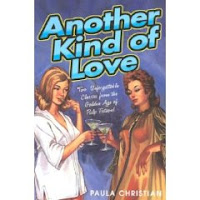
Another Kind of Love, is a collection of two novels by Paula Christian, Another Kind of Love and Love is Where You Find It.

There’s a fair amount of self-loathing and homosexuality bashing in pulp novels because of course being gay is unnatural and a disease. But despite the supposedly “moral” endings of pulp novels, there seemed to be a whole lot of hope for these women. At least one book ended with the girl getting another girl that did not suck at all. Oh, sure, they smile bitterly at one another and guess that they’ll be together for a while, then probably want to kill each other, or worse, share their unnatural lives together forever, but it’s all a matter of perspective. I can see Laura and Madeline growing old, watching the world change around them, until these days when they’re stepping out of their midtown apartment to walk down to a LGBTQ rights rally, holding hands, their gray-haired heads held high.

Paula Christian’s characters are often working women, in a world where it was still a little strange for women have a career. (These two novels were originally published in 1961.) Dee is a photographer, Laura a journalist. They work with men, and sometimes for them, but are not wrapped up in the world of men. Sure, both Dee and Laura have crappy taste in women, at least at first but, duh, who doesn’t? Girlfriends are like tattoos – you almost never like your first one. ^_^ (That doesn’t apply to you, honey.)

The one thing that really, truly impressed me about all of the novels by Christian was her use of “voice.” None of the protagonists sounded like one another from novel to novel, and the characters within any given novel all had unique voices. It’s my single favorite quality in a writer. Her characters have depth; they are not perfect – often they are really annoying, but they are always human and real. Laura is wishy-washy and becomes an alcoholic (but gets herself together before the end.) Dee starts off in an abusive situation, then hurts a nice kid out of self-protection and heads into the next relationship with a sense of futility. All the experiences Christian describes are entirely truthful, even if they are fiction. This is the kind of fiction that authors get letters about that read, “You must have lived through this, because no one who hasn’t could know how it feels.” Even when they haven’t.

Paula Christian is a good writer, and this is a fascinating piece of American lesbian history. If you’re looking for brainless reading that’s actually quite intelligent, this collection is a good choice.

Ratings – Another Kind of Love:

Story – 6
Characters – 7
Yuri – 10
Service (because pulp novels were ostensibly for the underground, the creeps and the like) – 8

Overall – 7

Ratings – Love is Where You Find It:

Story – 6
Characters – 6
Yuri – 10
Service – 7

Overall – 6

“Laura” was the “Natsuki” or “Yuriko” of its time. It seems that every third lesbian pulp protagonist was named Laura or Beth. (Or both, if you’ve read Ann Bannon’s stuff.)


Lesbian Novel: The Spanish Pearl

December 15th, 2007

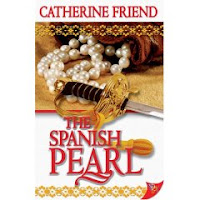
In preparing for my trip to Mexico, I stockpiled a bunch of trashy lesbian novels to take with me. One of the first was The Spanish Pearl by Catherine Friend.

The premise was simple – modern lesbian is transported back in time to 11th century Spain where she falls in love with a man who has a secret. The “secret” was not only obvious – it was stated plainly on the back of the book and in the description on Amazon. The “man” Kate falls in love with is really…gasp! shock!…a woman.

Okay, so I bought the book knowing this and thinking, cool, that would be the first few chapters and then there’d be a story. It was apparent about fifteen seconds after they met that “he” was a she, so I kept waiting for the rest of the story. Only, no, that WAS the story. The whole story. That was it. There was some violence (not enough) and some rape (plenty, thanks) and some internal and external medieval politics (about the right amount) but the main point was Kate figuring out slowly, painfully and awkwardly what any reader knew going into the book.

But you know, that wasn’t really that bad – just sort of “buh?” What was bad was Kate’s insistence on relating to the people around her in 21st century American terms. For instance, in one scene, she berates Louis for killing two men – two men who would have raped Kate, mind you. I would have been kissing Louis and kicking the corpses, but not Kate. She was furious that Louis stooped to violence instead of what – talking their way out of it? If this was day one in the story, I might have accepted it, but it was well into the story. And the reason they were in that situation was also Kate’s fault in the first place after several really bad decisions.

What was also sort of strange was Kate’s obsession about a child she met for less than an hour and her use of that child as an excuse to return to the future. And last, what tanked the book utterly for me was that there’s a sequel. The miserable girlfriend from the future comes back to the past to “rescue” Kate. Thanks. I’ll pass.

For fun, I often read Amazon reviews after I finish a book. To my shock everyone loved this book – they thought it funny and lyrical and a love letter to Spain. No one wrote, “I thought Kate was an ass.” Perhaps I should write a review there, because I totally did think that. ^_^;

On the positive side, Catherine Friend writes well. I don’t think I flinched at any portion of the book (as I did several times during my attempt to read another lesbian novel recently – whole sentences had me cringing. I gave up after the first chapter.) So for that alone, The Spanish Pearl is above average.

Ratings:

Story – 5
Characters – 5
Yuri – 9
Service – not on a bet, but the rape would suffice I imagine – 2

Overall – 5

If you aren’t looking for plot so much as a series of crises set around a relationship, it’s not really that bad a book. And with a blue ocean eating white sand, while you drink a brightly colored drink, you could definitely do worse. But you can also do better.