Archive for the Novel Category


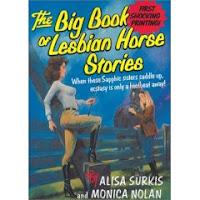
Lesbian Novel: The Big Book of Lesbian Horse Stories

November 30th, 2007

I know I’m not the only person to have marathoned a gazillion pulp novels and thought, “I gotta write me one of those.” But Alisa Surkis and Monica Nolan had an even better idea. They thought “I gotta write me ALL of those.” And so they did.

The Big Book of Lesbian Horse Stories is a completely unsubtle, totally over the top parody of every lesbian pulp plotline ever. From wartime barracks hijinks, to freckle-faced girls on the farm to the sleazy criminal underworld, with side trips into the depression dust bowl, the shtetl of the Lower East Side in New York and a new age womyn’s commune. And horses. Oh yes, every story includes a horse, sometimes under preposterous circumstances. All of the horses are beautiful in a nearly sexual way, except for Herschel the Wonder Horse who was definitely the best – and smartest – character in the book.

If you’re new to lesbian pulp novels, this book might not make a huge impression on you, but after reading some of the best of the breed (Women’s Barracks) and some of the silliest (Intimate Story of a Lesbian) you just know *exactly* what these authors are parodying.

I really can’t express how funny this book is, so I’m not going to try. I’m going to let it speak for itself. Here are a few choice quotes from some of the stories:

“Yes, I can be useful, woman though I am! Even because of the woman I am – a woman not like other women. But how not like other women – what kind of a woman am I? Will I meet other women like me, who can tell me what kind of a woman I am? Or will it be a woman unlike myself, who will show me what kind of woman I can be?”

“The whole car was stuffed so full of their belongings, the clothing, farm-tools and the bits of furniture they’d been able to take from the farm in Oklahoma after the bank foreclosed, that there was hardly any room for Ma, Pa, Uncle Jo-Jo, the five Budd children and Grandma Jennie.”

This story had the added charm of things like, “You won’t really understand dialectic materialism until you’ve heard it explained by Jack Rosenblum, who you may know as Pedro the Singing Bandit.”

And here’s Herschel the Wonder Horse, known as “Johhny Apple”: “…they had been selling fruit outside the yeshiva on 14th Street. Some of the young scholars were arguing over the Talmud, and one of them had quoted a passage incorrectly. He had paid no attention to Johnny Apple’s indignant snorts, and not until an overripe peach knocked his yarmulke off did he realize his error.”

Perhaps these don’t seem funny to you (especially the bits in, say, Yiddish) but I was laughing like a howler monkey. I read these, and many other lines out loud as we sat and stared at the Caribbean eat the spit of sand we were sitting on.

Book funny. Go read. And for heaven’s sake, please don’t take it seriously, like the first reviewer on the Amazon webpage did! It’s BROAD satire. Pun intended.

Ratings:

Overall – perfect beach reading.


Privilege of the Sword Novel

May 19th, 2007

You may recall that, this past February, I had the pleasure of spending the weekend with the folks from Prism Comics at New York Comic Con. One of the many cool people I had a chance to meet that weekend was author Ellen Kushner. I gave her a copy of my novel Shoujoai ni Bouken and, a few days after we spoke, I received a shiny new copy of her novel, Privilege of the Sword. I took it with me to Chicago and conveniently, it fits neatly into this week’s theme. :-)

The story follows a young woman, Katherine, as she is adopted into her uncle, the “Mad Duke”‘s household in place of lengthy and life-crushing lawsuits against her mother, the Duke’s sister. Immediately the Duke has her women’s clothes replaced with men’s and Katherine then begins to train as a swordswoman. But not out of choice. And not without resistance. Of course, she becomes a competent swordswoman…it would hardly be a fun novel if she sucked all the way through. (Although that might have made a funnier novel.) In the meantime, she comes of age in a household that is unusually free of the more typical sexual mores. In fact, the Duke, while bisexual, is well-known to prefer men. During the course of the narrative its implied that, as she comes of age and into herself, she will follow her “mad” uncle’s proclivities. In the end of the novel she’s with a man, but there’s no doubt in one’s mind that her best friend Artemisia would not be kicked out of bed. ^_^

So, what happens? Well, there’s politics and duels, intrigue and training and sex, and love and actresses and stalking and gingerbread. No religion, thank heavens. That would only complicate things. The end of the story is swift and painless, which is good because, given the setup, I was at a loss as to how it was going to end with anyone living happily ever after, much less all of them doing so. But fear not. ^_^

While Katherine may be bisexual, she in no way desires to be male (I’m not implying that these two things are in any way linked – it’s just a weak segue….) In the beginning she is *very* opposed to, and uncomfortable with, dressing as a man. If anything, she’s a pretty typical girl, who wants girl things including dresses and a noble suitor. In the same way, the Duke never wants her to pass as a boy, but quite openly tells people that she is his niece. (Although, exactly why he does this is never explained. By the end of the novel, one can put together some solid theories, but nothing is stated explicitly.) Early on in the story Katherine passes as a boy merely because she is wearing boy’s clothes and the person who mistakes her simply assumes that only a boy would wear those clothes. When the novel concludes, Katherine is apparently comfortable in both worlds, that of men and women, creating a nice balance between gender, sexuality and circumstance. I wouldn’t call this novel a “transgender” novel, but it absolutely does play with gender role and gender identity.

Privilege is part of a series, the whole of which I have not read. But one definitely does not need to have read the earlier novels to understand or enjoy this one. The time and place is a bit random – the clothes appear to be a mixture of French cavalier for the men and Regency for the women. The language too, has a tendency to wander between Regency novel and casual modern speech, with random visits to courtly, musketeer and pompous. But do NOT let this be seen as a detriment to the reader’s enjoyment. Since time and place are the author’s own creation, which shouldn’t the speech patterns be, as well? ^_^ (Towards the beginning, I found one particular exchange a little irritating and then had to laugh, because I remembered that I had done something almost identical in one of my own stories. So I shut up and kept reading. And let me clarify that I strongly dislike Regency novels, so the repartee – which is certainly witty – may appeal to others where it doesn’t to me.)

In her dedications at the end, Ellen says that this novel was written in pieces and, to a certain extent, it feels like it. The beginning is a little scattered, as if the direction of the story was still unclear. By halfway through the book, the characters have significantly solidified and by two thirds through, I found that I was reading much more quickly because I wanted to know what was going to happen!

I almost forgot – here’s today’s question for you. How many of my dear readers wear clothes more commonly associated with the opposite gender? I wear a suit and tie from time to time. ^_^

Ratings:

Story – 6
Characters – 7

Overall – 7

After it was pointed out by Donna, we all agreed that the woman on the cover looks remarkably like Callista Flockhart. ^_^


Lesbian Novel: Himeyuri-tachi no Houkago

April 20th, 2007

This is me reading Himeyuri-tachi no Houkago:

^_^

o_o

o_O

O_O

I had absolutely no expectations of this book when I got it. Never read a single review, never even read the description. I bought it entirely based on the fact that Mori Natsuko is a famous lesbian author and I liked the title. ^_^ I was totally, completely unprepared for the kind of stories the book contains. It turned out to be a collection of “erotic fiction.” In other words, Himeyuri-tachi no Houkago was unremittingly filthy. It was also brilliant. This is *exactly* the kind of thing that makes spending all those hours learning to read Japanese worthwhile. ^_^

All the stories are short tales of emotional S&M and light B&D sometimes in a school setting, other times not. The way each story is constructed lets the reader know that the author is completely aware of how silly each premise is (and they get REALLY silly at times) and that she just doesn’t care, thanks. This is the kind of cheesy titillation that Strawberry Panic attempted, but came nowhere near the level of intelligence and artistry (and wtf-ness) that Mori-sensei attains here.

The first story was mostly a tale of emotional sadism in high school, but that was followed quickly by revenge against a school counselor who calls two girls’ relationship a “pseudo” love. Extra kudos to the protagonist, Miu, who pegs the teacher’s comment as a beard for her own gay leanings.

There’s the story that takes place in the future, when masturbation is an Olympic sport (I’m laughing as I type that, because the story is just…indescribably funny) and the hysterical story about the day when the aliens show up and demand to see a lesbian threesome in order to save the world. ^_^

My favorite story was the penultimate one in which an old-school sukeban gang girl type shows up at a rich girl’s school to challenge “the chief” – only to be tied up and tamed by the Student Council. Oh my god…so brilliant. I read this traveling home on the train – I hope my fellow passengers weren’t too freaked out by my fits of shrieking laughter. The last story is an homage to Mori’s horror roots, with a creepy sisters-by-marriage story with an unpleasantly ambiguous end.

And despite the absurd premises, this book was pretty hot. So bonus points for Mori, because that takes actual skill.

Ratings:

Story – 8 on average, with moments of 12
Characters – 8 on average
Yuri – 127
Service – 10

This book was so “stimulating” that I’ve already come up with two stories in homage to the sheer evil genius here. ^_^ I *must* read more by her…


Lesbian Novel: Red Light

March 4th, 2007

Victoria “Tori” Scotts is a young woman with a lot on her plate. In her third year of college, she is looking for a way to support her family, build a career and have a life with the woman she loves, Kerry. It’s a great deal to balance – especially when no one seems to be all that supportive of her dream to become an EMT.

Tori struggles against the unreasonable expectations of her mother – a woman wounded by love and crushed by circumstance – and the constant comparison with her famous cousin, music star Nina Boyd. When Tori’s lover joins the ranks of those who have betrayed her, she is even more determined than before to carve out a life she wants, in spite of…perhaps because of, the obstacles in her path.

In Red Light by JD Glass, we follow Tori through love, lust and trauma on the streets and in her house, and we watch her come out the other side, a woman who has prevailed against much to become the person she truly wants to be.

There is much to like about Red Light – Tori is a real person, someone a reader can easily picture knowing or meeting somewhere. Young, superficially tough, a little crude, Tori is any typical New York kid trying to find herself in a tough, crude world. Tori’s life is filled with passion for her studies and her works as an EMT. The passages as she is educated in the ways of “New York’s Best” are some of the strongest in the book. Tori’s enthusiasm for the job is magnetic. As we read, we *want* to know how to handle these cases, just as Tori does. And we can sit back satisfied when Tori’s reactions are the right ones, and her skills are up to the task.

Even her weaknesses are real – we can hardly blame Tori for viewing her cousin Nina and her wife Samantha as “perfect,” even though we realize that they simply can’t be. Given her family history, her relationship with Nina and the fact that she has been compared unfavorably to Nina most of her life, it would be simply ridiculous for Tori to not see her that way. When, as Nina puts it, Tori does a “great impression of being an asshole” it’s almost a relief that she *can* fall apart so thoroughly.

Tori’s life is also filled with raw sexuality. At the beginning of the book, there is a strong dichotomy between the Tori who we follow in classes, with her family and friends, and the Tori in bed. These two people seem fundamentally irreconciliable. As Tori grows, the separation between the “real” Tori and Tori in bed becomes almost schizoid, something that is completely consistent with the lovers she takes. As the story progresses the two Toris move towards becoming one, the “real” Tori, the nice kid all grown up, the Tori this reader hoped she could become. Interestingly, as a writer who just about obsesses about “voice,” the quality of making each character sound unique from one another, and unique from the writer, I was amazed to note that as Tori takes new lovers in this book, the voice of the sex also changes. It’s true, its real, but not something I’ve seen very much in lesbian – or any – novels, really.

My *only* real complaint about the book was that the sex occasionally got in the way of the story. I found myself thinking – especially towards the end, “Okay, great, they’re having fun, but can we get back to the story? I want to know what happens!” :-) Also, I should note for those who might care – the sex and the language are quite *blunt* at times. If you prefer your romance and sex girly and mushy, this might be too much for you.

The world of Red Light is not a perfect one, but it is a rather enlightened one. The idea of homophobia exists, but it does not directly touch any of the women in this book. The lesbians are out, and mostly proud, the people around them accepting – even so far as to joke with them in the crudest possible manner without fear of offending. And oh my goodness, what a relief that is! There is no “coming out” angst in this novel, but it’s not a perfect world, as we learn when the subjects of marriage and criminal charges come up. Let’s call it an idyllic setting, if only so Staten Island can, for once in its existence, be called idyllic. ^_^

One last thing of interest – the idea of ethnicity runs through the entire book in a way that I have never, ever before seen. It’s a part of each character, their lives, their names, their thoughts, without bringing a sense of heaviness or cloying baggage with it. Perhaps the author errs on the side of idealism here, but I really enjoyed the various family gatherings that seem so stereotypical, but so typical and real at the same time.

Is Red Light worth reading? Yes, it absolutely is. Whether you’re looking for a sexy book with a plot that holds together, or a good book about a good character, with some romance and passion, then this book will definitely be worth adding to your “to read” pile.

In conclusion, I guess I have to say that Victoria “Tori” Scotts passes my litmus test for any character. I’d be glad to have her over for lunch anytime.


Kamikaze Girls Novel

May 10th, 2006

Oh.My.God.

To say that the novel Kamikaze Girls was sheer brilliance would be a dreadful understatement, but given the limitations of my beloved English, it’s the best I can do. This book is *brilliant*. Like, shiny brilliance. And genius brilliance, and any other possible meaning we can squeeze out of those 10 letters.

The book begins with a long, detailed and shockingly objective discussion of the true heart of the baroque – and of the gothic lolita. It was so good that not only was I hysterical laughing plenty of times, but I’m pretty sure it completely changed my opinion of Goth-Loli forever.

The surreal tale of the meeting of yanki gang girl Ichiko, and hardcore Goth-Loli Momoko is not radically different than the portrayal in the movie, but several of the stranger, sillier touches added in the movie are not in the novel. Once again I am reminded that the correct order for me is to first watch the visual version, movie, TV, anime, what have you, then manga, THEN read the original literature. It means that with every new version you have a richer, more detailed experience with new layers. If I go the other way around…I’ll be unhappy at the things that were cut or changed. (And let me tell you how worried I am, that having read the next few Maria-sama ga Miteru novels means that I won’t enjoy the third season of anime as much.)

I honestly can’t express how good this book is. The translator did such an amazing job, switching back and forth with levels of politeness – not only from character to character, but also just within Momoko’s narration….it was breathtaking.

Also stunningly brilliant was the fact that none of the Japanese puns or concepts were translated – they were explained, or simply left as is, with a Glossary in the back. Perfect! Viz scores a perfect 10 in this.

In fact, the ONLY downside I can think of, is that one very rude word – which is presented as a very rude word – isn’t defined in the glossary and I’d really like to know what it meant. ^_^

Yuri? No. But plenty of shinyuu, right in that space where two women are emotionally, karmically connected and yes, love one another, without being “in love.” In the end, Momoko rides off on the back of Ichiko’s bike, her head against the yanki‘s back, “like a lover’s”. So, okay – maybe not Yuri…yet. ^_^

Ratings:

10

Just read it.