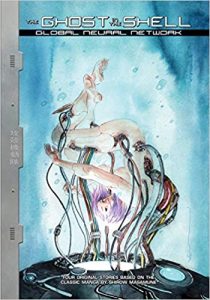
On April 23, 2020, a new iteration of Ghost in the Shell franchise, Ghost in the Shell, SAC_2045, will launch on Netflix. But that is merely a coincidence in regards to this article. I have wanted to do a massive overview of all of the Ghost in the Shell media for years. In fact, I conceived of this idea back in 2008, when I introduced the film Ghost in the Shell: Innocence at the Brooklyn Museum of Art.
Update: I have attempted, and failed in a similar analysis of the manga franchise as of August 2020 in The Future is Always Obsolete: Ghost In the Shell Manga Franchise.
Since we are all home for the duration, I took it upon myself to re-watch all of the Ghost in the Shell visual franchise in the order in which it was created. I chose this path because the nature of the story makes it nearly impossible to create a linear chronology. Instead, what I have found is three separate functional verticals of visual media:
The movies – which are all, ultimately, homage to the first movie. (There are homages to the movies in the TV series as well, but not as concentrated as in the movies.)
The television series Stand-Alone Complex, which is, after watching everything, still the only one I’d recommend to anyone expressing interest in this franchise.
The OVA, then television series, Arise, which significantly rewrites earlier points so is effectively an alternate universe/timeline completely. A 2015 stage play was based on Arise.
Here are my mostly free-form thoughts about the media as I watched it, talked about it on social media and thought out loud about it. I plan on doing a similar overview for all the manga iterations in a second part. This article presumes you have at least a passing familiarity with the Ghost in the Shell franchise; characters plot(s), etc. If you do not, I recommend the Ghost in the Shell Wikipedia entry for background.
So here we go, a Deep Dive into Ghost in the Shell: Visual Media 1995-2020

Ghost in the Shell (1995): Directed by Mamoru Oshii, written by Kazunori Itou. Based on Masamune Shirow’s manga, this movie established almost all the key visual elements of this series which will be replayed and reconfigured over and over and over in every subsequent iteration. It also established the franchise belonging to Oshii as much as it did to Shirow. Shirow’s love of technology and its symbiotic connection with human consciousness is meshed with Oshii’s love of philosophical discourse on the nature of humanity, creating a dialogue that will continue to be replayed for the next 25 years.
That said, this movie is the proto-incel movie of the ages, with a constant stream of women’s naked bodies, often violently dis-articulated, mannequins without agency or will, some faffing about the meaning of “humanity,” detailed backgrounds and cool lead characters doing action-y things. It’s basically unwatchably dull if you try and *watch* it. ^_^
What most fans liked about it are those very key visual elements that will be rehashed endlessly: The opening segment that shows a female cyborg body being built; Kusanagi jumping off the building functionally naked; Sexaroids attacking clients; Kusanagi ripping her arm pulling open a mecha, and, finally, Kusanagi rendered into an inert torso, talking about procreation and immortality with another entity in a disembodied head.
Kusanagi talking with Batou about her existence after scuba diving, becomes an important scene. This scene not only comes back later, it births the kernel of the plot for the 2017 live action movie. The Major muses in the original movie about not knowing if there was a “real” Kusanagi Motoko before her; maybe there was an accident and her personality was stolen. This is one of several possible histories given to Kusanagi through various iterations. Most importantly for this article, it is in this scene that Batou states plainly that the Major’s cyborg body does not legally belong to her and if she retired it would revert to the government. I imagine that we are to assume that should she choose this option, she could have her brain transferred to a civilian model, but it is not made explicit.
Watching this movie now, it becomes clear that a murder mystery, political intrigue and stultifying expressions of selfhood, combined with detailed animation, made a lasting emotional impression on generations of viewers.
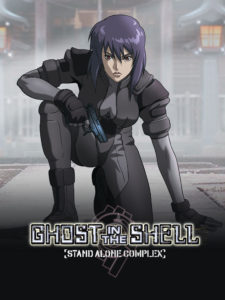 Ghost in the Shell: Standalone Complex, First Gig (2002-2003): Directed and Written by Kamiyama Kenji.
For this first time away from Oshii’s shadow, the characters feel more like the characters from the original manga, with in-jokes, personal lives, senses of humor. That they busted each other was part of what we love about the original manga. There was very little humor in the movie. Here, everyone teases Batou, even the Tachikoma.
The plot is pleasantly outside the same old set up of the original’s obsession with self. A little less fetishizing of the female body, but not much. There’s more time to make the characters feel human, and to deal with the life parts of their lives.
The Tachikoma lighten the mood – then darken it. They get the “am I real” conversations and their evolution from machines to “people” in real time is devastating. It’s like watching pets age from babies to dying of old age in 26 episodes.
The story is good, and for the first time, the story and the technology appear to be linked inextricably, instead of the plot being a murder mystery with technology.
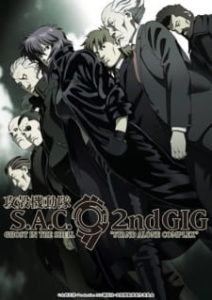 Ghost in the Shell: Standalone Complex, 2nd Gig (2004-2005): Directed and written by Kamiyama Kenji.
I remembered 2nd Gig as being my favorite, but now that I have re-watched it, I remember why. Everyone has personality; the Major has some backstory, Paz, Bohma and Saito actually get lines*, the Tachikoma are the humanest of them all. All the “what does it meant to be a human?” is actually tied into a plot and not just random waste-of-animation musing, like it will be/was in Innocence.
This series is the closest to an ensemble cast we’ve seen up to this point. The story is convoluted and shows signs of using random quotes from obscure authors as a plot point, a McGuffin and pointless waste of time all at once…. a narrative element that stuffs Innocence to impossible density. This series proposes another possible history for Kusanagi’s backstory.
Because Kuze exhorts Kusanagi to leave her physical body due to it’s limitations – one of which is that it does not belong to her – I feel that this is the closest thing to a lead-in Innocence has. Perhaps Kuze’s appeal in SAC:2nd Gig resonates with Kusanagi in a way that the Puppet Master’s did not because she feels an affinity for Kuze, which we’ll touch on later when we talk about her history
Animation is generally good in SAC, backgrounds don’t get that crazy detail they get in the movies, but the people fare better overall.
If anyone is asking me, at this point, Stand Alone Complex is by far and away the best iteration. It has enough of the things you vaguely remember from the movie, and enough of the best bits of the manga characters that it’s approachable and fun and *human*. This series ends where the manga begins, which is another nice tie-in.
I enjoy the music from this series the most, as well. Both OPs are excellent and are the only music from this series I have in my collection.
*Imagine being cast as Paz and telling your mother. “Hey Mom! I got cast in one of the most famous series in the world! No, no lines but sometimes I get to say “Roger.”
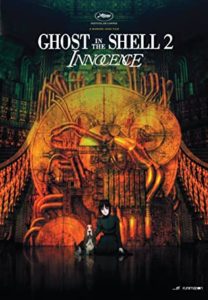 Ghost in the Shell 2: Innocence, (2004) Directed and written by Mamoru Oshii. I absolutely love this movie, but am well aware that it is densely packed with obscure references rather than having a plot, and, while extremely beautiful, not really a “fun” movie at all. The title is slightly confusing, too, as Ghost in the Shell 2.0 was the 2008 remake.
Innocence: Look at this multi-million dollar animated scene of a detailed Gothic structure at ridiculously high resolution and detail!
Also Innocence: Let’s use our massive animation budget to show the same scene of two guys not moving…three times.
There is a nod in the opening to being chronologically after SAC 2nd Gig, but not specifically in the same timeline. Innocence still insists that the Major did not own her body; this was part of the drive for the Major to upload herself into the net, before Innocence begins.
Innocence is a series of visual callbacks to the original movie, and is almost wholly divorced from the manga. Indeed, it is wholly divorced from Kusanagi at all. So, while the usual visual relics aren’t in this movie, we get a lot of the background events reworked. The floats parading through the streets is breathtakingly beautiful…and the music throughout is obviously a nod to the original movie. At hi-res, the CGI in Innocence is outstanding. The animation is almost uncanny valley in places. I probably watched this movie on my home screen in higher resolution than I saw it in the theater the first time. ^_^ This deserves the highest resolution possible, just to take in the excruciating visual detail.
The bulk of the series is a giant game of “guess the reference.” Quotes and visual cues clog up the dialog to the point of making it all but impossible to follow the story. The joke I always share is that when I saw this movie in the theater, when I watched the credits I shouted “Bellmer!” (because, although I recognized the gynoids instantly, I could not remember his name,) and woke all the people around me up. ^_^
Hans Bellmer’s designs for the gynoids befuddled me, but then…I’d forgotten Japanese jointed dolls, which they kind of, sort of resemble. Not *so* odd, I guess. But still unappealing from my perspective. Bellmer was a misogynist fuckhead among other sexual dysfunctions. The idea of using his not-even-slightly-idealized female forms for sexaroids is strange, but in a sense I think it’s another version of the grotesquery/female torso obsession Oshii plays with in his iterations of this franchise.
There’s a hint of grappling with mortality and morality but in the end, the Major – who is never really there at all – is the one who makes the point. And Batou fails to be a good person, which is a shame, but is a shout out to the manga.
As a coda, 2501 seems the *least* secure code you could pick, Batou. /facepalm/
 Ghost in the Shell Stand Alone Complex Solid State Society (2006) Directed by Kamiyama Kenji, written by Kamiyama Kenji, Suga Shotaro, Sakurai Yoshiki. As far as I know, this was my first time watching this iteration, but it seemed very familiar. Not sure if that’s because it’s basically the same kind of thing, I had seen it before, or something else.
I initially placed it between SAC 2nd Gig and Innocence, but it could just have easily come after Innocence, if Batou had managed to make it through his mid-career crisis. In any case this was another very-good ensemble piece – maybe the best for all the Section 9 characters overall, with more lines for everyone.
Amazing animation at the beginning, it settles down, but is generally very good.
I really liked that we finally see the Major using her consciousness in multiple different bodies. That’s a feature of the manga I really liked and felt that it would have been awesome – and sensible- in an anime, but was rarely used.
The music being so different from the rest of the series sets it apart in a kind of a pocket universe in which the Puppeteer makes a comeback. This was more of an OVA for the SAC series than a “movie”. Kamiyama Kenji gets my vote for writing any further Ghost in the Shell content. He really *gets* the things that can make this an interesting setup, then uses them and doesn’t get bogged down too much in philosophical discourse.
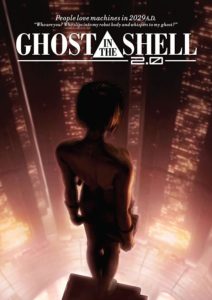
Ghost in the Shell 2.0 (2008): This remake of the 1995 movie is the same, with a few small changes. CGI is inserted in key scenes, including the opening, and much of the mecha is rendered in CGI. I remember clearly that this spliced nicely into the “get your CGI out of my anime!” wars. ^_^
There is, however, one important change.
In the final scene of the original movie, the Puppet Master is voiced by a man. In Japanese, the role was played by Kayumi Iemasa, and in English it was Tom Wyner. In 2.0, while in English the same audio track was used, in Japanese, the Puppet Master was now voiced by Sakakibara Yoshiko. Giving a woman’s voice to a non corporeal entity obsessing about procreation and immortality radically altered the feel of the scene.
In both iterations of this movie, the backgrounds are detailed and painstakingly animated. It’s easy to see why the movie was hailed as a masterwork of its time. But time moves on and here, it all looks a little worn.
 Ghost in the Shell: Arise (2015 – 2016) Directed by Kise Kazuchika, Written by Ubukata Tow. Arise is annoying. There I said it. Not only does it retcon what little we know about the major, but every single voice is different. Feels like an AU, rather than canon, which is a weird choice for a 20th anniversary.
But, let’s talk about that retcon: How many times has it been mentioned that the Major’s body is not her own? Well, now it is. And it is, before Section 9 is formed, so all those meaningful conversations about her existence and her body are all now moot. What a strange choice, to overwrite a core concept that is one of the few enduring “facts” we have.
Also, if the Major’s body is cyborg, why does she wear underwear? She doesn’t need anything to catch bodily fluids, or stop chafing or provide support or anything people wear underwear for. Creepy, boring fetishes are creepy and boring. (see: Sex and Sexuality).
Oh wow, Kusanagi’s mentor is the bad guy. I was so surprised. That wasn’t completely predictable from the first second we saw her in her low-cut uniform blouse and non-regulation hair.
The story doesn’t make a lot of sense within itself. As a kind of alternate universe fanfic of how the Major’s group was formed, it’s a lot of glitz, without the kind of storytelling I look for in Ghost in the Shell…like someone who sort of got it did the writing…and in, fact, felt like Ubukata Tow through and through. Using different voices for everyone definitely made it feel even more AU. This series is the weakest link in the franchise in every way. Character designs are uninspired, and the fact that it borrows so much from the original movie feels less like an homage here than a lack of originality. Before the original movie, all of it had already happened? Okay.
攻殻機動隊ARISE:GHOST is ALIVE Stage Play (2015): This is a stage version of Arise. I did not expect the dancing. In retrospect I should have.
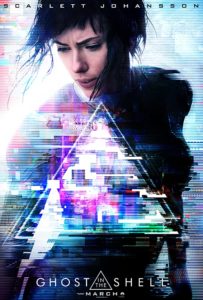 Ghost in the Shell (2017): Directed by Rupert Sanders, written by Jamie Moss, William Wheeler, Ehren Kruger. The main problem with the live-action Ghost in the Shell is not that it’s “bad,” its that it is a pretty fair retelling of the first movie with a made-by-Hollywood plot inserted and Hollywood whitewashing, which made Oshii and Shirow happy, but pissed off everyone else.
Let’s set aside the choice of actress for just a moment. That’s a main point, but IF the live-action had been a perfect retelling of the original, with a Japanese actress, people would still have not liked it, because it was *never* the story (which was barely there in the original) that people remembered. It was the emotional impact…and a series that is 20+ years old, that has used those same visual references over and over, cannot ever recapture that initial emotional impact.
Most of the visuals are homage to the original movie: Idealized “build a body” and same not-quite nudity. Similar music, heavy drums, women singing. False memories. Boat scene. Arm rip. Togusa’s got bad hair. Batou’s got dogs. Optical camo was handled well. The jump, murderous servobots, scene in her room by a window, garbage guys…all homage. The end theme is literally the opening of the original. Laying next to puppeteer/Kuze, air strike…it’s all there. And despite that, the problem is not that this movie lacked nuance – it actually added in nuance. It gave the Major a definitive backstory. Oulete is not Haraway, she actually cares. Major finds out who she was and gets an actual history.
There were some changes of course. “Major” is treated like a name, not a rank. She’s given a new name, Mira Killian and Section 9 isn’t a government department, she’s a corporate tool for an evil corporation. Those are changes that did need to be made for the actress to work. Overall they actually wrote a halfway decent story with some extremely stupid points. For instance, how did I forget that “Initiate the hack.” is a line in this movie? It’s so memorable. Also, “I’m trying, but she’s being hacked!” Scenes from the original are taken out of the context of the original, so the garbage guys scene isn’t as full of pathos. As the garbage guy is screaming “2571!,” not 2501, all I could think was now Batou can get a new code for his front door. (Haha GitS continuity jokes.)
Of all the visuals that were supposed to feel futuristic, the one that totally didn’t work were the giant floating faces all over the city as adverts. None of them had logos. What were they for? We’ll never know. That’s not how advertising works.
So, now, we can talk about the actress. Scarlet Johansson is not, IMHO, a good actress. She is bland looking and an indifferent actress. Her primary appeal is to be blandly attractive so an assumed-male audience can not care about the female characters she plays while they stay sexually attracted to her. To Shirow and Oshii, getting a top-name Hollywood actress to play “Major” would have been a triumph. HOLLYWOOD! ScarJo! It’s just that we all thought it was a terrible idea. So instead of writing a story about Kusanagi Motoko, they wrote a story around “why this Japanese character is white now” which was a less-optimal, more-insulting use of the audience’s time.
To make this movie excellent all they needed to do was bring back her manga-version body hopping and hire non-white actresses to play her, too. If there had been a single scene in which she networked with several other iterations of herself – played, ideally, by top name actresses from other parts of the world – they would have created a way to make their use of Johansson less annoying, while nodding to the original manga. To make it brilliant it needed very few changes: One scene, with Major interfacing with these other selves. Especially if they played up the idea that she’s a networked entity, that’s all it might have taken. But…they didn’t and it left fans of the franchise thinking they Hollywood is a bunch of imaginationless twits.
Oh well.
Possible histories for Kusanagi
Through the series, we’ve been given several alternate stories for Major Kusanagi Motoko.
Movie: She has no idea if she was ever a person. Maybe there was an accident and her personality was stolen. Batou and Kusanagi talk about how her body belongs to the government
SAC 2nd: She was cyborgized very young, and it’s implied that if she and Kuze are not the actual boy and girl in the story told to her by the curiosity shop owner, their individual stories are similar. Hence her sympathy and affinity for Kuze at the end of 2nd Gig in a way that the Puppet Master never evinced.
Arise: Retcons the first movie, when she wins ownership of her body and a trust fund to pay for it before her team is official. Furthermore, in Arise, we’re told she was cyborgized young, and raised by a scientist, but that history is erased as the series goes on, so in the end, we still don’t know what her history is.
Live-Action movie: Takes that throwaway line about an accident from the first movie and builds a history around it. She was Kusanagi Motoko, her death was pointless. Hanka robotics takes the brain, puts it into a fully cyborg body and trains it to be an enforcer.
And this doesn’t even touch on the body of manga, so expect a few more backstories there.
Sex and Sexuality
Kusanagi’s “sexiness” is a constant in the franchise, but it’s realized differently by different directors. Shirow and Kamiyama have an ass fetish, Kise liked tits, Oshii likes torsos without limbs, all of them like female bodies fakely naked or clothed in underwear. We know this because they did this over and over. And over. Every director’s specific fetish is just as obvious as all the others’. Isn’t that tiresome?
Kusanagi’s clothes are horrible, fetishy weird things throughout. The designers ought to be scolded. They make me chafe looking at them. Body suits suck. Flesh-toned bodysuits are ridiculous. If she’s a cyborg she won’t care that she’s naked. None of her clothes make any sense beyond the titillation of people with limited sexual imagination.
But what is interesting is that just as surely as she is “sexy,”, we learn her sexuality – if that’s even applicable in a networked cyborg. Although she is always shown as female – and she and Batou discuss that in SAC – what does sexuality even mean when gender and sex can be as fluid as the buyer wishes? So I’m choosing to call it pansexuality, rather than bisexuality because we never really know anything about her or her partners ultimately. Shirow has her as a pansexual. Kenji Kamiyama keeps that in SAC. And once again in the live action, we get a brief glimpse (although weirdly that’s been cut for the Amazon Prime release?) of the same.
Final Random Thoughts
Let’s just take a second and talk about a couple of those emotionally impactful scenes that we’ve all come to know and expect. Some of them make no sense. ^_^
We know Kusanagi’s extremely heavy cyborg body can be damaged, so in what universe does it make sense for her to leap off a building? She’s not flying, she’s falling. She’s hurtling herself downwards like a boulder. Her body and the building she crashes in to should be wreckage.
But the one thing I want to rant about is the, IMHO, extremely bizarre scene in every iteration where Kusanagi rips her arm opening a mecha’s access port. Isn’t it obvious that she’d ask to have that arm significantly reinforced after the first time? I just cannot with that scene.
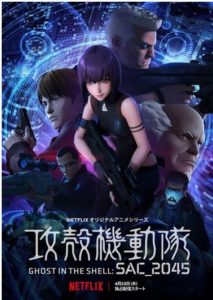
Ghost in the Shell: SAC_2045 So here we are in 2020, waiting for a new series. Which Kusanagi Motoko will we get?
The good news is that the news series is once again directed by Kamiyama Kenji and Aramaki Shinji.
Which is why I predict that SAC_2045 will be to SAC what the movies all are to the original – an homage, using something similar to SAC 2nd Gig‘s plot done with CGI…because technology changes more than story in the technological world of Ghost in the Shell.
But, with Kamiyama at the helm, I’m hoping we’ll get a new story, something that will make us all love Section 9 all over again.

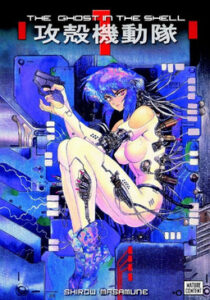 I was going to do a deep dive, as I said, but almost immediately, it was obviously impossible. Despite the pretension to profundity, there is very little depth to any of the manga, as both plot and protagonist are forced to do spins and turns so we can see the sexy parts, without the qualities of a person – or narrative – that might make those parts sexy.
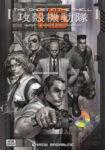 Overall, Shirow’s manga is a technical manual of Shirow’s internal world-building told while flashing us with a constant ass-crotch-tits sequence. It’s like trying to learn the quadratic equation with someone waving a porn magazine in your face. You can’t concentrate on either properly. The audience for all this was, clearly, people who were enamored with Shirow’s world-building and had little to no chance for sex and were therefore satisfied by the constant disruption of “Network” world-building to enable multiple angle panty shots.
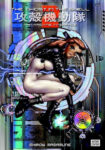 Tezuka sometimes popped little SD characters up of himself to make comments in his manga – it worked for him, not so much for Shirow who, we are frequently told is a great artist, who should not do manga. I posit that he is neither a great artist (although he is a competent draftsman) nor a good story teller, but is instead merely an “idea guy” so enamored of his ideas, that he can’t stop getting in the way of the story to tell you about them.
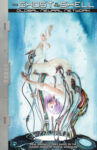 The future in Ghost in the Shell is already obsolete. Cyborg body parts exist, and they get decked out with paint and stickers, our rainy neon-lit city streets are dystopian in multiple ways and also horrifically banal. We put on masks to block out a pandemic and facial recognition as we head out to get our fast food takeout and we’re bluetoothed into our podcasts, not wired through ports in our necks. Shirow’s network teeters precariously between being a religious philosophy and a technological phenomenon. The only thing he got right is the proliferation of dangerously absurd conspiracy theories.