Archive for the Series Category


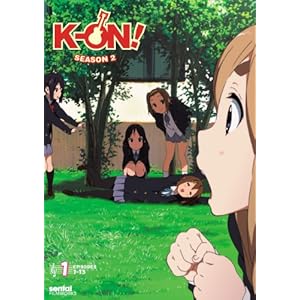
K-ON Anime, Season 2, Disk 1 (English)

August 15th, 2012

Season 2 of the K-ON! anime is, well, pretty much exactly the same kind of thing as Season 1 was, so if Season 1 didn’t appeal to you, then probably this season isn’t going to either. ^_^

Season 2 has exactly the kind of thing *I* liked about Season 1, so for me, this is total win.

The two things I liked best on this disk have nothing whatsoever to do with Yuri or music. For me, what makes K-On! work is the interplay between the four leads. More than any other series, this one strikes me as one written by someone who actually knew something about real girls. (As say, compared with Yuru Yuri, which reads like a guess as to sort-of what girls are, maybe, like, when they hang out.)

There are two scenes that strongly affected me in this way. The first, when the four are sharing a room for their school trip and making each other giggle by saying stupid things. Yep, we did that. Heck we *still* do that. My Mom once yelled at me when staying over my house for the holidays that my wife and I needed to stop giggling, it was keeping her up.)

The second is a scene so meaningless, so…normal…that it took my breath away. When they are all shopping at the home goods store and Yui comes running over to exclaim “Screws!” then dances in hyperactive delight at all the shapes and sizes of screw…yep, we do that too. ^_^

The palpable lack of Yuri is a plus, as well. When Yui hangs on Mugi there is no fanservice, overt or implied. This is how it should be. This is in fact, how it is.

K-ON! s that most rare of creatures – a moe 4-koma gag story about girls hanging out that gets it exactly right.

Ratings:

Art – 5
Story – 8
Characters – 9
Yuri – 1
Service – 4

Overall – 8

Once again it is my great pleasure to thank Okazu Superhero Eric P. for his sponsorship of today’s review!


Hayate x Blade Manga, Volume 16 (はやてxブレード)

August 13th, 2012

A new school term has begun and things are changing at Tenchi Gakuen as Hayate x Blade, Volume 16 (はやてxブレード) opens.

Superficially, the uniforms are different, and the rules of the Hoshitori are going to change. New students have arrived and new pair of shinyuu are arrayed for combat. Even the Student Council is different, as members who were seen as unmovable have fallen from the S-rank. Ayana and Jun have moved up into the high school at Tenchi, and Hayate and Momoka and their friends are now no longer first-years. Everyone is on pins and needles waiting for that first Hoshitori bell, signalling the new era.

In the middle of the chaos, we turn towards Momoka. Hayate’s stalwart friend and supporter, whose trials and travails in finding and keeping a partner, some of the very first arcs we were able to enjoy in English, is once again center stage. In a cast as big as this manga now has, it’s refreshing and nostalgic to remember where we started. Hayate relies on Momoka, as does Isuzu, her adoring and adorable partner. But who can Momoka rely on? Ultimately, her desire to be reliable undermines her confidence every time, and once again, she has to face the toughest enemy she has…herself.

She has seen Hayate, someone who is appreciably smaller and stupider than herself, rise through the ranks. Hayate and Ayana are poised on the brink of Special A-rank, with only Yukari and Maki in their way.

Let me digress for a moment here – in any other series, the battle with Maki and Yukari would have been epic. Yukari and Ayana, former shinyuu, with years of hard feelings and miscommunication between them…youch. But, you know…that’s all unimportant now. Ayana purged her demons when she fought Ensuu and Meiko. And Yukari purged hers *before* she and Maki did the same. They have nothing between them now – nothing except the desire to face one another and see who wins. This fight, when it comes, will be several steps beyond epic. Maki vs Ayana, Yukari vs Hayate. Think about it. It’s going to be nuts.

But back on planet Earth with the rest of the mortals, there’s Momoka, staring at Hayate who works too hard, plays too hard, eats too freaking much, sleeps like the dead and starts all over again at the beginning. Every day. Momoka knows she’s outclassed by Hayate, but can’t figure out why. And that pisses her off. She can see Hayate only has the settings 0 and 10. Why can’t she get to her 10? The only way she’s ever going to know is when she stands toe-to-toe with Hayate. And Isuzu, ever by her side, agrees to take on this suicidal task.

Ayana and Hayate vs Isuzu and Momoka. In a straight up, full-out, no tricks, no goofball moves, honest to goodness Hoshitori battle.

What’s lies beyond epic? This.

Ratings:

Art – 9
Story – 10
Characters – 10
Yuri – 1
Service – 1

Overall – 10

What a fucking fabulous series this is.


Light Novel: Miniskirt Space Pirates, Volume 1 (ミニスカ宇宙海賊(パイレーツ))

August 8th, 2012

When I was in Tokyo last December, I found, picked up and put down the same one novel over and over. I’d see the cover and think “Oooh!” pick it up, see that the title was Miniskirt Space Pirates and put it down again. I must have done that half a dozen times.  Well, I sure felt like I had dropped the ball on that when I started to watch the Bodacious Space Pirates anime. ^_^;; So, later that winter I added the first volume of  Sasamoto Yuuichi’s novel series, Miniskirt Space Pirates (ミニスカ宇宙海賊(パイレーツ) to my Amazon JP order.

It’s taken me a few months to get through this book, but right off the top, I have to say that it was totally worth it. I am glad I had seen the anime first, because a great deal of the kanji in this novel is above my reading level. Having context for what was going on meant that I missed less than if I had been reading this cold.

The story is pretty much the same as it is in the anime. The first novel is covered by the first 5 episodes of the anime and there is strikingly little changed or cut out. I expected long, lingering obsessive descriptions of ships or technology (as one gets in military and gun-fetish manga and novels) but…no. This is classic Space Opera – the technology takes second place to the people. The only semi-major fact that was changed for the anime (and I have no idea at all why it was…) is that Marika’s mother, Ririka, in the anime was a Bentenmaru crew member who was nicknamed Blaster Ririka. In the novel she was a captain in her own right and was known as Captain Ririka (a name she puts quickly aside when it’s brought up in the story.) The scene where she teaches Marika how to shoot in a combat situation actually is a rather touching mother-daughter bonding moment. ^_^

Other than that, I felt no major changes were made. Which was all to the good. One of the key things I liked about the anime was that the girls of the Hakuoh Jogakuin yacht club were left to find their way through various situations on their own. Neither Misa nor Kane, Bentenmaru crewmembers acting as faculty advisors, stepped in as the Odette was being tracked or hacked into. Jenny, Lynn, Chiaki, Marika and the members of the yacht club are allowed to make their own choices. They are given the opportunity to be as brave and competent as they can be  – and they rise to the challenge.

As usual when I complete a novel, my wife asked me “Did you like it?” Unreservedly, the answer this time is…yes. I will have to up my reading game for the next one.

Ratings:

Overall – 8

I have one small complaint. It comes at the very end of the book when Marika’s captain’s costume is described. We are told that Marika’s costume include a miniskirt for ease of movement. Dear men – miniskirts are not easier to move in. They are considerably *less* easy to move in than longer, looser and more flowy skirts or pants. Please stop using that as a reason to put the girl in a miniskirt, it just makes you look pervy *and* dumb.

Oh…the title? Editors decided to name the series that. So…yeah.


Yuri Manga: Sailor Moon, Volume 6, (English)

July 13th, 2012

You may have noticed that, although Sailor Moon has been out in English for some time, I have not yet written a review of it here. There was no ulterior motive, it’s merely because the first 5 volumes in this edition have no Yuri. It’s not until we reach Sailor Moon, Volume 6, that we’re turning our sights here on Okazu towards it. This is the beginning of what is referred to by fans of the series as the ‘S’ arc – a phrase that comes from the third season of the anime, Sailor Moon Super, or Sailor Moon S. (Those of you familiar with the series knew that, but there may be readers who have never read the manga or watched the anime before – after all, the series is 20 years old. That explanation was for them. ^_^)

Usagi is about to have a moment of unadulterated happiness with Mamoru when they are interrupted. Usagi feels as if, whenever they get a moment of complete quiet for themselves, it’s doomed to be brief. And she is completely correct, as a new enemy appears. With shared dreams and visions of destruction…and vague words about the “Talismans”, the Senshi are once again called upon to protect the Earth, this time from a group with  the ominous name Death Busters.

It’s very hard to read this volume of manga and not flip back and forth in my head to the anime. Eudial’s appearance made me laugh out loud…but there’s no reason why that should be, she’s merely another bad guy to be defeated here. Nonetheless, when she showed up, I immediately flipped over to the Eudial of the anime, who was one of the greatest bad guys in the history of anime, with her terrible driving, her migraines and the best Monster of the Day ever, Doorknobder. (Go ahead, let’s say it and get it out of our systems, shall we? “Doorknobder Desperate Attack!” Okay, there, we can move on now…)

But this is not the anime. The tension is deeper, the bad guys are far more ominous and the good guys are, as well. When Haruka and Michiru arrive, it is impossible for us or the Senshi to know if they are friends or enemies. And they appear, perhaps, to be playing a third side. Haruka gets close to Usagi and Michiru seems to have her eyes on Mamoru, but in their private time they seem to be a couple. Who are they? What do they want? Whatever it is, they know a lot more about the situation (we think), as they carry two of the Talismans.

Haruka is first presented as a guy, but when she’s seen in women’s clothes, then later as a Senshi, she’s understood to be a woman. Usagi will ask her which she is and unhelpfully, she will respond with a question, “Does it matter?” It doesn’t really, but it does matter that Haruka and Michiru are older, sexily hyper-competent and don’t know as much as they think they do about what’s going on.

Artemis and Luna offer useless information (as they always do) about the mysterious new Senshi that have appeared. (I am, and always have been convinced that the only one of the Senshi team with any brain cells to rub together is Diana.)

And what is the role played by the sickly girl, Hotaru?

We don’t really know by the end of this volume. Which means we want to get the next volume. ^_^

Ratings:

Art – 7
Story – 7
Characters – 8
Yuri – 8
Loser FanErica – 127

Overall – 7

I am reminded that the origin of the Yuri helicopters was Sailor Moon. (I should have remembered that Strawberry Panic! had no original elements of its own.)  Phew!


It’s A Woman’s World: Bodacious Space Pirates, Maria-sama ga Miteru and The Bechdel-Wallace Test

July 10th, 2012

Bodacious Space Pirates came to an end and I thought it delightful in every possible way. As I (over)thought how I’d approach a final season review, I started to think about the qualities that made the series stand out for me – and what, specifically, that meant in terms of storytelling. And, ultimately, I started thinking about how the series portrayed women.

Courtney Duckworth on Broad Recognition has a really excellent review of Pixar’s Brave, in which she discusses something that any woman in the corporate world knows…to be a successful woman, you have to be a man. I remember a conversation I had with a young executive who was being groomed for a CEO position in the company I worked for at the time. He was having a little crisis because, in order to be the man they wanted him to be, he had to give up his family life. It was expected, respected and demanded that he not be there to see his kids play in their first ball game, not attend recitals, because his company needed him. I watched him as he talked his way through this, as he justified letting his family drop off in importance and the company become the thing he would care about. In the end, he became a very successful CEO, and I remember this conversation as the saddest one I have ever had with another human being. For women, who are presumed to be primary caregivers, the stress of letting go of family in order to be successful as a CEO is almost insurmountable. Let someone else raise your kids? (Doesn’t matter if it’s your husband…it’s NOT YOU.) You’re heartless. Focused and driven? You’re a bitch. Want to take time off to see your kid’s recital? You’re not dedicated. There is no way to win, because you are not a man with a wife who will watch the kids in the background.

Merida, like Ermina (Paros no Ken), Safire (Princess Knight) and Lady Oscar (Rose of Versailles), excels at men’s skills, in a world that pretty much has one path to excellence – being as brave and competent as a man.

Let’s stop here and take a look at the Bechdel_Wallace Test for a second. As a reminder, the test goes like this.

1. [The media in question] has to have at least two [named] women in it.
2. Who talk to each other
3. About something besides a man

In a recent email exchange with Alison Bechdel, she and I discussed the idea of “would Mo watch it?” as an unwritten, extra factor to measure if a media property follows the letter, but not the spirit of the Test (that is, it fits the criteria strictly, but it’s still not the kind of thing that Mo is looking for in entertainment). ^_^

So what does this have to do with Bodacious Space Pirates and Maria-sama ga Miteru? Everything.

Let’s start with Maria-sama ga Miteru. In the rarified and protected world of Lillian Girls’ School there are no “men’s jobs.” The leaders of the student body are women, the Principal and many of the teachers are women. The presumption with which the entire series is presented to us is that Youko or Sachiko or any of the other members of the Student Council  will move into positions with decision-making power when they graduate – if not effortlessly, then they will certainly be capable of standing up for themselves, because they have been trained to be leaders. No one ever comments that they are as good as men, or that they run the student body with masculine focus. Lillian is a woman’s world and within it, women do jobs women can do, if they are give the opportunity to do them. (This is something that research bears out – given equal opportunity to excel, women will excel equally.)

In Bodacious Space Pirates, Marika is going to school in a woman’s world, but she isn’t thinking about it that way, any more than Yumi was. It’s just…school. Then something changes and Marika is indeed sent into a world that is traditionally inhabited by men – piracy. And here, at last, we get to the point. It’s true that Marika faces some trials based on the fact that she’s y’know, a high school girl, but her gender alone is less of a problem than one might have expected in a series like this. Being a woman doing “man’s work” is pretty much never an issue, except in one or two totally valid scenes. (Two young women trawling the back alleys of a pirate hangout is a completely reasonable use of that kind of tension.)

Both these series star female characters in a relatively female-heavy cast, and so they both fly through the letter of the Bechdel-Wallace Test easily. But…there’s more to them. In neither series is there a focus on turning a sexualized male gaze on the characters. It really doesn’t matter how “strong” a female character is – when we are forced to stare continually at their crotch or chest, there’s a different story being told – “Yes, she could kick your ass, but it’s okay, you could still have sex on her, so you’re still superior to her..”

Let’s think, for a second about the inevitable “beach episode” in Bodacious Space Pirates. In any other series, if I ask you, “What was the beach episode about?” the only real answer you’d have is “It was about reducing the female characters to a series of sexualized visual images.” Now think about the beach episode of BSP. What was it about? The plot was the trial run for the dinghy race, but it was *about* Ai-chan. In any other series, would there have been an entire episode about a relatively unimportant character like Ai-chan? Would there have been a follow-up episode about her? Would she have been developed as more than a name at all?  There was no attempt to turn Marika or any of the characters into a pair of jiggling boobs.  Yes, we absolutely saw the female characters in bathing suits…but we also saw Kane in a bathing suit. He was not ripped, but he was fit. We saw his ass as many times as we saw the girls’. I don’t care about *either* the girls or Kane in a bathing suit, but the service was pleasantly even-handed and blessedly low-key. It would have been hideously easy (and hideous) to simply stare up the Yacht Club members’ skirts all the time, as anime as a genre slides into a low place in which a majority of viewers seem content to huddle – but that does not happen here.

Both these series have female-heavy casts, but not female-exclusive casts. These are not reverse harems, not reverse shounen series. There are brothers, fathers, uncles, male teachers, colleagues and crew in these worlds, just as there are in the real world. A woman’s world in these series does not mean “the exclusion of all men,” as it might in a male gaze fantasy like Strawberry Panic!  These women have society, which is, in my reading of it, the meaning of the third and final criteria of the Bechdel-Wallace Test.

Maria-sama ga Miteru and Bodacious Space Pirates are about strong women as *I* understand the concept. Women who are perfectly capable living in a world populated by men and women; women who can take command of both men and women and be respected as leaders – and who are not judged by a set of standards that are skewed so they can only ever fail. Women who can find their own solutions to issues, not to have to excel at men’s thinking or men’s skills to be considered a success.

In these series, women are shown as being as brave and competent…as a woman.

Would Mo watch these? I think she might.