Archive for the Series Category


Ribon no Kishi The Musical (リボンの騎士 ザ・ミュージカル)

November 9th, 2011

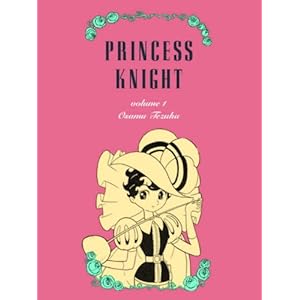
Since Princess Knight, recently released by Vertical Publishing (Volume 1 and Volume 2)  is moving ever closer to the top of my to-read and review pile, I thought it might be nice to finally watch all of Ribon no Kishi The Musical (リボンの騎士 ザ・ミュージカル)

This production is Takarazuka-esque, but in fact was not a Takarazuka production. Instead it starred members of pop idol groups Morning Musume and v-u-den. The three-disk edition I have included multiple versions of the same musical, with different lead actresses and casts. As I am not the audience for which this was intended, and indeed know next to nothing about Morning Musume except that, when I saw them 5 times on TV on New Tear’s Eve, the 14 of them, dressed in kimono and geta, were barely able to jump rope 40 times in unison.

It has been years since I last read Ribon no Kishi (Knight of the Ribbon). I have the three-volume set put out in 1974, based on the redrawn Nakayoshi magazine release of the story. My memory of it is relatively clear and the story in the musical, although rewritten in places and full of random musical numbers, was relatively simple to follow. With the exception of the many month interval between me watching Volume 1 and Volume 2, and so I was quite confused by the jailers little song and dance number at the beginning of Volume 2. I got over that, though.

I chose, with completely randomness, the Takahashi Ai version, but there were at least two other cast versions on these disks. Again, I’m not a MM fan, so seeing specific members was low priority, but even I know Ogawa Makoto, so it was kind of nice to see her on stage. (I believe I know her from her participation on Kunoichi, so nothing to do with her time with MM.) I knew people who cared more than I did would insist I be precise here and they have, yay fandom – the main character that changes cast member is Ferdinand.

Okay, so, Takahashi Ai did a really good job at playing Safire, I thought. Even when the camera or spotlight wasn’t on her, she gave it her all. And I liked her costuming quite a bit. The evil duke wasn’t all that ominous and there were some backup singers and dancers that weren’t helping. In general the singing was…okay. Lots of only partially hit notes, but the group pieces were mostly all very fluid and nice. Not her fault, but the costume on Prince Ferdinand did not work. It was pink and frilly and had the opposite effect of making Ferdinand boyish.

I’m never going to love musical theater, no matter how many Takarazuka tapes (or related all-female musical theater troupes) I watch, but compared with, say, The Scarlet Pimpernel, I thought Ribon no Kishi The Musical was enjoyable. Perfect Sunday afternoon background noise while I worked. I’d look up and there’d be Takahashi Ai, dressed dashingly as Safire and then I’d go back to work smiling.

Ratings – Overall – 7

Not the best all-female musical theater I’ve seen, but definitely not the worst.


Yuri Manga: GUNJO (羣青), continued

October 24th, 2011

It’s been a while since I talked about GUNJO (羣青), hasn’t it? The first volume was brutal and awful and wonderful and the second volume was, as I keep saying, like eating the most delicious razor blades ever.

And now, as the story approaches an end, I want to talk about it once more. Now, while it’s still in that Schroedinger’s Cat phase of not being over, but already ended. (It has to be ended, or nearly so, just because of the publishing schedule of magazines.)

As I read each new chapter, I find myself scanning the faces of the woman who was abused and despised by everyone ever who was supposed to have loved and cared for her and the only person who ever actually did,  wondering how this series could end without them both dead, wondering if they will ever be free, wondering if they will ever smile again, wondering if I’m as or more pathetic than they to even think that they might.

Look at the scan above. (I left in all the ghost images from the pages in front and behind this tableau, because this is what the pages look like when I read the chapters in the magazine.)

“Hey!” says the brunette, who Japanese fans call Megane-san because she wore glasses.

“…Mm?” says the blonde, called “Sensei” by Japanese fans because she was a vet, before she became a criminal.

There they are, facing each other down, having survived so much together and yet not together at all. The brunette gets angriest when the blonde shows her any kindness, the blonde gets angriest when the brunette becomes self-deprecating. Neither can let each other go….neither wants to be left alone….neither wants to be with the other. They are suspended in a relationship so intimate that they loathe each other for it, but when they think about it a little, they don’t dislike each other at all.

Where can this series go? I have absolutely no idea. I sit around sometimes and try to predict the end. Will Megane-san give herself up, and let Sensei return to what’s left of her life? Or maybe they will die in a freak accident, solving the entire problem? Or maybe they will be free, after all, the police haven’t caught up to them yet….maybe they can escape…and then I slap myself for being a fool.

You don’t know what the brunette says next. I don’t know what will happen next. Like every chapter of GUNJO, this one keeps us suspended on a knife bridge, spikes on one side, swords on the other. This moment is not a breath of fresh air – it’s the moment before the breath is punched out of us.

GUNJO has been the hardest thing I have ever read in my life. I love it to the point of incoherence.  It’s long moved past being about a lesbian, and I don’t even know what it’s about anymore…other than life and death.

However it ends, no matter how much it hurts (and it will, of that I have no doubt,) I’ll still consider this one of the greatest stories I have ever read in any language. Thank you Nakamura-sensei. Thank you for GUNJO.

要約:これまで読んできたあらゆる言語の作品の中で、最も優れた物語のひとつ (要約/翻訳 |小松さん)


Yuri Drama CD: GIRL FRIENDS (ドラマCD GIRL FRIENDS-ガールフレンズ)

September 29th, 2011

Because manga is primarily a visual media, I’m always fascinated by the transition of a manga story to Drama CD. Where something like Maria-sama ga Miteru is primarily communicated in words, a story like GIRL FRIENDS is first and foremost visual. And this manga, as good as it is, would  probably make a relatively dull anime, as most of the “action” exists only in interior monologue.

The GIRL FRIENDS Drama CD (ドラマCD GIRL FRIENDS-ガールフレンズ)does a decent job of balancing story framework and character development and, as a result, becomes something slightly different than the manga itself.

The manga starts off, (if you recall from my review of Volume 1,) as a catalog of fashionable girl interests. Hair, nails, clothes, etc., are the primary focus, and Mariko’s interest in Akiko grows from that. Because we’re listening to the conversations on the Drama CD, rather than watching the girls shop, the chapters feel very much like a tutorial. Bearing in mind that the manga ran in Comic High, which is generally targeted to men who want that glimpse behind the gauze curtain of “girls’ life,” this works amazingly well.

Let’s take a step back to the story itself to understand why. Mariko is a quiet, introverted girl. She is studious, has no real friends and generally lives a life of the mind. You know the type – reads during homeroom, lunch and any study periods. She is us. When Akiko breaks past her shell, Mariko finds herself dragged into a world she knows *nothing* about. This is a world in which girls talk about hair, clothes, fashion models, makeup colors and the like, endlessly and with actual interest. Mariko isn’t interested, per se, in the new fall colors for makeup, but her new friends’ interest interests her.

These sections of the Drama CD are the absolute best tutorial on what average girls like that I’ve ever heard. Because there are no visuals, and the spoken words have to provide the actions as well as the words, the dialogue very much sounds as if Mari is receiving training on “How to Be a Girl, 101.” Mariko even considers this, towards the end, as she’s rapidly slipping into “more than friend” feelings for Akiko. She recognizes that she never really had any girl friends before and never really had been socialized, so, she may be overreacting to just having a friend….

As in the anime, it’s the night of the group date that changes everything, irrevocably. After falling apart watching Akko with the guys, Mariko and Akko end up at Akiko’s place. After Akko drinks too much and falls asleep, Mari kisses her, then spends the rest of the week excoriating herself for it. Even after Akko laughs it off, Mari-chan realizes that her feelings aren’t just friendship.

The Drama CD comes to an end, as Mariko admits to herself that this is, quite probably, love. So, this CD covers chapters 1-10 of the manga.

There’s still a fair dollop of silly service in this story. Perhaps in some circles it is common for girls to kiss one another and feel each other up, but I can tell you that that never happened with any group of friends I had growing up. And we were on all sorts of sports teams, camp, school gym, which meant dressing and undressing in front of one another. No groping, peeking, breast size comparison….none of that ever went on anywhere I was. So, I’m still marking all that in the fanservice column as something things boys would like to think girls do.

The CD technicals were quite good. Everyone did a very decent job of voicing their characters. It was all very natural. I found Mari’s interior monologues (which were absolutely necessary to the story) a little cringe-making at times, but that was also necessary to the story. There is one short extra comic insert in the CD case, no cast talk track, though.

Noticably, this was a really long Drama CD. I had to drive quite a distance yesterday and listened to this CD for most of the trip there. Easily an hour, probably more. That was a pleasant surprise, as Drama CDs more commonly tend to be in the 30-45 minute range.

Ratings:

Overall – 8

I wasn’t sure how well this story would translate to Drama CD (I think some series are more suited than others, obviously) but overall found this to be a more than acceptable adaptation of what I considered to be a very good manga about first love.


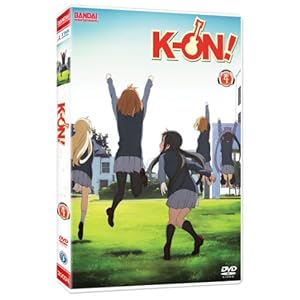
K-On! Anime, Volume 3 (English)

September 25th, 2011

(I apparently never watched or reviewed Volume 2 of this series. Woops. I’ll do that asap.)

Summer has arrived for the girls in K-ON!, Volume 3 and, with the arrival of new recruit Azusa, they get to relive all the same moments of their first summer together over again!

And then there’s wacky old Yui, who still knows nothing at all about her guitar. Hee Hee. And let’s never stop mentioning Mio’s underwear, shall we?

Don’t get me wrong, I love watching the band goofing off, not practicing, playing ball on the beach, etc,etc, but storywise, you have to admit, it does look a lot like the same episodes over again at this point. The big difference is this time they get a band name at the end of it.

Once again, I did not watching the dub, as I never do, nor did I listen to the interview with Ritsu’s dub actress. I did watch the English dub version of “My Love is A Stapler,” which my wife and I both thought sounded like a high school girl singing a song, so A for verisimilitude, but C on sounding good.

The thing is, the characters hit me in the right places and regardless of how utterly stupid, repetitive, superficial or banal this series is, I’m going to love it. There is no objectivity in me. ^_^

By now you either like the series, or not. If you’re waiting for me to convince you, I got nothing. This series is a feel-good piece of fluff and not a deep philosphical look at the meaning of life. Or, it’s a deep philosophical look at the meaning of life and I don’t care.

Of this series I said once that it is, like Mugi’s treats, refreshment not nutrition. I stand by that. As a day-at-the-beach-with-cotton-candy-and-fireworks of an anime, it just hits the spot every once in a while. ^_^

Ratings:

Art – Seriously? It’s moe. The backgrounds are rendered with loving care and the characters are blob-faced. 5
Story – Either you like this kind of comedic hyper-realism or you don’t. This time, I like it – 7
Characters- Separately, they are all kind of annoying. As a team, they work for me – 8
Yuri – 0, see below
Service – 98%, because Mio’s underwear! and Yui hugging Azusa obviously means they have bodily-fluid filled sex, duh.

Overall – 8

Many, many thanks to Okazu Superhero Eric P. for sponsoring today’s review and making me whistle “Don’t Say Lazy” all day. ^_^


Live Action: Maria-sama ga Miteru Movie (劇場版 マリア様がみてる 通常版)

September 15th, 2011

Many, many thanks to the efforts and sacrifice of Bruce for making it possible for me to buy this movie in Tokyo. As several people have noted, this was not easy to find on shelves, as it had pretty much sold out in pre-orders. The good news for overseas fans is that Amazon JP still has both the DVD and the DVD/Blu-Ray combo in stock. Being the bad otaku I am, I only bought the DVD, so missed out on some of the extras in the Blu-Ray combo set.

Maria-sama ga Miteru is a story about average high school girl Yumi, as she’s suddenly, unexpectedly drawn into the doings of the Yamayurikai, the Student Council of the school. This is no small matter as the Yamayurikai are known for being beautiful, smart and somewhat remote from the rest of the students. They even have a separate building on the campus in which they hold their meetings.

A chance meeting, an opportunistic photograph and a set of silly circumstances around the school play contrive to change Yumi’s life forever.

As I commented on my original viewing of this movie in Osaka, the actresses were each picked for a specific quality, so it was very easy to see “Youko” or “Sei” in them. Sachiko and Yumi are almost instantly lovable, IMHO. I liked that Sachiko starts to touch Yumi without realizing that she’s doing it.

Set in an old, wooden building, with creaky floors and small rooms, there’s a festive air of not-too-much-but-just-enough verisimilitude about the recreation of Lillian Jogakuen. Early on, there is an unexpected time lapse of Musashino City, so we are forced to imagine that this school is real, not just some fantasy space, like Astrea Hill.

The DVD includes the “Making Of” special, the trailer for the movie and the pre-movie in-theater “do not take pictures, eat loudly, make phone calls or give your soeur a rosary” warning animations, which were so amusing when I saw this in the theater. There are no subtitles for this movie, and as much as I hope that someone will license this, I would not bank on it.

The Maria-sama ga Miteru live action movie is a delightful rendering of this story which has captured so many hearts. It has certainly captured mine. Now I pray daily for the live action Kibara Kakumei sequel, as nothing would make me so happy as the chance to see Yoshino rage in live action. ^_^

Overall – 9 (+1 because squee! It’s a live action Maria-sama ga Miteru!)

If you consider yourself a Maria-sama ga Miteru fan, this is money well spent.