Archive for the Series Category


Yuri Manga: Sasamekikoto, Volume 8 (ささめきこと)

March 11th, 2011

Here we are at Volume 8 of Sasamekikoto (ささめきこと). And we are just about as far from where we started as we can be. Instead of layering Yuri tropes and riffing on fan expectations, Volume 8 is a straightforward look at what happens when two people decide to be more honest with their feelings, with the strong subtext of “taking responsibility.”

We left Sumi on the cusp of running for Student Council President and facing a smear campaign about her sexuality. To counter this, she is set up on a date with Akemiya-kun as a beard, but when he shows up as Akemi-chan, the more important message becomes one of personal responsibility for one’s choices. This is brought front and center when Mayu punches out a classmate for her unkind words and Sumi, as Karate team captain has to bear the responsibility. Ultimately, to save the Karate team from being disbanded, Sumi pulls herself from the election…only to have Ushio step in to replace her. Ushio, determined to be as responsible a member of the Student Body as Sumi is, wins. The Karate team remains intact, and Ushio does not back down from her own new responsibilities.

Throughout this volume, Ushio’s brother is being pressured by their grandmother to take responsibility for his own future and for Ushio. After she falls and is injured, he bites the bullet and confronts Kinuta-san about his responsibility to his grandmother and Ushio. The scene where he asks Kinuta to marry him was, IMHO, one of the funniest, most realistic scenes we’ve had in the series (and the reactions of the people around them remind me strongly of a night in a restaurant in England during which everyone in the room was visibly listening in on a breakup at a table in the center of the room.)

And then there’s Sumika. Sumi has been under a tremendous amount of stress recently. She’s pulled herself from the election, but had attention focused on her personal life in a rather unnerving way. Then she had to deal with Mayu’s situation. But what pushes her to the point of breaking is Ushio saying that she’s leaving to go take care of her grandmother. Smear her, blame her, make her the brunt of what you will…the one thing Sumika cannot tolerate is the loss of Ushio.

And that brings us to the end of a very excellent volume of a manga that is not what we could have expected, but has become everything it could be.

Ratings:

Art – 8
Characters – 9
Story – 9
Yuri – 7
Service – 1

Overall – 9

Where will Volume 9 lead us? I don’t know, but I can’t wait to find out!


Yuri Manga: Strawberry Panic Omnibus (English)

March 3rd, 2011

91Bt+QH8+zL It’s been practically an eon since I first encountered Strawberry Panic! in the pages of Dengeki G’s magazine as stand-alone scenarios of Yuri couples. Since then, both I and the series itself have changed a few times. The series underwent an adaptation to manga, in which the initial pairs were expanded to an entire cast, and adapted into an anime, which reached deep into Yuri memes and roots and pulled out a love story with a satisfactory ending. The Light Novels, with their melodramatic stylings, served to complete the unfinished manga in an over-the-top way.

For my part, I began with pretty much nothing but loathing for the series which wallowed and pandered in a way that completely turned me off. There was nothing in the original stories that was created with me in mind and the manga was decidedly shaped for the lowest common denominator. As the anime shifted from “stolen meme of the week, which we present with a straight face and no real desire to tell a story” to “stolen meme of the week, which we present with a wink and a nod and –  we can’t help ourselves –  a bit of character development and plot, too” my opinion began to change. (I consider this a positive quality in myself, even if fans have a somewhat difficult time accepting that. I still get angry letters about reviews I wrote 7 years ago.)  And then I read the novels.

I have to say, very frankly, anyone who cannot “hear” the overt campiness of the novels, the hyper-melodramatic tone in which they were written, is really, honestly missing the point. In my review of the first LN in English, I tried to illustrate this with a few of the quoted passages. My comments were not me being snarky, but me commenting on the snark embedded within the lines of the novel. Of these, this passage really stood out as a tell:

Of course, most of the young ladies used their judgment when they heard those legends. But there were some who really believed them. …And yet those same young ladies grew into fine women.

Really read that, please, and note the subtext which (for those of you who cannot see the flashing lights,) says, “DO NOT TAKE THIS STORY SERIOUSLY.”

At the moment I read that line in the Japanese edition of the Light Novel, I ceased to take any of Strawberry Panic seriously and was, at last, able to find affection for it in my heart.

This week I found myself re-reading the manga as the Strawberry Panic Omnibus, put out recently by Seven Seas (who are now more active on Twitter. Go say hello.). My primary emotion upon completing it was that I was a little sad that it ended so soon. There were so many good bits yet to come and at least one helicopter would surely have been included! But no, this story was terminated at the equivalent of the end of the first novel.

Technically, the omnibus looks good. The translation is as it was; the translation notes are short, but enough. I like the size of the book, which is A5 – this gives it the feel of a typical seinen manga. It feels good in my hand and isn’t going to break a foot if I drop it, as Cardcaptor Sakura might. The one thing I will continue to say about Seven Seas is that they really do a great job of giving us, the readers, an authentic manga reading experience.

The story is very Yuri. There is nothing else to be said about that – there are multiple pairings in this manga but, of them, there are two entirely romantic romances (which almost no fans cared about, instead focusing on the hopeless losers in the rivalries…which has got to be some kind of commentary on something, don’t you think?)

This we can say about Strawberry Panic in all its iterations: Shizuma is queen-like, a veritable goddess on earth who is inexplicably (even to herself) attracted to a humble, down-to-earth energetic, cheerful girl, Nagisa. And Amane is a Prince-like being who is inexplicably (especially to herself) attracted to humble, angelic, cry-baby Hikari. And those two romances fill the pages of this collection with melodrama, tears and kisses.

Love it or hate it, Strawberry Panic was a gateway Yuri series for a generation of fans last decade. If you have not already picked up a copy of this omnibus, please do. And get an extra for your library, to spread the love of Yuri love to the next generation.

Ratings:

Art – 6
Story – 7
Characters – 8
Yuri – 9
Service – 10

Overall – 8

Foreshadowing: I have had the opportunity to see the Strawberry Panic Light Novel Omnibus and it is also quite good. More than it being good, though, you need to read it to get the end of the story! If you liked/loved/tolerated the manga and 1) want to know what happened or 2) really, really want to read about the helicopters, get it! I have to say, I laughed through the novels all over again as I read them. The language is breathtakingly campy in places.

Postscript: Today we have the genuine pleasure of thanking our own candidate for Etoile, Okazu Superhero Eric P., for his sponsorship of today’s review! As always, Eric, thank you kindly for your generosity. If you’d like to become an Okazu Hero, just click on the Yuri Wish List links on Amazon and Amazon JP on the right-hand sidebar and purchase something for review and you’ll be a Hero to Okazu readers world-wide!


Light Novel: Maria-sama ga Miteru ~ Step

March 2nd, 2011

This week’s theme appears to be “some series never die.” We started off the week with a look back at Cardcaptor Sakura, Sailor Moon was just re-licensed in Germany, and I have another re-tread planned for later this week. And, today, we’re taking a look at one of the most recent volumes of a series that has lodged itself firmly in our hearts, Maria-sama ga Miteru. There is one massive spoiler ahead, be warned.

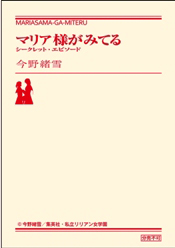
Maria-sama ga Miteru ~ Step (マリア様がみてる ステップ) tells the story of two girls, Katsuki and Ritsu. They are second-years in high school at Lillian and they are the very best of friends. They’ve been together so long that they are practically like sisters.

So, when Ritsu tells Katsuki that she’s seeing a boy, it comes as a shock – not because she’s seeing a boy so much, but because she’s *been* seeing him for a few weeks, and she never mentioned it. Katsuki is hurt, but honest about it, so they separate for a little while, then take it slow to repair the tears in their bonds carefully and neatly. But, as Katsuki points out in her interior monologue, once a person has taken that step up the stair of life, they can never really go back to being the person they were, even if they want to.

In the meantime, Katsuki has herself, through an accidental, somewhat silly, circumstance met a guy she thinks she might be interested in and, when she learns through another completely accidental circumstance that he is Ritsu’s brother, *she* keeps it secret from her best friend. Katsuki had somewhat complicated things a little by lying to “Ken-san,” the nickname she created for the guy she met, about her own name.

Then comes the day Katsuki encounters Ritsu’s boyfriend and her hurried confession the next day to Ritsu that it was another incredible coincidence and nothing else. But, Ritsu says, it doesn’t matter – she’s already broken up with Kouta. In fact, Ritsu knew that Katsuki had met her boyfriend…and the problem was not that she was jealous of Katsuki for being with Kouta, but that she was jealous of Kouta for being with Katsuki.

During the school trip, Ritsu “confesses” that her break-up with Kouta was because she likes Katsuki more. Katsuki thinks about it and asks if Ritsu would like to kiss her. Ritsu replies, “Sure, I guess,” to which Katsuki says, “Right – you guess.” She calmly points out that she really doesn’t think Ritsu’s gay and she’s fairly sure she might have noticed by now if she was and Ritsu pretty much agrees that she’s the same.But they agree that they love each other very much.

Katsuki is now sure that Ritsu does want to go out with Kouta (who she knows is a nice guy) and she kind of wants an excuse to see Isao, Ritsu’s brother, so she calls him to ask him to bring Kouta to the school festival. There is a little tension, but Kouta does come, and he and Ritsu head off to the Sakuratei cafe together. In the meantime, Katsuki meets and is instantly recognized by Isao as the girl he met in the park….despite her makeup and costume as a monster for the haunted house. Woops.

In the end, the two girls have frank talks with their prospective partners about their feelings for them and for each other. Kouta tells Ritsu that he also has a bosom buddy he feels that close too, Isao. And Katsuki comes to realize that Hasekura Isao is a genuinely nice guy.

The author’s note begins with the most obvious question ever – can you guess Kouta’s family name? I could and did. Can you?

One of the questions I’m asked most on #marimite_spoilers @rizon.net is “when” the book I’m discussing is. Yumi’s first-year or second or third? This one was impossible to peg until we were given that single hint. Once we got that, it was obvious “when” we were.

As with many of of Konno-sensei’s books, the plot here took a long time to develop. It was  a bit tiring at first, with all the “boyfriend this” and “boyfriend that” but, as the story developed it picked up some speed. And there were a number of small, but interesting features. Ritsu’s and Katsuki’s frank discussion about their affection for one another was one, Kouta’s admission of affection for Isao was another. But of all the interactions in the book, the most interesting to me was a conversation Katsuki had with another classmate, Watako.

Katsuki asks Watako if she had a lover, to which Watako replies, “not at the moment.” Katsuki and I both naturally interpreted that to mean that she had had one previously and expects to do so again. In this way, on top of the shocking idea Konno-sensei introduces in this novel that Lillian girls may have (*gasp!*) boyfriends, Konno-sensei introduces the even more shocking idea that some of them may have had lovers. Two steps out of the garden of maidens in one shot. You go Konno-sensei. ^_^

Ratings:

Overall – starts at a 5, but ends up an 8

The key thing to making this book work as well as it did was that both Kouta and Isao really are nice guys.


Cardcaptor Sakura Manga Omnibus, Volume 1 (English)

February 28th, 2011

513FFeTeOrLIt was no real surprise to me that I have never before reviewed Cardcaptor Sakura here. By the time I was writing regular reviews, the English edition of the anime was out of print and so was Tokyopop’s manga edition. I’m sort of sorry for that, since this was a Gateway Yuri story for a lot of people in that post-Sailor Moon phase of Yuri audience development. Because I am revisiting this series, but some of you may not be, let me tell the story from the beginning.

Cardcaptor Sakura was one of the earliest CLAMP mega-hits. (Not *the* earliest, but right in the zone.) As a manga it ran from 1996 – 2000 in Nakayoshi magazine, which meant it was riding on the magical girl coattails of the massive popularity of Sailor Moon. It had…one of everything. There was Yuri, BL, it was chockful of intergenerational relationships (my first thought was that there was *some,* but then I started to think about it and the list got longer and longer….) It had cute girls and beautiful women and cute boys and beautiful boys and even some handsome men. It had arguably some of the best magical creatures ever to grace a magical girl series. (Admit it, ladies, how many of you swooned over Yue?) And, not coincidentally, the voice cast of the anime was stellar – also major crossover from Sailor Moon. I have not loved everything CLAMP has produced, but no one can tell me that they are not geniuses at their business. Cardcaptor Sakura was a milestone.

The story contained in this CCS Omnibus Volume 1 is a simple one – cute, athletic, cheerful Sakura finds a book which, when she opens the cover, proves to be a book full of cards. The cards immediately scatter to the four corners and the creature depicted on the cover of the book comes to life. His name is Cereberus (nicknamed Kero-chan); he is the Guardian of the Cards. Because she could open the book at all, he tells Sakura, she must have magical ability. It is her task to gather the cards once more because blah, blah, blah.

Sakura is not the only one in the family with magical ability. Her deeply odd older brother, the bishounen Touya (Toya in the English edition) also can “see” things. Toya’s best friend is the real reason we all watched/read the series – Yukito, who has a secret within him that makes him even *more* the reason we all read/watched this thing. Unashamedly, I hung on Yuki’s every word, as he was voiced by Ogata Megumi, whose voice still sends chills up my spine. Sakura’s father is perfect, her mother is deceased, and their story becomes increasingly relevant to the overall plot of this omnibus volume as it progresses.

Sakura’s exploits as the “Card Captor” are filmed and enabled by her filthy rich and extremely besotted best friend Tomoyo. For those of you who came to Yuri in later years, Tamao from Strawberry Panic! was specifically meant to be a Tomoyo clone.  Tomoyo is practically the *definition* of the best-friend in one-sided love – in the manga this is made quite plain…and given historical precedent.

Ultimately, Sakura develops a rival in the form of Li Syaoran, which added shota and, eventually, heterosexual romance into what is a really entertainingly bent series. (^_^);  And let’s not forget Kaho-sensei. No…we must not forget her. She is, in any case, unforgettable.

So many of the things that made Cardcaptor Sakura work were an effect of timing, CLAMP’s unerring ability to squeeze a genre until it bleeds money and their raw talent for telling character-driven, beautifully drawn series. Cardcaptor Sakura is beautifully drawn, the characters are likable and the story, which has become a cliche of itself, still works. How can I say this? Because I have read the original in Japanese several times and in English several times, I have watched the anime several times and, when I hit the last page of this Omnibus, I thought, “I want to see what happens next!” Seriously, I did. I KNOW what happens next, but I can’t wait to read it again.

Technically speaking, Dark Horse did a fine job. I don’t recall being irked by the translation, the S/Fx are translated inline most of the time, except in a few spots where they were easily replaceable. The addition of color pages was a delightful bonus, I’m very glad that they thought to add those. If I were *forced* to come up with an objection to this omnibus I would say that this nearly 600-page volume is not, perhaps, little kid friendly. But in this world where Harry Potter novels were devoured by tweens, perhaps even that is not an obstacle. If you know a tween who likes fantasy, or just needs the smallest push to becoming an otaku, consider buying this series for them.

For me, though, the true pleasure of this Omnibus was spending time with old friends. Seeing Yamazaki lie so cheerfully, Tomoyo kvelling over Sakura, Kero-chan obsessing about sweets and Yuki eating gigantic lunches…was just, so…nice.

If you have never before read this series, I really hope you will. It’s got significant Yuri cred; it was, in its time, a gateway series for a lot of GL and BL fans. It’s CLAMP doing a series that is unshockingly an excellent example of the genre and, if you like XXXHolic or, especially, Tsubasa Chronicles, *this* is where major players came from. It’s good to know your roots.

Ratings:

Art – 8
Characters –  9
Story – 8
Yuri – 4
Service – 4

Overall – 9

As I have said repeatedly, I am not a nostalgic person. Reading this volume, I came as close as I’ll ever get to it. Many, many thanks to Okazu Hero Eric P. for letting me wallow, just a bit, in pleasant nostalgia. ^_^

Dear Nozomi/Right Stuf, if you’re looking for another anime series to resuscitate, Cardcaptor Sakura would not be a bad choice. Hint hint


Aria Manga, Volume 6 (English)

February 17th, 2011

Aria Volume 6 (Aria (Tokyopop))Among the many lessons in the Aria manga, there is one that is quiet, softly tucked in among the all the others. But of all the lessons within Aria, it is quite possibly at the very core of this manga’s value system.

In Volume 6, we learn what kind of adult Alicia wants to become, what a Master means to a student, what kind of person Athena is, what Alice doesn’t want anyone else knowing about her and what the secret behind the late night train whistle that runs through town is.

But more importantly – most importantly – we learn once again that everyone is good at…something. And in that simple fact, we’re reminded to appreciate the people around us for that thing, and by extension, appreciate our time with them, and our time in the world. In fact, if we learn anything from Aria, it should be to *appreciate* the life we have, because for each of us, it is unique and wonderful.

You could, of course, be reading Aria for whatever Yuri you may have made up in your head. And that too will be valid – as long as you appreciate it.

Ratings:

Art – 8
Story – 8
Characters – 8
Yuri – 0
Service – 1

Overall – 8

I am absolutely thrilled to say “Thank you, I appreciate it!” to brand-new Okazu Hero, Kayden L! Thank you for the sponsorship of today’s post – and for the lovely note that came with the book. I truly appreciate the kind words. Please email me  to receive your Okazu Hero badge, suitable for use on websites, social media profiles and other flat surfaces!

I would also like to express sincere appreciation to Tokyopop for continuing to put this series out, despite the fact that it will never have the hordes of fans it deserves.

I very much appreciate Amano-sensei for writing this series. I’m able to appreciate it anew with every volume.

And while I’m at it, I just want to say once more how much I appreciate you for reading this review.